OxaPayBlog : Aperçu des passerelles de paiement Crypto

Surveillance en temps réel dans les systèmes de paiement par blockchain

Real-Time Monitoring in Blockchain Payment Systems | OxaPay Deep Insights
OxaPay Deep Insights

Surveillance en temps réel dans les systèmes de paiement par blockchain

A system-level engineering guide to blockchain payment monitoring, covering probabilistic finality, multi-node observation, mempool divergence, confirmation engines, deterministic payment states, webhooks, fault tolerance, and the infrastructure required for reliable crypto payment processing.

Blockchain payment systems architecture for real-time crypto payment monitoring and merchant payment reliability

Blockchain payment systems need more than transaction visibility. They require monitoring, validation, confirmation logic, and reliable payment-state interpretation for merchant operations.

Strategic Framing: Why This Topic Matters

Real-time monitoring lies at the center of production-grade blockchain payment systems. A passerelle de paiement cryptographique cannot safely rely on a single node response, a simple transaction hash, or a fixed confirmation count. It must observe the network continuously, reconcile inconsistent data, track finality, detect abnormal behavior, and translate blockchain events into deterministic payment states.

This is especially important because blockchain settlement does not behave like traditional payment authorization. In card and banking systems, a central authority defines approval, reversal, and settlement logic. In blockchain networks, finality emerges from distributed consensus, network propagation, fee markets, block production, and chain-specific rules.

For merchants, the practical question is not only whether a transaction exists. The real question is whether the payment can be accepted, fulfilled, reconciled, and recorded without exposing the business to avoidable risk.

A transaction is a blockchain event. A payment is a business decision made after monitoring, validation, finality evaluation, and state transition.
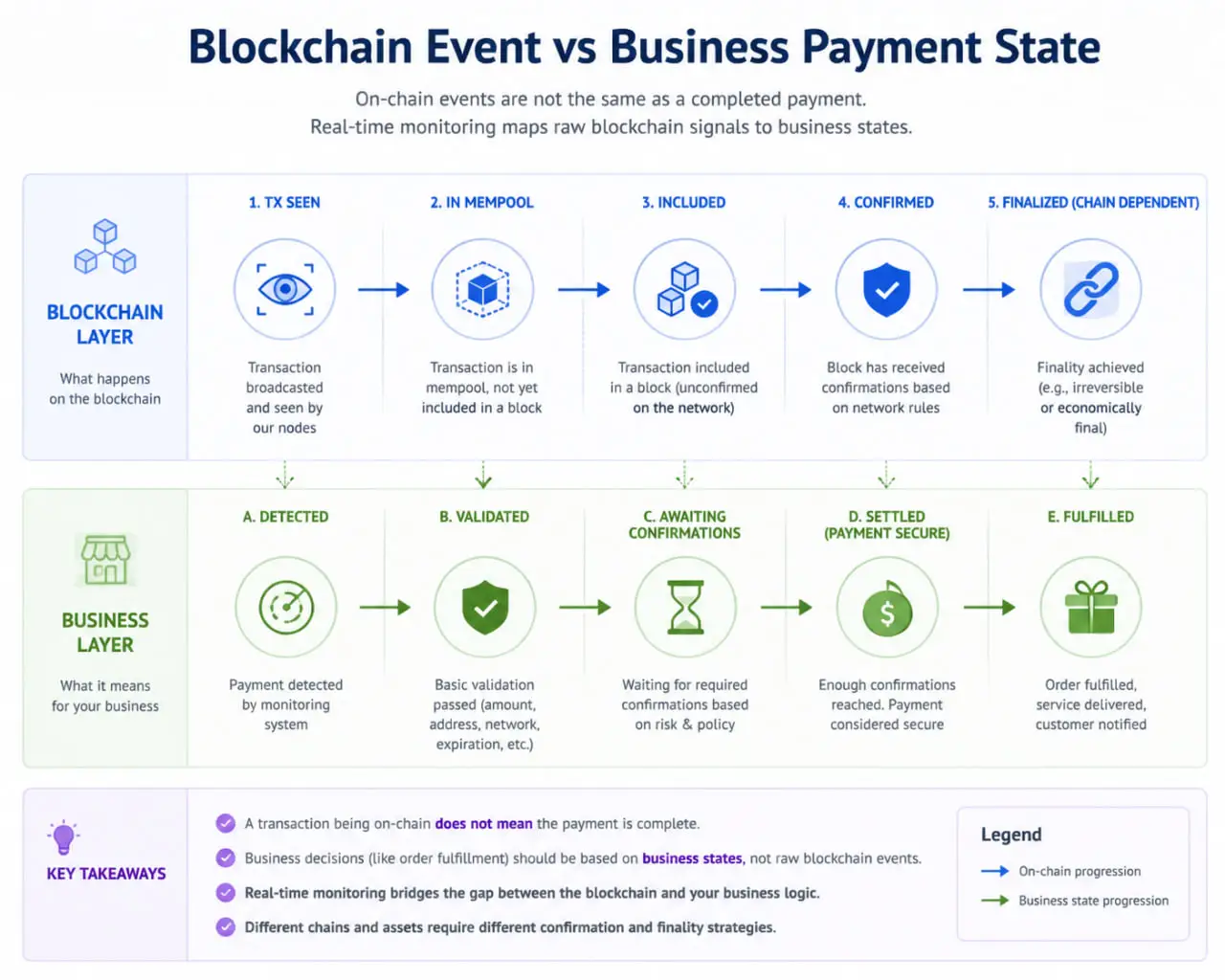
Blockchain event vs business payment state infographic showing mempool detection, confirmations, finality, validation, settlement, and merchant fulfillment flow

This infographic explains the difference between raw blockchain transaction events and business payment states. It visualizes how a transaction moves from mempool detection and confirmations into validated merchant payment states such as settled and fulfilled through real-time monitoring systems.

What This Deep Insight Covers

Network Observability

How listener nodes, mempool tracking, block detection, and multi-source monitoring create visibility into blockchain activity.

Finality Modeling

Why confirmation depth, reorg risk, chain type, and probabilistic finality must be evaluated before a payment becomes reliable.

State Machines

How raw blockchain events become payment states such as detected, underpaid, awaiting confirmations, settled, expired, or failed.

Operational Reliability

How webhooks, retries, idempotency, event sourcing, RPC verification, and fail-safe modes protect payment infrastructure.

This guide is not a simple overview of payment tracking. It is an infrastructure-level explanation of how real-time blockchain payment monitoring should be designed.
Real-time blockchain payment monitoring architecture showing listener nodes, event bus, confirmation engine, payment state machine, webhook dispatcher, and merchant system

A high-level view of how real-time monitoring connects blockchain networks, listener clusters, confirmation engines, payment state machines, webhook delivery, and merchant systems.

Section 1: The Need for Real-Time Blockchain Monitoring

A blockchain payment system must operate in an environment where the source of truth is distributed, delayed, and sometimes inconsistent across observers. A transaction may appear in one node’s mempool, fail to appear in another, enter a block, lose confirmation depth after a reorganization, or remain stuck because its fee is no longer competitive.

This makes monitoring a reliability layer, not a cosmetic feature. Without it, a gateway cannot safely expose payment states such as paid, failed, expired, settled, or underpaid.

Without Monitoring

  • single-node data can become misleading
  • reorgs can leave settled payments in unsafe states
  • mempool visibility may be confused with payment completion
  • merchant systems may fulfill too early

With Monitoring

  • events are observed from multiple sources
  • confirmation depth is updated continuously
  • payment states follow deterministic rules
  • business actions become safer and more predictable
A real-time monitoring engine is simultaneously a network observability tool, a transaction analysis layer, a finality evaluator, and a payment-state interpreter.

1.1 Probabilistic Finality

Unlike centralized settlement systems, many blockchain networks do not provide immediate deterministic finality. In Proof-of-Work networks, confidence increases as more blocks are added above the transaction. In Proof-of-Stake networks, finality depends on chain-specific consensus rules, finalized checkpoints, validator votes, or other protocol-level mechanisms.

Confirmation is not the same as business completion. It is a signal that reduces network uncertainty, but it does not verify amount correctness, payment timing, request matching, or merchant policy.
Pfinal(tx | d) ≈ 1 - preorg(d)

Where:
tx = transaction
d = confirmation depth
preorg(d) = probability of a chain reorganization up to depth d

The engineering implication is direct: a payment system cannot observe a transaction once and treat it as final. It must continue tracking the transaction, its depth, its canonical chain position, and its relationship to business rules.

1.2 Transaction Lifecycle and Failure Points

A payment-related transaction passes through several stages before it becomes reliable enough for merchant action. Each stage creates a different risk profile.

User Wallet │ ▼ Mempool ──► Block Inclusion ──► Confirmations ──► Economic Finality │ │ │ │ ├─ fee too low ├─ stuck or delayed │ ├─ conflicting tx ├─ reorg risk │ ├─ wrong network └─ insufficient depth └─ dropped or evicted

Figure 1: Lifecycle of a payment transaction and major failure points that a monitoring engine must observe.

Mempool visibility Block inclusion Confirmation depth Reorg risk Payment validation

1.3 Nodal Divergence

Different nodes may have different views of the network at the same time. This happens because of propagation delay, peer selection, local mempool policies, connectivity issues, fee thresholds, and hardware differences.

Let Mn(t) denote the mempool contents of node n at time t.

For two nodes n1 and n2:

|| Mn1(t) - Mn2(t) || > δ

A single listener node is therefore not a reliable source of truth for a production gateway. A robust monitoring engine should observe several independent nodes, reconcile their views, and assign confidence levels to each observed transaction signal.

Node A mempool: { tx1, tx2, tx5 } Node B mempool: { tx2, tx3 } Node C mempool: { tx1, tx3, tx4 } No single node has the full picture. The monitoring engine must merge, reconcile, and score observations.

Figure 2: Example of mempool divergence across nodes.

1.4 Latency and Confirmation-Time Modeling

Confirmation time is not only a function of block time. It is also affected by congestion, fee competition, mempool size, chain-specific finality rules, RPC performance, and monitoring latency.

E[Tconfirm] = d × E[Tblock] + ε

Where:
d = required confirmation depth
Tblock = average block time
ε = congestion and network variance

This matters because merchant systems must set realistic expectations. A checkout page, POS terminal, or automated invoice system should not treat blockchain confirmation as instant unless the network and risk model support that assumption.

Confirmation-time modeling helps detect stuck payments, define timeout windows, and reduce customer confusion during payment processing.

1.5 Economic Cost of Misclassification

Monitoring errors have financial consequences. A false positive may cause early fulfillment before a payment is reliable. A false negative may reject a legitimate payment and create support friction. Incorrect timing, network delay, and FX movement can also create operational cost.

Ctotal = wfpCfp + wfnCfn + wfxCfx + wnetCnet

Where:
Cfp = cost of false positives
Cfn = cost of false negatives
Cfx = FX or slippage cost
Cnet = network-related delay or fee cost

False Positive

The system accepts a payment too early and triggers fulfillment before finality or validation is sufficient.

False Negative

The system fails to recognize a valid payment, creating manual investigation, support load, or customer distrust.

Blockchain payment monitoring risk model showing false positives, false negatives, FX risk, network delay, and operational cost

Real-time monitoring reduces the operational cost of wrong payment-state decisions by separating weak signals, confirmed events, validated payments, and final business actions.

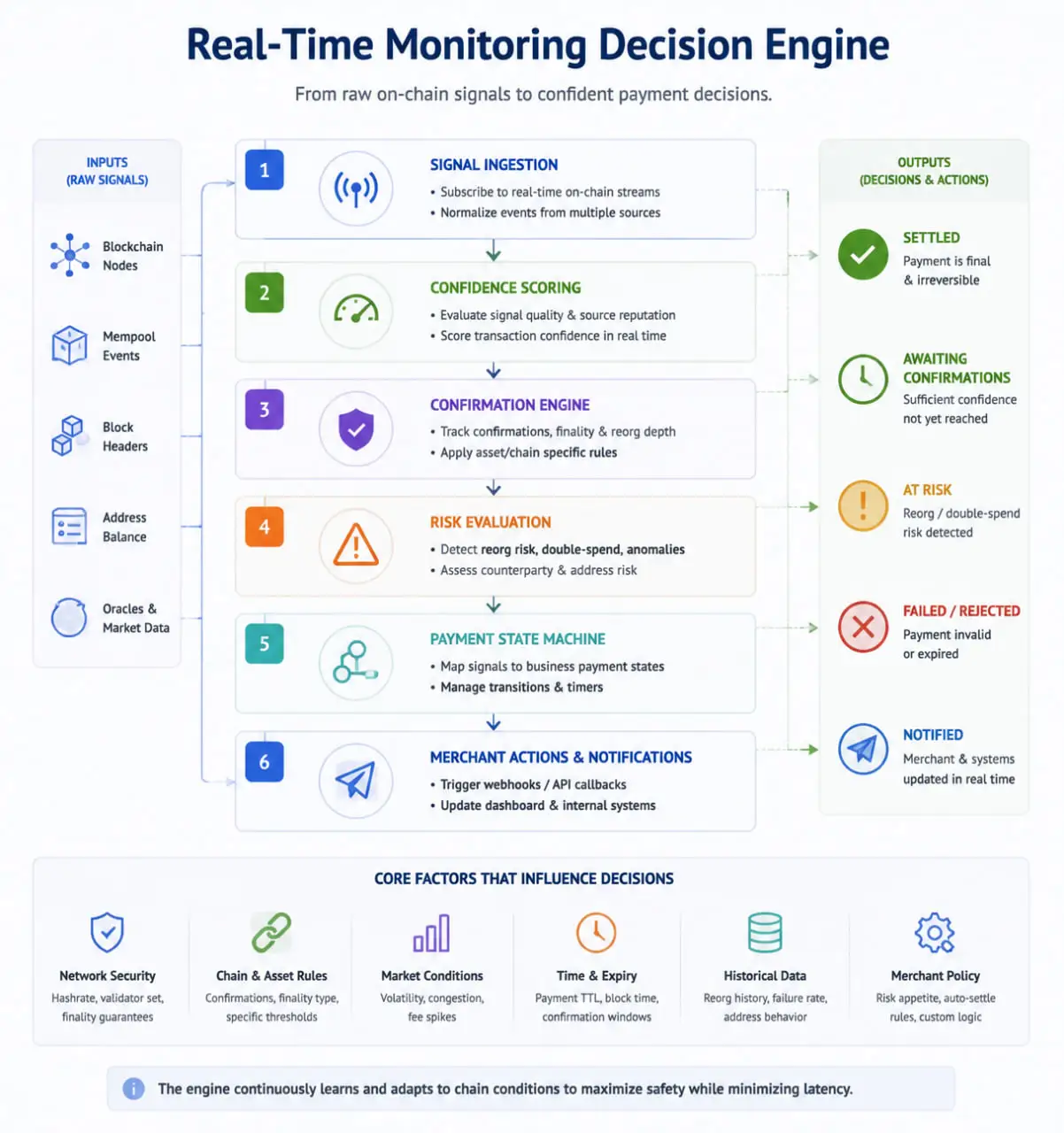
Real-time monitoring decision engine infographic showing signal ingestion, confidence scoring, confirmation engine, risk evaluation, payment state machine, and merchant notifications

This infographic visualizes the architecture of a real-time blockchain payment monitoring engine. It shows how blockchain signals are analyzed through confidence scoring, confirmation tracking, risk evaluation, and payment state management before triggering merchant actions and notifications.

Section 2: Architecture of a Real-Time Monitoring Engine

A production-grade blockchain monitoring engine is usually built from separate layers. Each layer has a narrow responsibility, which makes the system easier to scale, audit, recover, and secure.

1
Listener Layer Connects to blockchain nodes, observes mempools and blocks, and emits raw payment-related events.
2
Event Bus Transports normalized events to downstream services with ordering, buffering, and retry capabilities.
3
Confirmation Engine Tracks block height, confirmation depth, reorgs, finality, and chain-specific settlement conditions.
4
Payment State Machine Converts blockchain events into deterministic payment states used by the merchant system.
5
Webhook and API Layer Delivers payment status updates to merchant systems and supports reconciliation or status checks.

2.1 Listener Layer

The listener layer is the first point of contact with blockchain networks. It should not make business decisions. Its role is to observe, filter, normalize, and forward relevant events.

Blockchain Network │ ├── Node A ├── Node B ├── Node C │ ▼ Listener Cluster │ ▼ Unified Payment-Related Events │ ▼ Event Bus

Figure 3: Listener cluster aggregating mempool and block events from multiple nodes.

def match_candidate(tx, payment):
    if not output_matches_payment_address(tx, payment):
        return False

    amount = extract_amount_for_payment(tx, payment)

    if abs(amount - payment.expected_amount) > payment.tolerance:
        return False

    if is_rbf_enabled(tx):
        emit_event("TX_RBF_RISK", {
            "txid": tx.txid,
            "payment_id": payment.id
        })
        return False

    return True

The listener should identify candidates, but final acceptance belongs to the state machine and validation rules.

2.2 Mempool Reconciliation

Because mempool visibility differs across nodes, the monitoring engine should classify observations by confidence. A transaction seen by several independent nodes is stronger than a transaction seen by only one node.

def reconcile(events):
    grouped = {}

    for event in events:
        grouped.setdefault(event["txid"], set()).add(event["node_id"])

    strong = [
        txid for txid, nodes in grouped.items()
        if len(nodes) >= MIN_REQUIRED_NODES
    ]

    weak = list(set(grouped.keys()) - set(strong))

    return strong, weak

Strong Signal

The transaction is observed by multiple independent nodes and can move forward in the monitoring pipeline.

Weak Signal

The transaction is visible from a limited source and should be handled with caution until more evidence appears.

2.3 Confirmation Engine

The confirmation engine tracks new blocks, best-chain changes, transaction depth, finalized checkpoints, and reorg events. It converts raw block data into finality-related events for the payment state machine.

depth(tx) = best_height - block_height(tx) + 1
def update_confirmations(node, tracked_txs):
    best_height = node.get_height()
    best_block = node.get_best_block()

    for tx in tracked_txs:
        if tx.block_height is None:
            continue

        if detect_reorg(tx.last_seen_block, best_block):
            emit_event("REORG_DETECTED", {
                "txid": tx.txid,
                "payment_id": tx.payment_id
            })
            tx.depth = 0
        else:
            tx.depth = best_height - tx.block_height + 1

        if tx.depth >= tx.required_depth:
            emit_event("TX_CONFIRMED", {
                "payment_id": tx.payment_id,
                "txid": tx.txid,
                "depth": tx.depth
            })
The confirmation engine should never assume that all chains share the same finality model.

2.4 Payment State Machine

The payment state machine is the decision brain of the payment system. It translates low-level blockchain events into business-meaningful states.

AWAITING_PAYMENT ── TX_DETECTED ──► DETECTED DETECTED ── amount within tolerance ──► AWAITING_CONFIRMATIONS DETECTED ── underpaid ────────────────► UNDERPAID DETECTED ── overpaid ─────────────────► OVERPAID AWAITING_CONFIRMATIONS ── confirmed ──► SETTLED AWAITING_PAYMENT ── timeout ──────────► EXPIRED ANY STATE ── fatal_error ─────────────► FAILED

Figure 4: Simplified payment state machine for blockchain payments.

class Payment:
    def __init__(self, id, expected_amount, timeout):
        self.id = id
        self.state = "AWAITING_PAYMENT"
        self.expected_amount = expected_amount
        self.timeout = timeout
        self.detected_tx = None

    def on_timeout(self):
        if self.state in ["AWAITING_PAYMENT", "DETECTED"]:
            self.state = "EXPIRED"

    def on_tx_detected(self, tx):
        if self.state != "AWAITING_PAYMENT":
            return

        self.detected_tx = tx
        ratio = tx.amount / self.expected_amount

        if ratio < 0.98:
            self.state = "UNDERPAID"
        elif ratio > 1.02:
            self.state = "OVERPAID"
        else:
            self.state = "AWAITING_CONFIRMATIONS"

    def on_confirmed(self, depth, required):
        if self.state == "AWAITING_CONFIRMATIONS" and depth >= required:
            self.state = "SETTLED"
All state transitions should be idempotent, replay-safe, and audit-friendly.
Blockchain payment state machine showing awaiting payment, detected, underpaid, overpaid, awaiting confirmations, settled, expired, and failed states

A deterministic state machine helps payment systems avoid premature fulfillment, duplicate settlement, and inconsistent handling of underpaid or expired payments.

Section 3: Scientific and Engineering Challenges

Real-time blockchain monitoring looks simple only at the surface. In production systems, it involves distributed observation, inconsistent mempools, fee-market behavior, reorg risk, RPC reliability, webhooks, and chain-specific interpretation.

Mempool Heterogeneity

Different nodes can see different pending transactions at the same time.

Forks and Reorgs

Temporary chain branches can change transaction depth and payment safety.

Dynamic Fee Markets

Transactions with insufficient fee rates may remain stuck or become delayed.

Double-Spend Risk

Zero-confirmation flows can be exposed to conflicting transactions.

RPC Inconsistency

Nodes and providers may return late, stale, or conflicting data.

Cross-Chain Complexity

Each network uses different finality, mempool, and event semantics.

3.1 Reorg Detection and Safe Rollback

A reorganization occurs when the network switches from one branch of the chain to another. If a transaction was included in the discarded branch, its confirmation depth can disappear.

def detect_reorg(prev_best, new_best):
    return prev_best.hash != new_best.parent_hash
def handle_reorg(tx):
    if tx.state == "SETTLED":
        tx.state = "AWAITING_CONFIRMATIONS"

    tx.current_depth = 0

    emit_event("PAYMENT_ROLLBACK", {
        "payment_id": tx.payment_id,
        "txid": tx.txid
    })
A system that cannot roll back affected payment states after a reorg cannot be considered production-grade.

3.2 Fee Sufficiency and Stuck Transactions

In fee-based networks, a transaction’s chance of confirmation depends on its fee rate relative to current network demand. Monitoring should identify whether a transaction is likely to confirm quickly, slowly, or remain stuck.

def fee_risk(tx_fee_rate, recent_fee_rates):
    p50 = percentile(recent_fee_rates, 50)
    p80 = percentile(recent_fee_rates, 80)

    if tx_fee_rate >= p80:
        return "low_risk"
    elif tx_fee_rate >= p50:
        return "medium_risk"
    else:
        return "high_risk_of_being_stuck"

This allows the payment system to show a realistic state instead of treating all pending transactions the same way.

3.3 Double-Spend and Input Conflict Detection

In UTXO-based networks, zero-confirmation payments carry additional risk because conflicting transactions can spend the same inputs. A monitoring engine should detect these conflicts before allowing early acceptance.

def detect_double_spend(tx, mempool):
    for other in mempool:
        if other.txid == tx.txid:
            continue

        if set(other.inputs) & set(tx.inputs):
            return True

    return False
Zero-confirmation acceptance should depend on value, risk profile, fee behavior, RBF status, and merchant tolerance.

Section 4: Transaction Detection and Matching

Detecting whether a transaction actually belongs to a payment request is one of the most sensitive parts of the monitoring engine. A real system combines strict matching, tolerance-based matching, probabilistic scoring, and chain-specific logic.

Matching MethodButRisk
Strict MatchingAddress, network, amount, and time window must match exactly.May reject valid payments affected by rounding or wallet behavior.
Tolerance MatchingAllows small differences in amount to handle fees, rounding, or exchange movement.Needs clear underpayment and overpayment rules.
Probabilistic MatchingScores candidate transactions when multiple payments may look similar.Requires thresholds, review states, and auditability.
Chain-Specific MatchingUses UTXO outputs, EVM receipts, Solana logs, or Layer-2 invoice hashes depending on network type.Cannot be safely generalized across all chains.
Matching is not only technical. It defines whether a blockchain event can become a payment record.

4.1 Strict Matching

def strict_match(tx, payment):
    if tx.network != payment.network:
        return False

    if tx.destination != payment.address:
        return False

    if tx.amount != payment.expected_amount:
        return False

    if not (payment.valid_from <= tx.timestamp <= payment.valid_until):
        return False

    return True

Strict matching is clean, but real-world payment behavior often requires more flexible logic. Wallets, exchange rates, token decimals, network fees, and user mistakes can create valid but imperfect payment signals.

4.2 Tolerance-Based Matching

def tolerant_match(tx, payment, tolerance_ratio=0.02):
    ratio = tx.amount / payment.expected_amount

    if not (payment.valid_from <= tx.timestamp <= payment.valid_until):
        return False

    if 1 - tolerance_ratio <= ratio <= 1 + tolerance_ratio:
        return True

    return False

Underpaid

The payment is real, but the amount is below the required threshold. The system can request completion or reject it.

Overpaid

The payment is above the requested amount. The system may need refund, credit, or internal reconciliation logic.

4.3 Probabilistic Matching

At scale, several candidate transactions may look similar. Probabilistic matching helps assign confidence scores based on address, amount closeness, timing, node observations, and historical context.

def probabilistic_match(tx, payment):
    score = 0.0

    if tx.to_address == payment.address:
        score += 0.5

    amount_diff = abs(tx.amount - payment.expected_amount)
    score += max(0.0, 0.3 - (amount_diff / payment.expected_amount))

    time_diff = abs(tx.timestamp - payment.created_at)
    score += max(0.0, 0.2 - (time_diff / 300.0))

    return score
Ambiguous matches should not be silently accepted. They should move into a review, retry, or reconciliation flow.
Transaction matching in blockchain payment monitoring showing strict matching, tolerance matching, probabilistic matching, and chain-specific validation

Matching logic determines whether a blockchain transaction belongs to a specific payment request, and whether it should become a valid payment state.

Section 5: Fault Tolerance in Monitoring Systems

A real-time monitoring system must remain reliable when nodes fail, RPC providers return inconsistent data, webhooks are delayed, networks become congested, or event processing is interrupted.

Retry Logic

Temporary failures should trigger controlled retries with bounded exponential backoff.

Idempotency

The same event must not cause duplicate settlement, duplicate fulfillment, or duplicate accounting entries.

Dead Letter Queue

Events that repeatedly fail should move to a recovery queue for inspection and controlled reprocessing.

Fail-Safe Mode

If data sources disagree severely, the system should stop finalizing new payments until consistency returns.

5.1 Retry with Exponential Backoff

def retry_with_backoff(send_func, max_attempts=6):
    for attempt in range(max_attempts):
        try:
            send_func()
            return True
        except Exception:
            delay = min(2 ** attempt, 60)
            sleep(delay)

    return False

Backoff must be bounded. A payment system should recover, not wait forever.

5.2 Idempotent Event Handling

def handle_event(event):
    if already_processed(event.id):
        return

    apply_transition(event)
    mark_processed(event.id)
Idempotency is one of the most important financial rules in payment monitoring: a payment must never be settled twice.

5.3 Reliable Webhook Dispatch

Webhooks connect the payment monitoring system to merchant infrastructure. They must be retried, deduplicated, logged, and handled safely by the merchant endpoint.

def dispatch(event, endpoint):
    for attempt in range(MAX_RETRIES):
        response = http_post(endpoint, event)

        if response.status_code in (200, 201, 204):
            return True

        sleep(backoff(attempt))

    send_to_dead_letter_queue(event)
    return False
1
Payment Event CreatedA payment state changes in the monitoring engine.
2
Webhook QueuedThe event enters a dispatcher queue for delivery.
3
Merchant Endpoint CalledThe merchant system receives the status update.
4
Retry or ConfirmThe system retries failures and records successful delivery.
Reliable webhook architecture for blockchain payments showing event queue, dispatcher, retries, dead letter queue, merchant endpoint, and idempotent processing

Webhook reliability depends on queues, retry policies, idempotent handlers, dead letter recovery, and careful separation between payment updates and final business actions.

5.4 Event Sourcing and CQRS

Industrial monitoring systems often use event sourcing and CQRS to preserve every payment event, rebuild state after failure, support analytics, and keep multiple read models updated.

Raw Blockchain Events │ ▼ Listener Cluster │ ▼ Event Normalizer │ ▼ Event Bus │ ▼ Event Store │ ├────────► Write Side, Commands and State Transitions │ └────────► Read Side, Dashboard, API, Analytics, Reconciliation

Figure 5: Event-sourcing and CQRS pattern for blockchain payment monitoring.

{
  "event_id": "evt_8f3a1c9e",
  "event_type": "PaymentTransactionDetected",
  "payment_id": "pay_1732215678",
  "txid": "0xabc123",
  "chain": "ethereum",
  "amount": "500.00",
  "seen_by_nodes": 7,
  "first_seen_at": "2026-05-17T10:23:11Z",
  "event_version": 2,
  "sequence": 1
}

Section 6: Security in Real-Time Monitoring

Real-time monitoring engines interact with money, transaction data, merchant systems, RPC endpoints, webhooks, event buses, and internal state. Their security model must be strong enough to protect payment integrity.

Risk AreaFailure ModeDefensive Pattern
Replay AttacksOld transactions are reused to confuse the payment system.Use unique payment identifiers, validity windows, and transaction history checks.
RPC ManipulationA node or endpoint returns stale, inconsistent, or incorrect data.Verify block hashes across multiple independent nodes.
Webhook InjectionFake events are sent to merchant endpoints.Verify payload authenticity and process events idempotently.
Event ReorderingPayment states are applied in the wrong sequence.Use event sequence numbers and state transition guards.
Duplicate FulfillmentA repeated event triggers the same business action twice.Use idempotency keys and final-state locks.

6.1 RPC Response Verification

def verify_block_hash(height, nodes):
    hashes = [node.get_block_hash(height) for node in nodes]
    return len(set(hashes)) == 1

If RPC responses diverge, the system should reduce trust in abnormal nodes and may enter a fail-safe mode where new payments are not finalized until consistency returns.

6.2 Tamper-Proof Audit Logs

Audit logs should be append-only and tamper-evident. One practical model is a hash chain where each event links to the previous log state.

hj = H(hj-1 || eventj)

Where:
eventj = the j-th logged event
hj = hash after adding eventj
H = cryptographic hash function
A payment system should be able to reconstruct why a payment moved from one state to another.

Section 7: Cross-Chain and Layer-2 Monitoring

Modern crypto payment gateways rarely monitor one chain only. They may support Bitcoin, Ethereum, Tron, Solana, TON, Polygon, BNB Chain, stablecoin networks, and off-chain or Layer-2 systems. Each network has different monitoring assumptions.

Network TypeMonitoring FocusMain Challenge
Bitcoin and UTXO ChainsMempool, inputs, outputs, RBF, confirmation depth.Double-spend risk, fee spikes, reorgs, stuck transactions.
Ethereum and EVM ChainsReceipts, logs, nonce, contract events, finalized checkpoints.Gas behavior, internal transfers, token event parsing.
SolanaSlots, logs, instructions, vote status, root inclusion.High throughput, leader schedule noise, fork classification.
TONNEMasterchain sequence, shard coordination, logical time.Cross-shard ordering and message interpretation.
Layer-2 and ChannelsInvoice hashes, preimages, watchtowers, channel events.Off-chain state, routing failures, challenge windows.
Fixed confirmation counts are not enough for multi-chain payment systems. Each chain needs its own adapter and finality detector.

7.1 Chain-Specific Adapter Layer

[Bitcoin Adapter] ┐ [Ethereum Adapter] ├──► Event Normalizer ──► Unified Event Bus [Solana Adapter] │ [TON Adapter] │ [Tron Adapter] ┘ Unified Events: TX_DETECTED BLOCK_NEW REORG_DETECTED FINALITY_UPDATED PAYMENT_SETTLED PAYMENT_FAILED

Figure 6: Chain-specific adapters normalize different blockchain behaviors into a unified event stream.

def is_finalized(event, chain_type, payment):
    if chain_type == "bitcoin":
        return event.depth >= payment.required_depth

    elif chain_type in ["ethereum", "polygon", "base", "arbitrum"]:
        return event.finalized_checkpoint >= payment.required_checkpoint

    elif chain_type == "solana":
        return event.root_included and event.vote_quorum >= 2/3

    elif chain_type == "ton":
        return event.masterchain_seqno > payment.masterchain_seqno

    else:
        return event.depth >= payment.required_depth

7.2 Layer-2 and Channel Monitoring

Layer-2 systems introduce different monitoring models. Instead of only watching on-chain outputs or account balances, the engine may need to track invoice hashes, preimages, channel states, watchtower alerts, force-close events, or bridge settlement conditions.

Lightning Ark Liquid RGB ERC-4337 │ │ │ │ │ ▼ ▼ ▼ ▼ ▼ Layer-2 and Channel Listener Cluster │ ▼ Normalized L2 Events │ ▼ Unified Event Bus │ ▼ Payment State Machine

Figure 7: Layer-2 and off-chain monitoring events feed the same payment state machine as Layer-1 events.

def match_lightning_payment(payment_request, preimage, invoice):
    if sha256(preimage) != invoice.payment_hash:
        return "NO_MATCH"

    if invoice.amount_msat != payment_request.amount_msat:
        return "NO_MATCH"

    if invoice.expiry < now():
        return "NO_MATCH"

    return "EXACT_MATCH"
Multi-chain blockchain payment monitoring architecture with adapters for Bitcoin, Ethereum, Solana, TON, Tron, Layer-2 networks, event normalizer, and unified event bus

Multi-chain monitoring requires chain-specific adapters that normalize different finality models, transaction structures, and event semantics into one payment-state framework.

Section 8: Merchant Infrastructure Implications

The technical monitoring layer only becomes valuable when it improves merchant operations. For businesses accepting crypto payments, monitoring should reduce uncertainty, automate payment decisions, improve support visibility, and protect fulfillment logic.

Ecommerce

Orders should not move to fulfillment until payment state, amount, timing, and confirmation rules are satisfied.

SaaS

Account activation, subscription renewal, grace periods, and suspension logic should follow payment state transitions.

Produits numériques

Immediate delivery requires stricter handling because access may be hard to reverse once granted.

B2B Invoices

High-value payments need deeper finality, audit trails, reconciliation, and clear handling of late or partial payments.

The right monitoring policy depends on payment value, reversibility, confirmation risk, customer experience, and business tolerance.

Section 9: How OxaPay Fits This Architecture

For merchants, building a real-time monitoring engine from scratch requires blockchain listeners, payment matching logic, state machines, callbacks, retries, reconciliation, security controls, and chain-specific finality handling. This is why a structured système de paiement cryptographique matters when payment activity needs to become reliable business logic.

OxaPay helps merchants work with this complexity by providing structured crypto payment tools such as payment links, invoices, Merchant API flows, webhook-based status updates, transaction tracking, and operational payment states that can connect blockchain activity with merchant workflows.

Useful for businesses that need simple payment collection with clear status visibility.

Factures

Useful when each payment requires a fixed amount, expiration window, and trackable status.

API marchande

Useful when payment state must connect directly to order systems, dashboards, balances, or automated workflows.

Webhooks

Useful for receiving real-time updates when payment states change inside the payment flow.

The business value of monitoring is not only seeing a transaction. It is knowing what that transaction means for an invoice, order, account, balance, or fulfillment decision.

Section 10: Open Research Challenges

Real-time blockchain monitoring remains an active research area because payment systems are moving across chains, layers, wallets, bridges, and different finality models. Several challenges remain open.

Early Fork Detection

Predicting forks before they become globally visible requires probabilistic propagation modeling.

Zero-Confirmation Risk

Reliable zero-conf prediction requires mempool analysis, wallet behavior, fee dynamics, and conflict detection.

High-Throughput Chains

Parallel execution and fast block production require new event-ordering and listener strategies.

RPC Authenticity

Payment systems still need stronger trust scoring for RPC sources and decentralized data delivery.

Cross-Chain Correlation

Bridges and swaps require synchronized event interpretation across networks with different timing guarantees.

Layer-2 Reliability

Lightning, Ark, rollups, and channel-based systems require new monitoring models beyond simple on-chain tracking.

Conclusion: Monitoring Is the Reliability Layer

Real-time monitoring is where blockchain activity becomes operational certainty. A merchant does not only need to know that a transaction exists. The business needs to know whether that transaction belongs to the right payment request, whether the amount is correct, whether the network state is reliable enough, and whether fulfillment can move forward without creating unnecessary risk.

This is the real difference between basic transaction tracking and a production-ready payment system. Tracking shows an event. Monitoring interprets that event, tests it against business rules, updates the payment state, and keeps the merchant system aligned with what is actually safe to do next.

For merchants that want this level of visibility without building the full monitoring layer internally, OxaPay provides payment links, invoices, Merchant API flows, and webhook-based payment updates that help turn blockchain events into reliable merchant actions.

Use OxaPay when your business needs crypto payment monitoring that supports real operational decisions, from invoice status and order fulfillment to reconciliation and customer support.