Blockchain Payments: From Network Transaction to Business Payment
Understand how customer intent becomes an onchain transaction, how payment infrastructure interprets that transaction, and when a business can safely treat it as a completed payment.
A blockchain transaction is not automatically a business payment
A blockchain records a transfer of value. A business payment needs more context. The system must know what the transfer was for, which order it belongs to, whether the amount is correct, whether it arrived on time, and whether it is reliable enough for the next business action.
This is the central model for the entire article: a transaction is a network event, while a payment is an interpreted business state. The blockchain supplies evidence. Payment infrastructure turns that evidence into a decision.
Readers who need a broader introduction can first review how blockchain technology and blockchain payments work. This article starts one layer later. It focuses on how payment systems use blockchain data in real operations.
Reliable payments connect network truth, payment truth, and financial truth
Most confusion comes from treating these three layers as the same thing. They are connected, but each answers a different question.
The network can show that a signed transaction was broadcast, accepted, included in a block, and later supported by stronger finality evidence.
The payment system checks the order reference, address, network, asset, amount, expiration window, confirmation policy, and exception rules.
Settlement, balance updates, treasury routing, accounting entries, refunds, and reconciliation must reflect the accepted payment.
Consensus creates the shared transaction history behind network truth. The deeper relationship between consensus, ordering, finality, and payment behavior is covered in How Blockchain Consensus Shapes Payment Infrastructure.
The practical consequence is simple: a block explorer can prove that a transaction exists, but it cannot decide whether your order should be fulfilled or how your accounting system should record it.
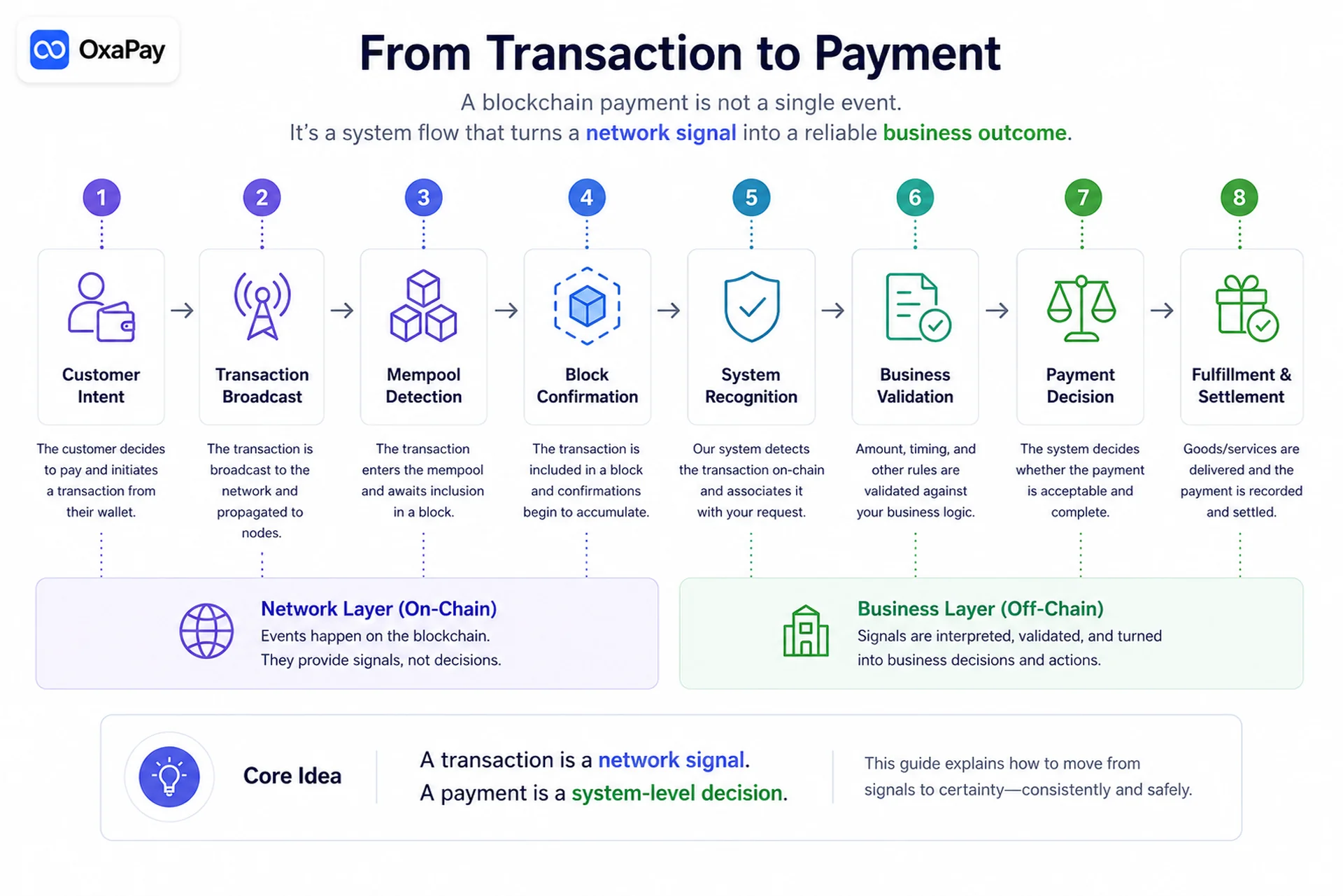
How a blockchain payment moves from intent to completion
The full lifecycle begins before the customer sends funds and continues after the transaction confirms. Each stage creates new evidence, but also introduces its own failure modes.
An order, invoice, subscription, account top-up, donation, or other obligation creates the commercial reason for payment.
It sets the expected amount, currency, network, destination, reference, lifetime, payer experience, and completion rules.
The wallet selects inputs or updates an account state, applies a fee, signs the transaction, and sends it to the network. The Bitcoin Developer Guide provides a detailed example of how transaction data is constructed.
Nodes validate and relay it. Block producers then decide which valid transactions to include. Fee conditions, capacity, and network rules affect how quickly this happens.
Inclusion is the start of confirmation, not the end of payment processing. Different networks expose different levels and forms of finality.
It identifies the relevant transaction and compares it with the expected payment context.
The system considers confirmation confidence, amount accuracy, timing, asset, network, order state, and fulfillment risk.
Access, shipping, balance credit, settlement, treasury routing, accounting, and reconciliation follow the accepted state.
Pending transactions and block inclusion deserve separate study. OxaPay’s guides on the mempool and transaction competition and block time and payment latency explain why the time between “send” and usable confirmation varies.
The payment request gives a transaction commercial meaning
A random transfer to a wallet is not enough to identify an order. Payment systems create context before funds move. That context lets the system decide whether a later transaction belongs to the expected commercial event.
A robust payment context usually includes:
A unique internal reference connects the onchain event with the correct order and prevents ambiguous processing.
The destination must match the intended network and asset model. Some systems use one-time addresses. Others use reusable addresses with a customer or order reference.
The system needs rules for exact payment, acceptable underpayment, overpayment, mixed payment, or conversion.
The blockchain does not know when an invoice expires. The payment system must enforce that rule and decide what happens after expiry.
Matching becomes harder when customers send several transactions, use the wrong network, pay after expiry, or reuse old payment details. Reliable systems do not hide these cases. They model them explicitly.
Confirmation reduces network risk, but it does not complete every business check
Confirmation answers whether the network has accepted a transaction with a given level of confidence. It does not verify the order, amount, expiration, fulfillment policy, or accounting record.
The meaning of finality also changes by network. Bitcoin applications often reason about confirmation depth and replacement risk. The Bitcoin payment-processing guide explains why confidence increases as more blocks build on a transaction. Ethereum uses checkpoint-based economic finality, described in its Gasper documentation. Solana RPC clients can request different commitment levels when reading state or receiving notifications.
These differences make one universal confirmation rule unsafe. A merchant policy must consider the network, transaction value, product type, ability to reverse fulfillment, and cost of a wrong decision.
The full design problem is covered in Payment Confirmation Systems. That analysis explains how visibility, confirmation depth, chain behavior, and merchant risk become a fulfillment decision.
A payment state machine turns uncertainty into controlled behavior
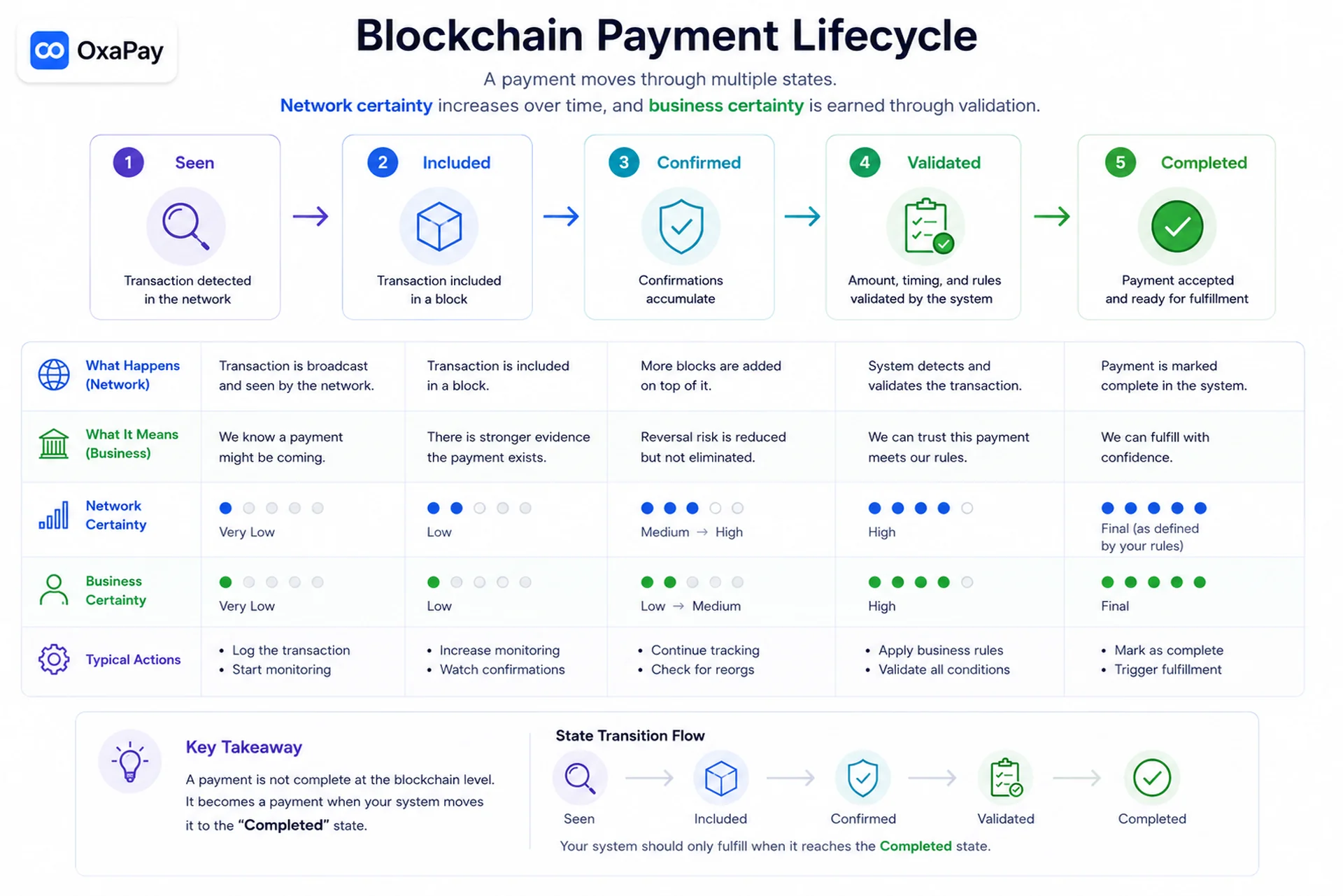
“Paid” and “unpaid” are not enough for asynchronous blockchain payments. The system needs intermediate and exception states that explain what is known, what remains uncertain, and which actions are allowed.
The customer may still be selecting a currency, preparing the transaction, or deciding not to continue.
The system can show progress, but irreversible fulfillment may still be unsafe.
Confidence is increasing. The system continues monitoring for additional confirmations or finality evidence.
Fulfillment, balance credit, settlement, and internal updates can follow according to the business workflow.
Underpaid, overpaid, expired, refunded, wrong-network, duplicate, replaced, or manually reviewed payments require explicit rules.
Status names differ across systems. The important requirement is that each state has a clear definition, allowed transitions, and permitted business actions. OxaPay’s payment status table is one practical example of exposing states such as new, waiting, paying, paid, underpaid, refunded, and expired.
Where payment reality diverges from the ideal path
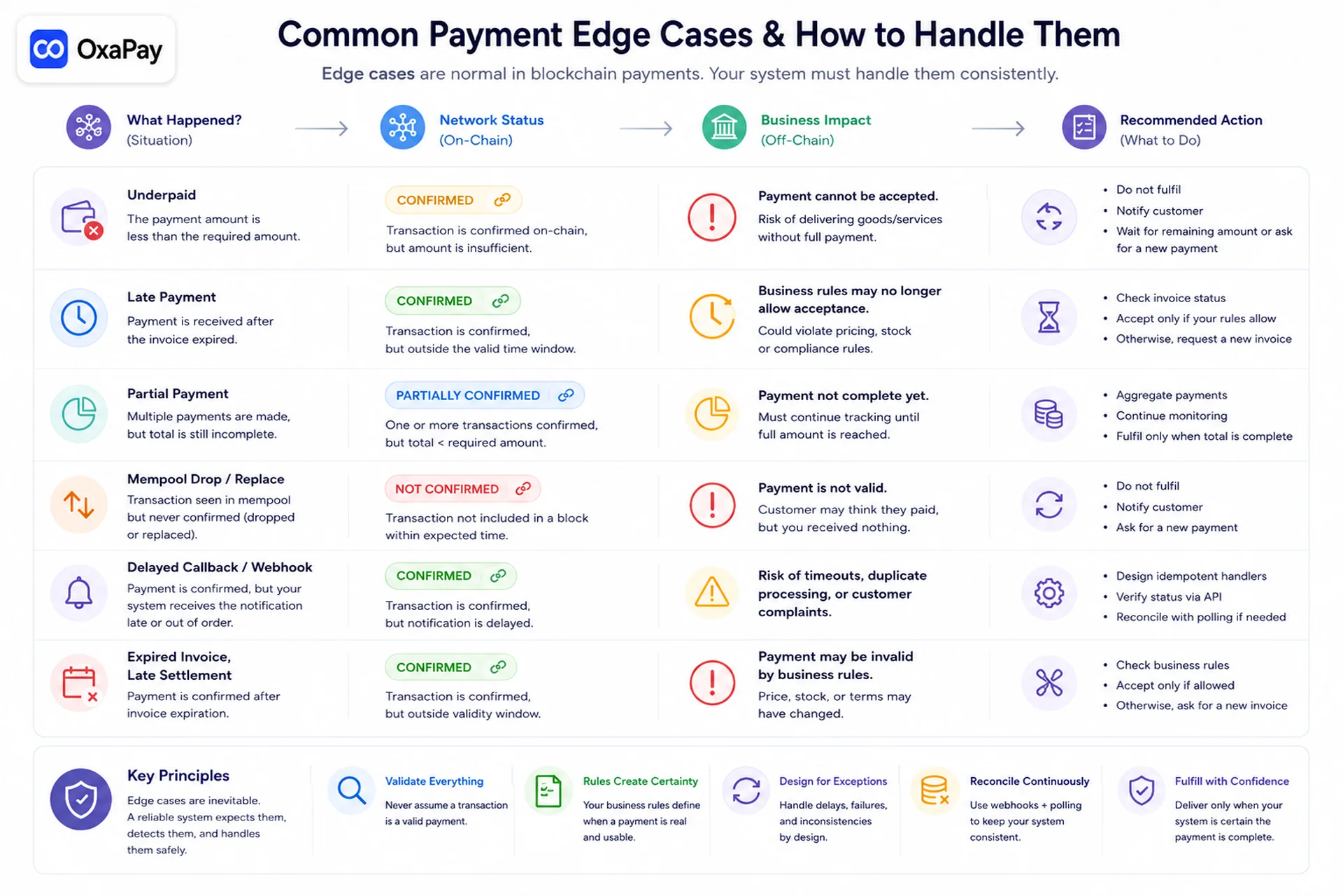
A strong system does not assume every customer sends one exact transaction before the timer ends. It expects imperfect behavior and variable network conditions.
The system may reject it, accept it within a defined tolerance, keep the invoice open, or request the remainder.
The excess may require a refund, account credit, manual review, or a policy that defines acceptable overpayment.
The transaction can be valid onchain while the original commercial offer is no longer valid. Price changes can make this especially important.
Webhook failure, provider downtime, delayed indexing, or internal processing errors can create a gap between network truth and payment truth.
Recovery may be difficult or impossible. The checkout must make the selected asset and network explicit before the transaction is sent.
The correct response depends on business policy, not only technical validity. A low-value account credit can tolerate different risk from a high-value, irreversible shipment.
A reliable payment system separates observation, interpretation, and action
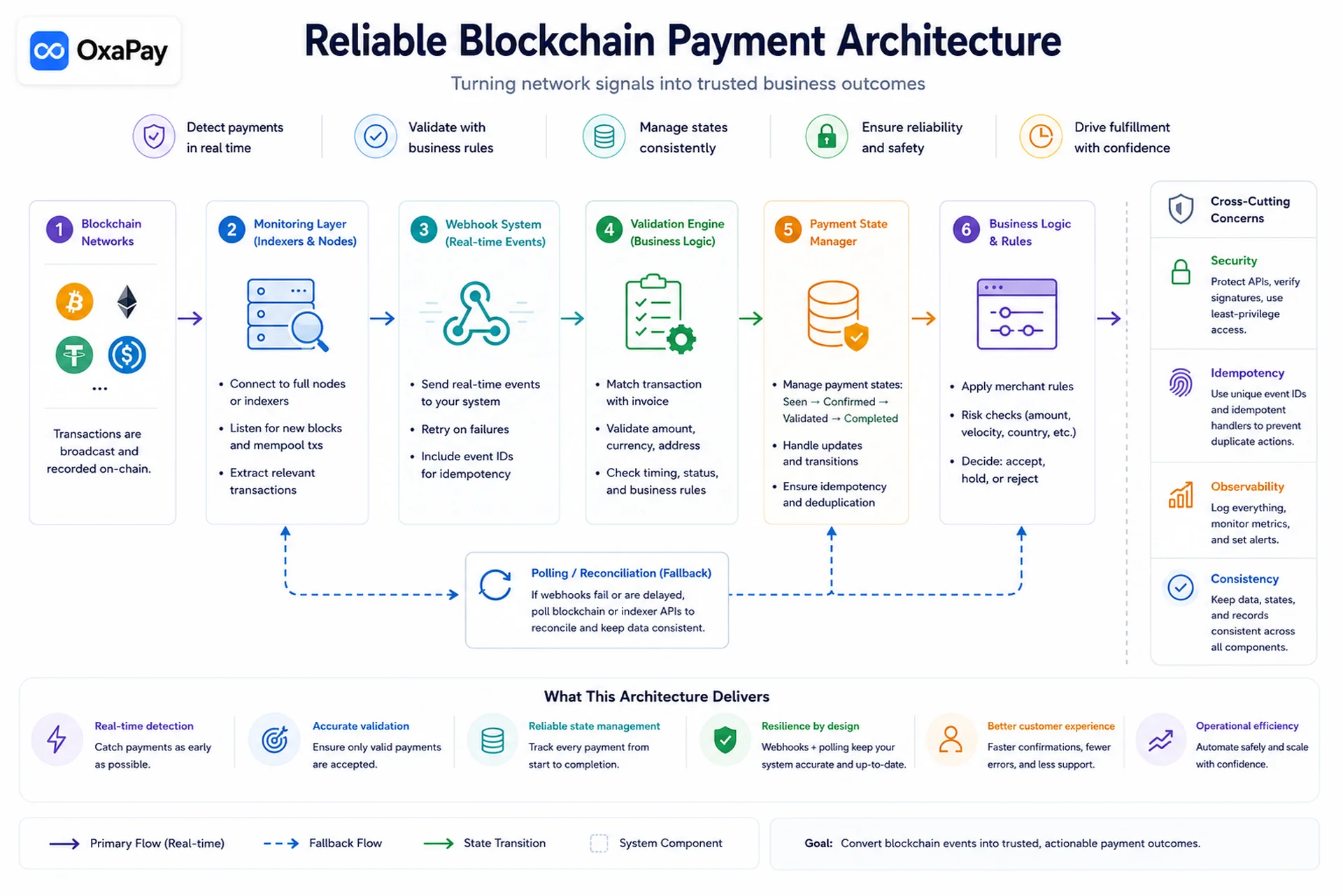
Production systems become safer when one component does not perform every task. Observation should collect network evidence. Interpretation should update payment state. Policy should authorize business actions.
It stores the order reference, amount, asset options, expiration, destination, tolerance, and merchant policy.
RPC calls, subscriptions, indexers, or nodes provide the raw data. Critical systems may verify important events through more than one source.
It evaluates destination, asset, network, amount, time, transaction conflicts, and confirmation policy.
Every event is applied to the existing payment record through valid transitions. Duplicate or late events must not create duplicate fulfillment.
Webhooks need authentication, retries, ordering awareness, and idempotent handlers. Stripe’s official guidance on webhook delivery and idempotent requests illustrates these general distributed-payment patterns.
Shipping, digital access, account credit, settlement, refunds, accounting, and reconciliation should consume the accepted state, not raw blockchain events.
Network observation is a specialized discipline. The related deep insight, Real-Time Monitoring in Blockchain Payment Systems, examines multi-source observation, confirmation engines, event handling, and fail-safe operation in greater detail.
The same transaction can justify different actions in different businesses
There is no universally correct moment to fulfill every payment. The correct threshold depends on the loss a business faces if the transaction reverses, conflicts, arrives late, or does not satisfy the order.
Higher-value payments usually justify stronger confirmation, additional validation, or manual review.
Reversible account access can use a different policy from shipped goods, withdrawals, or irreversible financial settlement.
The interface can acknowledge detection immediately without claiming the payment is fully accepted.
A policy that depends on frequent manual judgment will break as volume grows.
The customer experience should show honest progress: payment details created, transaction detected, confirming, paid, expired, or requiring attention. Clear states reduce duplicate payments and support pressure.
A platform can show immediate progress and reserve access while the payment confirms. It should release the irreversible entitlement only when its defined acceptance policy is met.
The merchant may require stronger finality, complete address and amount validation, fraud review, and a clear reconciliation record before dispatch.
The system should not silently apply the old price. It needs a defined path for manual acceptance, recalculation, refund, credit, or a new payment request.
Businesses evaluating whether and how to adopt this model can continue with the Merchant Guide to Crypto Payments. It focuses on readiness, provider evaluation, launch scope, and operating rules.
How this system model appears in a real payment implementation
OxaPay’s payment interfaces separate payment creation, payment tracking, status interpretation, and merchant notification. This reflects the same system model described above.
The request can define amount, currency, lifetime, order reference, callback URL, underpayment coverage, and other acceptance settings.
The payment track ID provides a stable reference for retrieving the current payment details and status.
Merchant systems can receive JSON payment updates through a configured callback endpoint and respond with the required acknowledgement.
This guide connects payment expectations, onchain interpretation, payment states, events, settlement, and business actions.
The implementation details matter, but the design principle matters more: create a payment context first, observe the network continuously, update one authoritative payment state, and trigger business actions from that state.
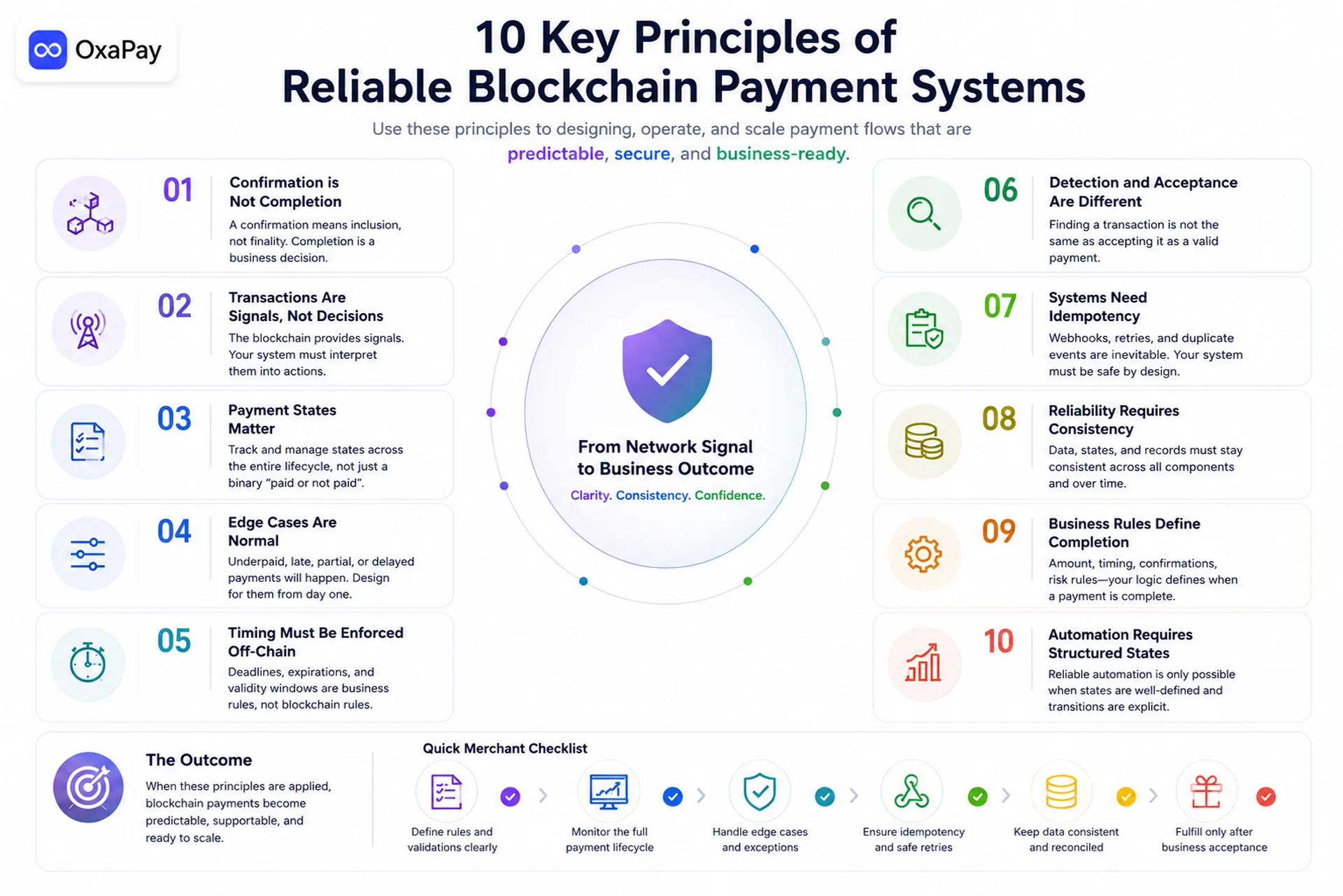
The complete model in ten operating principles
Define the order and acceptance conditions before funds move.
Network evidence is an input to the payment decision.
Verify reference, destination, asset, network, amount, and time.
Do not apply one confirmation rule to every chain and payment.
Detection, confirmation, acceptance, and settlement are different events.
Underpayment, expiry, late arrival, duplicates, and failed delivery are normal.
Payment truth changes as the network and internal systems process new evidence.
Repeated notifications must not repeat fulfillment or financial actions.
Raw transaction visibility should not directly trigger irreversible action.
Blockchain, payment, settlement, treasury, and accounting records must agree.
Technical references and related Deep Insights
The protocol-level explanations in this article were checked against primary documentation from Bitcoin, Ethereum, and Solana. The payment-reliability patterns were also compared with established webhook and idempotency guidance.
Transaction construction and spend structure.
Confirmation depth and merchant risk considerations.
Checkpoint-based justification and finalization.
Processed, confirmed, and finalized data commitments.
How networks establish ordered transaction truth.
How finality evidence becomes merchant policy.