Imagine running an online store. A customer hits “Pay Now,” and within seconds the payment is either approved or declined. For most merchants, it feels instantaneous and straightforward. Yet, behind this simplicity lies a multi-layered system that coordinates information, funds, and authorization.
Terms like payment gateway vs payment processor, and merchant account are often used interchangeably. In reality, each serves a distinct operational purpose, and knowing the differences is key to maintaining reliable, scalable, and efficient payment operations.
Modern platforms may bundle these roles into one interface, making it seem as if all tasks are handled by a single system. However, understanding the individual roles helps businesses troubleshoot issues, optimize workflows, and make informed choices when evaluating payment solutions.
What a Payment Gateway Actually Does
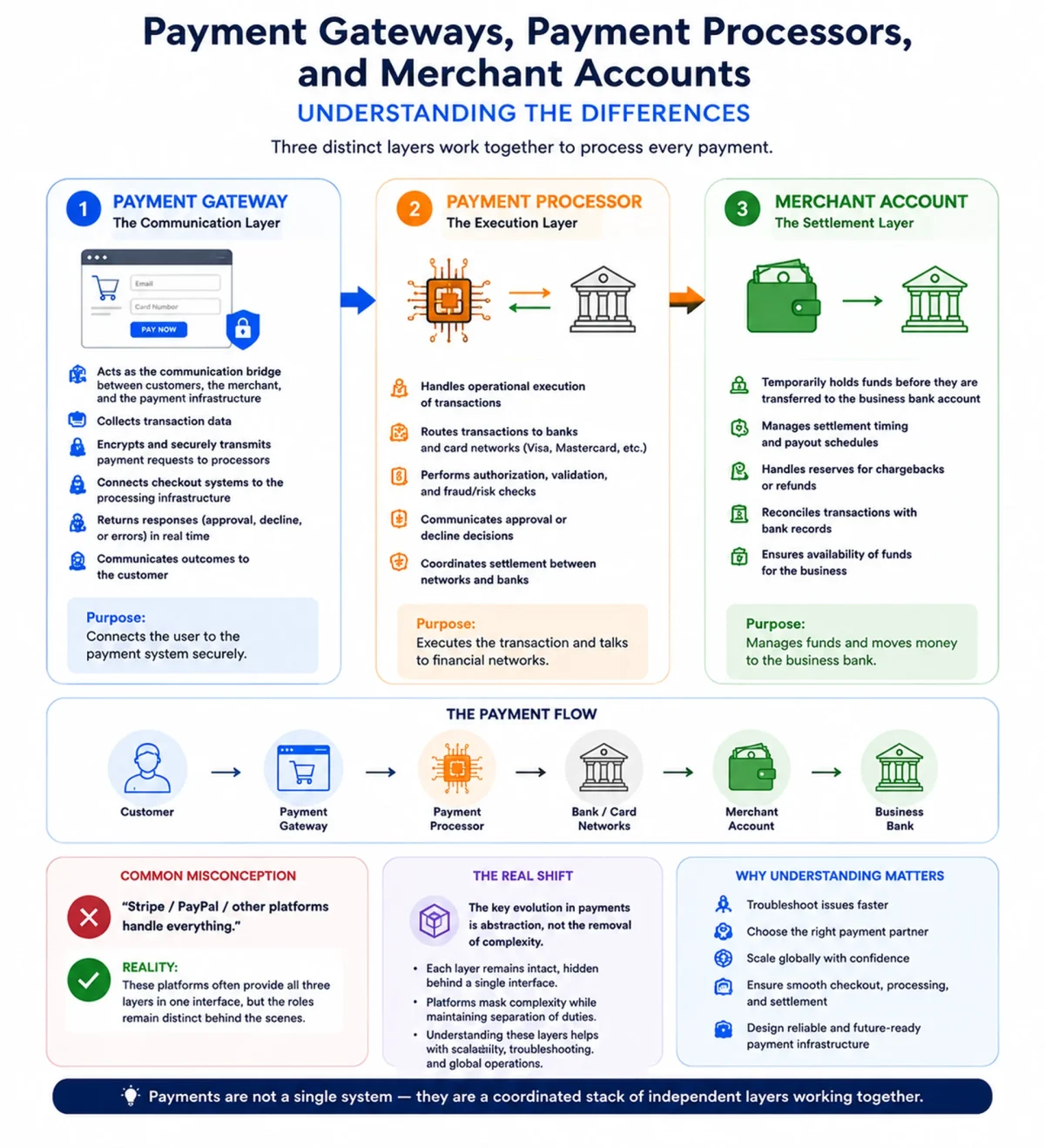
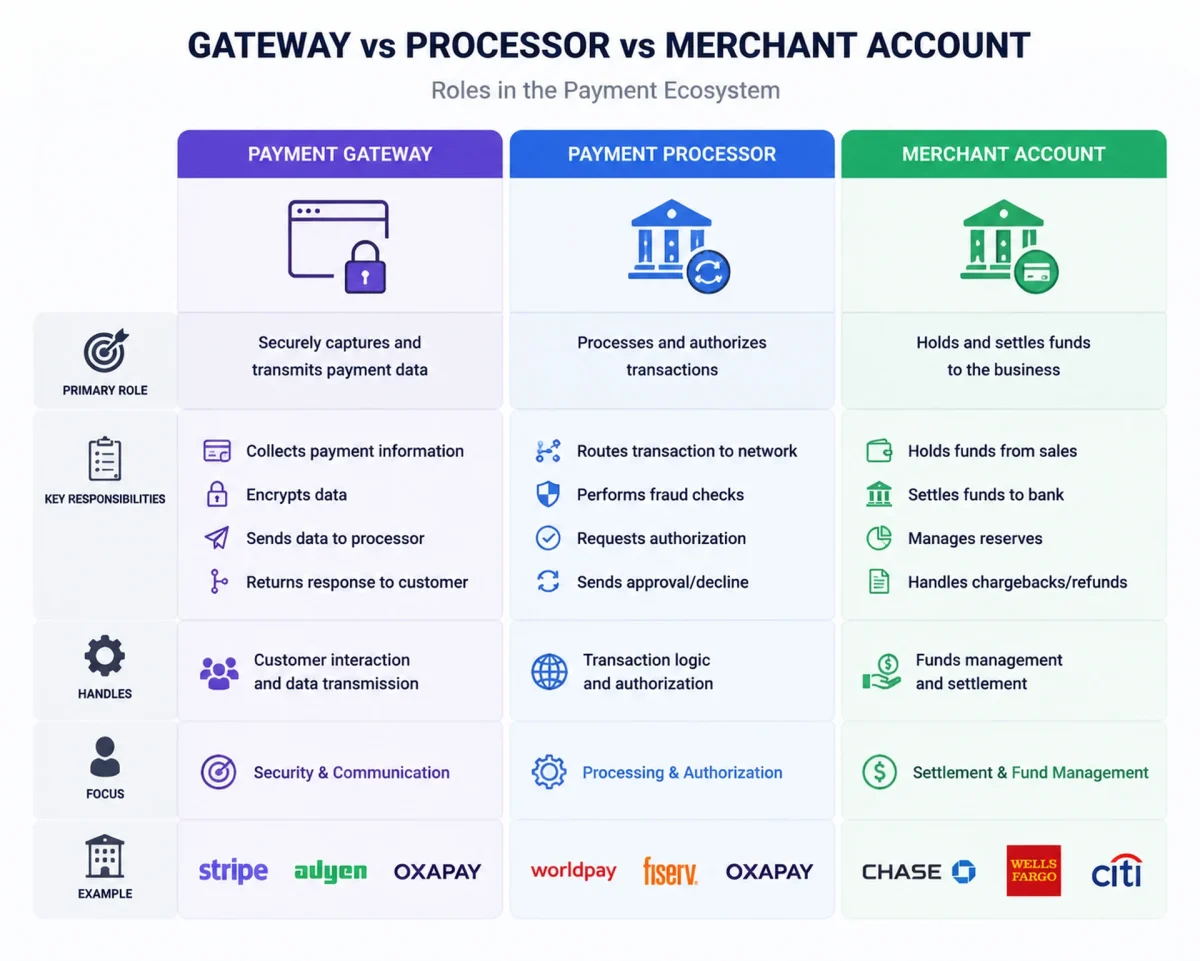
A payment gateway acts as the communication bridge between customers, the merchant, and the payment infrastructure. Its main job is coordinating the checkout experience, not moving money itself.
When a customer submits payment information, the gateway:
- Collects transaction data
- Encrypts and securely transmits payment requests to processors
- Connects checkout systems to the processing infrastructure
- Returns responses indicating approval, decline, or errors
- Communicates outcomes to the customer in real time
A well-designed gateway improves checkout speed, trust, and user experience. Modern gateways often include fraud monitoring and tokenization systems.
What a Payment Processor Does
The payment processor handles the operational execution of transactions. While gateways communicate, processors move payment information between financial networks.
Processors may interact with issuing banks and acquiring banks, card networks (ویزا, مسترکارت, etc.), settlement systems, fraud detection and risk engines.
What a Merchant Account Is
یک merchant account is the financial layer that temporarily holds funds before they are transferred to the business’s bank account. It manages settlement, fund availability, reserves, and payout schedules.
Key considerations:
- Timing of settlements
- Availability of funds
- Handling of reserves for chargebacks or refunds
- Reconciliation of transactions with bank records
While modern platforms often abstract the merchant account, its operational role remains critical, particularly for cash flow management and dispute resolution.
Why Businesses Often Get Confused
Many merchants assume all payment tasks are handled by one system. Consider:
- A Shopify store using Stripe sees one dashboard.
- A business accepting PayPal payments experiences a similar “single interface” simplicity.
In reality, behind these unified platforms:
- The gateway coordinates the checkout interaction.
- The processor executes the transaction and communicates with financial networks.
- The merchant account manages تسویه before funds reach the bank.
This is exactly why understanding payment gateway vs payment processor is important in real-world payment systems.
Recognizing which layer is responsible for specific issues is essential. Checkout delays may be a gateway problem, while missing payouts or reconciliation errors could be a merchant account issue.

Modern Payment Systems Blur Traditional Boundaries
Traditionally, gateways, processors, and merchant accounts were separate providers. Today, platforms often combine these roles into unified ecosystems, offering:
- Centralized dashboards
- Simplified reconciliation
- Developer-friendly APIs
- Faster onboarding
The consolidation improves operational visibility but does not eliminate the underlying roles. Each layer still performs its function, even if hidden from the merchant.
The Real Shift Was Not Technology, It Was Abstraction
The difference between payment gateway vs payment processor becomes less visible due to abstraction.
- Each layer remains intact, but is hidden behind a single interface.
- Platforms mask complexity while maintaining separation of duties.
- Understanding these layers is crucial for scaling operations, troubleshooting, and international payment management.
This abstraction allows merchants to focus on business operations without being overwhelmed by technical complexity, but knowledge of the underlying roles ensures informed decision-making.
Blockchain Payments Introduce New Models
پرداختهای بلاکچینی change traditional assumptions:
- Settlement can occur directly on-chain.
- Merchant accounts are often not required.
- Operational focus shifts to wallet coordination, confirmation tracking, and blockchain monitoring.
While blockchain removes some traditional intermediaries, operational complexity remains—it simply moves to a different infrastructure layer.
Why Understanding These Differences Matters
Grasping the distinctions between gateways, processors, and merchant accounts enables businesses to:
- Troubleshoot operational problems efficiently
- Evaluate platforms based on operational fit, not only features
- Scale globally with multiple currencies and customer regions
- Ensure smooth checkout, processing, and settlement workflows
Even with a unified system, informed decisions require understanding the underlying infrastructure.
نتیجهگیری
Payment gateways, processors, and merchant accounts each play distinct operational roles. payment gateway vs payment processor Modern platforms often combine them into unified interfaces, but the differences remain significant.
Businesses that understand these distinctions are better positioned to design reliable, scalable payment infrastructure, whether using traditional card networks or blockchain-based systems. Accepting payments is no longer just about completing transactions—it’s about creating operational systems that support long-term growth.
Start Accepting Payments the Right Way
Understanding how payment gateways, processors, and merchant accounts work is only the first step. The real value comes when you turn this knowledge into a reliable payment system for your business.
با OxaPay, you don’t just get one layer of the payment stack — you get a complete infrastructure that connects everything in a single system.
From checkout experience to transaction processing and final settlement, OxaPay brings all key payment components together through a unified crypto payment gateway built for modern businesses.
You can:
- Accept crypto payments instantly
- Manage transactions through a single dashboard
- Use API-based integrations for full control
- Automate payouts and settlements
- Track every payment in real time
If you’re building for global customers, simplifying your payment architecture is no longer optional — it’s essential.
👉 Start integrating crypto payments with OxaPay and turn your payment flow into a scalable system, not a fragmented process.