
Choisir la meilleure passerelle de paiement crypto dépend moins de sa popularité que de son adéquation avec les opérations de votre entreprise. Le comportement du règlement, le parcours checkout et l’intégration comptent souvent davantage que le nombre de cryptomonnaies prises en charge.
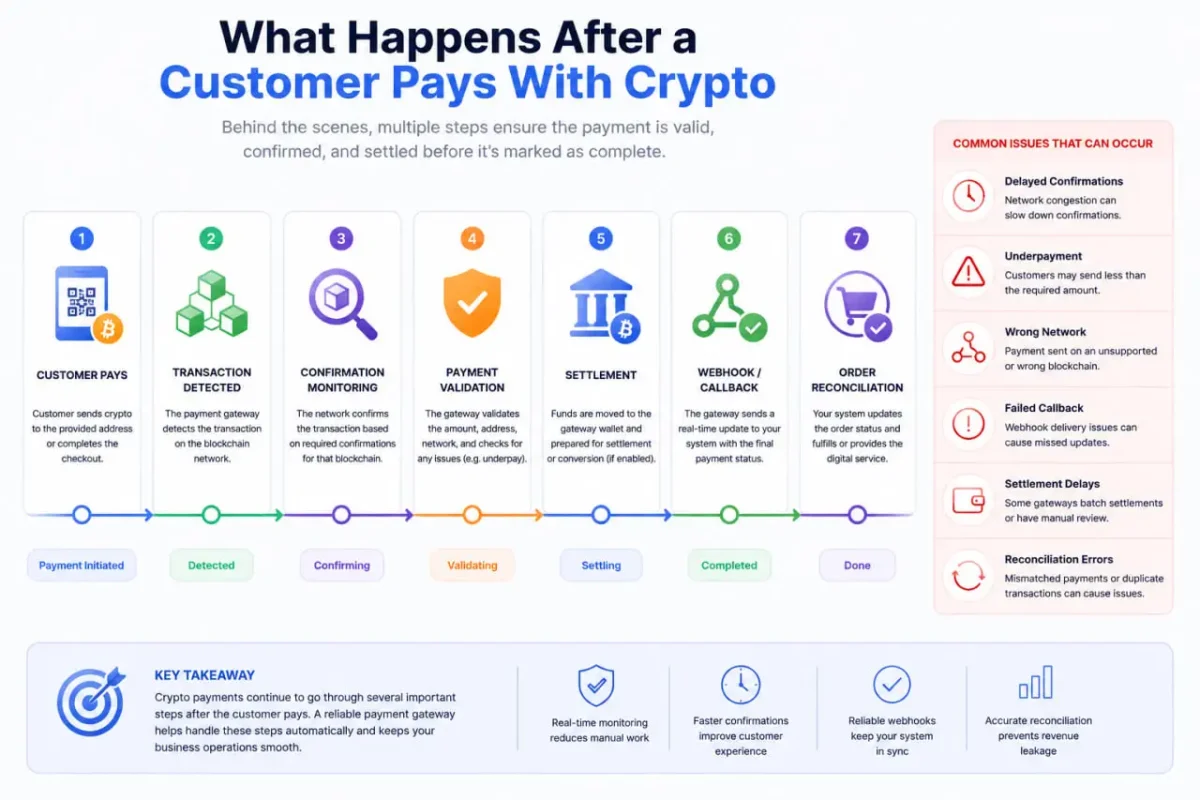
De nombreuses entreprises rencontrent des difficultés après avoir adopté les paiements crypto : confirmations retardées, statut de paiement peu clair ou rapprochement manuel. Dans la plupart des cas, le problème ne vient pas de la crypto elle-même, mais de la passerelle utilisée. Ce comparatif se concentre sur les différences pratiques entre les principaux fournisseurs afin de vous aider à prendre une décision plus éclairée.
Pour les entreprises qui évaluent encore si les paiements crypto conviennent à leur modèle, ce comparatif peut aussi être lu avec le guide plus large d’ OxaPaysur la mise en place d’un système de paiement crypto fiable.
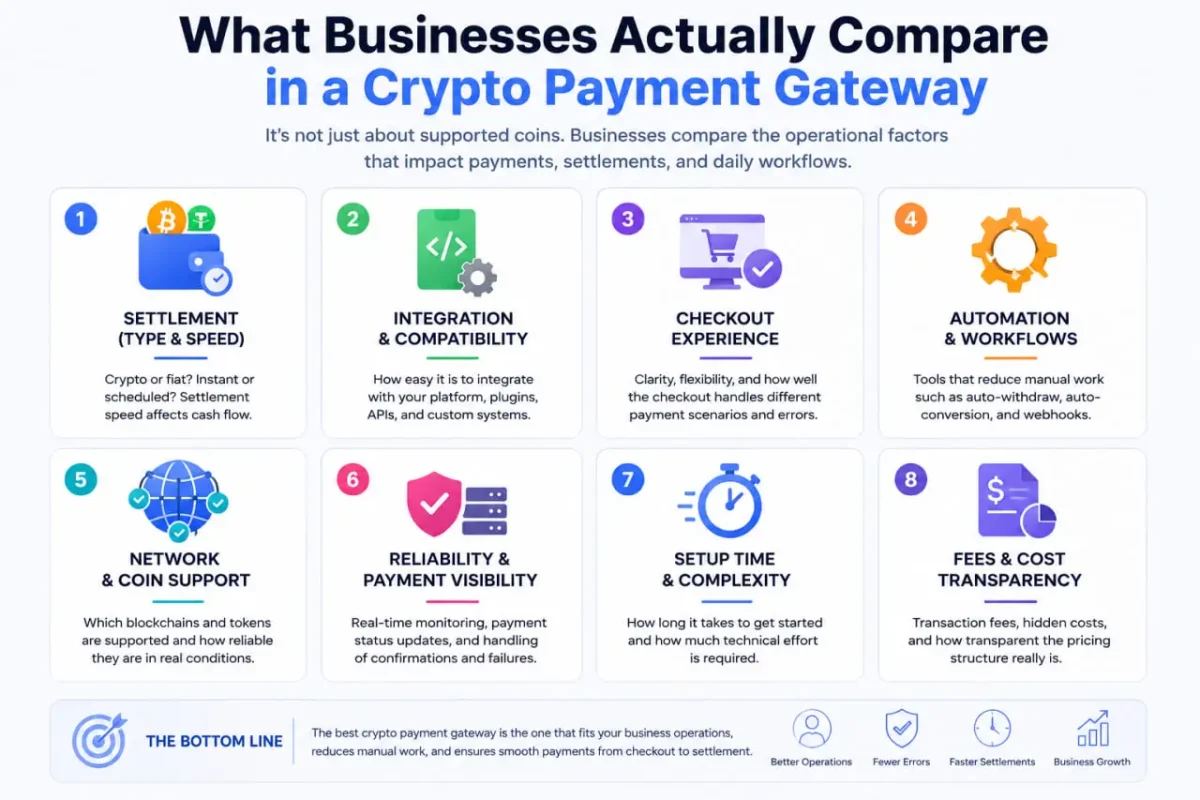
Comment nous avons comparé les meilleures passerelles de paiement crypto
Ce comparatif se concentre sur les facteurs qui ont un impact direct sur l’usage réel, plutôt que sur de longues listes de fonctionnalités.
- Frais : transparence et coût réel des transactions
- Règlement : type de versement et délais
- Intégration : compatibilité avec les plateformes et API
- Expérience checkout : clarté, fluidité et gestion des cas de paiement particuliers
- Automatisation : disponibilité d’outils réduisant les tâches manuelles
- Réseaux : couverture pratique des réseaux
- Friction de mise en place : temps et complexité nécessaires pour démarrer
- Limitation principale : contrainte clé pouvant affecter l’utilisation
Ces critères reflètent les préoccupations opérationnelles courantes lors de l’acceptation des paiements crypto.
Comparaison rapide des meilleures passerelles de paiement crypto
Comparer les passerelles de paiement crypto peut rapidement devenir complexe, surtout lorsque plusieurs facteurs techniques et opérationnels entrent en jeu. Pour simplifier le processus, nous avons divisé la comparaison en deux tableaux ciblés.
Le premier tableau présente les critères financiers et techniques qui influencent directement les coûts, le règlement et l’intégration système. Le second se concentre sur l’expérience utilisateur et les facteurs opérationnels qui influencent les performances de chaque passerelle dans des scénarios e-commerce réels.
📊 Table 1: Financial & Technical Criteria
Ce tableau se concentre sur l’infrastructure fondamentale de chaque passerelle, notamment les frais, le type de règlement, les possibilités d’intégration et la prise en charge des réseaux. Ces facteurs sont essentiels pour évaluer l’efficacité des coûts, la scalabilité et la facilité d’intégration dans vos systèmes existants.
| Passerelle | les frais | Règlement (type + vitesse) | Intégration | Réseaux | Friction de mise en place |
|---|---|---|---|---|---|
| OxaPay | À partir de 0,4 % | Crypto, généralement rapide | Bonne (plugins + API) | Multiréseau (principales blockchains) | Faible |
| BitPay | ~1% | Fiat + crypto, vitesse moyenne | Bonne | Limitée | Moyenne–élevée |
| NOWPayments | 0,5–1 % | Crypto, relativement rapide | Bonne (plugins + API) | Très large | Faible |
| CoinPayments | ~0.5% | Crypto, moyenne | Bonne | Très large | Moyenne |
| CoinGate | ~1% | Crypto + fiat, moyenne | Bonne | Moyenne–élevée | Faible |
| Coinbase Commerce | ~1% | Crypto + fiat, moyenne | Moyenne | Limitée | Moyenne–élevée |
📊 Table 2: User Experience & Operational Factors
Les capacités techniques sont importantes, mais les performances réelles dépendent souvent de l’ergonomie et de la flexibilité. Ce tableau compare l’expérience checkout, l’automatisation et les limitations courantes susceptibles d’affecter les opérations quotidiennes.
| Passerelle | Expérience checkout | Automatisation | Idéal pour | Limitation principale |
|---|---|---|---|---|
| OxaPay | Bonne (gestion flexible) | Bonne (retrait automatique, outils de conversion) | E-commerce, entreprises en croissance | Pas de versement fiat ; marque moins établie |
| BitPay | Flexibilité limitée | Moyenne | Grandes entreprises, règlement fiat | Workflows moins adaptables |
| NOWPayments | Bonne (paiements partiels/mixtes pris en charge) | Moyenne | Large prise en charge des monnaies | Modèle centralisé |
| CoinPayments | Moyenne | Moyenne | Marchands de niche / altcoins | Modèle custodial |
| CoinGate | Bonne | Moyenne | PME, entreprises européennes | Personnalisation limitée |
| Coinbase Commerce | Basique | Moyenne | Entreprises privilégiant la marque | Flexibilité limitée |
Analyse détaillée de chaque passerelle de paiement crypto
OxaPay
Idéal pour : les entreprises e-commerce, les sociétés en croissance et les équipes qui ont besoin de workflows crypto flexibles et d’automatisation.
OxaPay se concentre sur la gestion directe des cryptomonnaies avec une large gamme d’outils, notamment les factures, Payment Links, POS, adresses statiques, ainsi que intégrations via API. Il propose également de bonnes fonctions d’automatisation telles que le retrait automatique et la conversion automatique.
Principaux points forts :
- Frais faibles à partir de 0,4 %
- Automatisation solide et prise en charge multiréseau
- Options white-label complètes et de checkout flexible disponibles
- Configuration rapide et bonne prise en charge des plugins
Principales limitations :
- Pas de versements fiat directs
- Marque moins établie que les fournisseurs plus anciens
BitPay
Idéal pour : les grandes entreprises et sociétés qui ont besoin d’un règlement fiat et d’un fournisseur reconnu.
BitPay est l’une des passerelles les plus établies, avec un accent sur la stabilité et l’intégration traditionnelle. Elle prend en charge les versements fiat, ce qui est important pour de nombreuses entreprises.
Principaux points forts :
- Options fiables de règlement fiat
- Forte notoriété de marque et fonctions de conformité
- Bonne intégration avec les outils comptables
Principales limitations :
- Frais plus élevés (~1 %)
- Moins de flexibilité pour les paiements mixtes/partiels et le white-label
NOWPayments
Idéal pour : les entreprises qui ont besoin d’un large choix de monnaies et d’une configuration relativement simple.
NOWPayments donne accès à un grand nombre de cryptomonnaies et à des fonctions d’automatisation correctes.
Principaux points forts :
- Très large prise en charge des monnaies et réseaux
- Frais compétitifs
- Bon écosystème de plugins
Principales limitations :
- Modèle centralisé (moins de contrôle direct)
- Expérience du support client variable
CoinPayments
Idéal pour : les marchands souhaitant accepter de nombreuses monnaies de niche et altcoins.
CoinPayments est connu pour prendre en charge un grand nombre de monnaies, dont beaucoup sont rarement disponibles ailleurs. Il peut donc convenir aux marchands qui souhaitent cibler des communautés crypto de niche.
Principaux points forts :
- Prise en charge extrêmement large des monnaies
- Structure tarifaire fixe simple
- Présence ancienne sur le marché
Principales limitations :
- Modèle custodial (contrôle réduit des fonds)
- Automatisation et expérience checkout moyennes
CoinGate
Idéal pour : les PME européennes et les entreprises recherchant une solution simple combinant crypto et fiat.
CoinGate propose un mélange d’options crypto et fiat avec une intégration relativement simple. Il peut donc constituer un point de départ pratique pour les entreprises qui souhaitent éviter de construire une infrastructure de paiement complexe.
Principaux points forts :
- Prise en charge du règlement en crypto et en fiat
- Onboarding simple
- Prise en charge multimonnaie correcte
Principales limitations :
- Personnalisation avancée et white-label limités
- Frais moyens (~1 %)
Coinbase Commerce
Commerce Idéal pour : les entreprises qui privilégient la confiance dans la marque et une intégration simple au sein de l’écosystème Coinbase.
Coinbase Commerce est souvent choisi en raison de son association avec Coinbase et de son interface simple. Il peut donc convenir aux entreprises qui préfèrent une marque familière et une expérience de paiement simplifiée.
Principaux points forts :
- Forte réputation de marque
- Interface facile à utiliser
- Adapté aux environnements réglementés
Principales limitations :
White-label et fonctions avancées plus faibles
Prise en charge limitée des monnaies et réseaux
Quelle passerelle de paiement crypto choisir ?
- Choisissez OxaPay si vous souhaitez des workflows crypto flexibles, de l’automatisation et une gestion directe des paiements crypto.
- Choisissez BitPay si les versements fiat et une infrastructure établie sont importants pour votre entreprise.
- Choisissez NOWPayments ou CoinPayments si la diversité des monnaies est votre priorité principale.
- Choisissez CoinGate si vous préférez une configuration simple avec des options crypto et fiat.
- Choisissez Coinbase Commerce si la familiarité de la marque et l’écosystème Coinbase sont vos principaux critères.
Conclusion
Il n’existe pas une seule passerelle de paiement crypto adaptée à toutes les entreprises, car chaque configuration gère les paiements différemment. Par conséquent, le bon choix de passerelle de paiement crypto dépend de la façon dont les paiements sont gérés dans votre workflow. Au lieu de vous concentrer uniquement sur les listes de fonctions, observez comment chaque passerelle gère le règlement, l’intégration et les opérations quotidiennes afin de choisir une solution adaptée à votre workflow, plutôt qu’une solution qui affiche simplement davantage de fonctions sur le papier.