Choosing the best crypto payment gateway is less about popularity and more about how well the system fits your business operations. Factors like settlement behavior, checkout flow, and integration often matter more than the number of supported coins.
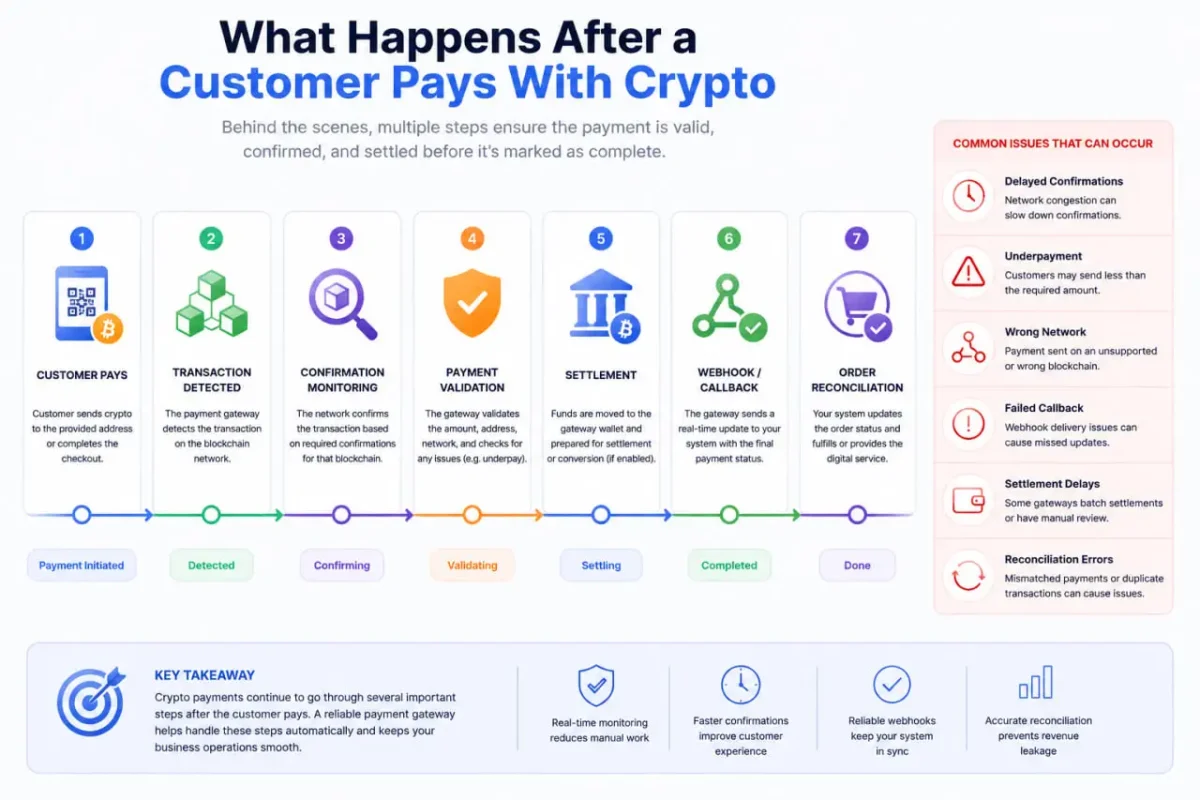
Many businesses face issues after adopting crypto payments, such as delayed confirmations, unclear payment status, or manual reconciliation. In most cases, these challenges are not about crypto itself, but about the gateway being used. This comparison focuses on practical differences between leading providers to help you make a more informed decision.
For businesses still evaluating whether crypto payments fit their model, this comparison can also be read alongside OxaPay’s broader guide on building a reliable crypto payment system.
How We Compared the Best Crypto Payment Gateways
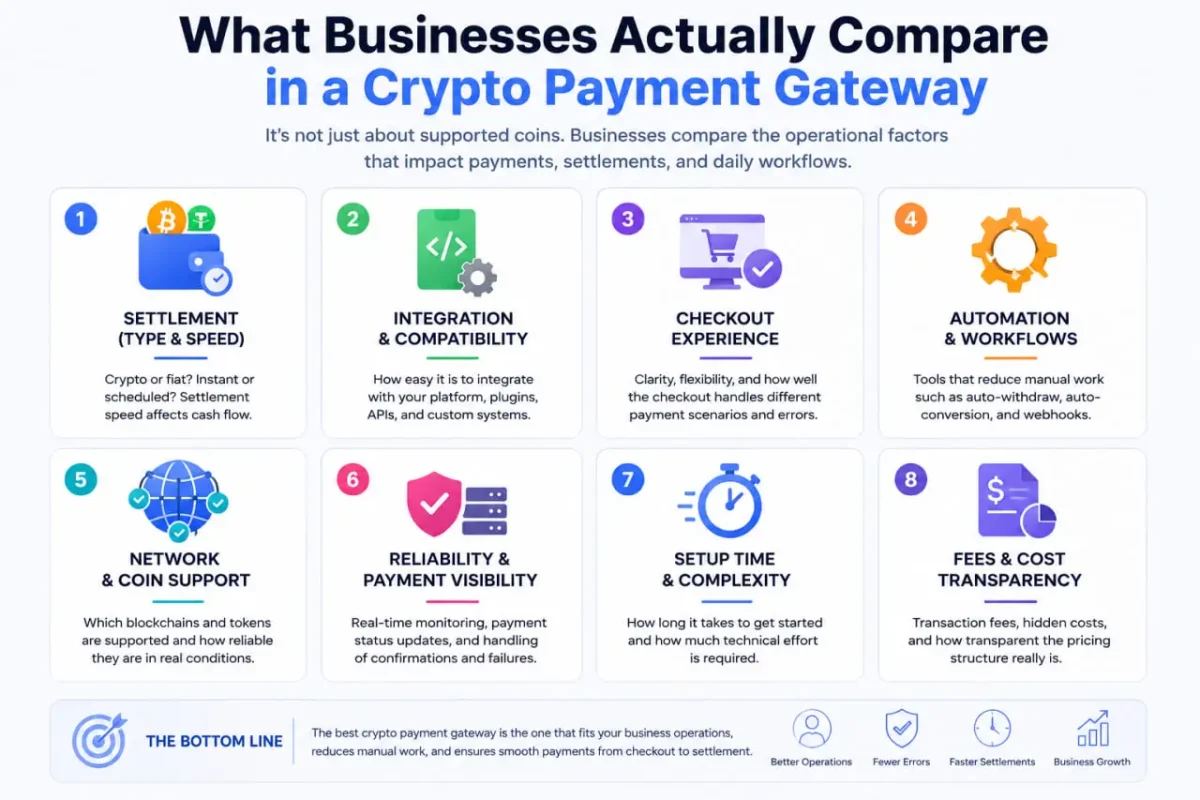
This comparison focuses on factors that have a direct impact on real-world usage, rather than broad feature lists.
- Fees: Transparency and actual transaction costs
- Settlement: Type of payout and timing
- Integration: Compatibility with platforms and APIs
- Checkout Experience: Clarity, flow, and handling of payment edge cases
- Automation: Availability of tools that reduce manual work
- Networks: Practical network coverage
- Setup Friction: Time and complexity required to get started
- Main Limitation: Key constraint that may affect usage
These criteria reflect common operational concerns when accepting crypto payments.
Quick Comparison of the Best Crypto Payment Gateways
Comparing crypto payment gateways can quickly become complex, especially when multiple technical and operational factors are involved. To simplify this process, we’ve divided the comparison into two focused tables.
The first table highlights financial and technical criteria, which directly affect costs, settlement behavior, and system integration. The second table focuses on user experience and operational factors, which influence how each gateway performs in real ecommerce scenarios.
📊 Table 1: Financial & Technical Criteria
This table focuses on the core infrastructure behind each gateway, including fees, settlement type, integration capabilities, and network support. These factors are critical when evaluating cost efficiency, scalability, and how easily the gateway fits into your existing systems.
| Gateway | Fees | Settlement (Type + Speed) | Integration | Networks | Setup Friction |
|---|---|---|---|---|---|
| OxaPay | From 0.4% | Crypto, generally fast | Good (plugins + API) | Multi-network (major chains) | Low |
| BitPay | ~1% | Fiat + crypto, moderate speed | Good | Limited | Medium–High |
| NOWPayments | 0.5–1% | Crypto, relatively fast | Good (plugins + API) | Very broad | Low |
| CoinPayments | ~0.5% | Crypto, moderate | Good | Very broad | Medium |
| CoinGate | ~1% | Crypto + fiat, moderate | Good | Medium–High | Low |
| Coinbase Commerce | ~1% | Crypto + fiat, moderate | Moderate | Limited | Medium–High |
📊 Table 2: User Experience & Operational Factors
While technical capabilities are important, real-world performance often depends on usability and flexibility. This table compares how each gateway handles checkout experience, automation, and common limitations that may impact daily operations.
| Gateway | Checkout Experience | Automation | Best For | Main Limitation |
|---|---|---|---|---|
| OxaPay | Good (flexible handling) | Good (auto-withdraw, conversion tools) | Ecommerce, growing businesses | No fiat payouts; less established brand |
| BitPay | Limited flexibility | Moderate | Enterprises, fiat settlement | Less adaptable workflows |
| NOWPayments | Good (partial/mixed supported) | Moderate | Wide coin support | Centralized model |
| CoinPayments | Moderate | Moderate | Niche / altcoin merchants | Custodial model |
| CoinGate | Good | Moderate | SMBs, EU businesses | Limited customization |
| Coinbase Commerce | Basic | Moderate | Brand-oriented businesses | Limited flexibility |
Detailed Review of Each Crypto Payment Gateway
OxaPay
Best for: Ecommerce businesses, growing companies, and teams that need flexible crypto workflows and automation.
OxaPay focuses on direct crypto management with a wide set of tools including invoices, payment links, POS, static addresses, and API-based integrations. It offers good automation features such as auto-withdrawal and auto-conversion.
Key strengths:
- Low fees starting from 0.4%
- Strong automation and multi-network support
- Full white-label and flexible checkout options
- Fast setup and good plugin support
Main limitations:
- No direct fiat payouts
- Less established brand compared to older providers
BitPay
Best for: Enterprises and businesses that need fiat settlement and a well-known provider.
BitPay is one of the more established gateways with a focus on stability and traditional integration. It supports fiat payouts which is important for many companies.
Key strengths:
- Reliable fiat settlement options
- Strong brand recognition and compliance features
- Good integration with accounting tools
Main limitations:
- Higher fees (~1%)
- Less flexibility in mixed/partial payments and white-label
NOWPayments
Best for: Businesses that need broad coin support and relatively simple setup.
NOWPayments offers access to a large number of cryptocurrencies and decent automation features.
Key strengths:
- Very wide coin and network support
- Competitive fees
- Good plugin ecosystem
Main limitations:
- Centralized model (less direct control)
- Variable customer support experience
CoinPayments
Best for: Merchants who want to accept many niche and altcoins.
CoinPayments is known for supporting a large number of coins, including many that are not commonly used elsewhere. This makes it relevant for merchants that specifically want exposure to niche crypto communities.
Key strengths:
- Extremely broad coin support
- Simple flat fee structure
- Long presence in the market
Main limitations:
- Custodial model (reduced fund control)
- Average automation and checkout experience
CoinGate
Best for: European SMBs and businesses looking for a straightforward crypto + fiat solution.
CoinGate offers a mix of crypto and fiat options with relatively simple onboarding. Therefore, it works as a practical starting point for businesses that want to avoid building a complex payment infrastructure.
Key strengths:
- Supports both crypto and fiat settlement
- Easy onboarding
- Decent multi-coin support
Main limitations:
- Limited advanced customization and white-label
- Average fees (~1%)
Coinbase Commerce
Commerce Best for: Businesses that value brand trust and simple integration within the Coinbase ecosystem.
Coinbase Commerce is often chosen because of its association with Coinbase and its straightforward interface. As a result, it can suit businesses that prefer a familiar brand and a simpler payment experience.
Key strengths:
- Strong brand reputation
- Easy-to-use interface
- Good for regulated environments
Main limitations:
Weaker white-label and advanced features
Limited coin and network support
Which Crypto Payment Gateway Should You Choose?
- Choose OxaPay if you want flexible crypto-focused workflows, automation, and direct crypto payment management.
- Choose BitPay if fiat payouts and established infrastructure are important for your business.
- Choose NOWPayments or CoinPayments if coin diversity is your main priority.
- Choose CoinGate if you prefer a simple setup with both crypto and fiat options.
- Choose Coinbase Commerce if brand familiarity and the Coinbase ecosystem are your main considerations.
Conclusion
There is no single crypto payment gateway that fits every business, because each setup handles payments differently. Therefore, the right crypto payment gateway choice depends on how payments are managed in your specific workflow. Instead of focusing only on feature lists, you should focus on how each gateway handles settlement, integration, and day-to-day operations, so you can choose a solution that fits your workflow rather than one that simply lists more features on paper.