A customer clicks “Pay.”
Seconds later, the order is confirmed and the transaction appears complete.
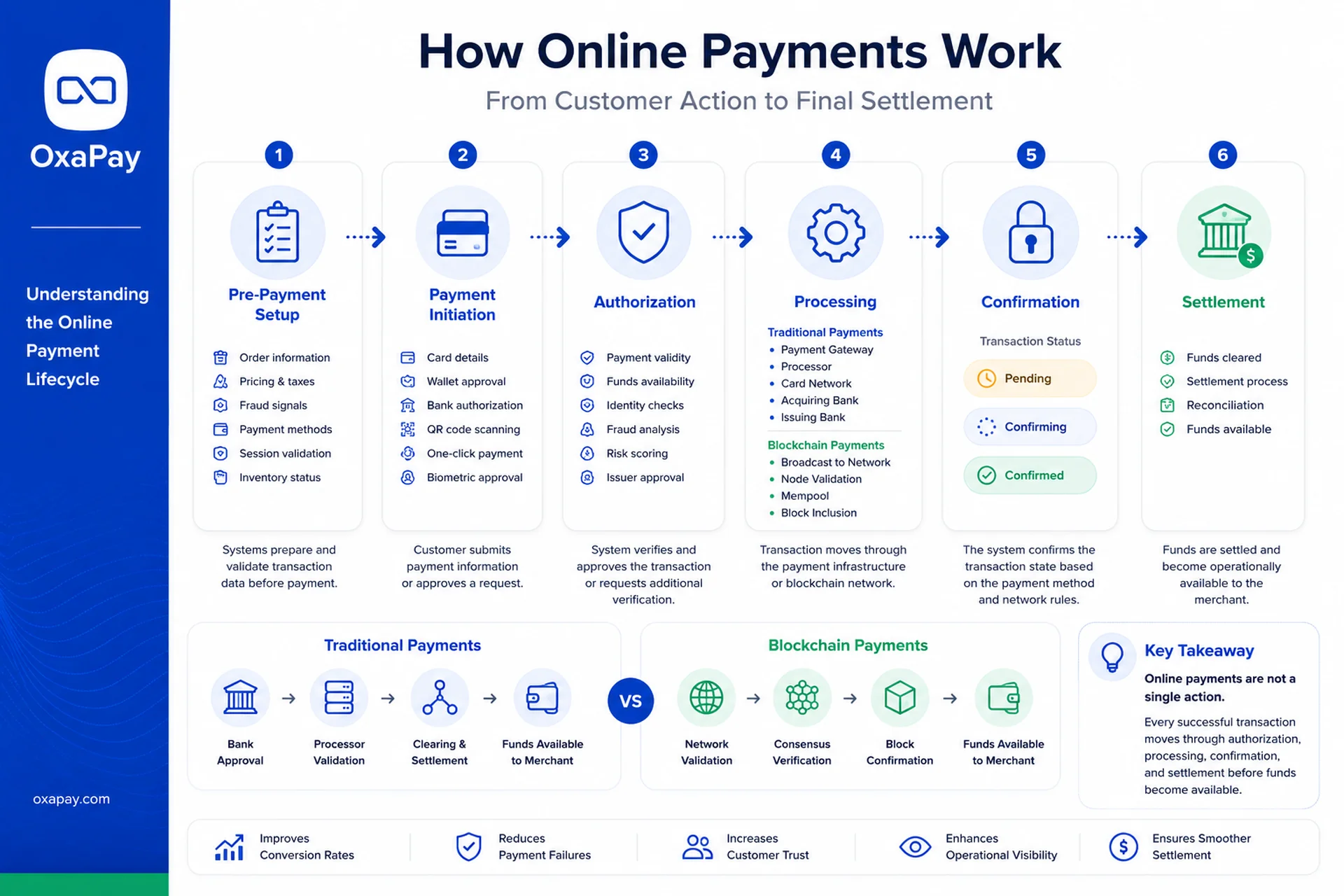
But online payments are not a single action. Behind every successful transaction, multiple systems work together to authorize, process, verify, and settle the payment. Payment gateways, processors, banks, fraud detection systems, and blockchain networks all play a role in determining whether a payment succeeds, fails, or requires additional verification.
Understanding how online payments work helps businesses improve payment reliability, customer experience, operational visibility, and long-term scalability. Once you understand the payment lifecycle, a checkout button stops looking like a simple interface element and starts looking like the modern payment infrastructure that powers digital commerce.
How Online Payments Work Across Multiple Systems
One of the biggest misconceptions about online payments is the idea that they happen instantly in a single step.
They do not.
A payment is usually a sequence of separate events happening across multiple systems.
Even simple purchases often involve:
- customer-side payment initiation
- payment routing
- authorization checks
- fraud evaluation
- transaction confirmation
- balance verification
- settlement processing
- تطبیق مالی عملیاتی
Some of these happen within milliseconds. Others may take minutes, hours, or even days depending on the payment method being used.
This is why two payments that look identical to customers can behave completely differently operationally.
A credit card transaction, a bank transfer, a stablecoin payment, and a blockchain transaction may all appear as “successful payments” on the frontend. But internally, their infrastructure, settlement logic, reversibility, timing, and risk models are entirely different.
Understanding how online payments work requires looking beyond the checkout experience and examining the systems operating behind it.
They operate at the operational layer behind it.
The Payment Lifecycle Starts Before the Customer Pays
One of the most misunderstood aspects of how online payments work is when the payment process actually begins.
In reality, the payment lifecycle often starts much earlier. Before a transaction reaches the checkout stage, payment systems are already preparing order data, validating customer sessions, calculating taxes, evaluating fraud signals, and determining which payment methods should be available.
Modern payment infrastructure continuously adapts these decisions based on factors such as customer location, device type, transaction value, and merchant preferences. As a result, the payment experience itself is already part of the payment system long before money starts moving.
شروع پرداخت
The visible payment process begins when a customer submits payment information. Depending on the payment method, this could involve entering card details, approving a wallet transaction, scanning a QR code, or confirming payment through a banking application.
At this point, no value has necessarily been transferred yet. The customer is simply requesting that the payment process begin.
Before a payment can proceed, the system must determine whether it should be approved.
In traditional payment networks, مجوز often involves card validation, balance checks, fraud analysis, and approval from the issuing bank.
Blockchain payments follow a different model. Instead of relying on institutional approval, the network verifies transaction signatures, wallet ownership, protocol compliance, and fee requirements.
This distinction creates two fundamentally different trust models: institutional trust versus cryptographic trust.
Businesses that want a deeper understanding of how authorization decisions are made and why they matter for payment security may find the article on payment authorization a useful resource.
پردازش تراکنش
After authorization, the transaction enters processing.
In card payments, information may pass through gateways, processors, card networks, and banking infrastructure. In سیستمهای بلاکچینی, transactions are broadcast to the network, validated by nodes, and prepared for inclusion in blocks.
Although customers rarely see this stage, much of the payment system’s speed, reliability, and operational behavior is determined here.
تأیید
One of the most common misconceptions about payments is assuming that a transaction is final the moment it is sent.
Different payment systems use different سیستمهای تأیید پرداخت to determine when a transaction can be safely treated as final. A card payment may be authorized but not yet settled. A blockchain transaction may be visible on the network while still waiting for additional confirmations.
This is why payment systems often display states such as Pending, Confirming, or Completed. These states are not errors. They represent different levels of certainty that the payment can be safely treated as final.
For example, a digital product business may deliver a low-value purchase immediately after payment detection, while a merchant selling high-value services may wait for additional confirmations before treating the payment as final.

تسویه
Settlement is the point at which funds become operationally available.
In traditional payment systems, settlement may require clearing and coordination between financial institutions. In blockchain networks, settlement often occurs directly on-chain after sufficient confirmations have been achieved.
Although customers rarely notice settlement, it is one of the most important stages for business operations because it determines when funds can actually be used, withdrawn, or reconciled.
Because settlement timing directly affects when funds become available, businesses often benefit from understanding the payment settlement process in greater detail.
What Makes Crypto Payments Different Behind the Scenes
Looking at https://oxapay.com/blog/deep-insights/blockchain-payments/reveals another important dimension of how online payments work behind the scenes. A customer sends funds from a wallet, the transaction appears on the blockchain, and the payment eventually becomes confirmed.
Behind the scenes, however, crypto payments follow a different trust model. Traditional payment systems rely on banks, processors, and financial institutions to approve and manage transactions. Blockchain networks rely on cryptographic verification and network consensus instead.
For merchants, this means a payment is not necessarily complete the moment it appears on the blockchain. Transaction detection, amount verification, confirmation status, and payment acceptance may still need to be verified before an order can proceed.
Understanding Crypto Payment States
به همین دلیل سیستمهای پرداخت رمزنگاریشده often display statuses such as:
- در انتظار پرداخت
- شناساییشده
- during confirmation
- paid
- expired
- underpaid
These statuses represent operational stages, not just visual labels.
For example, a transaction may already be visible on the blockchain while still waiting for confirmations, or a customer may send the wrong amount or use an unsupported network. From the customer’s perspective, the payment has been made. From the merchant’s perspective, additional verification may still be required.
Why Payment State Management Matters
Modern crypto payment infrastructure automatically tracks these states and updates business workflows in real time.
Without payment state management, businesses would struggle to handle confirmation timing, underpayments, expired invoices, network mismatches, and transaction tracking at scale.
In practice, successful crypto payment systems are not simply blockchain integrations. They are operational systems designed to manage blockchain behavior reliably across different customers, currencies, and networks.
Why Payment Failures Happen
Understanding how online payments work also helps explain why transactions sometimes fail even when customers believe they completed the payment successfully.
In reality, payment failures are usually operational outcomes of risk, timing, validation, or infrastructure rules.
Common causes include:
- insufficient balance
- expired authorization
- network instability
- fraud triggers
- تأخیر در تأییدها
- processor outages
- fee underpayment
- incorrect transaction data
- currency mismatches
- timeout conditions
In ecommerce environments, even small increases in payment failure rates can create significant revenue loss.
This is why modern businesses increasingly focus on:
- payment visibility
- پایش تراکنش
- retry systems
- recovery flows
- operational reliability
Payments are not only about moving money anymore.
They are also about reducing operational uncertainty.
Why Payment Experience Matters Operationally
Many businesses treat payments as a backend function.
Customers do not.
Customers experience payments emotionally.
Unclear payment states, slow confirmations, inconsistent messaging, failed redirects, or delayed settlement updates create uncertainty during the most sensitive part of the buying process.
That uncertainty directly affects:
- اعتماد
- تبدیل
- retention
- support volume
- repeat purchases
A technically functional payment system can still create poor customer experiences if the operational flow feels unreliable.
This is one reason modern payment infrastructure increasingly focuses on:
- real-time visibility
- transparent payment states
- faster confirmations
- simplified checkout flows
- operational predictability
The infrastructure layer and the customer experience layer are no longer separate systems.
They directly affect each other.

Why Modern Businesses Need Payment Visibility
As businesses gain a deeper understanding of how online payments work, the importance of payment visibility becomes increasingly clear.
A company handling a few daily transactions can manually monitor payments.
A company processing thousands of international transactions cannot.
This creates operational challenges around:
- tracking payment states
- identifying failed transactions
- reconciling payments
- managing refunds
- monitoring settlement timing
- handling customer support
- detecting anomalies
Modern payment systems increasingly compete not only on payment acceptance, but on operational visibility.
Businesses now expect:
- رهگیری تراکنش
- real-time status updates
- Callbackهای خودکار
- operational dashboards
- reconciliation support
- payment analytics
The payment itself is only part of the system.
Operational control matters just as much.
Blockchain Payments Changed the Structure of Payment Infrastructure
One of the most significant changes introduced by پرداختهای بلاکچینی is not simply faster transactions.
It is a different approach to how payment infrastructure establishes trust.
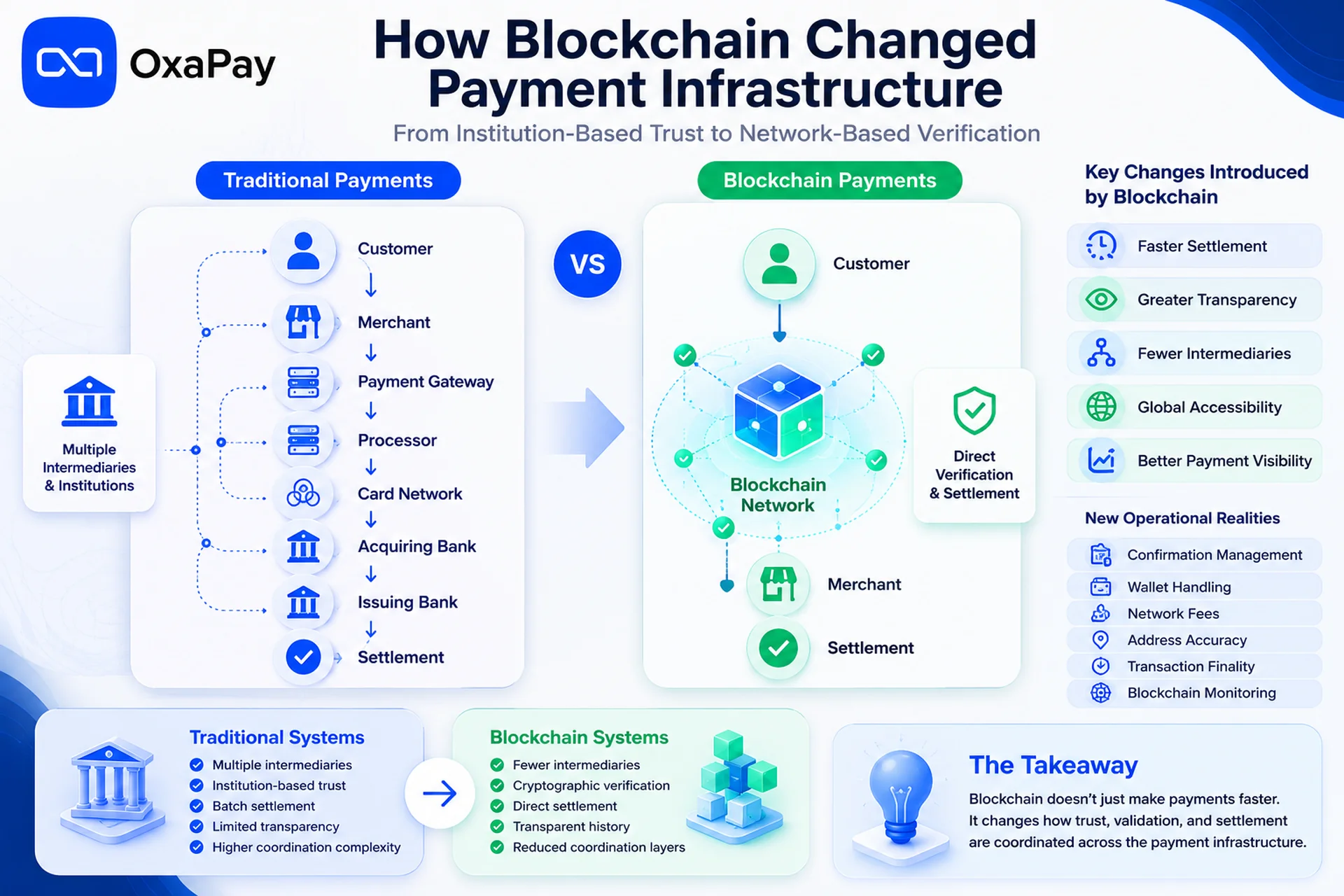
Traditional payment systems typically rely on multiple institutions working together to validate, process, and settle transactions. Payment gateways, processors, banks, card networks, and clearing systems each play a role in determining whether a payment can be trusted and completed.
Blockchain networks approach the same problem differently.
Instead of relying primarily on institutional coordination, transaction validation occurs directly on the network through cryptographic verification and distributed consensus. The network itself becomes part of the trust infrastructure.
This architectural shift changes several operational characteristics of payments, including:
- زمان Settlement
- تیransaction transparency
- infrastructure dependencies
- international accessibility
- payment visibility
- گردشکارهای تطبیق
In traditional systems, adding trust often means adding another intermediary. In blockchain systems, trust is increasingly established through network rules, cryptography, and shared verification mechanisms.
That does not mean blockchain payments eliminate operational complexity.
They simply move part of that complexity to different areas.
Businesses accepting blockchain payments must still manage:
- confirmation policies
- wallet operations
- کارمزدهای شبکه
- transaction finality
- address accuracy
- پایش بلاکچین
As a result, blockchain infrastructure is not necessarily simpler in every respect. Instead, it changes where complexity exists and who is responsible for managing it.
The most important difference is that payment validation, settlement, and transaction visibility become more directly connected to the network itself rather than a chain of financial intermediaries.
For businesses, this represents a fundamental shift in how payments are verified, monitored, and ultimately trusted.
نتیجهگیری
The most important thing to understand about how online payments work is that they are not simply transactions.They are infrastructure systems that coordinate authorization, processing, confirmation, settlement, and operational visibility behind the scenes.
As digital commerce continues to grow, businesses will increasingly choose payment solutions based not only on acceptance rates or supported payment methods, but on how effectively those systems support reliability, automation, scalability, and day-to-day operations.
For businesses exploring crypto payments, understanding this operational layer becomes even more important. Modern زیرساخت پرداخت کریپتو helps manage transaction states, confirmations, settlement workflows, and payment visibility while reducing much of the complexity traditionally associated with blockchain transactions.
If you’re looking to accept cryptocurrency payments through a payment system designed for operational efficiency, global accessibility, and real-time payment management, explore the crypto payment solutions available through درگاه کریپتوی OxaPay.