
Most explanations of Blockchain Technology start in the wrong place.
They start with Bitcoin. Or cryptocurrency. Or digital payments.
But blockchain technology was never fundamentally about moving money.
Money was simply the first large-scale demonstration of a much deeper idea: how independent participants can maintain a shared system without relying on a central authority to decide what is true.
That is the real breakthrough.
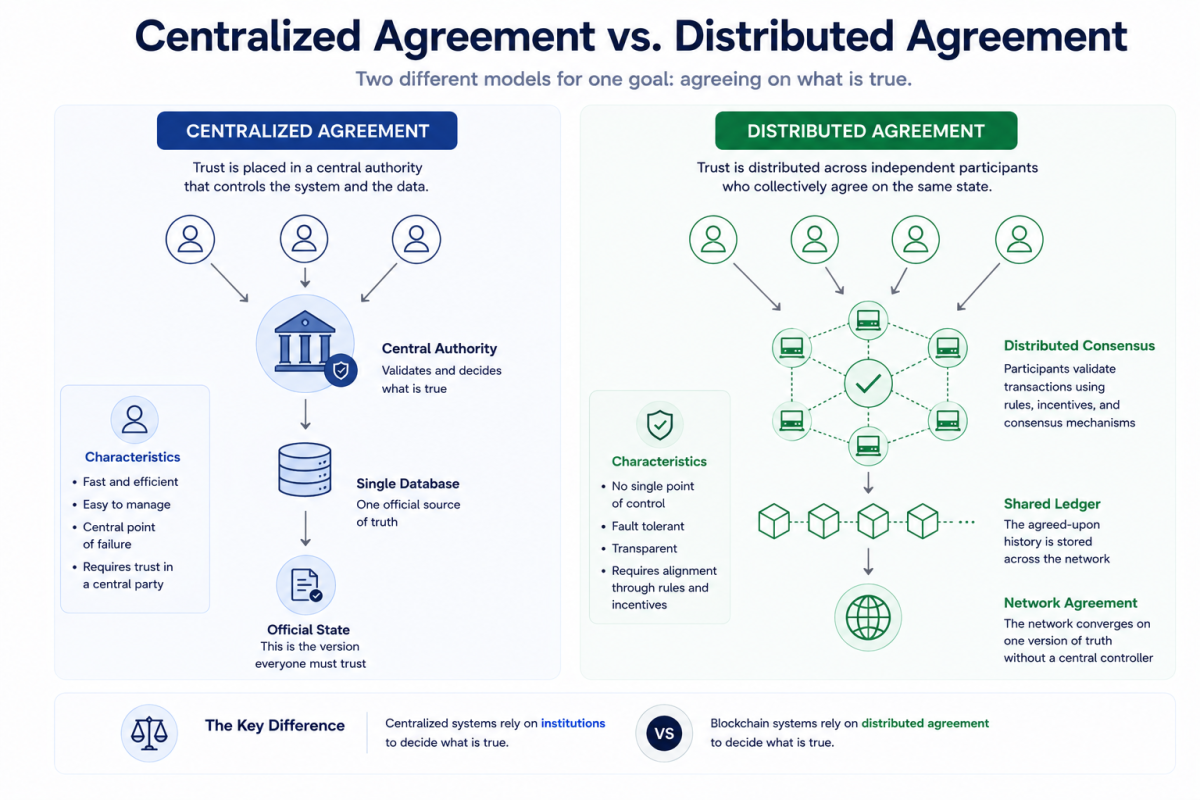
Before blockchain, digital systems almost always depended on a central coordinator. A bank maintained account balances. A company controlled a database. A platform decided which records were valid and which were not.
Blockchain changed the structure of agreement itself.
Instead of one institution maintaining the official version of reality, blockchain networks allow thousands of independent participants to continuously synchronize around the same transaction history through rules, cryptography, incentives, and distributed consensus.
This may sound abstract at first.
But once you understand this shift, blockchain stops looking like “a database with coins attached to it.” It starts looking like a new model for coordinating trust across the internet.
And that distinction changes everything.
Blockchain Is Not Just Storage
One of the biggest misconceptions about blockchain is the idea that it is mainly a storage technology.
It is not.
Databases already store information extremely well. In fact, traditional databases are usually faster, cheaper, and more efficient than blockchains.
If the only goal were storage, blockchain would often be a poor engineering decision.
The real challenge blockchain tries to solve is not storing information.
It is maintaining agreement about information between parties that do not fully trust each other.
That is a completely different problem.
A traditional database assumes someone controls the system.
A blockchain assumes nobody fully controls the system.
This forces the architecture to change dramatically.
Instead of trusting a central operator to validate actions, blockchain networks distribute verification across many participants. The network itself becomes responsible for determining:
- which transactions are valid
- which state changes are accepted
- which history becomes permanent
- which version of reality the system agrees on
This is why blockchain systems are expensive computationally.
They are constantly performing coordination, not just storage.

The Real Problem Blockchain Solves
To understand blockchain deeply, you first need to understand the problem it was built to solve.
The internet solved communication between computers.
Blockchain attempts to solve agreement between computers.
These are not the same thing.
Sending information across a network is relatively easy.
Ensuring every participant agrees on the same state of information without centralized trust is much harder.
Imagine thousands of computers distributed globally:
- none fully trust each other
- some may fail
- some may act maliciously
- some may go offline
- some may attempt fraud
- and yet all participants must eventually converge on the same transaction history
That is the actual problem blockchain addresses.
This challenge becomes even more difficult when the system manages scarce digital assets.
Digital information is naturally copyable.
Without coordination, digital money can be duplicated infinitely.
Before Bitcoin, this “double-spending problem” required centralized control.
A bank prevented the same funds from being spent twice because the bank controlled the ledger.
Blockchain introduced a radically different approach.
Instead of one institution maintaining the ledger, the network collectively maintains it.
Consensus replaces central authority.
Why Blocks Exist at All
Many people never ask an important question:
Why does blockchain even use blocks?
Why not simply record transactions continuously?
The answer is coordination efficiency.
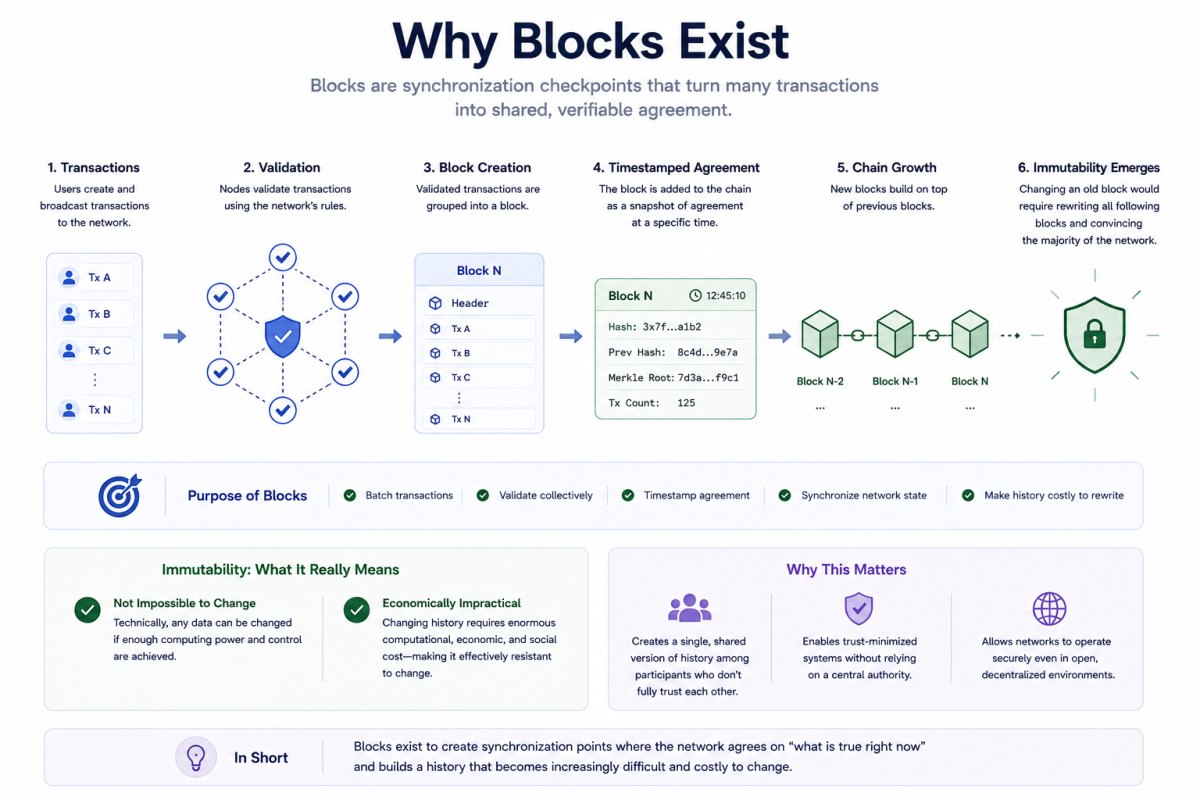
Networks need a mechanism to:
- batch transactions
- validate them collectively
- timestamp shared agreement
- and synchronize network state periodically
Blocks create these synchronization checkpoints.
Each block acts like a temporary agreement snapshot:
“These are the transactions the network currently accepts as valid.”
Once blocks are chained together chronologically, reversing history becomes increasingly difficult because changing older records would require redoing all subsequent agreement built on top of them.
This is where immutability actually comes from.
Not magic.
Not absolute permanence.
Immutability emerges because altering agreed history becomes computationally, economically, and socially impractical.
That distinction matters.
Blockchain data is not “uneditable” because technology forbids change.
It becomes effectively resistant to change because the cost of rewriting shared agreement becomes extremely high.
Consensus Is the Core of Blockchain
At the center of blockchain technology is consensus.
Consensus mechanisms determine how distributed participants agree on network state.
This is the true engine of blockchain systems.
Without consensus, blockchains collapse into disconnected databases with no reliable shared history.
Different blockchains solve this problem differently:
- Proof of Work
- Proof of Stake
- delegated systems
- hybrid systems
- Byzantine Fault Tolerance variations
But all of them are attempting to answer the same question:
How can distributed participants agree on one valid history without centralized control?
This is why blockchain is fundamentally interdisciplinary.
It combines:
- distributed systems engineering
- cryptography
- networking
- game theory
- economics
- incentive design
- and adversarial security
Most technologies only need to function under normal conditions.
Blockchain systems must continue functioning even when participants actively attempt manipulation.
That changes how everything is designed.
Blockchain Is Slow on Purpose
One of the most misunderstood aspects of blockchain is performance.
People often ask:
“Why are blockchains slower than centralized systems?”
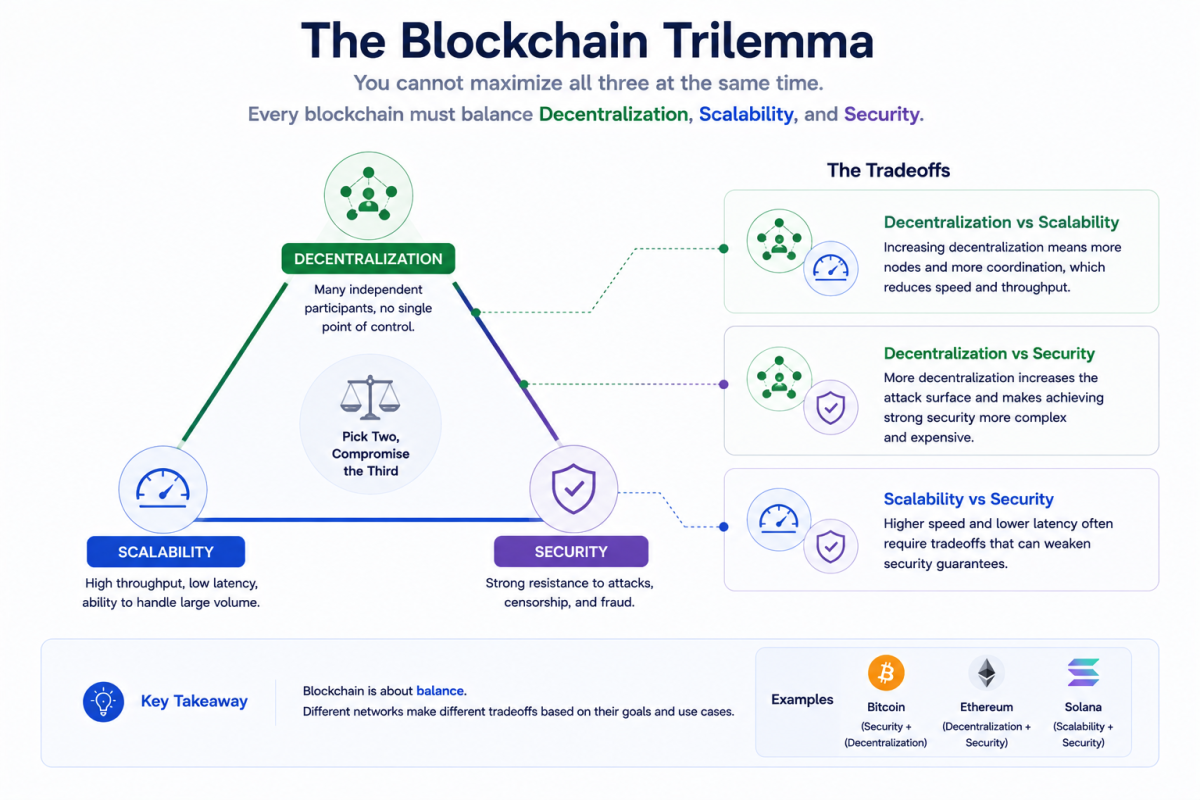
Because decentralization has costs.
Centralized systems are fast precisely because one authority controls coordination.
Blockchain systems intentionally sacrifice speed and efficiency in exchange for:
- censorship resistance
- distributed verification
- fault tolerance
- and reduced dependency on centralized trust
Every additional validator, node, or verification layer increases coordination complexity.
This means blockchain scalability is not simply an engineering optimization problem.
It is fundamentally a tradeoff problem.
You cannot maximize simultaneously:
- decentralization
- scalability
- and security
This tension is often called the blockchain trilemma.
And it explains why blockchain architecture evolves slowly compared to traditional software systems.
The Blockchain Trilemma: Security, Scalability, and Decentralization
Transparency Changes System Behavior
Blockchain systems are also structurally transparent.
Transactions, balances, contract activity, and state transitions are often publicly observable through blockchain explorers.
This creates a very different operational environment compared to traditional finance or centralized applications.
Transparency affects:
- auditing
- trust assumptions
- risk analysis
- market behavior
- security models
- governance dynamics
But transparency does not automatically create simplicity.
In fact, blockchain transparency often exposes complexity that traditional systems normally hide behind institutions.
Users suddenly see:
- mempool congestion
- confirmation delays
- validator behavior
- fee competition
- chain reorganizations
- liquidity fragmentation
- and settlement uncertainty
Traditional systems abstract these problems away internally.
Blockchain systems expose them directly to participants.
This is one reason blockchain initially feels confusing to newcomers.
The system reveals coordination mechanics that centralized platforms usually conceal.
Smart Contracts Expanded the Meaning of Blockchain
Bitcoin demonstrated distributed monetary coordination.
Smart contracts expanded blockchain into programmable coordination.
This changed blockchain from:
“a network that records payments”
into:
“a network that executes shared logic.”
Ethereum smart contracts were the major turning point.
Instead of merely validating balances, blockchain systems could now execute applications whose rules were enforced directly by network consensus.
This transformed blockchain from a payment system into an execution environment.
The implications were enormous:
- decentralized finance
- tokenization
- DAOs
- stablecoins
- on-chain identity
- digital ownership systems
- programmable marketplaces
- autonomous infrastructure layers
Whether all of these use cases ultimately succeed is still debated.
But the architectural shift itself was historically important.
Blockchain stopped being only about money.
It became a model for distributed state execution.
Blockchain Does Not Eliminate Trust
One of the biggest myths around blockchain is the phrase:
“trustless system.”
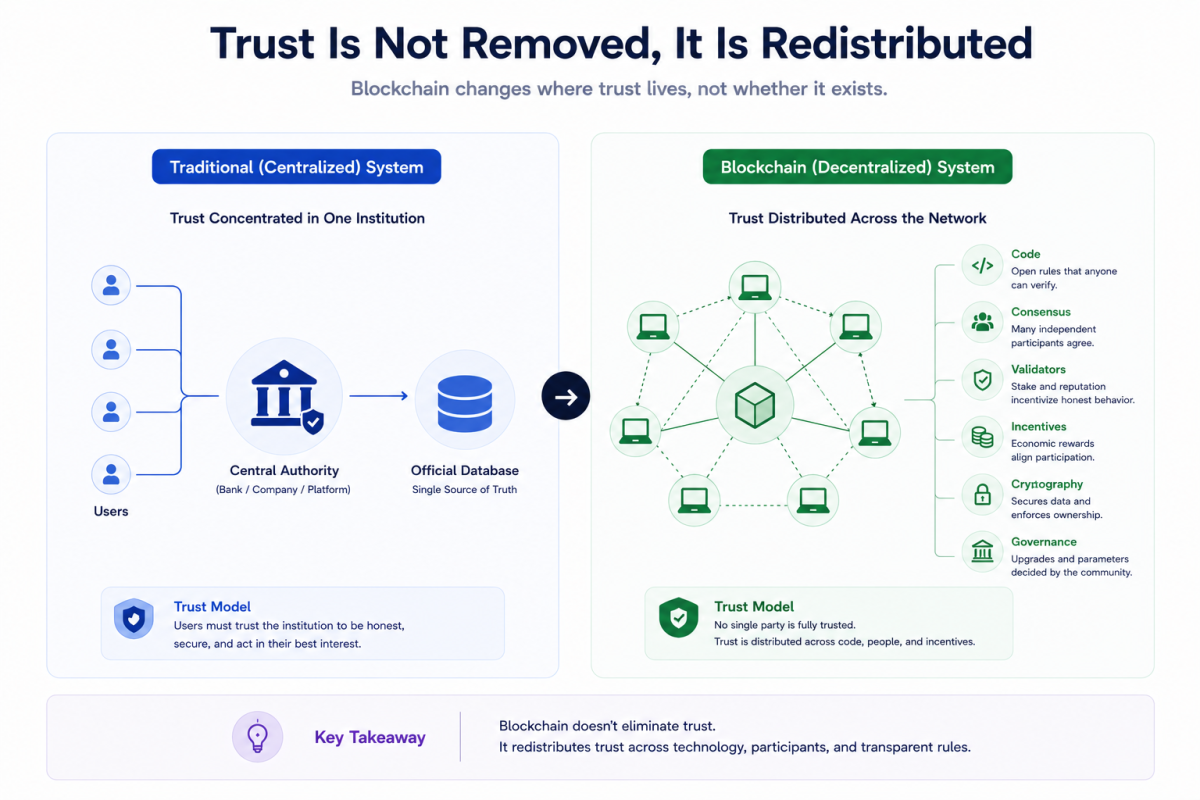
In reality, blockchain does not eliminate trust.
It redistributes trust.
Traditional systems concentrate trust inside institutions.
Blockchain systems distribute trust across:
- code
- consensus rules
- cryptography
- economic incentives
- validator behavior
- and network participation
Users still trust:
- protocol design
- client implementations
- governance processes
- developers
- validator incentives
- and infrastructure providers
The difference is not “trust vs no trust.”
The difference is where trust is placed and how power is distributed.
This is a much more accurate way to understand blockchain systems.
Most Industries Do Not Need Blockchain
This is another uncomfortable but important truth.
Not every system benefits from blockchain.
In many cases, a centralized database is simply better:
- faster
- cheaper
- easier to maintain
- easier to govern
- easier to scale
Blockchain only becomes valuable when decentralization itself creates meaningful advantages.
Usually this happens when:
- multiple parties need shared state
- trust between participants is limited
- censorship resistance matters
- global coordination matters
- ownership portability matters
- or centralized control creates systemic risk
Without these conditions, blockchain often introduces unnecessary complexity.
This is why many “blockchain projects” fail conceptually.
They add decentralized architecture to problems that never required decentralized coordination in the first place.
At its deepest level, blockchain technology is a system for maintaining shared reality across distributed participants.
That may sound philosophical, but technically it is accurate.
The network continuously answers questions like:
- What transactions happened?
- In what order?
- Which balances are valid?
- Which state transitions are accepted?
- Which history becomes canonical?
Every blockchain is essentially a machine for producing agreement under uncertainty.
That is the real innovation.
- Not coins.
- Not speculation.
- Not hype.
The deeper contribution of blockchain technology is the idea that large groups of independent participants can coordinate around shared state without requiring a single institution to permanently control the system.
That is why blockchain matters historically, even beyond cryptocurrency itself.
Conclusion
Blockchain technology is often misunderstood because people focus on its surface-level applications rather than the underlying coordination model it introduced.
At its core, blockchain is not merely a payment technology or a distributed database. It is a system designed to maintain shared agreement across independent participants operating without centralized trust.
Everything else, blocks, tokens, confirmations, validators, and smart contracts, exists to support that goal.
Once this becomes clear, blockchain stops looking like a mysterious financial trend and starts looking like something much deeper: a new architecture for distributed coordination in digital systems.
To better understand how these systems behave operationally in real transactions, you can also read this guide on how blockchain payments work.