Payment Confirmation and Finality Systems
Learn how payment infrastructure separates transaction visibility, block inclusion, confirmation, protocol finality, and business acceptance. See how merchants decide when a blockchain payment is reliable enough for the next action.
Confirmation is a confidence threshold, not a universal block count
A blockchain payment does not become operationally complete at one universal moment. First, the transaction becomes visible. It may then enter a block, gain confidence, reach a network-specific finality state, and satisfy the merchant’s payment policy.
These stages answer different questions. Detection asks whether the system has seen a candidate transaction. Confirmation asks how strongly the network supports its current position. Finality asks how difficult or exceptional reversal has become. Business acceptance asks whether the payment is safe enough for a specific commercial action.
This article owns that decision boundary. It explains how network confidence becomes operational finality. For the wider transaction-to-payment model, start with پرداختهای بلاکچینی: از تراکنش شبکه تا پرداخت کسبوکار. The underlying agreement layer is covered in How Blockchain Consensus Shapes Payment Infrastructure.
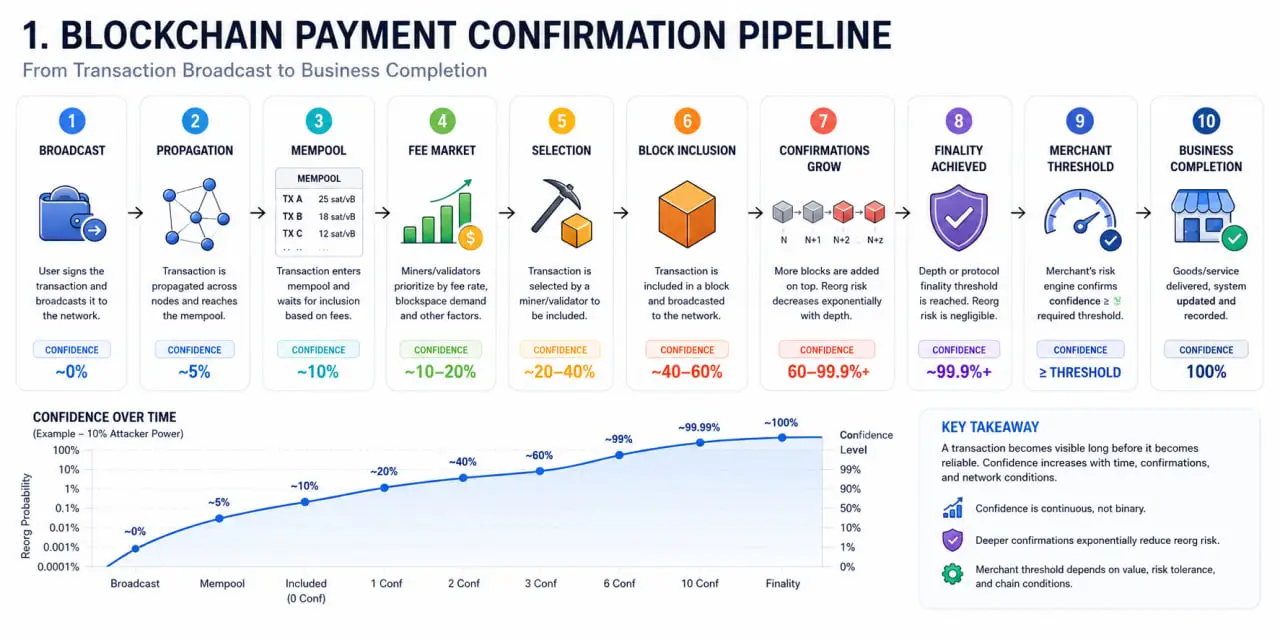
Visibility, inclusion, confirmation, finality, and acceptance are different states
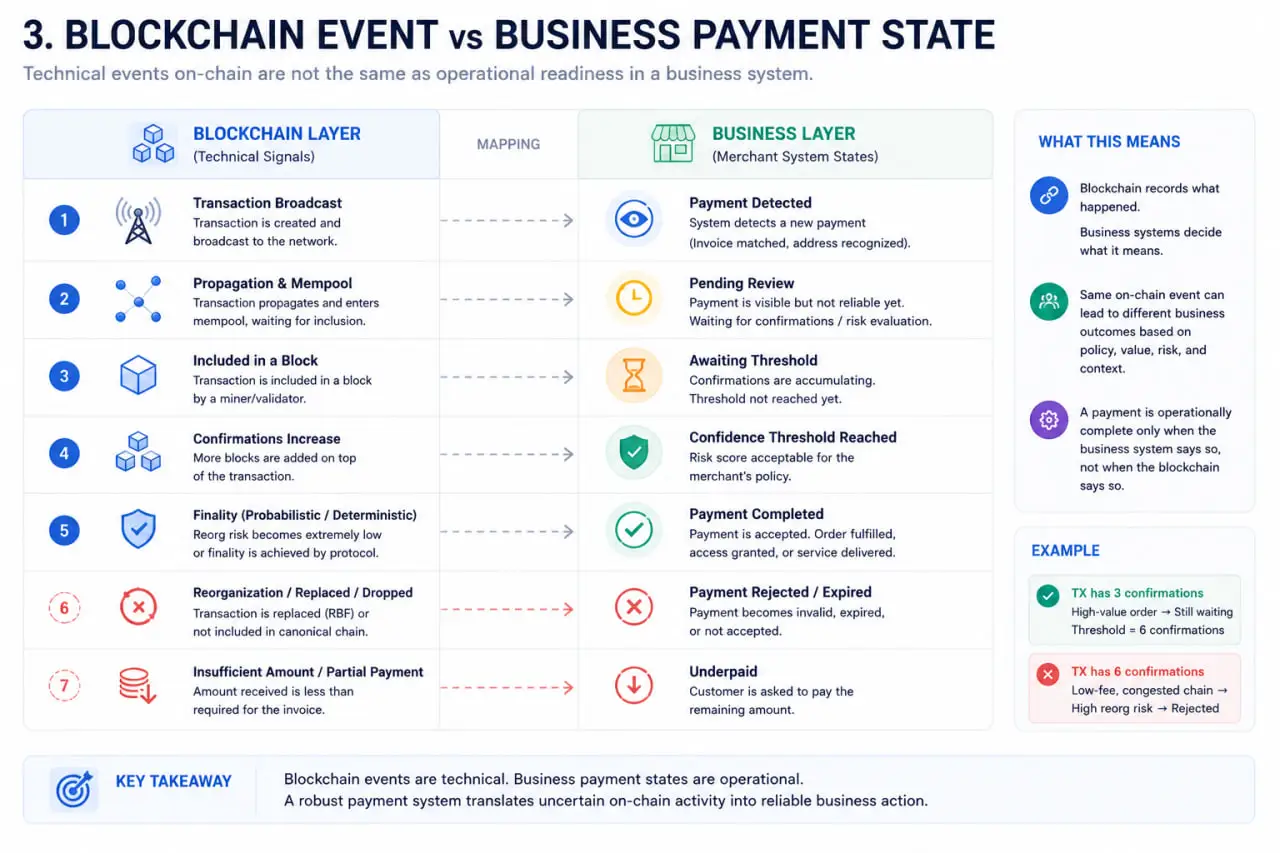
The word “confirmed” is often used too broadly. A wallet, explorer, node, gateway, and merchant dashboard may use different labels for different confidence levels. A robust system therefore defines its own state meanings instead of relying on one interface label.
The payment intent exists, but the network may not have accepted or propagated it.
Detection improves user feedback, but an unconfirmed transaction may still be replaced, dropped, or delayed.
Inclusion is stronger than mempool visibility, but early chain history may still change.
The exact meaning depends on the chain: depth, validator votes, commitment level, or another protocol signal.
Reversal now requires an exceptional consensus failure, economic attack, or violation of the stated trust model.
Amount, asset, network, timing, order match, risk tier, and fulfillment policy have all been evaluated.
This separation also prevents a common support problem. A customer may correctly say that the transaction is visible, while the merchant system correctly keeps the payment pending. The two systems are reporting different states, not necessarily conflicting facts. The simpler terminology behind these labels is explained in OxaPay’s guide to وضعیت تراکنش کریپتو.
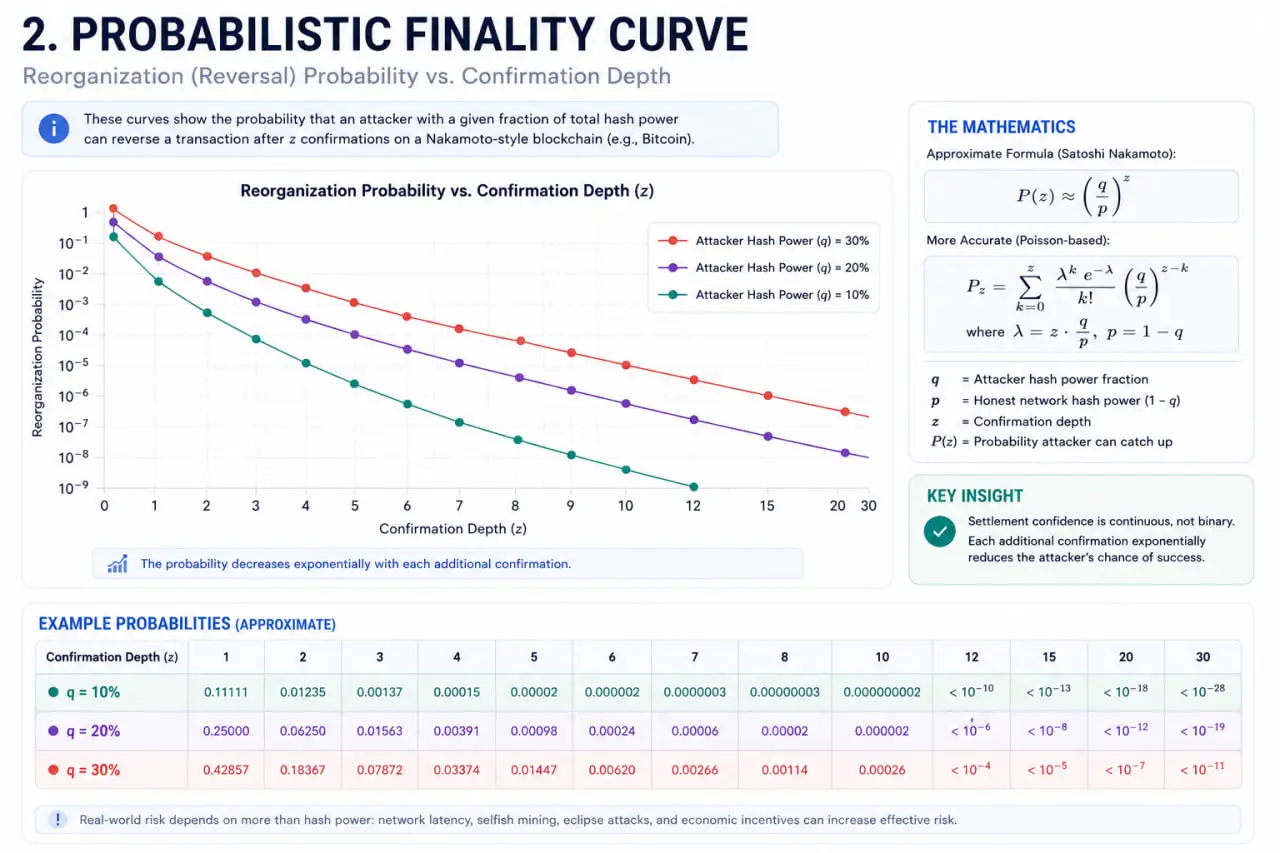
Confirmation primarily protects against unstable or competing transaction history
In a chain-based system, nodes can briefly disagree about the latest accepted history. Two valid blocks may be proposed near the same time. Network participants then follow the protocol’s fork-choice and finality rules until one history becomes canonical.
A reorganization replaces one recent branch with another. A transaction may move to a different block, return to the mempool, or disappear from the accepted chain if a conflicting spend becomes canonical. Confirmation depth and finality signals reduce this risk.
Bitcoin uses accumulating proof of work. The analysis in the Bitcoin whitepaper shows that an attacker’s chance of catching up declines as the honest chain advances. This decline is not a reason to use one fixed number for every payment. It explains why deeper history generally provides stronger confidence.
Unconfirmed Bitcoin transactions require even more caution. Bitcoin Core documentation explains that mempool contents are local and non-permanent, and transactions from stale blocks can return to the mempool. The official Bitcoin P2P network guide is a useful reference for this behavior.
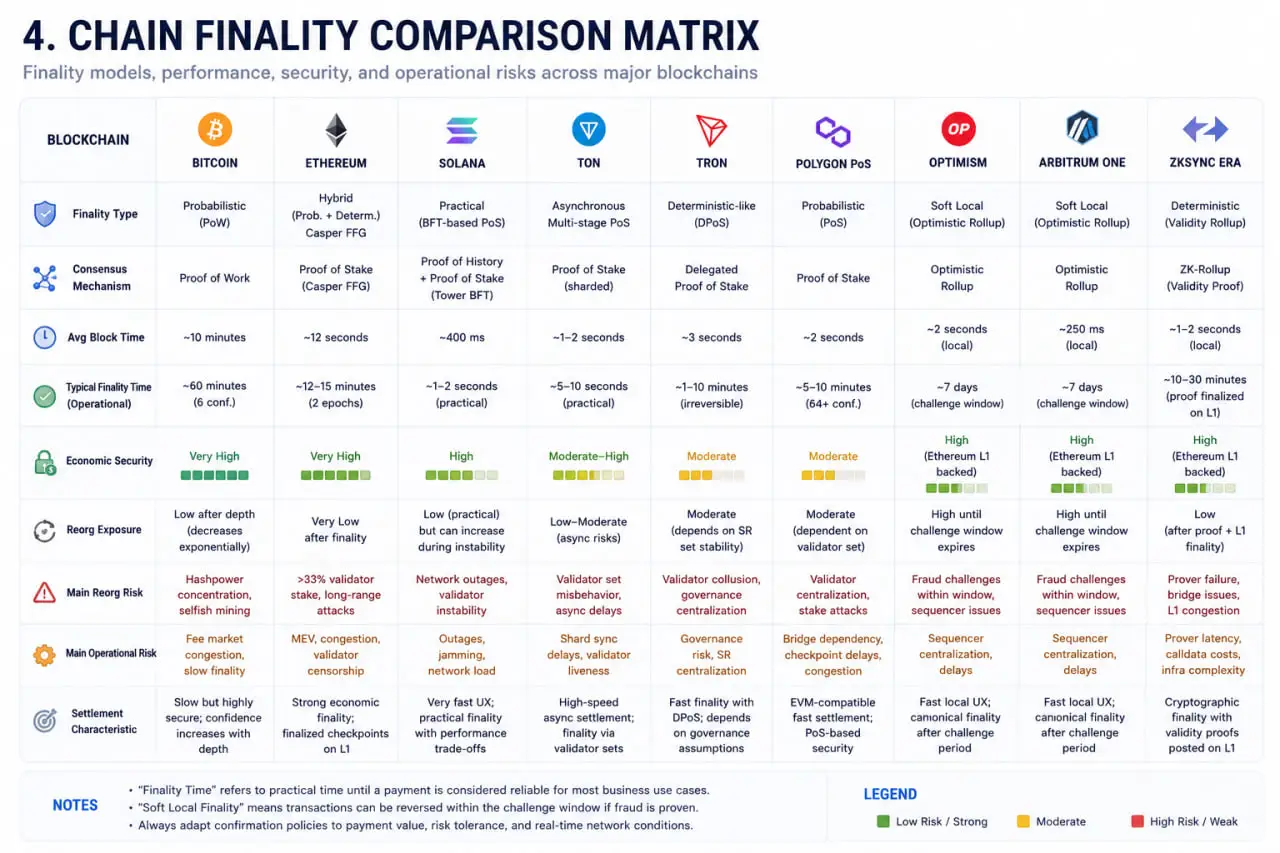
Different networks create confidence in fundamentally different ways
“Finality” is not one mechanism. It is the strongest irreversibility claim a network can make under its own protocol and trust assumptions. Payment infrastructure must understand what produced that claim before mapping it to a merchant decision.
Reversal becomes less likely and more expensive, but the protocol does not expose one absolute instant of finality.
Reverting finalized history requires severe protocol failure, large economic loss, or violation of the validator assumptions.
Sequencers, batches, data publication, parent-chain finality, bridges, or proofs may create several confidence stages.
Ethereum combines fork choice with checkpoint finality. Its official Gasper documentation explains how a two-thirds supermajority link justifies and finalizes checkpoints. Ethereum therefore distinguishes a recent chain head from stronger “safe” and “finalized” states.
Finality still depends on stated assumptions. Ethereum describes it as crypto-economic security because reverting finalized history would require destroying a substantial share of staked ETH. This is stronger than ordinary inclusion, but it is not magic or institutional chargeback protection.
A multi-chain payment system must translate different confidence languages
Networks expose confidence through different terms and data structures. The payment system must map each one into consistent merchant states without pretending that the underlying guarantees are identical.
| شبکه | Early signal | Stronger signal | Operational interpretation |
|---|---|---|---|
| Bitcoin | Mempool visibility or first block inclusion | Increasing confirmation depth | Confidence is probabilistic and should scale with payment exposure. |
| Ethereum | Recent head or ordinary inclusion | Safe and finalized checkpoints | Finalized is a stronger crypto-economic guarantee than recent inclusion. |
| Solana | Processed | Confirmed and finalized | Processed is fast feedback, but it can still be dropped during forks. |
| تن | Pending or confirmed trace state | Masterchain-referenced finality | The system must track asynchronous messages and the final trace result. |
Solana’s official payment verification guidance separates processed, confirmed, and finalized states and warns that a processed transaction can still be dropped during forks. TON’s payment processing documentation explains that transaction finality follows inclusion through the masterchain reference.
The correct confirmation threshold depends on the loss the business could suffer
A merchant does not need the strongest possible finality for every payment. It needs enough confidence for the action being authorized. Waiting longer can reduce network risk, but it can also damage checkout completion, activation speed, and customer trust.
The policy should therefore begin with business exposure, not a copied chain convention. The most important inputs are payment value, reversibility, customer history, asset and network, current chain health, and the cost of a false acceptance.
Higher values usually justify stronger finality and more conservative exception handling.
Reversible actions can accept earlier states more safely than irreversible delivery.
Confirmation depth, validator commitment, liveness, and reorg indicators should match the chain.
Instant access, retail checkout, B2B settlement, and treasury transfers have different latency requirements.
Underpayment, wrong asset, expiry, duplicate payment, or wrong network remain separate from finality.
This is why “six confirmations” is not a universal rule. It became a familiar Bitcoin convention for deeper confidence, not a requirement that every merchant must apply to every order. A low-value, reversible credit and a high-value, irreversible B2B delivery should not share the same policy.
The merchant-side planning behind these choices is covered in the Merchant Guide to Crypto Payments.
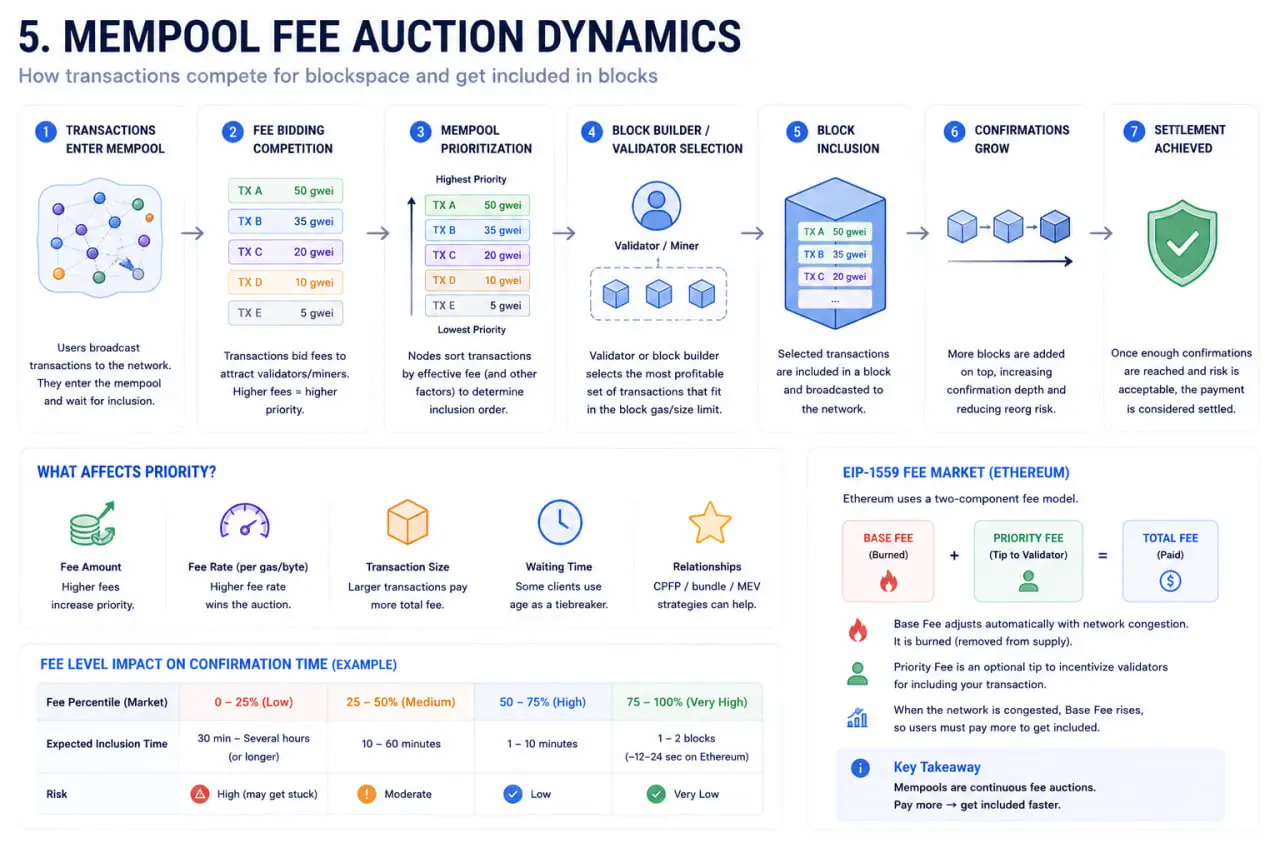
Mempool detection improves feedback, but it does not create settlement
Fast payment experiences often show “payment detected” before block inclusion. This is useful because customers receive immediate feedback. It is also risky if the same state triggers fulfillment.
Mempools are local policy environments, not a single global waiting room. Nodes may see different transactions. An unconfirmed transaction may have a weak fee or disappear from a node’s pool. It may also conflict with another spend or be replaced under network rules.
Fee conditions influence inclusion timing, but they are not finality. A competitive fee can increase the chance of prompt inclusion. It cannot prove that the transaction matches the order or should be treated as complete. For a focused explanation, see Mempool Explained and OxaPay’s analysis of transaction delays.
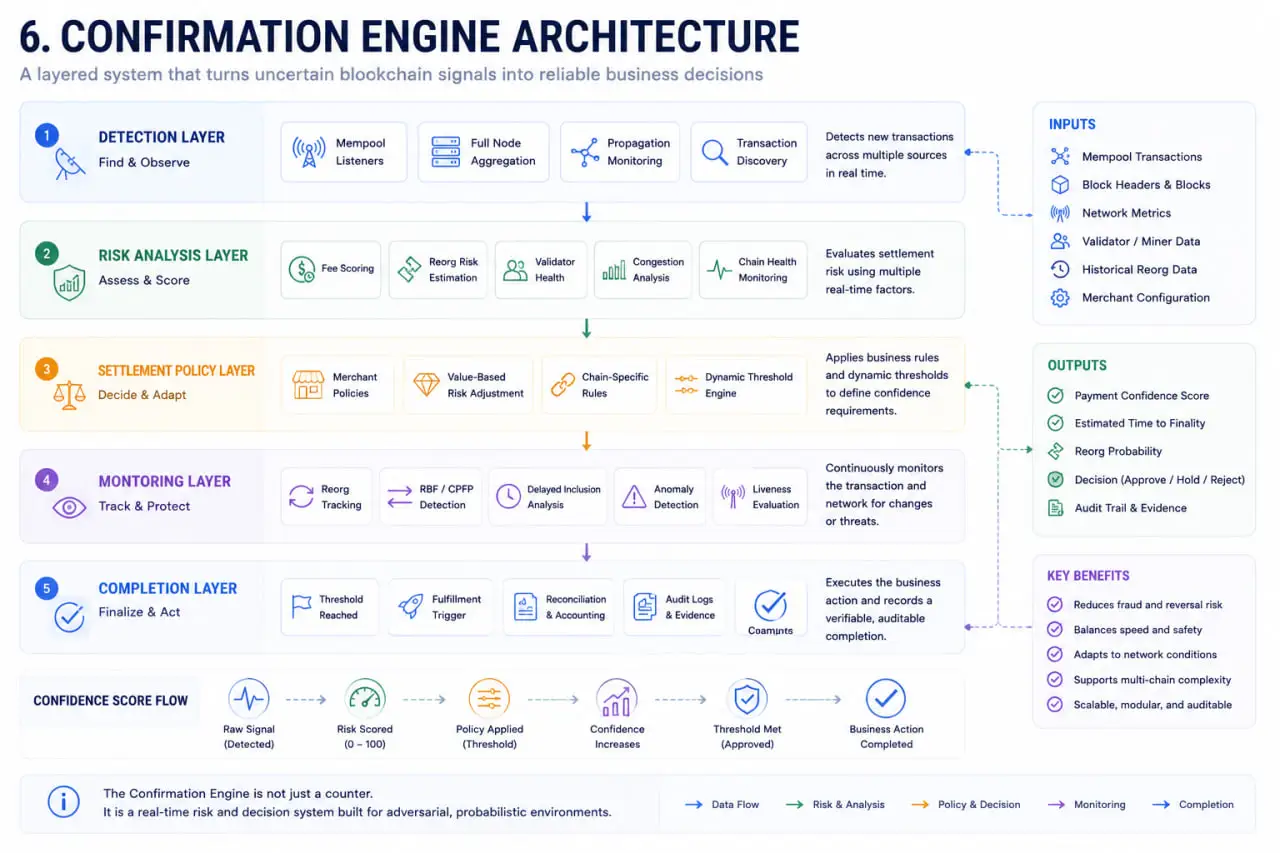
A confirmation engine translates protocol evidence into one controlled decision
A production payment system should not read one explorer label and trigger an order. It needs a chain-aware process that collects evidence, verifies the expected payment, applies merchant policy, and records why the state changed.
Use reliable nodes or providers and preserve the source and timestamp of each observation.
Do not flatten processed, included, safe, finalized, and depth-based states into one ambiguous label.
A final transaction can still be the wrong payment for the merchant’s request.
Value tiers, reversibility, chain health, and exceptions determine the required confidence.
Repeated polling results or webhook retries must not create duplicate fulfillment.
The observation layer is explored in پایش لحظهای در سیستمهای پرداخت بلاکچینی. That article owns node diversity, event collection, missed updates, and recovery. A separate Payment State Machines analysis should own the full state-transition model. This article focuses on the confidence decision between them.
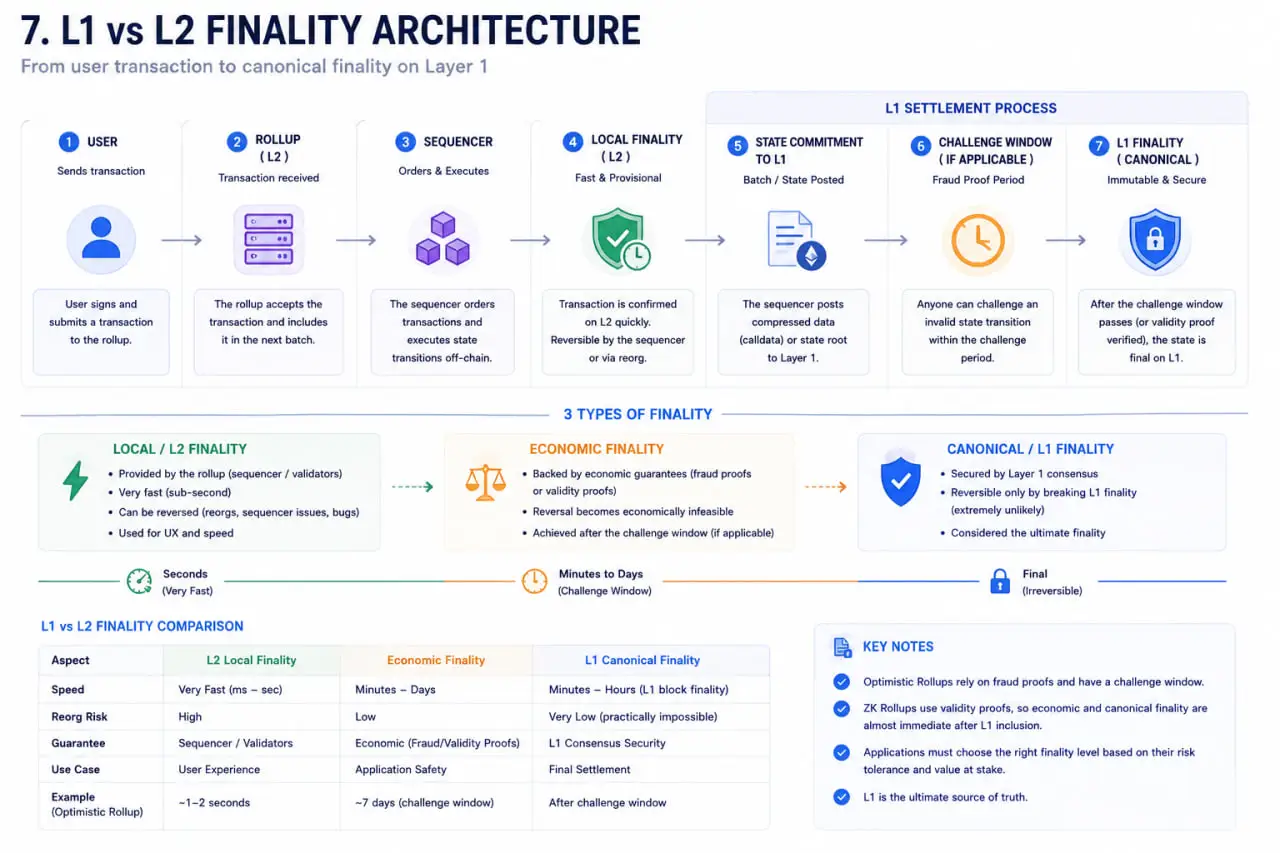
Layer-2 payments can have fast local confirmation and slower inherited finality
A rollup transaction may receive an immediate sequencer response, later become part of a batch, and finally inherit settlement confidence from its parent chain. These are separate stages with different trust assumptions.
Optimism documents unsafe, safe, and finalized transaction states. Its transaction flow documentation defines three useful stages. Unsafe transactions are processed but not yet written to Layer 1. Safe transactions are written to Layer 1 but remain exposed to an L1 reorganization. Finalized transactions are anchored in finalized L1 history.
Arbitrum similarly distinguishes fast sequencer-based soft finality from stronger finality after data is posted and finalized on the parent chain. The official Arbitrum sequencer documentation describes the provisional nature of the real-time feed and its dependence on sequencer integrity.
The same transaction state can justify different actions in different businesses
The system can display detected immediately, credit provisionally after a defined threshold, and restrict withdrawal until stronger finality.
The merchant may require stronger confirmation because the download or license cannot be recovered easily.
The payment may require finalized network state, exact invoice matching, manual evidence review, and treasury confirmation.
Detection can start picking and packing, while shipment waits for the required confidence threshold.
A fully finalized transaction may still need a top-up, refund, new quote, or manual review.
Better status communication also reduces perceived delay. OxaPay’s article on payment confirmation and conversion explains the customer-experience value of fast, clear feedback. The operational safeguard is to communicate early detection without presenting it as irreversible completion.
OxaPay exposes payment states so merchants can connect network progress to operations
Building every chain adapter, confirmation rule, payment matcher, notification path, and retry mechanism internally creates significant operational work. OxaPay provides payment interfaces that let merchants create structured payment requests and receive status changes without exposing customers to the underlying chain complexity.
راهنمای Generate Invoice API supports an amount, currency, lifetime, order ID, acceptable underpayment coverage, mixed payment behavior, and a callback URL. These fields help define the commercial context that blockchain confirmation alone cannot provide.
در OxaPay، مستندات webhook OxaPay distinguishes an early paying update from the later paid status. It also documents HMAC validation and delivery retries. Merchant systems should
process those updates idempotently and return the required successful response only after
the event has been handled safely.
The payment request establishes what a valid business payment must match.
Redirects support user experience. Server-to-server status updates support operations.
The integration should prevent duplicate effects and log every state change.
Teams building custom flows can review the OxaPay Merchant API documentation. Businesses evaluating the complete operating model can use the Crypto Payment System guide.
Use this framework before allowing a payment to trigger irreversible action
If not, finality only makes the wrong payment permanent.
Preserve the chain-native signal instead of relying on a generic “confirmed” label.
Finality delay, reorgs, sequencer downtime, provider disagreement, or liveness problems may require a hold.
Use stronger thresholds when loss is large, recovery is difficult, or downstream funds can move immediately.
Idempotency, event logs, reconciliation, and manual override rules are part of confirmation reliability.
The strongest policy is not always the slowest. A strong policy uses the minimum confidence that safely supports the action, then communicates the current state clearly. This preserves conversion without hiding risk.
Use protocol documentation for finality claims and OxaPay resources for implementation
Finality terminology changes across networks and can evolve through protocol upgrades. The following primary sources should be used when defining or reviewing confirmation policies:
Useful for probabilistic security, chain competition, mempool behavior, and stale-block handling.
Useful for checkpoints, supermajority links, fork choice, justification, and crypto-economic finality.
Useful for processed, confirmed, and finalized commitment levels.
Useful for asynchronous payment processing, trace validation, and masterchain-referenced finality.
Useful for soft, safe, and parent-chain finality assumptions.
For OxaPay implementation details, continue with the API فاکتور, مستندات webhook OxaPay، و Crypto Invoice service.