OxaPayBlog : Aperçu des passerelles de paiement Crypto

Payment Confirmation Systems

Payment Confirmation Systems | OxaPay Deep Insights
OxaPay Deep Insights

Payment Confirmation Systems

From blockchain signals to operational finality, this deep insight explains how modern crypto payment infrastructure transforms transaction visibility, confirmation depth, fee-market behavior, chain-specific finality, adversarial risk, and merchant policy into reliable business payment decisions.

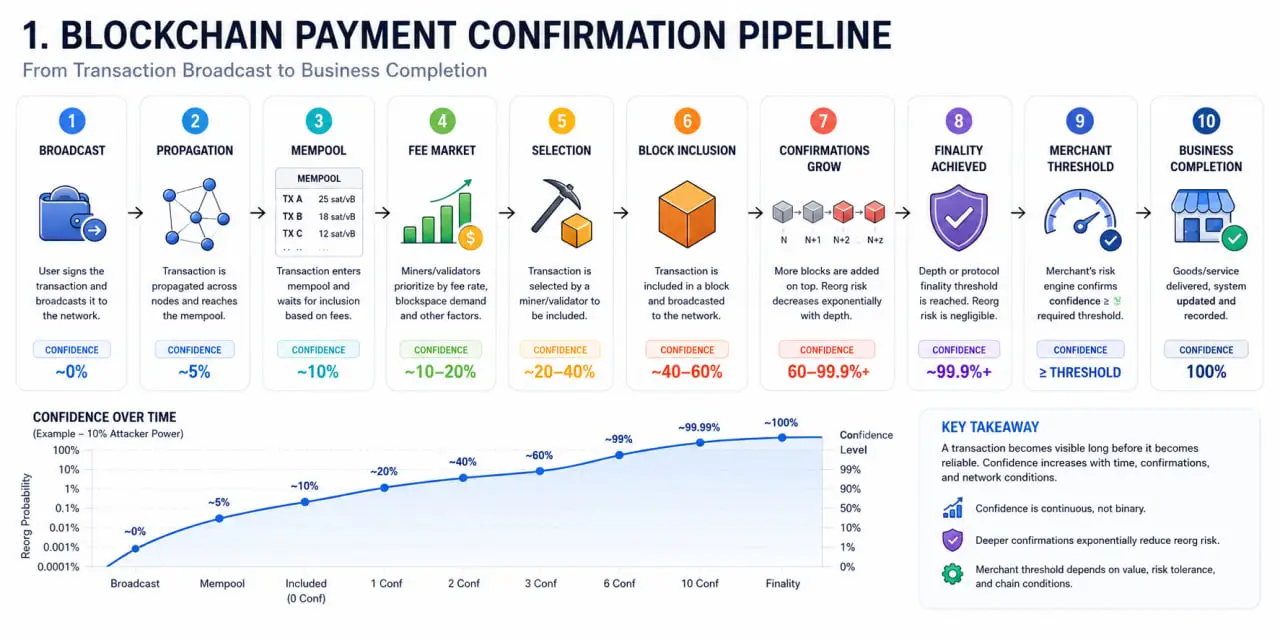
Blockchain payment confirmation pipeline showing transaction broadcast, mempool detection, fee evaluation, block inclusion, confirmation depth, finality, and business completion

A confirmation pipeline separates transaction visibility from operational completion. A payment moves through detection, propagation, fee evaluation, block inclusion, confirmation depth, finality assessment, and business approval before it becomes safe for fulfillment.

Strategic Framing: From Blockchain Signals to Operational Finality

Blockchain payments are often described as confirmed once a transaction enters a block. In practice, payment confirmation systems are far more complex than that. A blockchain records distributed network agreement, but a business must still determine what that agreement means operationally.

For a merchant, the real question is never only whether the blockchain confirmed the transaction. The real question is whether this payment is reliable enough for the action the business is about to take.

That distinction changes the entire architecture. A blockchain event is a technical signal. A payment confirmation system is the business interpretation, probabilistic risk evaluation, adversarial analysis, and operational decision layer built on top of that signal.

A blockchain can say that a transaction exists. A payment system must decide whether the transaction should trigger fulfillment, account activation, invoice completion, reconciliation, or manual review.

Confirmation Is a Business Problem, Not Only a Blockchain Problem

Traditional payment systems rely on centralized authorities such as banks, card networks, settlement institutions, and payment processors. These systems define whether a payment is approved, whether settlement is final, whether a payment can be reversed, and whether fraud intervention should occur.

Blockchain systems work differently. Consensus emerges from validator coordination, mining incentives, distributed cryptographic verification, economic game theory, and probabilistic or deterministic finality mechanisms rather than institutional authority.

This creates a fundamentally different operational challenge: a payment may become visible long before it becomes trustworthy.

Centralized Payment Logic

Approval and settlement are interpreted by banks, processors, card networks, clearing systems, and institutional rules.

Blockchain Payment Logic

Settlement confidence emerges from consensus, block production, validator or miner incentives, fee markets, and network propagation.

The gap between propagation, mempool visibility, block inclusion, settlement confidence, and operational finality is where confirmation systems become necessary.

A Blockchain Transaction Is Not Instantly Final

One of the most damaging misconceptions in crypto payments is assuming that transaction broadcast equals completed payment. That is not how blockchain systems work.

A transaction usually moves through several distinct stages. Each stage changes the confidence level of the payment, and confidence, not visibility, is what confirmation systems actually measure.

1
Transaction Signed Locally The user wallet creates and signs the transaction before it reaches the network.
2
Broadcast to Peers The wallet sends the transaction into the network, but not every observer sees it at the same time.
3
Network Propagation The transaction spreads across nodes, with visibility affected by latency, peer topology, and relay behavior.
4
Mempool Evaluation The transaction waits in mempool queues and competes inside fee markets for scarce blockspace.
5
Block Inclusion A miner or validator includes the transaction in a block, creating a stronger settlement signal.
6
Additional Confirmations More blocks or finality checkpoints increase confidence that the transaction will remain part of canonical history.
7
Operational Acceptance The merchant system decides whether the payment is reliable enough for the next business action.
A blockchain explorer may display a transaction seconds after broadcast. That does not mean the transaction is globally propagated, competitively priced, irreversible, or operationally safe.
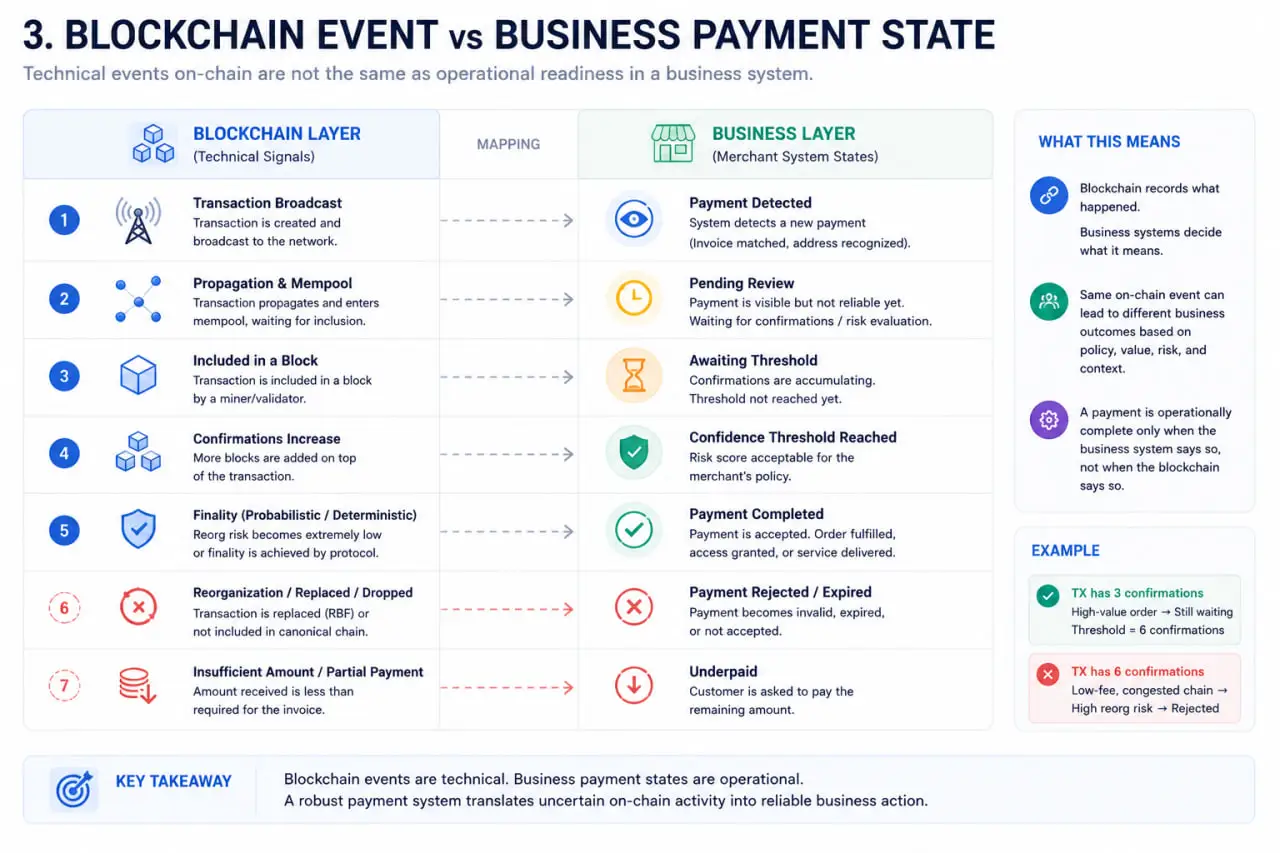
Blockchain event vs business payment state showing transaction confirmation, confidence threshold, underpaid state, reconciliation state, and operational completion

The blockchain may describe a transaction as confirmed, while the merchant system may still classify the payment as pending review, underpaid, awaiting reconciliation, or below the required operational threshold.

Visibility Does Not Equal Reliability

A confirmation engine separates network activity detected from payment considered operationally reliable. This distinction becomes critical in ecommerce, SaaS activation, gaming, API monetization, treasury settlement, exchange deposits, OTC transfers, and automated fulfillment systems.

Acting too early introduces financial risk. Waiting too long introduces operational friction. Modern confirmation systems exist to balance those forces dynamically.

Detected

The transaction is visible, but may still be weakly propagated, underpriced, replaceable, or exposed to competing states.

Fiable

The transaction has passed the merchant’s confidence threshold based on confirmations, finality, amount, timing, risk, and policy.

A good confirmation system does not simply ask whether a transaction exists. It asks whether the transaction can safely become a business state.

Confirmation Systems Are Probabilistic Risk Engines

A confirmation system is fundamentally a probabilistic settlement engine. Its purpose is not simply delaying fulfillment. Its purpose is estimating how difficult, expensive, or improbable it would be for this payment state to change under current network conditions.

This is especially important in Nakamoto-style consensus systems where finality is probabilistic rather than absolute. In these systems, confidence increases as confirmation depth grows, but it does not become perfectly binary at a single block height.

Let:

q = attacker hash power fraction
p = 1 - q
z = confirmation depth

Approximate probability that an attacker catches up after z confirmations:

P(z) ≈ (q / p)^z
Poisson-based formulation:

Pz = Σ(k=0 to z) [(λ^k × e^-λ) / k!] × (q / p)^(z-k)

Where:

λ = z × (q / p)
These equations form part of the theoretical foundation behind Bitcoin finality, but they should not be used as the only operational risk model for merchant payment decisions.
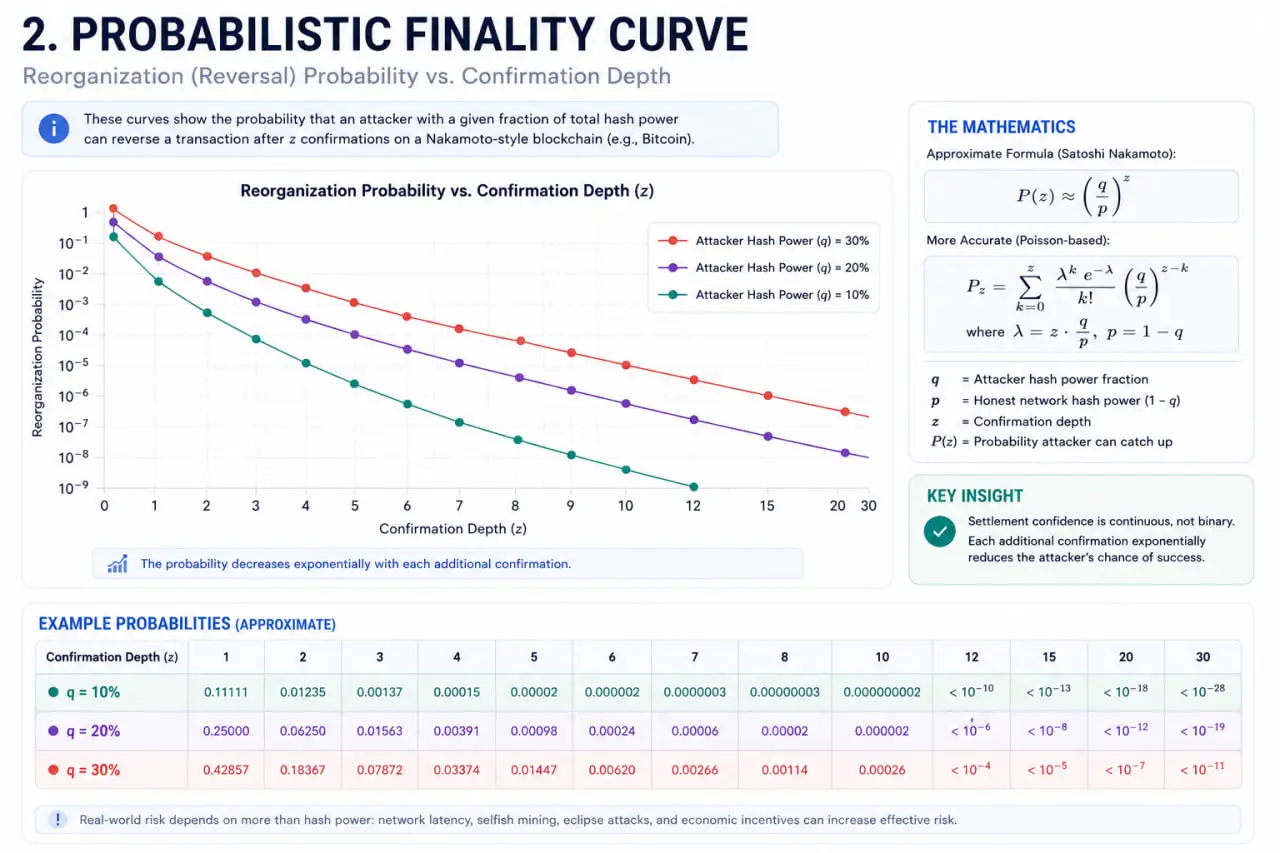
Probabilistic finality curve showing reversal probability decreasing as blockchain confirmation depth increases

Settlement confidence is continuous. A transaction does not suddenly become safe. Its reversal probability declines as confirmation depth increases, while operational confidence depends on value, network health, and business policy.

The Limitations of Probabilistic Models

These models are useful, but they are not perfect representations of real-world settlement risk. They assume independent block discovery, neutral propagation conditions, static attacker behavior, homogeneous miner incentives, and stable network topology.

Real blockchain systems behave differently. Mining pools coordinate. Validator incentives shift dynamically. Latency varies geographically. Mempool visibility differs between nodes. Relay infrastructure affects propagation. MEV incentives influence ordering. Temporary hashpower concentration can emerge.

For example, q = 0.1 is often treated as a conservative attacker assumption. But modern attack environments may involve rented hashpower, validator cartels, bridge-focused attacks, short-term coordinated incentives, or economic rather than permanent attacker control.

Model-Based Risk

Uses simplified assumptions to estimate reversal probability from attacker share and confirmation depth.

Operational Risk

Includes chain health, propagation quality, fee pressure, validator behavior, MEV, infrastructure stability, and merchant exposure.

Mathematical finality and operational finality are not always identical. A merchant system must treat mathematical models as inputs, not as complete decision engines.

Reorganization Probability in Practice

Assuming an attacker controls 10% of total network hashpower, reversal probability falls as confirmation depth increases. The important insight is not the exact number. The important insight is that settlement confidence is continuous rather than binary.

ConfirmationsApproximate Reversal ProbabilityOperational Interpretation
1~20%Early signal, usually insufficient for high-value or irreversible fulfillment.
2~5%Confidence improves, but risk remains material for sensitive payments.
3~1.3%More reliable, but still depends on payment value and network conditions.
4~0.35%Usually stronger confidence, but not a universal completion rule.
6~0.024%Historically treated as deep confidence for Bitcoin-style settlement.
10Near negligibleVery strong confidence under normal security assumptions.
A transaction does not suddenly become safe. Its reversal probability declines asymptotically as confirmation depth increases.

Why Six Confirmations Became a Convention

Bitcoin popularized waiting for six confirmations. But six confirmations are not a protocol rule. They emerged historically because reversal costs rise sharply with depth, attacker economics become unfavorable, and deeper history becomes computationally expensive to reorganize.

Confirmation requirements should depend on payment value, network security, attack economics, settlement urgency, chain architecture, and current congestion conditions. A modern payment infrastructure should never apply identical confirmation thresholds universally.

Low-Value Retail Payment

May tolerate faster staged states if fulfillment is reversible or customer experience matters more than deep finality.

High-Value B2B Invoice

Usually requires stricter finality, deeper confirmation logic, audit trails, and reconciliation confidence.

Digital Product Access

Needs careful policy because access may be difficult to reverse once delivered.

Exchange Deposit

Requires stronger protection because accepted deposits can be moved, traded, or withdrawn quickly.

Confirmation Depth Is Really Reorg Resistance

Confirmation depth primarily protects against chain reorganizations, double-spend attacks, competing histories, and unstable settlement assumptions. Temporary competing versions of chain history may exist before consensus converges.

Deeper confirmations reduce the probability that another chain overtakes current history, the payment disappears from canonical history, or fulfillment occurs on unstable state.

Competing Chain Histories Chain A: Block 100 → Block 101 → Block 102 → Payment Included Chain B: Block 100 → Block 101b → Block 102b → Block 103b If Chain B becomes canonical, the payment state on Chain A may lose confidence.

Figure 1: Confirmation depth helps protect payment systems against competing chain histories and reorganization risk.

Confirmation depth matters most in proof-of-work systems, lower-security chains, congested periods, and economically attackable environments.

Reorganizations Are Not Theoretical

Confirmation systems exist because reorganizations and settlement instability actually happen. These events affect exchanges, wallets, merchants, payment gateways, and automated systems that must decide when a payment is reliable enough.

Ethereum Classic 51% Attacks

Attackers rented hashpower, privately mined alternative histories, released longer competing chains, and reversed previously accepted deposits.

Bitcoin Chain Splits

Bitcoin has experienced stale blocks, orphan blocks, temporary chain divergence, and accidental consensus splits.

Solana Outages

Network outages caused halted block production, degraded validator coordination, delayed visibility, and settlement ambiguity.

Ethereum Classic attacks led some exchanges to suspend deposits, delay withdrawals, and increase confirmation requirements dramatically. The operational lesson is direct: static confirmation thresholds fail when network security assumptions degrade.

Bitcoin’s 2013 chain split showed that even highly secure systems can temporarily disagree on canonical history. This highlighted the importance of node diversity, propagation quality, software compatibility, consensus coordination, and infrastructure resilience.

Solana revealed another category of confirmation risk: infrastructure instability. Applications had to distinguish delayed settlement from failed settlement, which requires monitoring liveness, validator participation, propagation health, and infrastructure stability alongside confirmation depth itself.

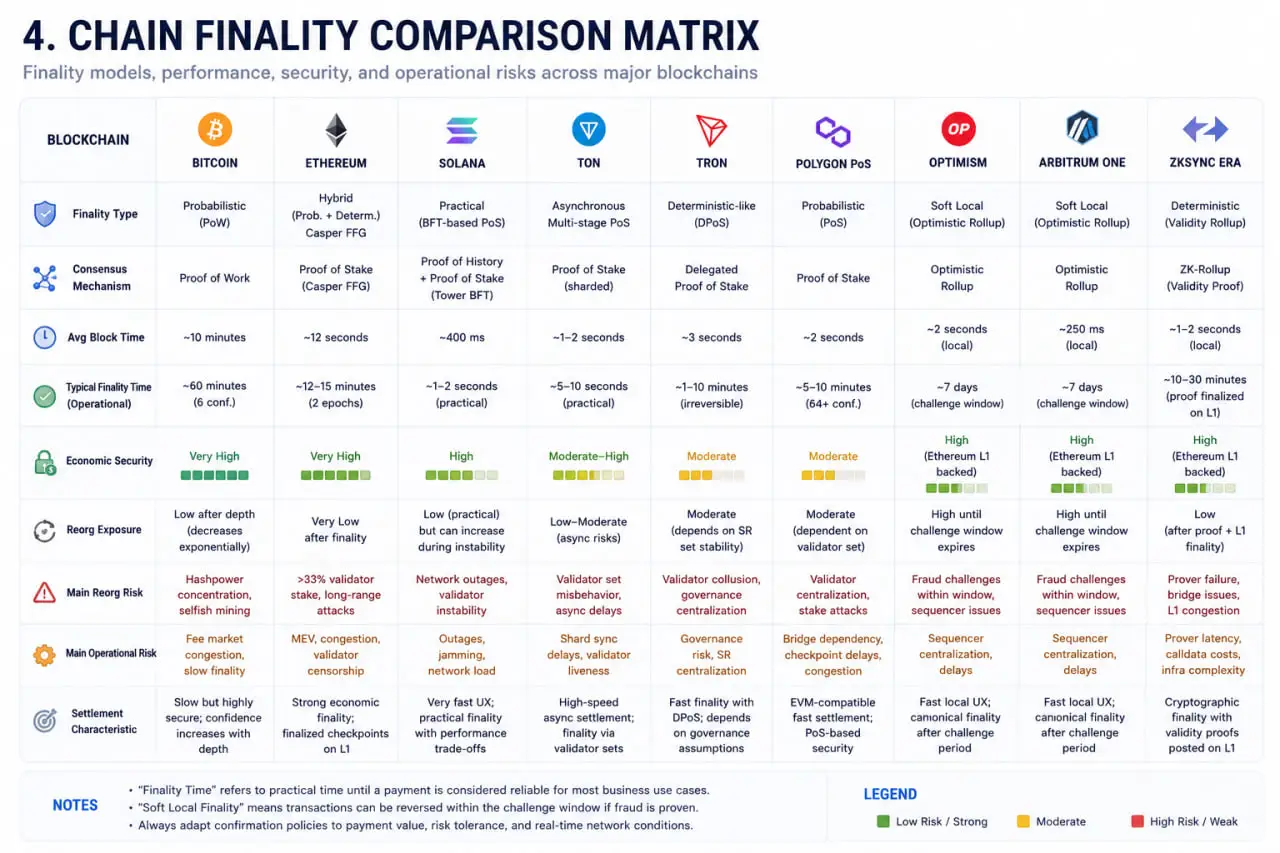
Chain finality comparison matrix comparing Bitcoin, Ethereum, Solana, TON, Tron, Polygon, Arbitrum, Optimism, and zkSync finality assumptions

Different networks finalize payments differently. Confirmation systems must account for block time, finality type, economic security, reorg exposure, sequencer assumptions, bridge risk, and infrastructure stability.

Probabilistic vs Deterministic Finality

Different blockchains finalize state differently. This distinction is foundational for payment confirmation systems.

Probabilistic Finality

Confidence increases gradually. Settlement improves asymptotically. Reversibility probability declines over time, but there is no absolute instant guarantee.

Deterministic Finality

Validator quorums finalize checkpoints. Finalized blocks become extremely difficult to revert, and settlement confidence changes more abruptly.

Bitcoin uses probabilistic finality. Ethereum’s Casper FFG combines probabilistic block production with deterministic economic finality. This changes how businesses evaluate settlement confidence operationally.

A payment system cannot treat every chain like Bitcoin, and it cannot treat every finality claim as equivalent.

Chain Confirmation Benchmark Comparison

No serious payment infrastructure uses identical confirmation logic across all chains. Different blockchains have different consensus systems, fee markets, validator assumptions, economic security models, reorg exposure, and settlement latency.

ChainFinality TypeAvg Block TimeTypical Finality TimeMain Operational Risk
BitcoinProbabilistic~10 min~60 min deep confidenceFee congestion, slow settlement, confirmation depth requirements.
EthereumHybrid deterministic~12 sec~12 to 15 minMEV, congestion, gas volatility, validator economics.
SolanaFast practical finality~400 msSecondesNetwork instability, liveness degradation, validator coordination.
TONNEAsync multi-stageSub-secondSecondesShard synchronization and async message interpretation.
TronDeterministic-like DPoS~3 sec~1 to 3 minValidator dependency and governance concentration.
PolygoneHybrid PoS~2 secMinutesBridge assumptions and security-layer dependency.
ArbitrumOptimistic rollup~250 ms localDays canonicalSequencer dependency and fraud-window assumptions.
OptimismeOptimistic rollup~2 sec localDays canonicalChallenge-window risk and sequencer assumptions.
zkSyncValidity-proof basedSecondesMinutesProver latency, proof publication timing, bridge finality.
Fixed confirmation counts are not enough for multi-chain payment systems. Each chain needs its own adapter, finality detector, and settlement policy.

Fee Markets Are Confirmation Systems

Confirmation reliability cannot be separated from economics. Transactions compete for scarce blockspace. Confirmation systems are therefore economic systems, auction systems, and incentive systems in addition to cryptographic systems.

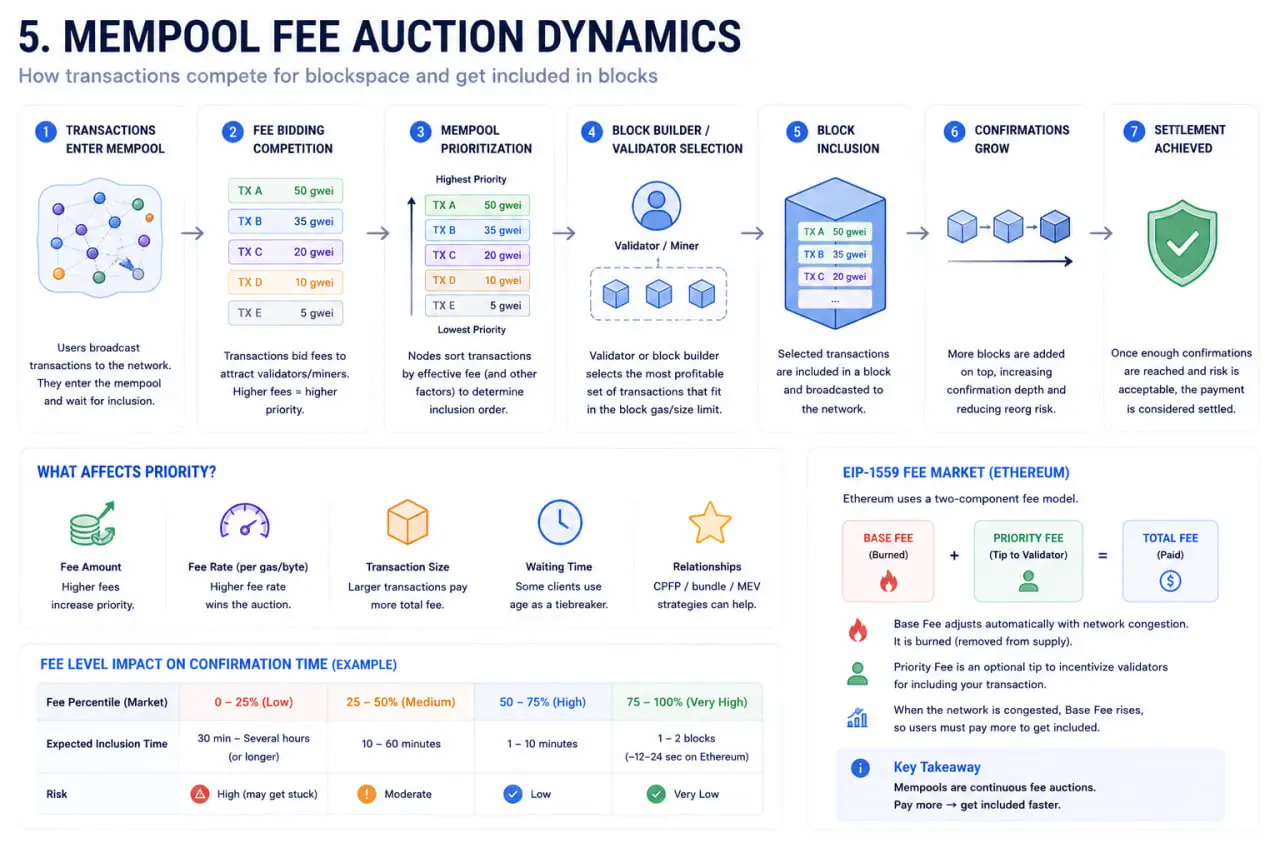
A mempool functions as a real-time auction market for limited blockspace. Transactions compete using fee competitiveness, urgency, profitability, and ordering incentives.

A weakly priced transaction may remain pending, become delayed, lose propagation priority, require replacement, or expire operationally. This directly affects customer experience, settlement timing, support workload, and merchant operations.

Fee Competitiveness

A transaction’s position relative to current fee percentiles affects how quickly it is likely to be included.

Operational Timeout

A payment may still be technically pending, but operationally expired if it exceeds the merchant’s time window.

Mempool fee auction dynamics showing transaction competition, blockspace demand, fee percentile, delayed payments, and confirmation priority

Mempools behave like continuous auctions. Fee rate, congestion, blockspace demand, transaction ancestry, and replacement behavior all influence confirmation probability and payment timing.

EIP-1559, RBF, CPFP, and Transaction Mutation

Ethereum’s EIP-1559 introduced base fees, priority fees, fee burning, and dynamic congestion adjustment. This changed validator behavior significantly. Validators now optimize around priority extraction, MEV opportunities, and ordering profitability.

Bitcoin settlement systems must also understand Replace-By-Fee and Child-Pays-For-Parent because transaction state can evolve after broadcast. A transaction can be replaced, accelerated, delayed, or reprioritized before it confirms.

EIP-1559

Introduces dynamic base fees and priority fees, making Ethereum confirmation behavior sensitive to congestion and validator economics.

Replace-By-Fee

Allows certain unconfirmed Bitcoin transactions to be replaced with higher-fee versions, affecting early confidence.

CPFP

Allows a related child transaction to raise the effective fee incentive for miners to include the parent transaction.

Modern monitoring engines track transaction ancestry, fee escalation, replacement signals, mempool mutation, and propagation quality rather than relying only on static confirmation counts.

Confirmation Systems Operate in Adversarial Environments

Blockchains are hostile economic environments. Confirmation systems defend against double-spend attacks, selfish mining, eclipse attacks, validator censorship, propagation manipulation, MEV ordering attacks, and spam congestion attacks.

A confirmation engine is continuously evaluating adversarial settlement risk, not only ordinary network progress.

Double-Spend Risk

A payment may appear valid while a conflicting transaction attempts to spend the same inputs or replace the same intent.

Validator Censorship

Transactions may be delayed or excluded due to validator behavior, policy filters, or ordering incentives.

Spam Congestion

Network congestion can degrade inclusion probability, increase fees, and create operational uncertainty.

Selfish Mining, Eclipse Attacks, and MEV Ordering Risk

Selfish mining allows attackers to privately mine hidden chains, selectively publish blocks, manipulate honest miner visibility, and influence settlement assumptions. This increases reorg probability, settlement ambiguity, and chain convergence instability.

In eclipse attacks, nodes become isolated, network visibility becomes manipulated, and false settlement assumptions emerge. Enterprise-grade systems therefore use geographically distributed nodes, independent mempool listeners, cross-node propagation verification, and multi-provider infrastructure instead of relying on a single network view.

Modern blockchains increasingly face MEV extraction, transaction reordering, sandwich attacks, and validator prioritization incentives. This means transaction inclusion order itself can become economically adversarial.

Confirmation depth helps, but it is not enough by itself. High-value settlement systems increasingly require ordering analysis, propagation monitoring, inclusion consistency verification, and adversarial signal detection.
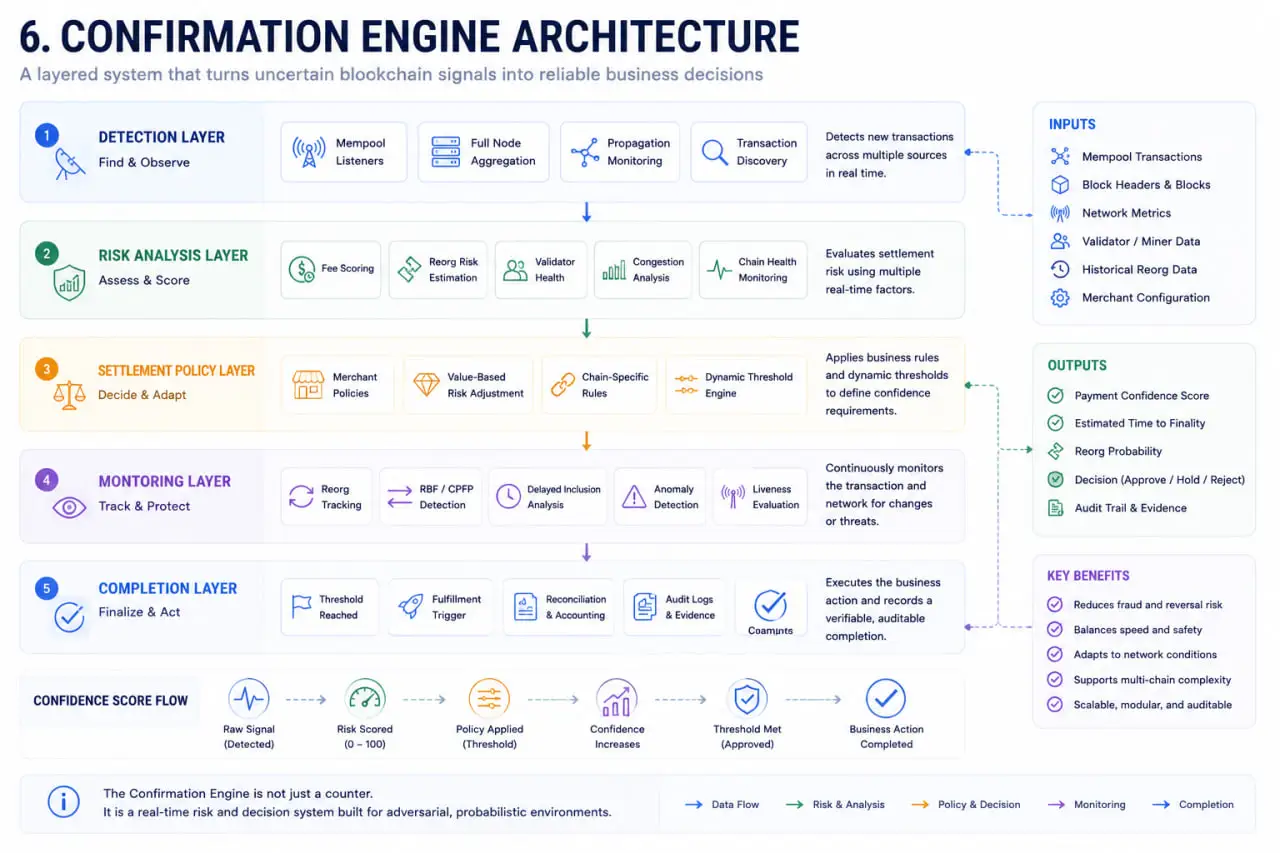
Confirmation engine architecture showing detection layer, risk analysis layer, settlement policy layer, monitoring layer, and completion layer

A confirmation engine is a layered system. Detection, risk analysis, settlement policy, monitoring, and completion logic work together to convert blockchain signals into reliable business outcomes.

Merchant Confirmation Engines

Real merchant systems rarely track only confirmed or unconfirmed. Modern infrastructures often use states such as invoice_created, payment_detected, propagating, pending_confirmation, confidence_threshold_reached, awaiting_finality, completed, expired, underpaid, overpaid, refunded, and failed.

The blockchain understands balances, signatures, and consensus. The merchant system must understand invoices, subscriptions, reconciliation, operational thresholds, fulfillment timing, and customer expectations.

Blockchain State │ ├── transaction detected ├── included in block ├── confirmation depth increased ├── finalized checkpoint reached │ ▼ Confirmation Engine │ ├── amount verified ├── confidence scored ├── risk evaluated ├── policy applied │ ▼ Business State ├── payment_detected ├── pending_confirmation ├── awaiting_finality ├── completed ├── underpaid ├── expired └── failed

Figure 2: The confirmation engine translates blockchain state into business state.

The confirmation engine becomes the translation layer between blockchain consensus and merchant operations.

Confirmation Engine Architecture

Enterprise-grade confirmation systems are typically layered architectures rather than single scoring functions. Each layer has a specific responsibility and contributes to operational reliability.

1
Detection Layer Responsible for mempool listening, node aggregation, propagation monitoring, and transaction discovery.
2
Risk Analysis Layer Responsible for fee scoring, reorg probability estimation, validator participation analysis, congestion analysis, and chain health monitoring.
3
Settlement Policy Layer Responsible for merchant-specific thresholds, value-sensitive risk adjustment, chain-specific rules, and dynamic settlement requirements.
4
Monitoring Layer Responsible for reorg tracking, RBF detection, delayed inclusion analysis, anomaly detection, and liveness evaluation.
5
Completion Layer Responsible for fulfillment triggers, reconciliation, audit logging, operational completion, and payment-state communication.
This layered architecture is significantly more sophisticated than simple confirmation counting.

Mempool Detection Changed Merchant UX

Modern systems increasingly use mempool detection before confirmation because users expect immediate feedback. Waiting for full confirmation before displaying payment detected creates uncertainty and often increases abandonment or support requests.

The right model separates detection, confidence, settlement, and completion into independent operational stages.

1
Transaction Detected in MempoolThe system sees a candidate payment signal.
2
Propagation Quality EvaluatedThe system checks whether the transaction is visible across enough independent sources.
3
Fee Competitiveness ScoredThe system estimates inclusion likelihood under current blockspace demand.
4
Confirmation Depth MonitoredThe system tracks inclusion, depth, and chain stability.
5
Finality Threshold ReachedThe payment satisfies chain-specific and merchant-specific confidence rules.
6
Business Settlement ApprovedThe merchant system marks the payment operationally complete.

Quantifiable Confirmation Metrics

Modern confirmation systems monitor measurable operational metrics. These metrics enable adaptive settlement policies instead of static assumptions.

MétriqueMeaning
Time-to-finalityEstimated duration until operationally acceptable settlement.
Reorg probabilityEstimated likelihood that the settlement state could reverse.
Confirmation varianceStability of confirmation timing across recent network conditions.
Mempool residencyTime the transaction spends waiting before inclusion.
Propagation delaySpeed of network-wide transaction visibility.
Validator participationCurrent consensus health and participation level.
Fee percentileRelative inclusion priority compared with current fee market conditions.
Stale or orphan rateFrequency of discarded competing blocks or unstable chain branches.
Liveness scoreOperational health of the network or settlement layer.
Inclusion latencyTime between transaction detection and block inclusion.

Dynamic Confirmation Risk Engines

Modern infrastructures increasingly score transactions dynamically. Inputs may include confirmation depth, fee competitiveness, validator participation, mempool congestion, transaction value, propagation quality, chain health, reorg history, and adversarial indicators.

Settlement therefore becomes risk-weighted rather than binary.

def evaluate_payment(tx):

    confidence = 0

    confidence += tx.confirmations * chain.confirmation_weight

    if tx.fee_percentile > 0.75:
        confidence += 15

    if chain.validator_participation > 0.9:
        confidence += 12

    if chain.reorg_risk == "low":
        confidence += 20

    if tx.propagation_quality == "high":
        confidence += 10

    if tx.detected_rbf:
        confidence -= 30

    if chain.liveness_degraded:
        confidence -= 25

    if tx.value_usd > merchant.high_value_threshold:
        confidence *= 0.65

    return max(0, min(confidence, 100))
Real production systems are usually more complex and continuously adaptive. This simplified example only shows the principle: confirmation is a confidence model, not just a block counter.
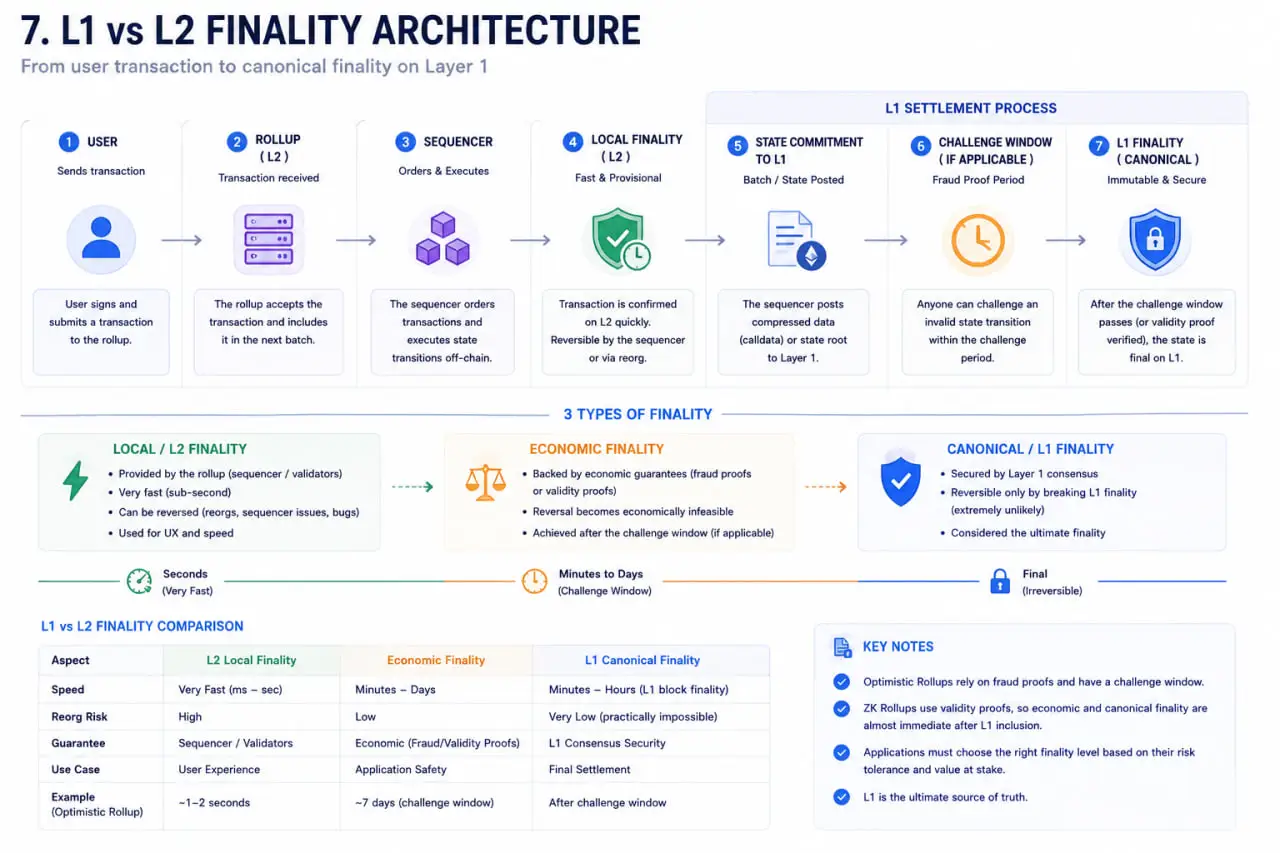
L1 vs L2 finality architecture showing local rollup confirmation, sequencer assumptions, challenge windows, validity proofs, bridge settlement, and L1 finality

Layer-2 systems introduce layered finality. A payment may appear settled locally while still depending on sequencers, challenge windows, validity proofs, bridge assumptions, data availability, and L1 settlement.

Layer-2 Confirmation Systems

Layer-2 systems introduce additional settlement complexity. A transaction may appear settled locally while still depending on sequencer behavior, challenge windows, L1 settlement guarantees, bridge assumptions, proof publication, or data availability.

Rollups optimistes

Assume validity unless challenged. This creates soft local finality, delayed canonical finality, fraud-proof dependency, and sequencer trust assumptions.

ZK Rollups

Use validity proofs instead of challenge periods. They reduce some uncertainty while introducing proof generation latency and prover infrastructure dependency.

Bridge Settlement

Cross-domain payment flows may depend on bridge synchronization, message passing, withdrawal windows, and settlement confirmation across layers.

Sequencer Dependency

Local confirmation may depend on a sequencer before canonical settlement is fully anchored on the base layer.

For merchants, a payment may appear operationally complete on a Layer-2 while still not being canonically finalized on the base layer.

Modular Blockchain Settlement

Modern modular architectures separate execution, sequencing, settlement, and data availability. This fundamentally changes confirmation systems because settlement confidence may depend on more than one domain.

Modular Settlement Stack Execution Layer │ Sequencing Layer │ Data Availability Layer │ Settlement Layer │ Bridge or Cross-Domain Messaging │ Merchant Confirmation Policy

Figure 3: Modular architectures require payment systems to evaluate confirmation across multiple infrastructure domains.

Settlement confidence may depend on DA availability, shared sequencers, bridge synchronization, asynchronous settlement coordination, and cross-domain ordering assumptions.

Future payment systems will increasingly require multi-domain confirmation logic rather than single-chain assumptions.

Shared Sequencers and Cross-Domain Finality

Emerging modular ecosystems introduce shared sequencing, interoperable rollups, fragmented settlement domains, and asynchronous bridging. This creates new confirmation challenges.

Conflicting Local Finality

Different domains may show different levels of confidence at the same time.

Bridge Synchronization Delays

A payment-related event may be locally accepted before cross-domain settlement is complete.

Cross-Domain Ordering

Settlement logic may need to account for ordering inconsistencies between multiple execution or settlement domains.

Confirmation systems are evolving from single-chain settlement engines into multi-domain distributed settlement coordinators.

AI-Driven Confirmation Systems

Future confirmation systems will increasingly use predictive risk scoring, telemetry analysis, anomaly detection, adaptive settlement thresholds, and probabilistic forecasting.

Instead of static rules, systems will continuously adapt to congestion, validator behavior, attack probability, settlement volatility, and network instability.

Predictive Risk Scoring

Estimates whether a transaction is likely to confirm quickly, remain pending, require replacement, or become operationally unsafe.

Anomaly Detection

Identifies unusual propagation, fee behavior, validator instability, reorg patterns, or suspicious ordering activity.

Adaptive Thresholds

Adjusts confirmation requirements based on chain health, payment value, business model, and current risk conditions.

Confirmation engines are gradually becoming real-time distributed risk intelligence systems.

Blockchain Events vs Business State

One of the most important realizations for merchants is that a blockchain event is not automatically a business state.

The blockchain may say transaction confirmed. The merchant system may still say awaiting review, insufficient confidence, underpaid, awaiting reconciliation, or pending operational threshold.

The Blockchain Describes

  • network agreement
  • transaction inclusion
  • confirmation depth
  • validator or miner consensus

The Payment System Describes

  • invoice status
  • amount correctness
  • reconciliation state
  • fulfillment readiness
The blockchain describes network agreement. The payment system describes operational meaning. These are not the same thing.

Confirmation Systems Become Critical at Scale

Small businesses may manually review occasional payments. Large infrastructures cannot. At scale, thousands of concurrent payments, multiple chains, Layer-2 settlement, asynchronous bridges, webhook retries, mempool volatility, validator instability, and adversarial conditions all require automated confirmation infrastructure.

This is where confirmation systems evolve from checking the blockchain into operating a real-time payment reliability engine.

High Volume

Manual inspection cannot handle thousands of concurrent payment states across networks.

Prise en charge multi-chaînes

Each network requires different finality assumptions, monitoring logic, and policy thresholds.

Operational Automation

Fulfillment, reconciliation, customer updates, and support visibility depend on reliable state transitions.

How OxaPay Fits This Confirmation Layer

For merchants, building confirmation infrastructure from scratch requires blockchain monitoring, transaction detection, chain-specific rules, risk scoring, payment-state management, webhook delivery, retries, reconciliation, and operational completion logic.

OxaPay helps merchants work with this complexity through structured crypto payment tools such as payment links, invoices, Merchant API flows, payment status tracking, and webhook-based payment updates that connect blockchain activity with merchant systems.

Factures

Useful when each payment needs amount control, expiration timing, transaction tracking, and status visibility.

Useful for simple payment collection flows where users need a clear payment page and merchants need reliable status updates.

API marchande

Useful when payment confirmation must connect directly to order systems, dashboards, balances, fulfillment logic, or automated services.

Webhooks

Useful for receiving structured payment status changes as payments move from detection to confirmation and completion.

The business value of confirmation infrastructure is not only knowing that a transaction exists. It is knowing when that transaction is reliable enough to become a business action.

Practical Takeaways / Checklist

A practical confirmation system should help a merchant answer one operational question: what is safe to do next?

Separate Detection from Completion

Do not treat transaction visibility, mempool detection, block inclusion, confirmation depth, and business completion as the same state.

Use Chain-Specific Rules

Bitcoin, Ethereum, Solana, TON, Tron, Polygon, rollups, and ZK systems require different finality assumptions.

Adjust by Payment Value

High-value, irreversible, or sensitive payments should require stronger confidence than low-risk payments.

Watch Fee Competitiveness

A transaction with weak fees may be visible but unlikely to confirm within the merchant’s operational window.

Monitor Reorg and Liveness Risk

Confirmation policy should account for reorg history, validator participation, outages, stale blocks, and degraded network health.

Handle Underpaid and Overpaid States

Amount correctness must be evaluated separately from transaction existence and confirmation depth.

Keep Payment State Idempotent

Repeated events, webhook retries, or delayed updates must not trigger duplicate fulfillment or duplicate accounting entries.

Log Every State Transition

Merchants should be able to reconstruct why a payment moved from detected to pending, completed, expired, underpaid, or failed.

The safest confirmation policy is not always the slowest one. The best policy is the one that fits the chain, the payment value, the business model, and the action being triggered.

Scientific and Protocol References

Foundational references for confirmation systems include protocol papers, consensus research, fee-market research, rollup documentation, MEV research, and operational blockchain security studies.

These references matter because confirmation systems are distributed systems problems, economic coordination problems, consensus-engineering problems, and operational reliability problems, not merely payment UX problems.

Final Perspective: Confirmation Is Operational Intelligence

A blockchain confirmation is not the final goal. It is only one signal inside a much larger operational decision system.

The true purpose of a payment confirmation system is translating uncertain distributed blockchain activity into reliable business action. As crypto infrastructure becomes multi-chain, modular, rollup-based, validator-driven, latency-sensitive, and economically adversarial, payment confirmation systems become one of the most important layers in the crypto payment stack.

For merchants, the practical advantage is clear: better confirmation logic reduces uncertainty, protects fulfillment, improves support visibility, strengthens reconciliation, and helps payment operations move from raw blockchain signals to dependable operational finality.

Use OxaPay when your business needs crypto payment flows that connect transaction detection, payment status, webhook updates, and merchant operations in a structured way.