Many digital platforms depend on users adding funds to an internal balance before they can access a service, purchase digital goods, or continue using the platform.
For these businesses, accepting a payment is only part of the problem.
The payment also needs to be identified, connected to the correct user, reflected in the account balance, and recognized quickly enough to avoid unnecessary support requests.
This becomes more important when deposits are frequent.
A user who adds funds several times a week expects the process to feel simple and predictable. Requiring new payment instructions, manual transaction checks, or repeated conversations with Support adds friction to an action that should become routine.
Crypto deposits can provide another funding option for these platforms. But the design of the deposit flow matters just as much as the payment method itself.
One model that can simplify recurring deposits is assigning each user a persistent crypto deposit address.
Why Recurring Deposits Need a Different Payment Flow
Not every crypto payment has the same purpose.
A customer purchasing a product once may be comfortable creating a new invoice for that transaction.
A user repeatedly adding funds to an account has a different expectation.
The typical flow is closer to:
Choose amount → Send funds → Balance updates → Continue using the platform
The more frequently this happens, the more important consistency becomes.
If users need to request a new address each time, find an old Payment Link, or send a transaction hash to Support after every deposit, the funding process becomes unnecessarily complicated.
At small volume, platforms may be able to manage these cases manually.
As activity grows, manual matching creates operational problems:
- deposits take longer to attribute;
- Support spends more time investigating transactions;
- users may send funds to outdated or incorrect destinations;
- balance updates can be delayed;
- reconciliation becomes harder.
The deposit model therefore needs to match the way users actually interact with the platform.
Common Ways to Handle Crypto Deposits
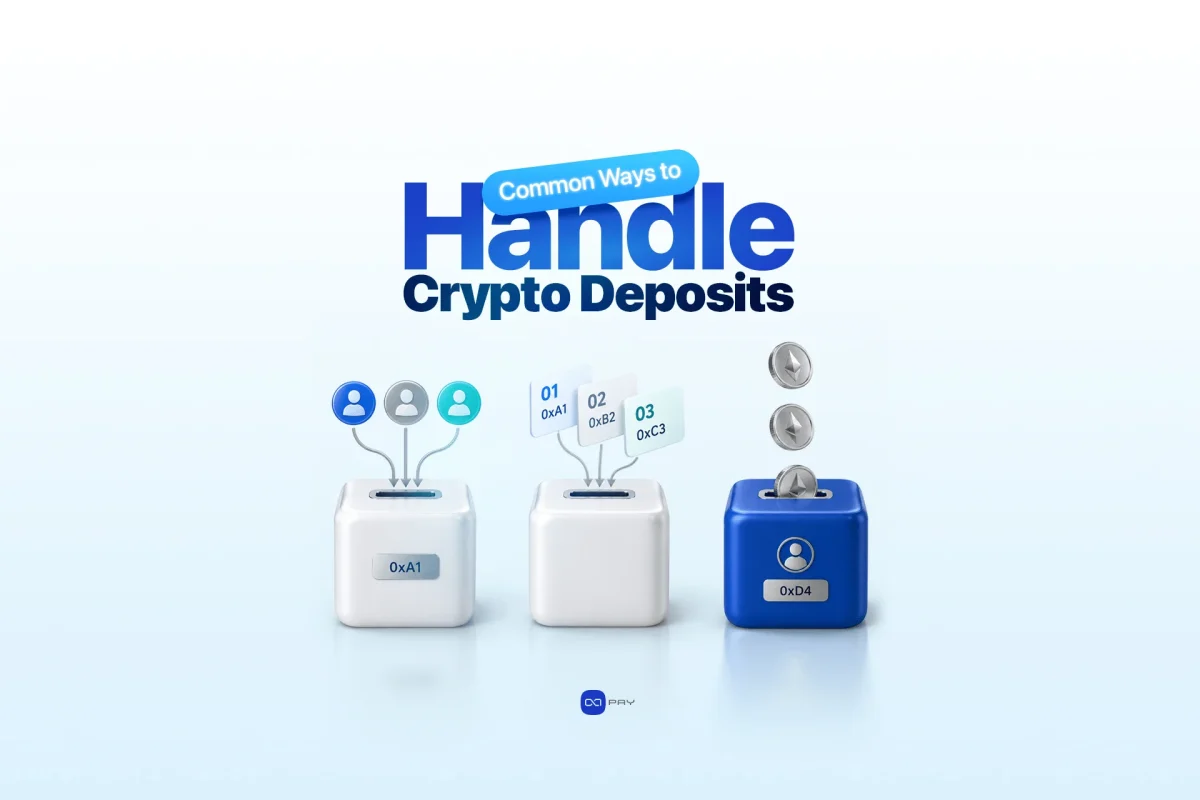
Platforms can organize incoming crypto deposits in several ways.
Each model creates a different balance between simplicity, attribution, and operational control.
One approach is to receive multiple user deposits through the same address.
The platform then needs another way to determine which transaction belongs to which user.
That may involve transaction hashes, payment references, amounts, or additional matching logic.
The model can work, but attribution becomes increasingly important as transaction volume grows.
If a payment cannot be matched automatically, someone may need to investigate it manually before the user’s balance can be updated.
New Address for Every Deposit
Another approach is to create a fresh payment address for each deposit request.
This provides a clear relationship between the payment request and the incoming transaction.
For occasional payments, this can work well.
But repeated balance loading creates a usability trade-off.
A returning user must generate or retrieve new payment instructions every time they want to deposit.
For platforms where adding funds is a frequent user action, that extra step can interrupt an otherwise simple workflow.
Persistent Address Per User
A third model assigns a dedicated crypto address to each user.
The same user can return to that address for future deposits.
Because the address is already linked to the account, incoming transactions can be attributed to the correct user without requiring a new deposit request each time.
Conceptually, the flow becomes:
User Account → Dedicated Crypto Address → Incoming Deposit → Balance Update
This model can be particularly useful when users make recurring deposits and the platform needs reliable account attribution.
Why a Persistent Address Can Improve the User Experience
The main advantage of a persistent address is familiarity.
Once a user has received a deposit address, they can save it in their wallet or exchange account and reuse it when they need to add funds again.
They do not need to navigate through the entire payment flow every time.
That can reduce several sources of friction.
Fewer Repeated Steps
The user does not need to generate a new destination for every deposit.
For frequent deposit behavior, removing even a few repeated steps can make the experience noticeably simpler.
Clearer Account Attribution
Because the address belongs to a specific user account, the platform has a direct reference for identifying incoming funds.
This reduces dependence on manual matching.
Faster Operational Recognition
When the system knows which user owns the address, an incoming transaction can move directly into the platform’s deposit-monitoring and balance-update logic.
The platform still needs its own rules for confirmations and balance crediting. A documented payment-status model helps keep those decisions consistent, while the address itself solves the attribution problem.
Less Support Friction
Many payment-related support conversations begin with a simple question:
“Did you receive my payment?”
A well-designed deposit flow reduces the number of cases where the platform has to ask the user for transaction details simply to determine who sent the funds.
The Deposit Address Is Only One Part of the System
Assigning a fixed address does not mean the deposit flow becomes automatic by itself.
The platform still needs infrastructure around the address.
A reliable flow should answer several questions:
- Which user owns this address?
- Which cryptocurrency and network does it support?
- Has a transaction been detected?
- Has it reached the required confirmation state?
- How much value should be credited?
- Has the same transaction already been processed?
- How should the platform record the deposit for later reconciliation?
The address solves the destination and attribution problem.
توضح broader payment infrastructure still handles مراقبة المعاملات, status-change notifications, record keeping, and business logic.
This distinction is important because a good user experience depends on both layers working together.
Network Choice Also Affects Deposit Experience
Recurring deposits are often sensitive to transaction cost and confirmation speed.
Users adding relatively small balances may care more about network fees than customers making large one-time purchases.
For this reason, platforms often consider networks that can support frequent transactions efficiently.
In production, available asset-network combinations should be checked against the provider’s current supported-currency and network data rather than hard-coded assumptions.
However, network selection should not be based on transaction cost alone.
The platform also needs to consider:
- which assets its users actually hold;
- wallet and exchange support;
- operational reliability;
- network-specific risks;
- how clearly users can distinguish between supported networks.
Supporting several networks can improve accessibility, but it also increases the importance of clear payment instructions.
A user sending an asset through an unsupported network can create a much more difficult support problem than a delayed deposit.
From Incoming Transaction to User Balance
A useful way to think about the deposit system is as a sequence of connected events.
1. Address Assignment
The platform associates a supported crypto deposit address with the user account.
2. Transaction Detection
When funds arrive, the payment infrastructure detects the blockchain transaction.
3. User Attribution
The destination address identifies which user account should receive the deposit.
4. Payment Validation
The system checks the asset, network, amount, transaction state, and any other rules required by the platform.
5. Balance Credit
Once the transaction reaches the platform’s approved state, the user’s internal balance can be updated.
6. Record Creation
The deposit remains connected to the user, transaction, asset, network, amount, and relevant timestamps for reporting and reconciliation. For provider-side review, Payment History can be used to retrieve and filter payment records.
The important point is that detecting a blockchain transfer and crediting a user balance are not necessarily the same event.
The platform should define clearly when an incoming transaction becomes an accepted deposit.
Why This Matters for Operations
Deposit design affects more than customer convenience.
It also determines how much operational work the platform creates for itself.
When deposits are easy to attribute automatically, teams spend less time investigating routine payments.
Support can focus on genuine exceptions.
Finance receives cleaner deposit records.
Operations can monitor unresolved transactions more easily.
Developers can build clearer balance-crediting logic around consistent payment events.
This becomes increasingly important as volume grows.
Manual processes often appear inexpensive when transaction counts are small. The hidden cost becomes visible only when the same investigation, matching, or support task has to be repeated hundreds or thousands of times.
A scalable deposit model tries to make the normal case automatic and reserve human attention for exceptions. That same principle sits at the center of reliable crypto payment operations.
Where OxaPay Static Addresses Fit
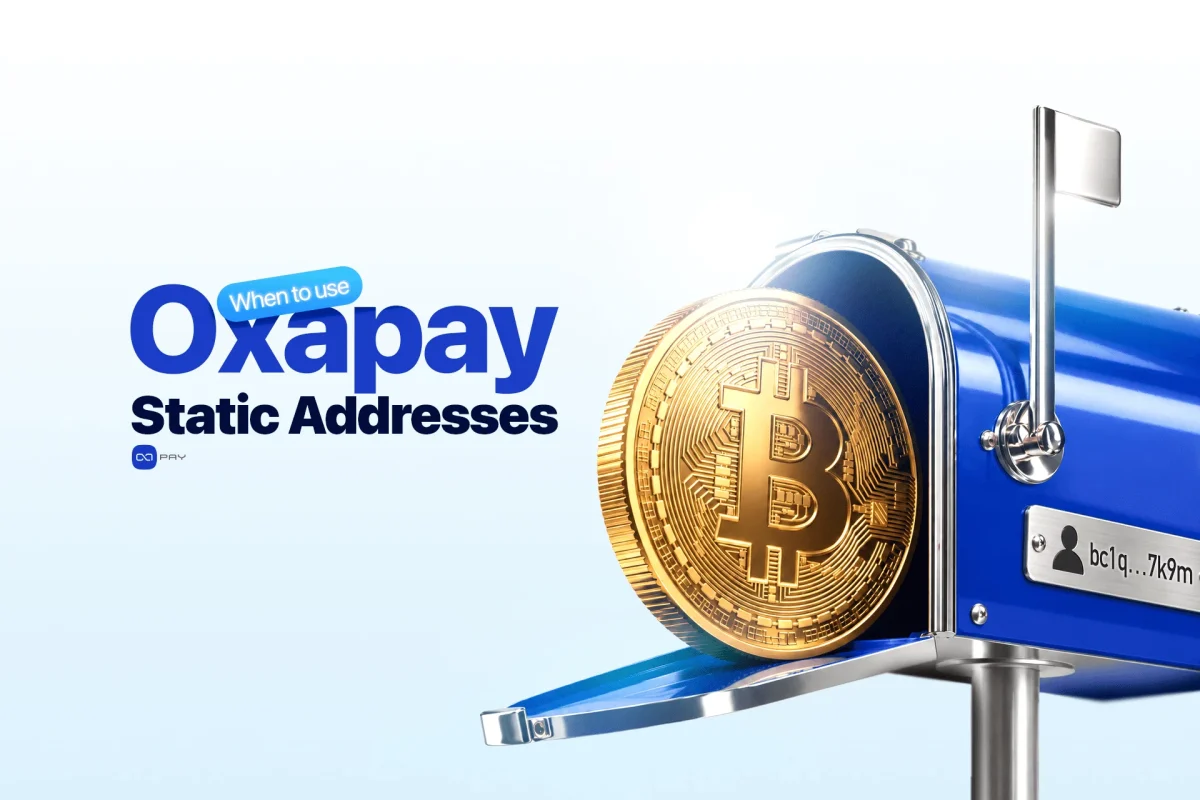
OxaPay’s Generate Static Address API is designed around this type of recurring deposit flow.
A platform can associate a static crypto address with an individual user and use that relationship for future deposits rather than generating a completely new destination for every funding event.
Each generated static address is linked to a unique track_id. If a callback_url is provided, the platform can also receive notifications when payments are made to that address.
OxaPay notes that static addresses with no transactions for six months are revoked, so “persistent” should not be interpreted as an unconditional lifetime guarantee.
Current asset and network availability should be read from OxaPay’s Supported Currencies endpoint rather than maintained as a fixed list inside the application.
For balance-based platforms, the important benefit is not simply having a reusable address.
It is the ability to connect:
User → Address → Deposit → Account Balance
inside a repeatable payment workflow.
That can make Static Addresses useful for platforms where customers frequently reload balances, fund accounts, or make repeated deposits over time.
When a Static Address Model Makes Sense
A persistent address is not automatically the right choice for every crypto payment.
For one-time commerce, invoice-based payments may still be more suitable when each transaction is tied to a specific order, price, expiration time, or commercial agreement.
Static addresses become more attractive when:
- users have persistent accounts;
- deposits happen repeatedly;
- funds are credited to an internal balance;
- the platform needs reliable user attribution;
- generating a new payment request every time adds unnecessary friction.
The decision should therefore follow the business model.
A one-time checkout and a recurring account deposit solve different problems and may require different payment structures.
ما الخطوة التالية؟
Adding crypto as a funding option is only the first decision.
The next question is how the deposit flow should behave after users start using it repeatedly.
For balance-based platforms, a good deposit system should make routine funding predictable for both the customer and the business.
Users should know where to send funds.
The platform should know who sent them.
The system should know when the deposit can be credited.
And the resulting records should remain usable for Support, Operations, and Finance.
Persistent crypto addresses can help create that structure.
When they are combined with reliable transaction monitoring and clear balance-crediting rules, recurring deposits can become a normal part of the platform experience instead of a payment process that needs to be reconstructed every time.