Sending one crypto transfer is easy. Running payouts as part of a business system is different. Once you need to pay customers, affiliates, vendors, contractors, sellers, or other recipients repeatedly, the real challenge is no longer creating a blockchain transaction. It is making sure every payout goes to the right destination, only once, with a status your application can track and reconcile.
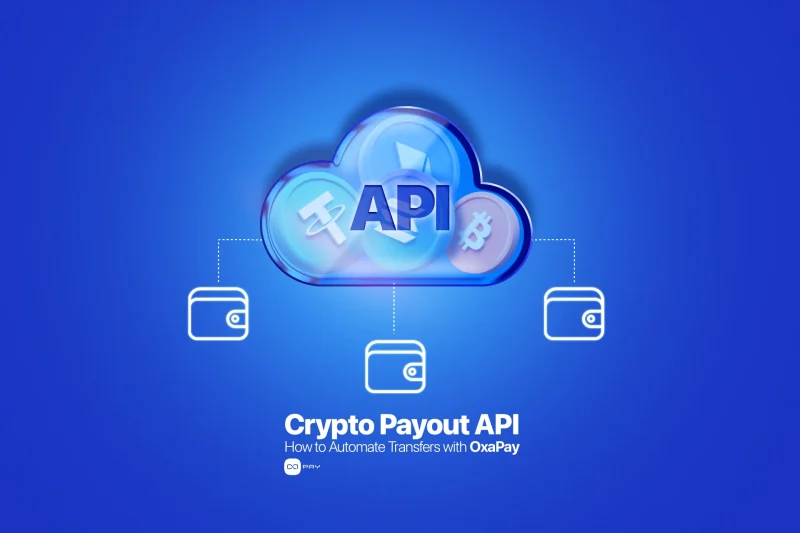
A crypto payout API solves that operational problem by letting your backend create outbound transfers programmatically. Instead of staff copying wallet addresses into a wallet interface, your system can submit approved payout instructions, store the returned identifier, monitor the transfer lifecycle, and update your own records when the payout reaches its final state.
This guide explains what a crypto payout API should do, when it makes sense to use one, and how the current OxaPay Payout API works in a production-oriented payout flow.
What Is a Crypto Payout API?
A crypto payout API is an interface that allows software to send cryptocurrency from a business balance to recipient addresses and then retrieve the status and details of those outbound transfers.
It is the outbound counterpart to a واجهة برمجة تطبيقات الدفع بالعملات الرقمية. A payment API usually helps your business receive money from a customer. A payout API moves value in the other direction: from your business or platform to a recipient.
That distinction matters because outbound transfers require stronger operational controls. If an incoming payment is delayed, you can normally wait for confirmation. If an outbound payout is sent to the wrong address or sent twice, recovering the funds may be impossible.
A useful payout API therefore needs more than a create endpoint. It should give your system a way to authenticate requests, validate payout parameters, identify every payout, follow status changes, receive asynchronous updates, retrieve historical records, and reconcile the final transaction.
When Does a Business Need a Crypto Payout API?
A payout API becomes useful when outbound crypto transfers are part of a repeatable product or operational workflow rather than an occasional finance task.
- Marketplaces can pay sellers after an order or settlement period.
- Affiliate programs can distribute commissions automatically.
- Platforms can process user withdrawals from internal balances.
- Businesses can pay crypto-enabled suppliers, vendors, or contractors.
- Gaming, creator, or rewards platforms can distribute prizes, incentives, or earnings.
- Teams with recurring payout runs can trigger transfers from approved internal records instead of preparing each transaction manually.
The API does not decide who should be paid. Your own system should remain responsible for the business obligation, recipient approval, amount calculation, and any internal authorization rules. The payout API executes and reports the transfer after those decisions have been made.
How a Crypto Payout API Works
A production payout flow usually has six stages.
1. Your System Creates an Approved Payout Instruction
The process should begin with a business record in your own system: for example, an approved seller settlement, affiliate commission, user withdrawal, or vendor payment. This gives the payout a reason, an owner, and an internal reference before funds move.
2. Validate the Recipient, Asset, Network, and Amount
Before calling the payout API, validate the destination address, cryptocurrency, network, amount, and memo or tag when the selected network requires one. Sending the right asset to the wrong network can be just as damaging as sending to the wrong address.
3. Create the Payout Through the API
With OxaPay, the current Generate Payout endpoint is POST https://api.oxapay.com/v1/payout. Requests are authenticated with a dedicated Payout API Key in the payout_api_key header.
The request requires a recipient address, currency, and amount. The network is required when the currency is available on multiple networks. You can also provide a callback_url, memo, and description when relevant.
4. Store the Returned track_id
After a payout request is created, OxaPay returns a track_id. Store it with your own payout or settlement record. This identifier is what connects the original business instruction to later API lookups, callbacks, support cases, and reconciliation.
Do not treat the creation response itself as proof that the recipient has received funds. A successful API response means the request reached a documented API state; the payout can still move through processing and تأكيد البلوكشين afterward.
5. Track the Payout Until a Final State
توفر OxaPay Payout Information endpoint at GET /v1/payout/{track_id}, as well as Payout History for broader reconciliation. The current status table includes processing, pending, confirming, confirmed, canceled, and rejected states.
For normal external blockchain delivery, confirming means a transaction has been created but is still waiting for network confirmation. Confirmed is the state that indicates the transaction has been paid successfully. Rejected or canceled API states, and Failed callback outcomes, should enter an exception flow instead of being silently retried.
6. Reconcile the Result With Your Own Records
When the payout reaches its required final state, store the final status, transaction hash when available, amount, asset, network, destination, fee information, and completion time alongside your internal payout record. This gives finance, support, and engineering one traceable record of what happened.
Use Callbacks Instead of Treating Payouts as Synchronous
Crypto payouts are asynchronous. Your application should not assume that the HTTP response to the create request is the end of the process.
OxaPay lets you provide a callback_url when generating a payout. When payout status changes, OxaPay can send a server-to-server notification to that endpoint. The current وثائق webhook في OxaPay shows payout callbacks for states such as Confirming and Confirmed, as well as failure outcomes.
Every payout callback should be authenticated before it changes your business state. OxaPay signs payout callbacks using HMAC-SHA512 over the raw POST body, with your Payout API Key as the shared secret. Compare the calculated signature with the HMAC request header before processing the event.
Your callback handler should also be safe to process the same event more than once. Network retries and duplicate deliveries are normal conditions in distributed systems; they should not create duplicate ledger entries or trigger a second payout.

Mass Payouts: Automation Does Not Mean One Batch Request
OxaPay positions the Payout Service for frequent and mass payout workflows, but there is an important implementation detail: the current Generate Payout API schema creates a payout for one recipient address and amount per request.
That means a mass payout workflow should be designed in your own application as a controlled set of payout requests unless a separate batch method is explicitly documented for your account or integration. For example, your system can prepare 500 approved recipient records, validate them, submit each payout through the API, store every track_id, and monitor each result independently.
This model is actually useful for reconciliation because every recipient has a separate status and transaction record. The critical requirement is to make your application resumable: if the process stops after 240 payouts, you need to know exactly which payouts were already created before continuing.
Avoid Duplicate Payouts When Requests Time Out
One of the most important payout failure modes happens when your application sends a request but does not receive a clear response. The transfer may have been created even though your connection timed out.
The unsafe response is to immediately submit the same payout again. If the first request actually succeeded, the retry can create a second transfer.
Your payout workflow should therefore keep its own stable payout record and move uncertain requests into a verification path. Use the returned track_id whenever you have one, check Payout Information and your payout history, and reconcile the original request before deciding whether another payout should be created.
For high-volume systems, this control is as important as the payout call itself.
Internal and External Payouts with OxaPay
OxaPay also distinguishes between transfers inside the OxaPay ecosystem and transfers to external blockchain destinations.
Internal Transfers
According to OxaPay’s current Payout Service information, transfers between OxaPay addresses can be processed without blockchain fees. This can make internal transfers useful for frequent payouts and smaller amounts when the recipient also uses OxaPay.
External Transfers
External payouts send funds to a blockchain address outside the OxaPay internal environment. Network fees and minimum transfer requirements can apply, and processing time depends partly on the selected blockchain and its confirmation conditions.
Do not model these as two unrelated APIs unless the current documentation tells you to do so. From an application perspective, the core payout workflow remains the same: identify the recipient, define the asset and amount, create the payout, store the track_id, monitor status, and reconcile completion.

OxaPay-Specific Payout Integration Controls
The general payout lifecycle above covers the sequence. For OxaPay, implementation mainly comes down to three operational controls.
Secure the Payout API Key
Log in to OxaPay and open the Payout Service. OxaPay requires a dedicated Payout API Key for payout operations. The current Payout Service also states that two-factor authentication must be enabled to generate or edit a payout API key.
Treat this key as a high-value financial credential. Keep it only on the server side, outside source code and client applications. Use IP restrictions where appropriate so payout requests are accepted only from approved infrastructure.
Map the Request and Persist track_id
For each approved payout, send the destination address, amount, currency, and network when required. Add a memo or tag for networks that need one, a description that helps your operations team identify the payout, and a callback URL if you want asynchronous status updates.
As soon as the API returns a track_id, save it with your internal payout reference. Do not wait until the transfer is confirmed. The track_id is necessary for troubleshooting uncertain states and retrieving payout information later.
Validate Callbacks and Close Final States
Receive payout callbacks on an HTTPS endpoint, verify the HMAC signature using the Payout API Key, and map the event to the stored track_id. Only then should the event update your payout state.
Treat intermediate statuses as work in progress. When the payout reaches the final successful state, record the completion and transaction evidence. If the API status is rejected or canceled, a callback reports Failed, or the payout remains unresolved, move it to an exception queue for investigation rather than automatically generating a replacement transfer.
Security Controls a Payout Integration Should Have
A payout API can move funds, so its security model should be stricter than a read-only integration.
- Keep the Payout API Key in server-side secret storage and never expose it in browser or mobile code.
- Restrict the infrastructure allowed to make payout requests, including IP allowlisting where appropriate.
- Require internal authorization before a payout instruction reaches the API.
- Validate the recipient address, currency, network, and memo before submission.
- Validate HMAC signatures on payout callbacks before trusting their status.
- Record who or what approved each payout and retain the internal reference, track_id, status history, and transaction hash.
- Never automatically retry an uncertain value-moving request without first reconciling whether the original payout was created.
Automation should reduce repetitive manual work without removing financial controls. The safest design separates payout approval from payout execution and makes every transfer traceable.
What to Evaluate in a Crypto Payout API
If you are comparing payout providers, the create endpoint is only one part of the decision. Evaluate how the system behaves when something does not go as planned.
- Which cryptocurrencies and blockchain networks are supported?
- How are recipient addresses and network-specific memo requirements handled?
- What statuses can a payout enter, and which state represents final delivery?
- Can you retrieve one payout by a stable identifier and list payout history?
- Are callbacks available, signed, and safe to retry?
- What controls exist around API credentials and allowed request sources?
- How are fees and minimum transfer amounts exposed?
- How should your application handle timeouts, rejected payouts, and ambiguous results?
- Can finance and support reconcile API records with blockchain transaction evidence?
These questions determine whether a payout API can support a production payment operation rather than just a successful demo.
ما الخطوة التالية؟
A crypto payout API is most useful when outbound transfers need to become part of your product or operational system. The objective is not simply to send crypto faster. It is to create a controlled process in which every payout begins with an approved obligation, produces a traceable API record, moves through known states, and ends with evidence that can be reconciled.
With OxaPay, the practical starting point is straightforward: create a dedicated Payout API Key, generate payouts through the current /v1/payout endpoint, save every track_id, validate payout callbacks, and wait for the final successful state before closing the payout in your own system.
Explore the OxaPay Payout Service