Blockchain transactions provide precise technical information.
Businesses need something different.
Finance needs to know how much money was received. Support needs to identify which customer made a payment. Operations needs to know which orders are complete, pending, or require attention. Management needs reliable reports that show what is actually happening.
This creates an important gap.
A blockchain may record a transaction perfectly while the business still struggles to understand what that transaction means operationally.
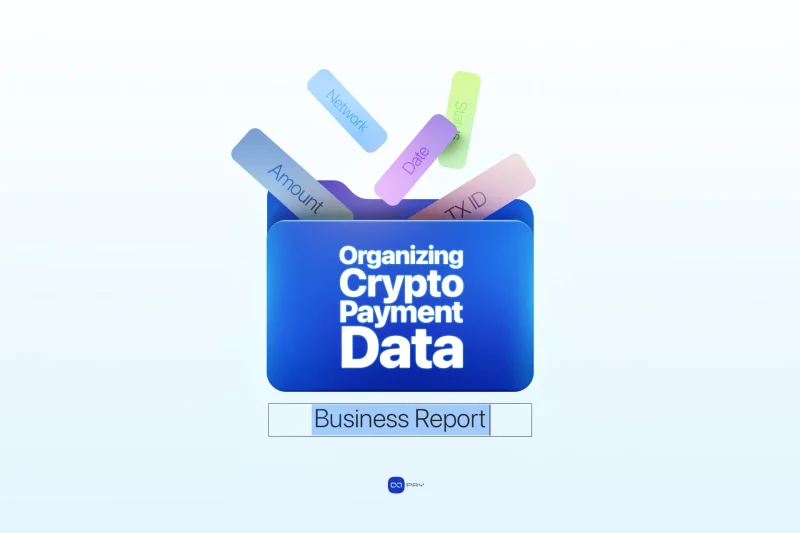
Crypto Payment Data Management closes that gap by turning transaction hashes, payment statuses, assets, networks, amounts, timestamps, and business references into structured records that teams can actually use.
Why Blockchain Data Alone Is Not Enough
On-chain data is excellent for proving that a transaction happened.
It can show information such as:
- İşlem Hash’inden Fazlasına İhtiyacı Vardır;
- sender and destination addresses;
- varlık ve ağ;
- transferred amount;
- confirmation state;
- transaction time.
But those fields do not automatically answer business questions.
Örneğin:
- Bu ödeme hangi siparişe ait?
- Has the customer completed the required payment?
- Should the product or service now be delivered?
- Does Finance classify this as a received payment, an unresolved payment, or an exception?
- Can Support find the transaction when the customer contacts them later?
A technically valid blockchain transaction can still be difficult to use if it is not connected to the business context around it.
This is why payment infrastructure needs a structured data layer between blockchain activity and business reporting.
The Goal Is Structured Payment Data
Good payment data should describe both the transaction and its business meaning.
A useful payment record may include:
- an internal Order ID or invoice reference;
- a payment identifier;
- expected payment amount;
- alınan tutar;
- cryptocurrency and blockchain network;
- transaction reference;
- Ödeme Durumu;
- relevant timestamps;
- customer or account reference;
- any related refund or adjustment information.
The exact fields depend on the business. What matters is consistency.
If every payment is recorded differently, reporting becomes an interpretation exercise. If every transaction follows the same structure, the business can work directly from organized payment records instead of reconstructing context later.

Connect Every Payment to a Business Record
One of the most important parts of organizing crypto payment data is establishing a reliable relationship between the payment and the business transaction behind it.
A transaction hash alone is usually not enough.
The business should be able to move from:
Order -> Payment -> Blockchain Transaction
and also in the opposite direction:
Blockchain Transaction -> Payment -> Order
This connection becomes more important as payment volume grows. At low volume, a team may recognize individual transactions manually. At higher volume, relying on amounts, timestamps, wallet addresses, or memory becomes unreliable.
Payment identifiers should therefore be captured as part of the payment flow rather than reconstructed later. In an API-based setup, the kripto ödeme API'si should preserve enough payment and order context for the business to trace the relationship in both directions.
When payment records contain consistent identifiers from the beginning, reconciliation, customer support, and reporting become substantially easier.
Normalize Data Before Reporting
Even when payment data is available, different systems may describe the same information differently.
Örneğin:
- one system may use local time while another uses UTC;
- asset symbols may be formatted differently;
- network names may vary;
- payment statuses may use technical terminology that does not match internal business states;
- amounts may use different decimal precision.
These differences may look small, but they create reporting problems.
Before payment data reaches dashboards, spreadsheets, or internal reports, the business should normalize the fields that matter.
Several technical states, for example, may be mapped into business-friendly reporting categories such as:
- pending
- tamamlandı
- Needs Review
- expired
- refunded
The original provider status should still be preserved. The normalized status gives business teams a consistent language for reporting and operations without removing the underlying technical evidence.
Capture Payment Data When the Event Happens
The most reliable time to organize payment data is when the payment activity occurs.
Waiting until the end of the week or month creates unnecessary work. If payment records are captured automatically as their status changes, the business can build structured data continuously.
In API-based payment systems, Webhooks and payment lookups can feed these updates into business systems as events occur.
A typical flow might look like:
Payment Created -> Payment Updated -> Business Record Updated -> Reporting Dataset Updated
This removes much of the manual work associated with copying transaction details into spreadsheets or internal systems and reduces the risk that one employee records a payment differently from another.
The purpose of automation here is not simply speed. It is consistency: every payment should pass through the same logic and produce the same type of business record.
Store Business Context, Not Just Raw Blockchain Data
Another common mistake is collecting large amounts of technical information without deciding what the business actually needs.
Raw blockchain data can be useful for verification and investigation, but business reports rarely need every available field.
Instead, reporting records should emphasize information that answers operational and financial questions.
Örneğin:
- a transaction hash can be stored as a transaction reference within the payment record;
- a blockchain status can contribute to an internal payment state;
- an asset and network can become standardized reporting dimensions;
- a payment identifier can connect the transaction to an order or customer;
- a technical timestamp can be converted into the reporting timezone used by the business.
The objective is not to remove technical evidence. It is to add context around it.
The raw transaction remains available when deeper investigation is needed, while everyday reports use a cleaner and more understandable structure.
Keep Teams Working from the Same Payment Data
Payment information often becomes fragmented as a business grows.
Support maintains one spreadsheet. Finance creates another report. Operations checks the payment dashboard. Engineering looks at API records.
When these systems are not aligned, different teams may reach different conclusions about the same payment.
Structured payment data provides a shared reference: Support can identify whether a customer payment was detected, Operations can see whether the related order reached the correct state, Finance can review received payments and unresolved differences, and Management can analyze trends without rebuilding the underlying dataset every time.
This shared structure reduces one of the most common operational problems in payment systems: multiple versions of the truth.

Automation Can Connect Payment Data to Existing Tools
Businesses do not necessarily need to replace the systems they already use.
Structured payment data can be routed into spreadsheets, databases, reporting tools, or internal applications.
For example, a business using OxaPay Merchant Service can retrieve consistent Payment Information and use an automation platform such as Make.com to move selected fields into the tools used by its teams.
The automation layer might:
- receive or retrieve payment information;
- select the fields required by the business;
- normalize those fields;
- update the relevant business record;
- send the structured data to the reporting destination.
The important part is not the automation platform itself. It is defining a reliable data structure before information is distributed across the business.
Without that structure, automation only moves inconsistent data faster.
What Crypto Payment Data Management Makes Possible
Once payment data is structured properly, many tasks become easier.
Daily Payment Reporting
Teams can use organized Payment History to see how many payments were completed, pending, expired, or unresolved without manually reviewing blockchain transactions.
Payment Volume Analysis
Payment records and payment statistics can be grouped by period, asset, network, product, or other business dimensions to show how payment activity changes over time.
Mutabakat
Orders and payment records can be compared using consistent identifiers rather than manually searching for matching amounts and transaction hashes.
Müşteri Desteği
Support teams can find payment information using an order or payment reference and understand the current state without requiring blockchain expertise.
Exception Monitoring
Underpayments, delayed payments, unmatched records, or other payment issues can be separated from normal transactions and reviewed directly.
Operational Analysis
Businesses can identify patterns such as repeated payment delays, network-specific issues, or increasing exception rates.
At that point, payment data becomes more than a record of transactions. It becomes an operational dataset.
Better Reporting Starts Before the Report
Businesses sometimes treat reporting as something that happens after payments are processed. In practice, reporting quality is determined much earlier.
If payment data is created without consistent identifiers, statuses, timestamps, and context, producing a reliable report later becomes difficult. If the payment flow creates structured data from the beginning, reporting becomes a natural output of the system.
This changes the question from:
“How do we build a report from all these transactions?”
şuraya:
“Which view of our structured payment data do we need?”
That is a much more scalable approach.
From Blockchain Transparency to Business Insight
Blockchains provide transparency at the transaction level. Businesses need clarity at the operational level. The connection between the two is structured payment data.
A strong payment data process should:
- connect each payment to the correct business record;
- preserve technical transaction evidence;
- normalize fields used across systems;
- capture payment updates consistently;
- separate normal payments from exceptions;
- provide the same reliable information to different teams;
- make reporting and reconciliation easier as volume grows.
Crypto payment operations do not become difficult because blockchain transactions lack information. They become difficult when technical information is not translated into business context.
Good Crypto Payment Data Management makes that translation part of the payment infrastructure itself. The result is cleaner reporting, simpler reconciliation, faster investigation, and better decisions based on payment data that teams can actually understand and trust.