Accepting crypto payments is no longer the hard part.
The real challenge begins after the payment arrives.
So what does crypto payment automation actually change once the transaction is complete?
For many businesses, crypto payments still behave like isolated events. Funds arrive on the blockchain, someone checks a dashboard, someone else updates a spreadsheet, another person sends a confirmation email, and finance reconciles everything later. The payment works, but the workflow around it stays manual, fragmented, and fragile.
This is where the combination of OxaPay and Make.com changes the picture entirely.
Instead of treating crypto payments as standalone transactions, no-code automation turns them into programmable business events.
From isolated payments to connected workflows
A typical crypto payment flow looks simple on paper:
Customer pays → Merchant receives crypto
In reality, businesses need much more than that:
- Proof of payment for customers
- Internal records for sales and finance
- Notifications for support or operations
- Rules for payouts, swaps, or routing funds
- Clean data for reporting and analysis
Without automation, these steps are handled manually or through disconnected tools. That approach works at low volume, but it breaks down quickly as payments scale.
OxaPay already provides the infrastructure to accept, monitor, and manage crypto payments reliably. Make adds the missing layer: workflow logic without code.
Together, they allow businesses to define what should happen when a payment occurs, not just how the payment is processed.
What no-code automation actually means in crypto payments
No-code automation is often misunderstood as a shortcut or a simplified version of “real” systems. In practice, it is the opposite.
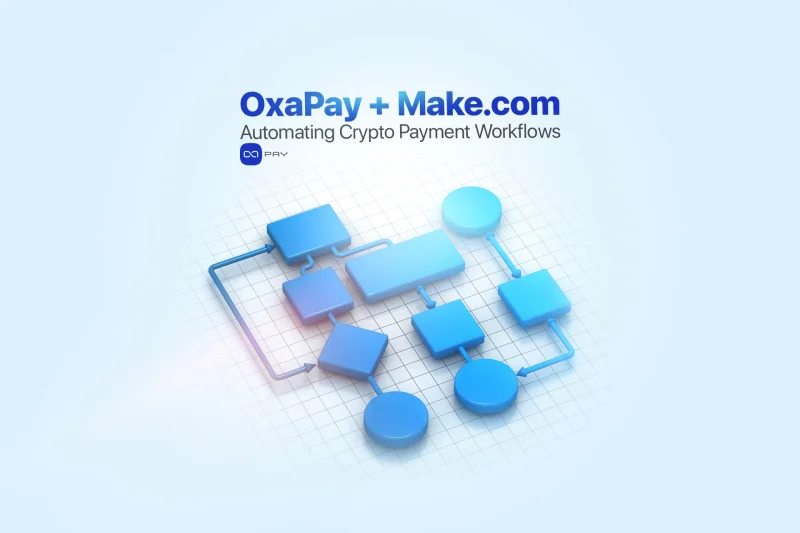
With Make, businesses can visually design workflows where each step reacts to an event. A crypto payment becomes a trigger, not a dead end.
For example:
- A payment is received
- The payment data is fetched and structured
- Records are created or updated in business tools
- Notifications are sent automatically
- Optional financial actions are executed
All of this happens without writing custom scripts, maintaining servers, or building internal tooling.
The important shift is conceptual. Crypto payments move from being technical transactions to operational signals.
How OxaPay fits into automated workflows
OxaPay plays a central role in crypto payment automation by exposing a complete set of capabilities that Make can orchestrate. This includes core payment actions as well as post-payment operations.
At a high level, OxaPay enables:
- Generating invoices with fixed amounts and expiration logic
- Creating static wallet addresses for recurring or identified payments
- Monitoring payment and payout events in real time
- Executing payouts to specific wallet addresses
- Swapping assets inside the payment infrastructure
- Retrieving detailed transaction, balance, and status data
Make connects to these capabilities as modular building blocks. Instead of hard-coding logic, businesses connect actions and conditions visually.
This matters because payment workflows change over time. No-code automation allows teams to adjust logic as the business evolves, without waiting for development cycles.
Why this matters for real businesses
For real businesses, crypto payment automation is not theoretical.
It directly affects speed, reliability, and operational cost.
1. Fewer manual steps, fewer errors
Manual reconciliation and notifications are common sources of mistakes. Automation ensures that every payment is handled consistently, even at scale.
2. Faster response times
Support teams can be notified instantly when payments arrive or fail. Customers receive confirmations without delays. Finance sees updated data in near real time.
3. Clear separation between infrastructure and logic
OxaPay handles payment correctness and blockchain interaction. Make handles workflow logic. This separation keeps systems clean and easier to reason about.
4. Scalability without developer dependency
Businesses can expand payment volume or complexity without building internal tools for every new requirement. Operations scale without proportional increases in engineering effort.

Typical automation patterns enabled by OxaPay and Make
In practice, crypto payment automation follows a few recurring patterns. While each business designs its own workflows, some patterns appear repeatedly across different use cases.
One common pattern is post-payment documentation. When a payment is confirmed, the workflow automatically stores its details in a structured format, such as a spreadsheet or internal database. This creates a reliable payment ledger outside the blockchain explorer.
Another pattern is real-time notifications. Payments or payouts trigger alerts to sales, finance, or support teams. Instead of checking dashboards, teams react to events as they happen.
More advanced workflows involve conditional logic. For example, payments above a certain amount can trigger automatic routing, splitting, or swaps, while smaller payments follow a simpler path.
The key point is that these patterns are not hard-wired. They are configurable, visible, and adaptable.
Why no-code matters specifically for crypto
This is where crypto payment automation benefits most from a no-code approach.
Crypto payments introduce variables that traditional payment systems often hide: networks, confirmations, on-chain states, and asset types. This complexity makes flexibility more important, not less.
No-code automation allows businesses to respond to these variables without rebuilding systems. New assets, new rules, or new reporting requirements can be handled by adjusting workflows instead of rewriting integrations.
This is especially valuable for teams that are operationally mature but do not want to become payment infrastructure engineers.
A shift in how payments are designed
The biggest change is not technical. It is architectural.
With OxaPay and Make, payments stop being endpoints. They become inputs to a broader system. Every transaction feeds operations, finance, analytics, and customer experience automatically.
That shift is what allows crypto payments to move from experimentation to production-grade usage in real businesses.
Automation does not replace payment gateways. It completes them.
Final thoughts
Crypto payments succeed when they integrate cleanly into how a business already works. Accepting crypto is easy. Managing it consistently, transparently, and at scale is the real challenge.
By combining OxaPay’s payment infrastructure with Make’s no-code automation, businesses gain the ability to design payment workflows that behave like modern systems rather than manual processes.
In that model, a crypto payment is not just a transaction.
It is a business event, ready to trigger action.
Ready to turn crypto payments into automated workflows?
If you are already accepting crypto, the next step is making those payments work for your business.
With OxaPay and no-code automation, you can connect payments to notifications, reporting, accounting, and operations without writing a single line of code.
Explore ready-made automation scenarios and templates built for OxaPay on Make, or start from scratch and design workflows that match how your business actually runs.
Start automating your crypto payment workflows today:
👉 Explore OxaPay automation templates on Make
👉 Read the OxaPay API documentation
👉 Create a free OxaPay account