Blockchain Payments: A System-Level Guide for Merchants
Understand how blockchain payments actually work, from transaction to completion, and how to design a reliable payment system that turns network signals into business-ready decisions.
Strategic Framing: What This Guide Actually Does
Most content about blockchain payments focuses on tools, integrations, or surface-level explanations.
This guide does not.
It is designed to help merchants understand how blockchain payments actually work as a system, and how that system behaves under real conditions.
The goal is not to explain how to “accept crypto.” The goal is to clarify how a blockchain payment moves from a network event to a usable business outcome.
What This Guide Is
System-Level Explanation
A clear model for understanding blockchain payments beyond simple “sent” and “confirmed” labels.
Practical Payment Behavior
A merchant-focused view of delays, confirmations, mismatches, late payments, and incomplete payments.
Decision Framework
A way to decide when a transaction becomes usable for fulfillment, access, accounting, or reconciliation.
Operational Reliability
A guide to building rules, states, and workflows that reduce uncertainty instead of reacting to it manually.
What This Guide Is Not
- not a product overview
- not a promotional page
- not a simplified introduction to cryptocurrency
- not a claim that blockchain confirmation alone solves payment operations
The focus is the payment system behind the experience, not the marketing language around it.
The Core Perspective
Blockchain payments are often treated as simple:
A transaction is sent → it is confirmed → the payment is complete.
In reality, this model is incomplete.
A blockchain payment is not a single event. It is a sequence of states that must be interpreted, validated, and translated into a business decision.

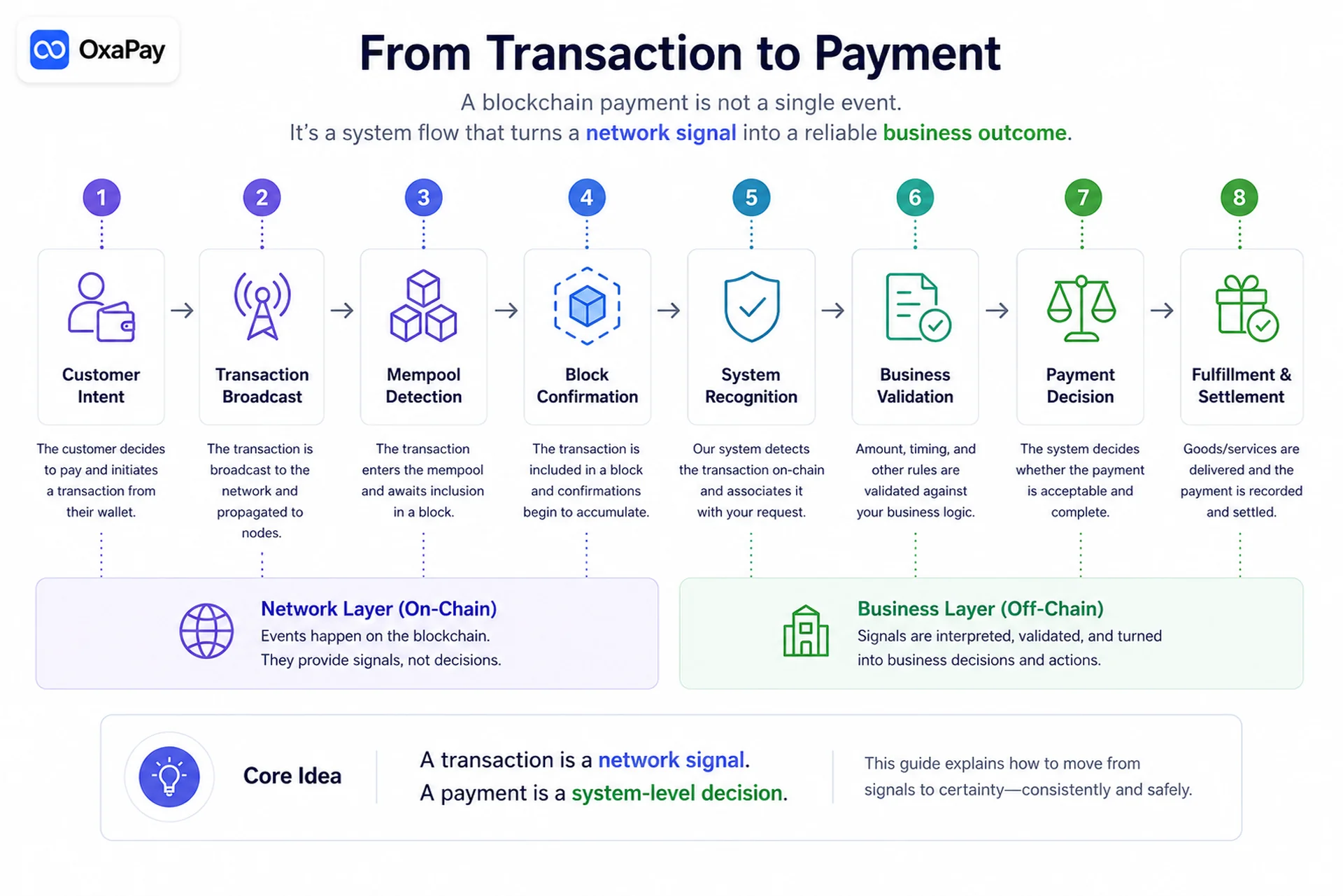
A visual overview of how blockchain payments move through different stages, from customer intent and transaction broadcast to confirmations, validation, fulfillment, and settlement.
Why This Matters for Real Merchants
If this system is misunderstood, operational problems appear quickly.
Premature Fulfillment
Access, downloads, credits, or shipping may be triggered before the payment is actually safe to use.
Accounting Mismatches
A transaction may exist on-chain, but still fail to match amount, invoice, timing, or internal records.
Support Pressure
Customers see that they sent funds, while the business system still has no reliable decision to act on.
Inconsistent Decisions
Teams begin handling late, partial, or unclear payments case by case instead of using repeatable rules.
When the system is understood correctly, uncertainty is managed, rules are applied consistently, and payment flows become more predictable.
Section 1: Why Blockchain Payments Are Interpreted Incorrectly
Merchants often approach blockchain payments using a familiar mental model from traditional payment systems.
A customer pays. The payment is approved. The transaction is complete.
This works in card networks and banking systems because approval, settlement, and final state are structured by a central system.
Blockchain payments do not follow this structure.
Where the Assumption Breaks
- there is no central authority defining payment completion
- transactions are processed by a distributed network
- finality is probabilistic, not absolute
- timing is variable, not guaranteed
The mistake happens when merchants interpret one network signal as the final business answer.
The Common Shortcut
A typical assumption looks like this:
If the transaction is confirmed, the payment is complete.
This shortcut is attractive because it simplifies a complex system into a single event.
What Confirmation Actually Represents
Confirmation does not represent completion.
What It Represents
- inclusion in a block
- increasing probability of permanence
- network-level acknowledgment
What It Does Not Represent
- correctness of the amount
- timing validity
- system recognition
- business acceptance
The Real Gap
The gap is not only technical. It is conceptual.
Merchants are asking: Is the payment done?
The blockchain is answering: This transaction exists in the network.
These are different questions, and reliable payment systems must keep them separate.
The Resulting Problems
- payments are accepted too early
- incorrect amounts are processed
- late payments create ambiguity
- confirmed transactions are not matched in the system
These are not rare issues. They are predictable outcomes of applying the wrong model.
A More Accurate Mental Model
Instead of thinking confirmation = completion, a more accurate model is:
To resolve the misunderstanding, the next step is to understand what a blockchain payment actually is from a system perspective.
Section 2: What a Blockchain Payment Actually Is
From a network perspective, a blockchain payment is a transaction recorded on a distributed ledger.
From a business perspective, that definition is incomplete.
A usable payment is not defined by the blockchain alone. It is defined by how that transaction is interpreted inside a system.
Two Layers of a Blockchain Payment
1. Network Layer
This is where the transaction exists as part of the blockchain.
- transaction broadcast
- propagation across the network
- mempool presence
- block inclusion
- accumulation of confirmations
Question answered: Has this transaction been processed by the network?
2. Business Layer
This is where the transaction becomes meaningful for a merchant.
- detecting the transaction
- associating it with a payment request
- validating amount and timing
- applying operational rules
- deciding whether to fulfill
Question answered: Can this transaction be treated as a valid and complete payment?
Why These Layers Do Not Align Automatically
These two layers operate independently.
- a transaction can be confirmed on-chain, but not yet detected by the system
- a transaction can be detected by the system, but not yet validated
- a transaction can be confirmed and detected, but still invalid due to timing or amount
This misalignment is normal. It is not an error in the blockchain. It is a property of the payment system.
The Core System Insight
A blockchain transaction is not a payment.
It is an input into a crypto payment system.
Why This Distinction Matters
If the Network Layer Is Treated as Final
- decisions are made too early
- uncertainty is ignored
- behavior becomes inconsistent
If the Business Layer Becomes the Decision Layer
- uncertainty is managed
- rules are applied consistently
- outcomes are predictable
To fully understand how this system behaves, the next step is to map the complete lifecycle of a payment from initiation to completion.
Section 3: End-to-End Flow: How a Blockchain Payment Actually Moves
A blockchain payment does not happen at once.
It unfolds across a sequence of stages, each introducing a different level of certainty, delay, and risk.
Understanding this flow is more important than understanding any individual component.
The Full Payment Flow
User initiates payment → Transaction broadcast → Mempool → Block inclusion → Confirmations → System detection → Business validation → Payment completion
Each step is a transition.
No step, on its own, guarantees that a payment is usable.

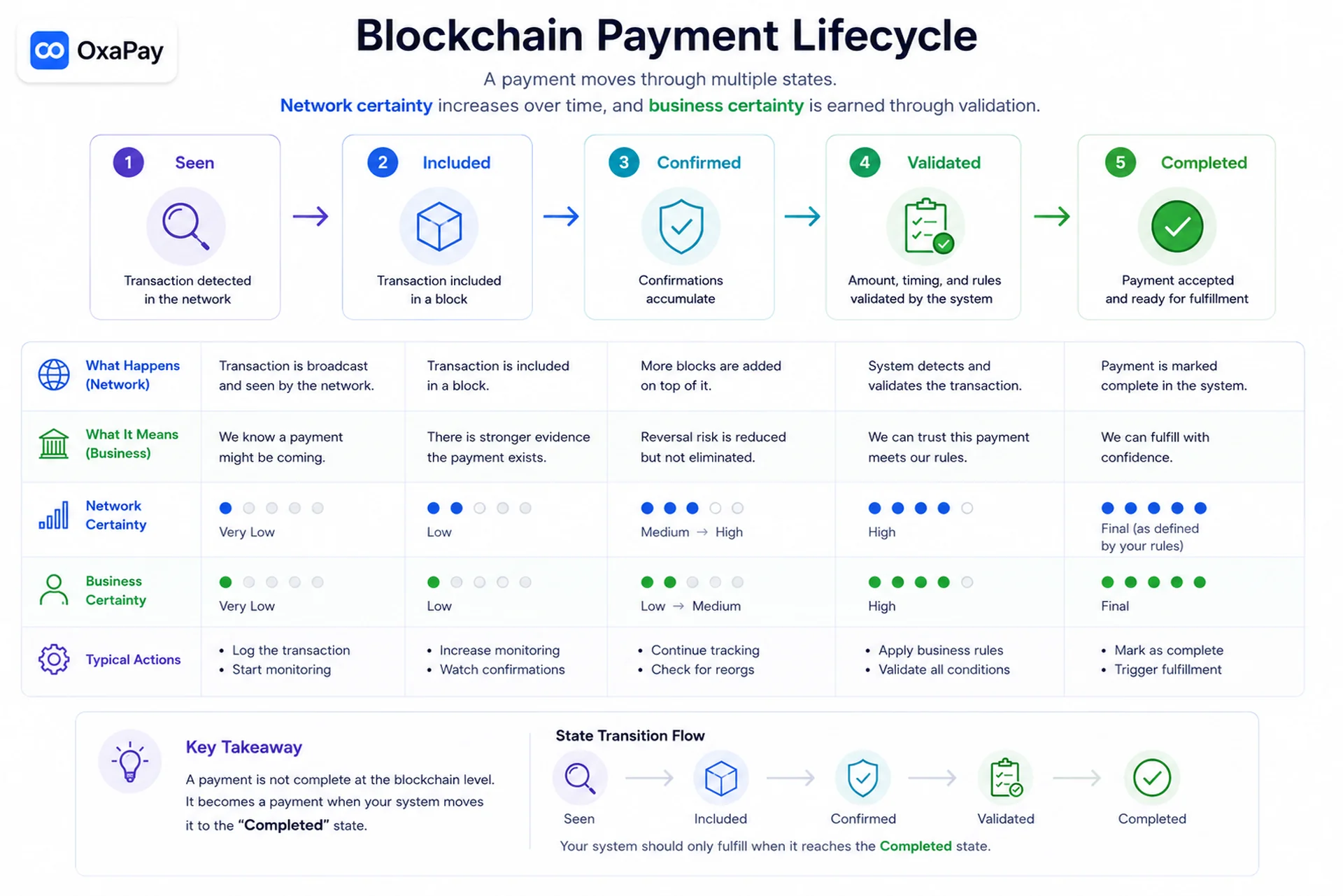
This infographic explains how a blockchain payment progresses through multiple operational states and how merchants should interpret confirmations before fulfillment.
Stage-by-Stage Breakdown
1. User Initiates Payment
A customer sends a transaction from their wallet.
At this point:
- the intent to pay exists
- the network has not validated anything
From a business perspective, this is only a signal of intent.
2. Transaction Broadcast
The transaction is propagated across the network.
It becomes visible to nodes, but:
- it is not yet confirmed
- it may still fail or be replaced
This stage introduces uncertainty without stability.
3. Mempool Stage
The transaction enters the mempool, where it waits to be included in a block.
At this stage:
- the transaction is visible
- it is not finalized
- it may be delayed, reprioritized, or dropped
This is often misinterpreted as “payment received.”
4. Block Inclusion
The transaction is included in a block.
This is the first point where confirmation begins.
However:
- a single confirmation does not guarantee finality
- the block itself may still be reorganized
Certainty increases, but remains incomplete.
5. Confirmations Accumulate
More blocks are added on top of the transaction.
With each confirmation:
- the probability of reversal decreases
- confidence increases
This process is probabilistic, not absolute.
6. System Detection
Your system becomes aware of the transaction.
This may occur through:
- blockchain monitoring
- devoluciones de llamada
- polling
The transaction may already exist on-chain, but your system may not yet recognize it.
7. Business Validation
The transaction is evaluated against business rules.
This includes:
- matching to a payment request
- verifying the amount
- checking timing constraints
- applying operational logic
At this stage, the system determines: Does this transaction qualify as a valid payment?
8. Payment Completion
Only after validation is the payment treated as complete.
This is the moment when:
- fulfillment happens
- access is granted
- accounting is updated
This step is not defined by the blockchain.
It is defined by your system.
Section 4: Payment State Machine: Modeling Payment Reality
The flow explains how a blockchain payment moves. The state model explains how it should be understood.
Traditional payment systems are often treated as binary: paid or unpaid. Blockchain payments are not.
They exist in multiple states, and each state requires different handling.
A Practical State Model
| State | Meaning | Risk Level | Business Action |
|---|---|---|---|
| Pendiente | Transaction not yet visible | Desconocido | Wait |
| Seen | Detected in mempool | Muy alto | Do not act |
| Included | In a block, usually first confirmation | Alto | Observe |
| Confirmado | Multiple confirmations received | Medio | Conditional trust |
| Finalized | Deep enough in chain to reduce reversal risk | Baja | Safer to act |
| Recognized | System has recorded the transaction | Medio | Sync internally |
| Validated | Amount, timing, and rules all match | Bajo | Ready |
| Completed | Accepted as a usable payment | Mínimo | Fulfill |
This model separates network signals from business decisions, which is the foundation of reliable payment handling.
Section 5: Where Blockchain Payments Break in Reality
Blockchain payments do not fail in obvious ways.
They fail through repeatable patterns that appear under real operating conditions.
These are not rare exceptions. They are normal behaviors that reliable systems must be designed to handle.
1. Delayed Payments
A transaction is sent, but confirmation takes longer than expected.
- network congestion can slow inclusion
- low transaction fees can delay confirmation
- block timing always remains variable
The user believes payment has already happened, while the system is still waiting for usable certainty.
2. Underpaid Transactions
A payment is received, but the amount is lower than required.
- incorrect fee estimation
- exchange rate movement
- manual input mistakes
The system must decide whether to accept it, reject it, or request an additional payment.
3. Overpayments
A user sends more than the expected amount.
- refund logic may be needed
- credit allocation may be required
- reconciliation becomes more complex
If this is not defined in advance, the same situation may be handled differently each time.
4. Late Payments
A payment arrives after the expected time window.
- the user may have sent it too late
- the network may have confirmed it too slowly
- the original payment context may already be expired
A transaction can be valid on-chain while still being ambiguous in business terms.
5. Mempool Drops
A transaction appears in the mempool, but never confirms.
- fees may be too low
- the transaction may be replaced
- network conditions may shift before inclusion
6. Chain vs System Mismatch
A transaction is confirmed on-chain, but not reflected in your internal system.
- detection may be delayed
- callbacks may fail
- synchronization may lag behind
The user sees a completed payment. The system does not. This is where trust and support issues begin.
Section 6: Why Blockchain Confirmation Is Not Enough
At this point, the limitation of relying on confirmation should be clear.
Confirmation answers a network-level question, not a business-level decision.
What Confirmation Actually Answers
Confirmation answers a narrow question:
- Has this transaction been included in the blockchain (blockchain confirmations)?
It does not answer whether the payment is complete, correct, or usable.
Where the Assumption Breaks
1. Finality Is Probabilistic
- early confirmations still carry risk
- reversals are rare but possible
2. Confirmation Does Not Solve Timing
- transactions may confirm after expiration
- timing must be enforced by your system
3. Confirmation Does Not Validate the Amount
- amount correctness is not guaranteed
- matching must be handled off-chain
4. Confirmation Does Not Ensure System Awareness
- your system may not detect it yet
- callbacks may fail or delay
5. Confirmation Is a Signal, Not a Decision
The network produces signals. Your system produces decisions.
Core Insight
Section 7: The Hidden Layer: Time, Latency, and Perception
Most discussions focus on transactions.
Real user experience is defined by time, latency, and perception.
Three Different Timelines
1. User Timeline
- payment feels complete at “send”
- expectation is immediate feedback
2. Network Timeline
- mempool → block → confirmations
- timing is variable
3. System Timeline
- detection → validation → decision
- processing delays exist
Where Friction Comes From
- user thinks payment is done
- network still processing
- system not finished
This mismatch creates confusion, retries, and support issues.
Why This Layer Matters
- users judge based on perception
- unclear states reduce trust
- even correct systems can feel broken
Design Implication
- expose clear payment states
- communicate progress continuously
- align system behavior with expectations
Section 8: Designing a Reliable Blockchain Payment System
Understanding the system is not enough.
Reliable systems do not simplify blockchain behavior. They structure it.
Multi-Step Validation
- confirmation depth
- amount accuracy
- timing constraints
- request matching
Each layer reduces a different type of uncertainty.
State-Based Processing
- pending
- partial
- expired
- confirmado
- completed
Each state must trigger a defined response.
Rule-Driven Decisions
- confirmation thresholds
- minimum amounts
- expiration windows
- late payment handling
Decisions must come from rules, not improvisation.
Real-Time Awareness
- blockchain monitoring
- callbacks or webhooks
- fallback polling
Delayed detection leads to mismatches.
Detection ≠ Acceptance
- detection is technical
- acceptance is a business decision
Treat Edge Cases as Normal
- underpayments
- late payments
- multiple transactions
- delayed confirmations
These are not exceptions. They are expected.
Key Principle
Section 9: Operational Rules: Turning System Behavior into Decisions
At some point, every system must answer one question:
What do we do with this payment?
Defining Payment Completion
- depends on value and risk tolerance
- not defined by the blockchain
Completion is a policy, not a property.
Confirmation Thresholds
- higher = lower risk
- lower = faster experience
Consistency matters more than optimization.
Handling Incorrect Amounts
- accept within tolerance
- request additional payment
- reject and restart
Defining Time Windows
- set expiration limits
- define late payment rules
Timing is enforced by your system, not the blockchain.
When to Fulfill
- early fulfillment improves UX
- late fulfillment reduces risk
Handling Ambiguity
- unconfirmed transactions
- late confirmations
- incomplete payments
Without rules, systems rely on manual decisions.
Key Principle

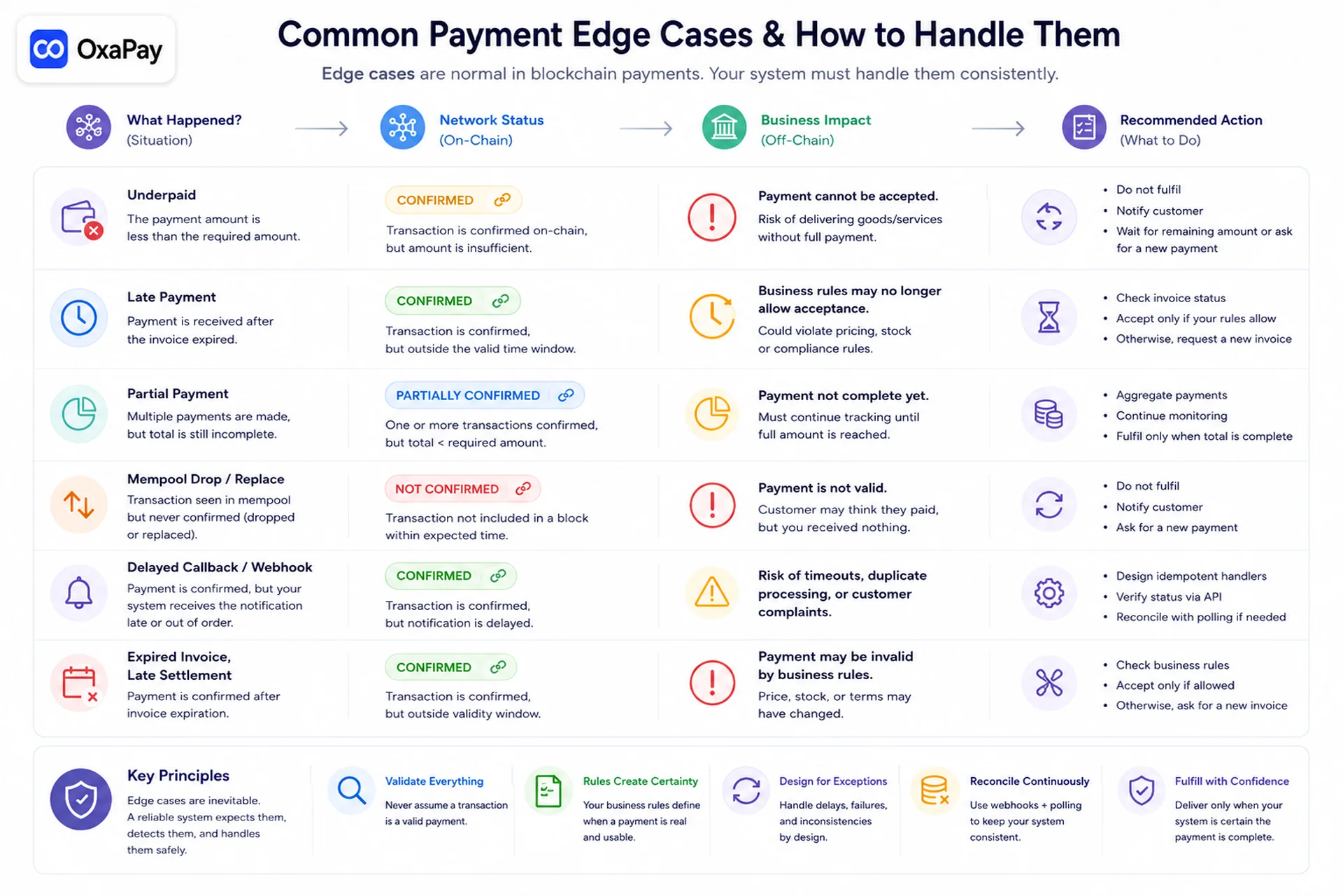
A practical visual guide to common blockchain payment edge cases including underpayments, delayed confirmations, late settlements, webhook delays, and incomplete transactions.
Section 10: Real-World Scenarios: How Payments Behave in Practice
Theory explains the system.
Scenarios show how that system behaves under real conditions.
These patterns are common in blockchain payments, and reliable systems are designed with them in mind.
Scenario 1: Partial Payment
A user sends less than the required amount.
- the transaction is valid at the network level
- the payment remains incomplete at the business level
- the system must decide whether to accept, reject, or request a top-up
A valid transaction does not automatically become a valid payment.
Scenario 2: Late Payment
A payment confirms after the expected time window has already passed.
- the transaction is technically valid
- the payment context may already be expired
- the system must decide whether to accept it conditionally or reject it
Timing is not enforced by the blockchain, it is enforced by your business rules.
Scenario 3: Confirmed but Not Recognized
A transaction is confirmed on-chain, but your system does not yet reflect it.
- detection may be delayed
- callbacks may not have arrived
- internal synchronization may still be incomplete
The user sees proof of payment, but the business system still lacks actionable certainty.
Scenario 4: Multiple Transactions for One Payment
A user sends several smaller transactions instead of one complete payment.
- the system must determine whether aggregation is allowed
- individual transactions may be insufficient on their own
- without aggregation logic, valid total payment may still be rejected
Payment behavior is not always clean or single-step in real usage.
Scenario 5: Transaction Seen but Never Confirmed
A transaction appears in the mempool, but never reaches confirmation.
- fees may be too low
- the transaction may be replaced
- it may disappear before ever becoming stable
Scenario 6: Confirmation Occurs Too Late
A transaction eventually confirms, but only after it is no longer acceptable within business logic.
- the blockchain treats it as valid history
- the merchant may treat it as operationally invalid
- the system needs a clear rule for how to respond
A payment can be valid on-chain and still unusable in context.
Key Observation
These scenarios are not unusual.
They are normal patterns in blockchain payment environments.
Merchant Scenarios: Different Businesses Need Different Rules
The same blockchain signal can require different business decisions depending on what the merchant sells and how quickly fulfillment happens.
SaaS Subscription
A low-risk monthly subscription may activate access after a lighter confirmation policy, especially when account activity can be paused later if needed.
Digital Download
A downloadable product needs stricter timing because fulfillment is immediate and difficult to reverse once access is granted.
Physical Ecommerce
A merchant shipping goods can wait longer before fulfillment because the operational cost of a wrong decision may include inventory, logistics, and support.
High-Value Invoice
A large B2B invoice usually needs deeper confirmation, clearer reconciliation, and a stricter policy for underpaid or late transactions.
Section 11: Decision Framework: Making Consistent Choices Under Uncertainty
After understanding payment behavior, the next step is consistency.
A reliable payment system is not defined by perfect conditions.
It is defined by how clearly it decides when conditions are imperfect.
A Practical Decision Matrix
| Situation | Recommended Action |
|---|---|
| Low-value transaction | Accept with fewer confirmations |
| High-value transaction | Require deeper confirmation |
| Slight underpayment | Accept or request top-up |
| Significant mismatch | Reject and restart |
| Late payment | Conditional acceptance or reject |
| Unconfirmed transaction | Wait, do not act |
| System mismatch | Delay fulfillment until synchronized |
The goal is not to remove uncertainty, but to respond to it in a repeatable way.
Core Decision Questions
Every merchant should have clear answers to a small set of operational questions.
- When is a payment considered complete?
- How many confirmations are required?
- What happens if the amount is incorrect?
- What happens if the payment arrives late?
- When is fulfillment triggered?
If these answers are unclear, payment handling becomes inconsistent by default.
Consistency Over Optimization
It is tempting to optimize for speed, lower confirmation thresholds, or earlier fulfillment.
- faster decisions can improve user experience
- weaker thresholds can also increase risk
- inconsistent exceptions create instability over time
A clear rule applied consistently is more reliable than a faster rule applied unpredictably.
Risk vs Experience Trade-Off
Every payment decision balances business safety against user experience.
- earlier acceptance improves speed, but raises uncertainty
- later acceptance reduces risk, but adds friction
- there is no universal threshold that fits every business
The right balance depends on transaction value, fulfillment sensitivity, and operational tolerance.
What Consistent Decisions Require
Consistency does not happen automatically. It must be designed into the system.
- define states clearly
- attach rules to each state
- separate network signals from business acceptance
- avoid case-by-case improvisation
Final Principle
A blockchain payment system should not rely on assumptions.
It should rely on defined states, clear rules, and repeatable decisions.
Section 12: Choosing the Right Payment Approach
Understanding blockchain payment behavior is only part of the equation.
The next step is choosing how that behavior fits into your pasarela de pagos criptográficos.
Different approaches offer different levels of control, structure, and complexity.
Enlaces de pago
A simple way to accept crypto without deep integration.
- quick to create and deploy
- no complex system connection required
- flexible for manual or one-time payments
Best for early-stage adoption, freelancers, or simple payment flows.
Structured Invoices
Each payment is tied to a defined request with clear rules.
- fixed amount and expiration window
- better tracking and reconciliation
- stronger alignment with business logic
Best for businesses with defined products, services, or predictable payment flows.
Custom Integrations
Fully integrated into your application and operational logic.
- supports automation and advanced workflows
- enables full control over states and decisions
- requires technical implementation and maintenance
Best for high-volume systems, automated fulfillment, or complex payment handling.
Choosing Based on System Needs
The right choice depends on how your business actually operates.
- how customers interact with your payment flow
- how your system processes and validates transactions
- how much control and automation you require
A mismatch between approach and system needs leads to unnecessary complexity.
A Common Mistake
Many systems start with the most complex solution too early.
- over-engineering before real usage is observed
- adding automation without understanding edge cases
- building complexity without validated need
Complexity should be introduced only after real behavior is understood.
Key Principle
Start simple, then evolve.
Choose the simplest approach that allows you to observe and control payment behavior.
Section 13: From System Understanding to Implementation
Implementation becomes predictable once system behavior is understood.
The goal is not to remove uncertainty, but to design for it.
Translating System Design into Practice
- define payment states clearly
- apply validation rules consistently
- separate detection from acceptance
- handle non-ideal scenarios explicitly
Without this, even correct integrations fail operationally.
Structured Payment Flow
- map transactions to known states
- enforce timing and amount rules
- handle edge cases consistently
- reflect real-time status accurately
If you are designing your payment flow from scratch, it helps to start with a sistema de pago criptográfico that aligns blockchain signals with business decisions.
Implementation Is Not Just Integration
- system-level design is required
- rules must be defined
- state management must be consistent

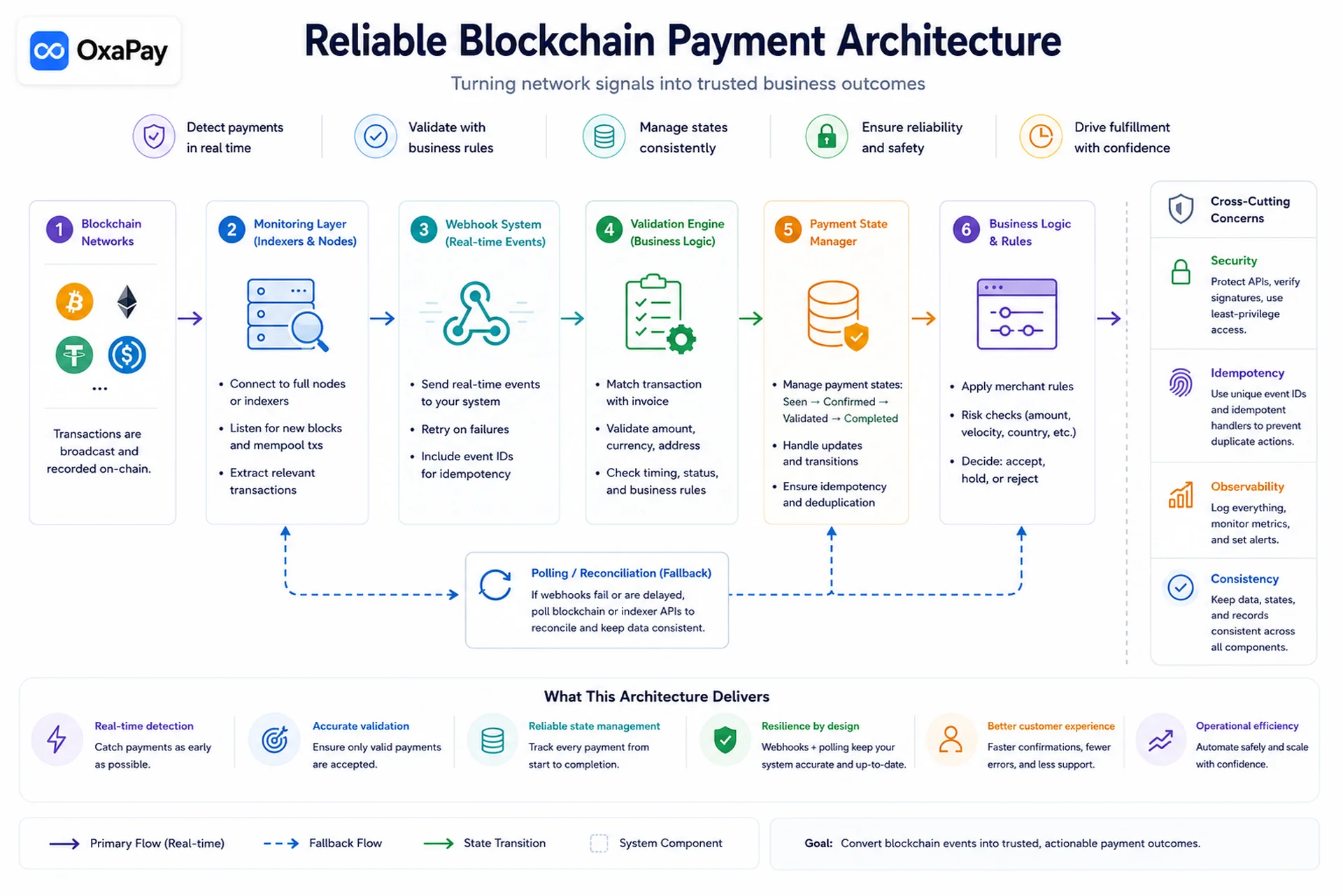
A system-level architecture showing how monitoring, validation, state management, webhooks, and reconciliation work together in reliable blockchain payment infrastructure.
Section 14: Advanced Concepts for Reliable Systems
Advanced systems require more than a checkout page and a confirmation count.
They need reliability mechanisms that protect the business when events arrive late, repeat, fail, or disagree with internal records.
This is where blockchain payments become a real payment infrastructure problem rather than only a transaction monitoring problem.
Event-Driven Processing
Event-driven processing lets a payment system react when a relevant payment update happens.
- payment detected
- confirmation count updated
- invoice marked as paid
- payment expired or rejected
This approach improves responsiveness, but it must be designed carefully.
Webhooks and Callback Reliability
Webhooks are useful because they send payment updates to your system without requiring constant manual checks.
But webhook delivery should never be treated as perfect.
- a webhook may arrive later than expected
- a webhook may be retried
- your server may be temporarily unavailable
- events may need to be verified before action is taken
For this reason, webhook handling should update payment state first, then allow business actions only after the state is valid.
Idempotency: Protecting Against Duplicate Actions
Idempotency means the same event can be received more than once without causing the same business action to happen twice.
This matters because payment systems may retry notifications or reprocess events during recovery.
- do not fulfill the same order twice
- do not credit the same account twice
- do not create duplicate accounting records
- do not change a completed payment back to an earlier state
Retry Logic and Recovery
Temporary failures are normal in real systems.
- a callback endpoint may fail temporarily
- a database write may not complete
- a queue may process events later than expected
- a payment may need to be checked again after network delay
Retry logic helps the system recover without relying on manual support intervention.
Polling as a Fallback, Not the Main Experience
Polling means your system checks payment status at intervals.
It is usually slower than webhook-based updates, but it can be valuable as a fallback verification layer.
- use webhooks for fast updates
- use polling to recover from missed or delayed events
- use reconciliation checks for high-value or disputed payments
State Consistency
State consistency means the blockchain state, payment gateway state, and merchant system state do not drift apart.
- the invoice state should match payment reality
- the order state should match invoice validity
- fulfillment should only follow a completed state
- accounting records should reflect final payment decisions
Without state consistency, teams spend time resolving disputes that the system should have prevented.
A Reliable Payment Infrastructure Pattern
Section 15: Final Summary
- transaction = network event
- payment = system decision
- confirmation ≠ completion
- payments move through states
- edge cases are normal
- rules create reliability
The Shift in Thinking
Not: Is the payment confirmed?
But: Is it valid, complete, and safe?
What Matters Most
- clear states
- consistent validation
- predictable decisions

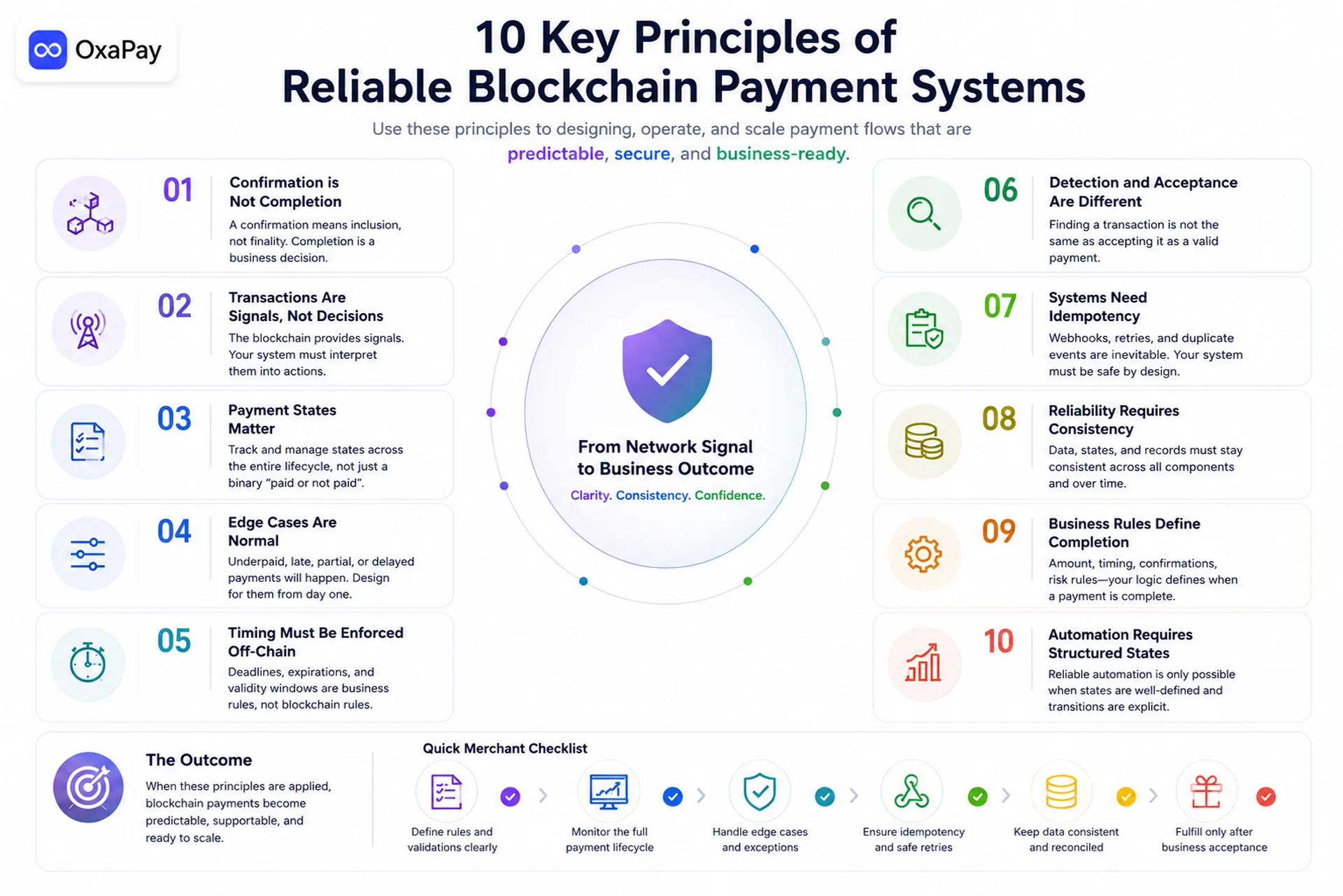
Ten practical principles for building blockchain payment systems that are reliable, consistent, scalable, and business-ready.
Section 16: Next Step
Understanding is the first step. Application creates value.
A merchant does not need to expose every blockchain detail to the customer. But the payment system behind the experience must understand those details clearly.
Practical Starting Point
- start with the simplest payment method that fits the business model
- define payment states before increasing automation
- set rules for underpaid, late, expired, and unconfirmed payments early
- observe real customer behavior before adding unnecessary complexity
- use reconciliation and webhook handling as part of the system, not as afterthoughts
Design Before Tools
- define behavior first
- define decisions second
- choose tools third
- handle edge cases explicitly
The best payment infrastructure is not the one that hides complexity completely. It is the one that turns complexity into clear states and reliable actions.
Where OxaPay Fits
For merchants, the hard part is not only receiving a blockchain transaction. The hard part is turning that transaction into a structured payment state the business can trust.
OxaPay helps bridge this gap by giving merchants practical payment tools such as payment links, invoices, API-based integrations, real-time status updates, and structured payment handling.
Instead of forcing teams to interpret raw blockchain activity directly, OxaPay helps convert network-level events into payment flows that can support fulfillment, reconciliation, and operational decisions more reliably.
Reflexión final
Blockchain payments become reliable when businesses stop treating confirmation as the full answer.
The real improvement comes when every transaction is understood as part of a larger system: detected, validated, matched, decided, and then completed.