The first decision is not how to accept crypto—it is whether crypto solves a real payment problem
Crypto payments may create a valuable new payment route, but they can also add complexity without producing a business benefit. Start by naming the customer segment and the actual friction that existing payment methods fail to solve.
Cross-border declines, unavailable payment rails, expensive transfers, slow settlement and requests from customers are testable reasons. A coin list, an API or a provider comparison is not a business case. The decision process can legitimately end in adoption, a small pilot or a pause.
- Define the payment problem and a measurable baseline
- Identify the customer group that faces the problem
- Estimate the commercial benefit and operational workload
- Choose launch, pilot or pause using evidence
Merchant takeaway: Introduce crypto as a response to measurable payment friction, not as a technology project searching for a use case.
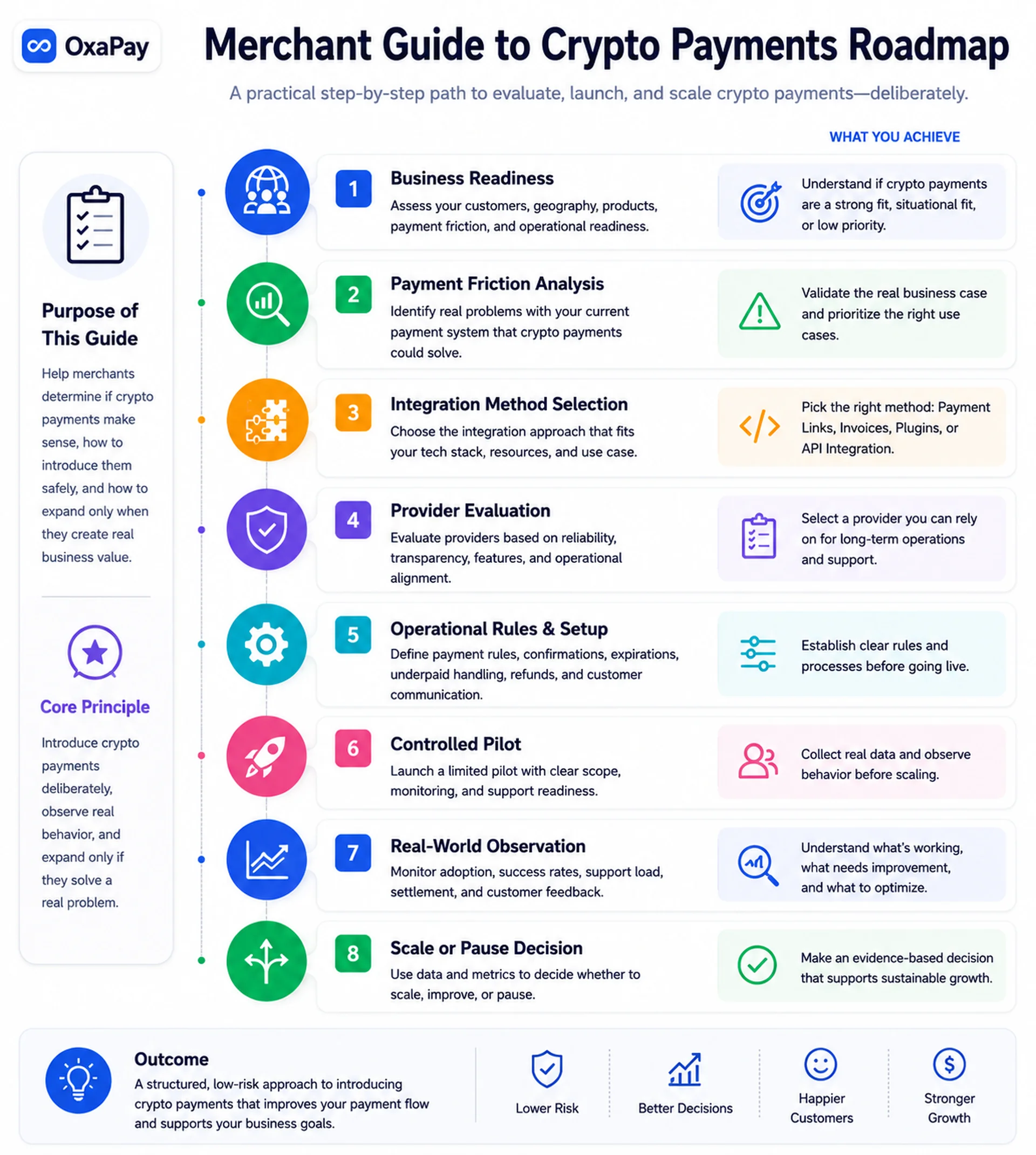
Business fit depends on customer access, payment friction, product risk, and internal capacity
International and digitally native customers may face access, speed, cost and transparency problems with conventional payments. This creates a reason to test crypto, not proof that crypto is always the answer. The Bank for International Settlements documents persistent cross-border payment frictions.
Digital services, remote work, software, online communities and international B2B invoices often allow a controlled trial. Physical delivery, regulated goods, frequent refunds or irreversible fulfillment may justify tighter policies. A business with reliable existing payments and no customer demand may have little reason to prioritize adoption.
- Customer signal: requests for crypto, declined cards or cross-border demand
- Commercial signal: recoverable sales, lower delay or access to a segment
- Operational signal: people who own exceptions, support, records and settlement
- Risk signal: fulfillment can wait for sufficient confidence or be reversed
Merchant takeaway: A business is ready to test when the expected benefit is specific and an operational owner is assigned.
Official references and related resources: BIS
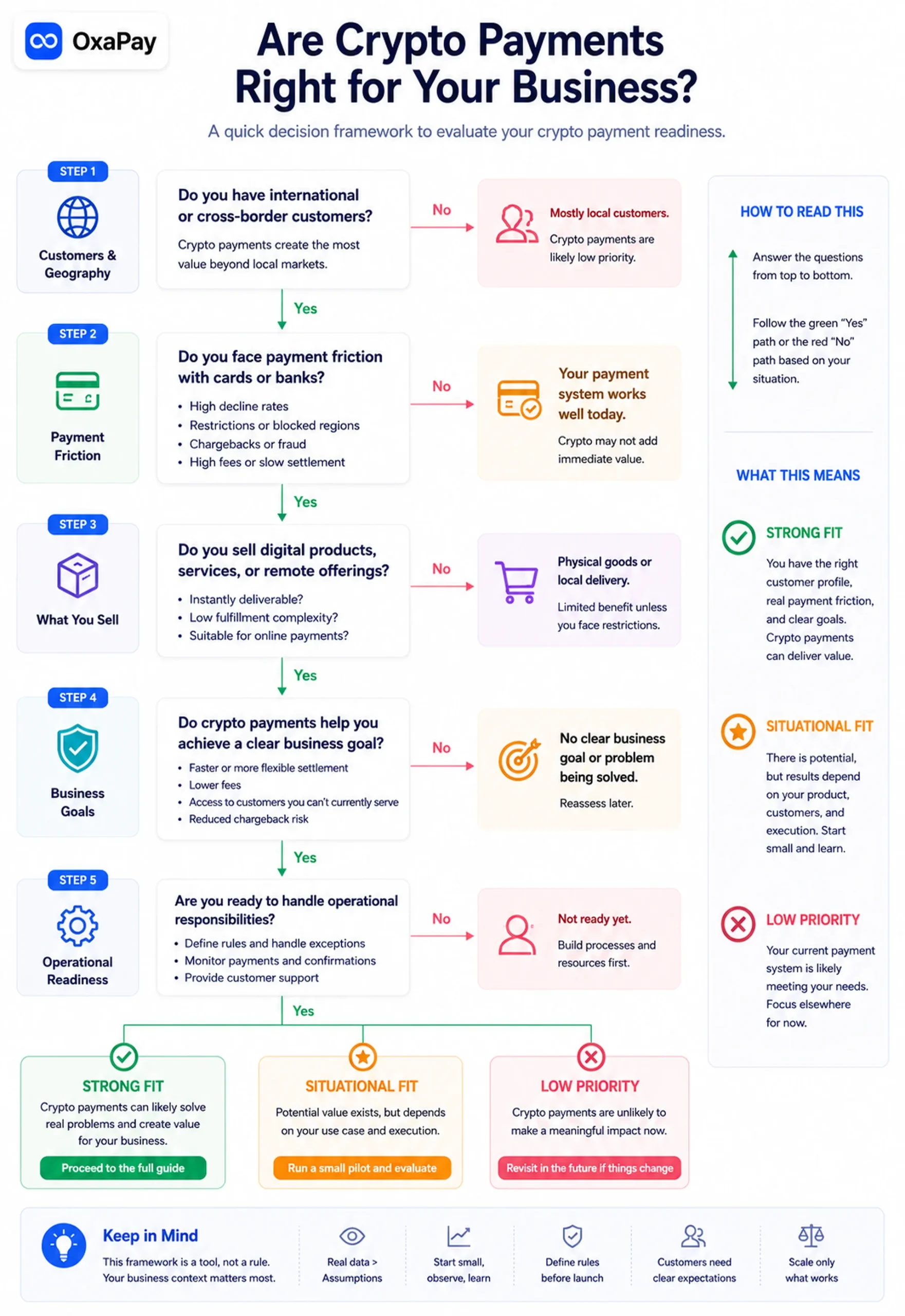
Decide who will own payment interpretation before choosing the technology
Receiving funds in a wallet is not the same as processing an order. A wallet does not automatically generate an invoice, apply expiration, match a payment, classify underpayment or update customer support and accounting records.
A gateway introduces payment requests, status, records and automated merchant workflows. Custom infrastructure offers deeper control at the price of engineering, security, incident response and maintenance. Select the least complex design that still protects the business.
- Direct wallet: small volume and acceptable manual reconciliation
- Payment gateway: structured requests, status tracking and automation
- Custom infrastructure: payment flow is core product functionality and needs deep control
Merchant takeaway: Technical control adds value only if the team has the capacity to operate it safely.
Merchants need accurate mental models before accepting real payments
Crypto payments are generally initiated by the payer, who chooses a wallet, asset, network, transaction fee and broadcast timing. This differs from a card authorization. A broadcast is not a confirmed payment, and confirmation cannot tell whether the commercial order is still valid.
A valid transaction can arrive too late, use the wrong network, or send an unexpected amount. Merchants need separate rules for each condition. Refunds generally require a new transfer and a validated destination, with approvals and a traceable financial record.
- Timing: detection, inclusion, confirmation and finality are separate milestones
- Amounts: underpayment, overpayment, rounding and multiple sends need rules
- Networks: token symbols alone cannot identify a payment route
- Refunds: verify recipient, network, amount, authorization and record
Merchant takeaway: The blockchain transfers value; the merchant defines commercial meaning, messaging and the next action.
Official references and related resources: Bitcoin Developer Guide
Choose the payment method that matches the sales flow and automation level
A freelancer collecting a one-off fee should not be forced into the same architecture as an online store, subscription product, marketplace or account-based platform. Start with how the customer buys and which order data must survive the transaction.
A Payment Link is suitable for no-code requests, early demand testing and social sales. A hosted invoice provides amount, expiration and traceable status. Plugins synchronize supported stores and billing systems. An API connects payments to custom applications. Static addresses fit deposits and top-ups but require careful matching when reused.
- Payment Link: no-code service payments and early trials
- Hosted Invoice: defined amount, lifetime, order reference and state
- Store or billing plugin: order and payment status synchronization
- Merchant API: custom checkout and product automation
Merchant takeaway: Start with the simplest model that preserves order context and support visibility.
Official references and related resources: Payment Link · Hosted Invoice · Store Plugins · Merchant API
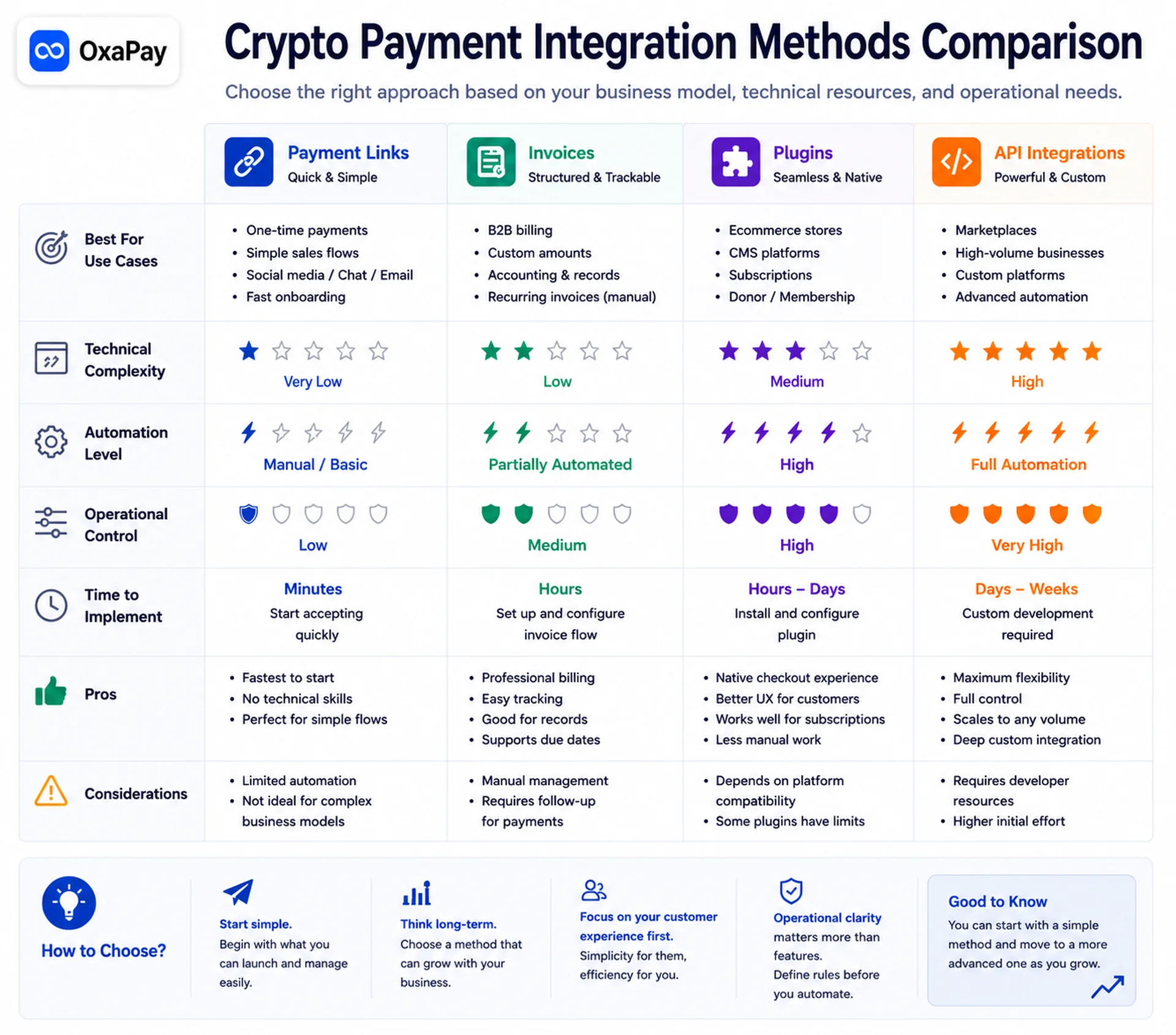
Offer a deliberate asset and network set instead of enabling every option
More currencies increase choice but also introduce wrong-network errors, support costs, reconciliation complexity and treasury exposure. Enable only those asset-network pairs that actual customers can use and the business can maintain.
Check demand, wallet access, price stability, fees, confirmation behavior, liquidity, settlement and accounting. Stablecoins may reduce unit-price volatility but retain issuer, network and liquidity risks. Use maintained supported-currency data rather than a permanently hard-coded list.
- Customer access: can people obtain and send the selected asset?
- Economics: are network fees and confirmation times suitable for order size?
- Treasury: will funds be held, converted or withdrawn?
- Support: can staff investigate delayed, unsupported or wrong-network transfers?
Merchant takeaway: Each enabled asset-network route needs a customer reason and a named operational owner.
Official references and related resources: OxaPay Supported Currencies · Supported Currencies API
Evaluate a provider as an operating dependency, not a checkout feature
Feature lists do not reveal whether a provider will support reliable real-world operations. Evaluate precise payment states, recoverable records, notification behavior, security, settlement control, incident handling and support depth.
Total cost is broader than the advertised processing fee: network fees, conversion, withdrawal, refunds, developer work, support and reconciliation all matter. Test APIs and published status definitions. OWASP API Security guidance is a useful starting point for access control, authentication, configuration and resource limits.
- State clarity: can staff explain every status and permissible action?
- Recovery: can records be queried after a missed webhook?
- Settlement: are custody, conversion, withdrawal and timing clear?
- Documentation: does actual behavior match published APIs?
- Security: are keys separated, callbacks verified and permissions limited?
- Support: can cases be traced across order, transaction and settlement?
Merchant takeaway: Choose for dependable operations under imperfect conditions, not the longest feature list.
Official references and related resources: OxaPay Pricing · OWASP API Security Top 10
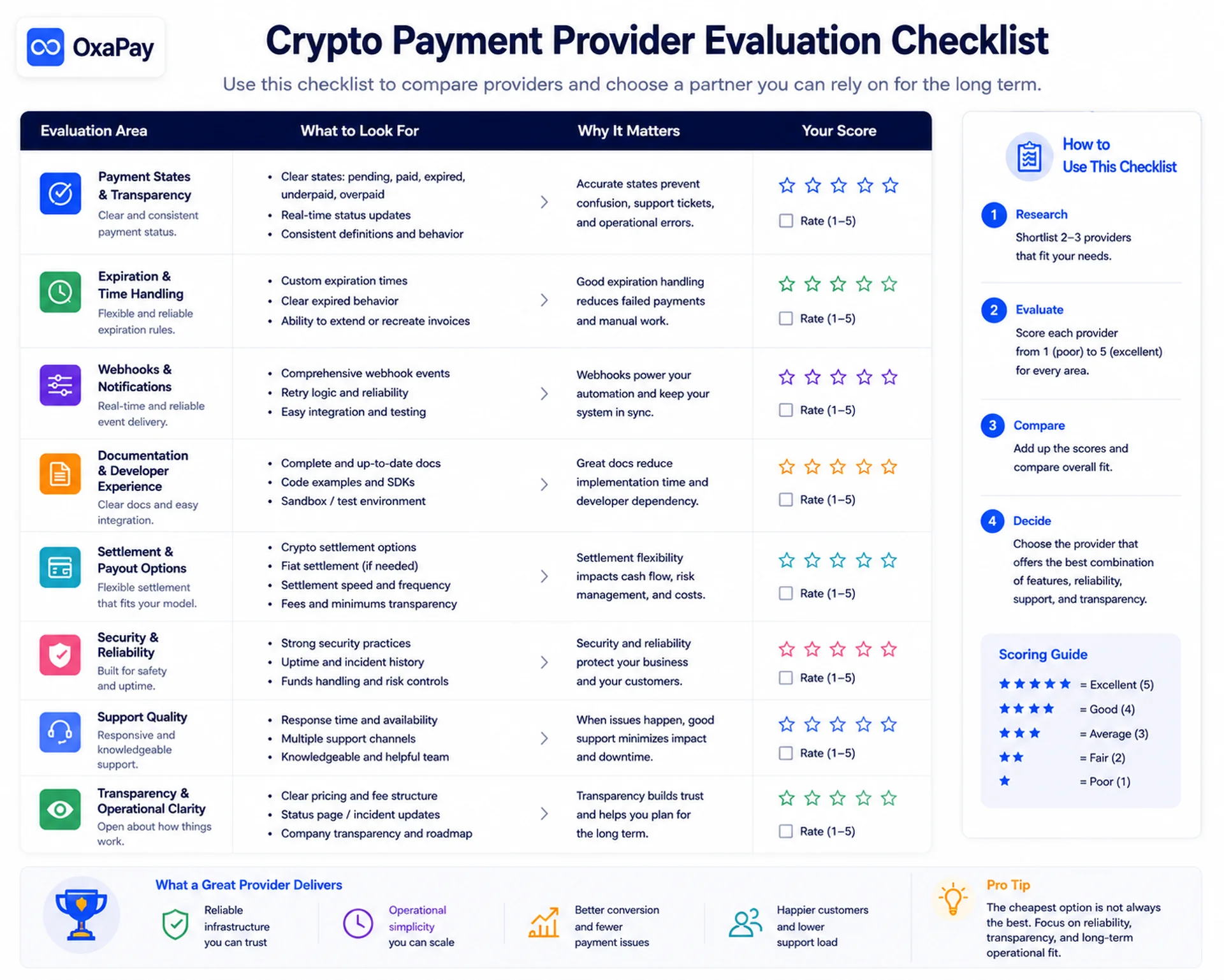
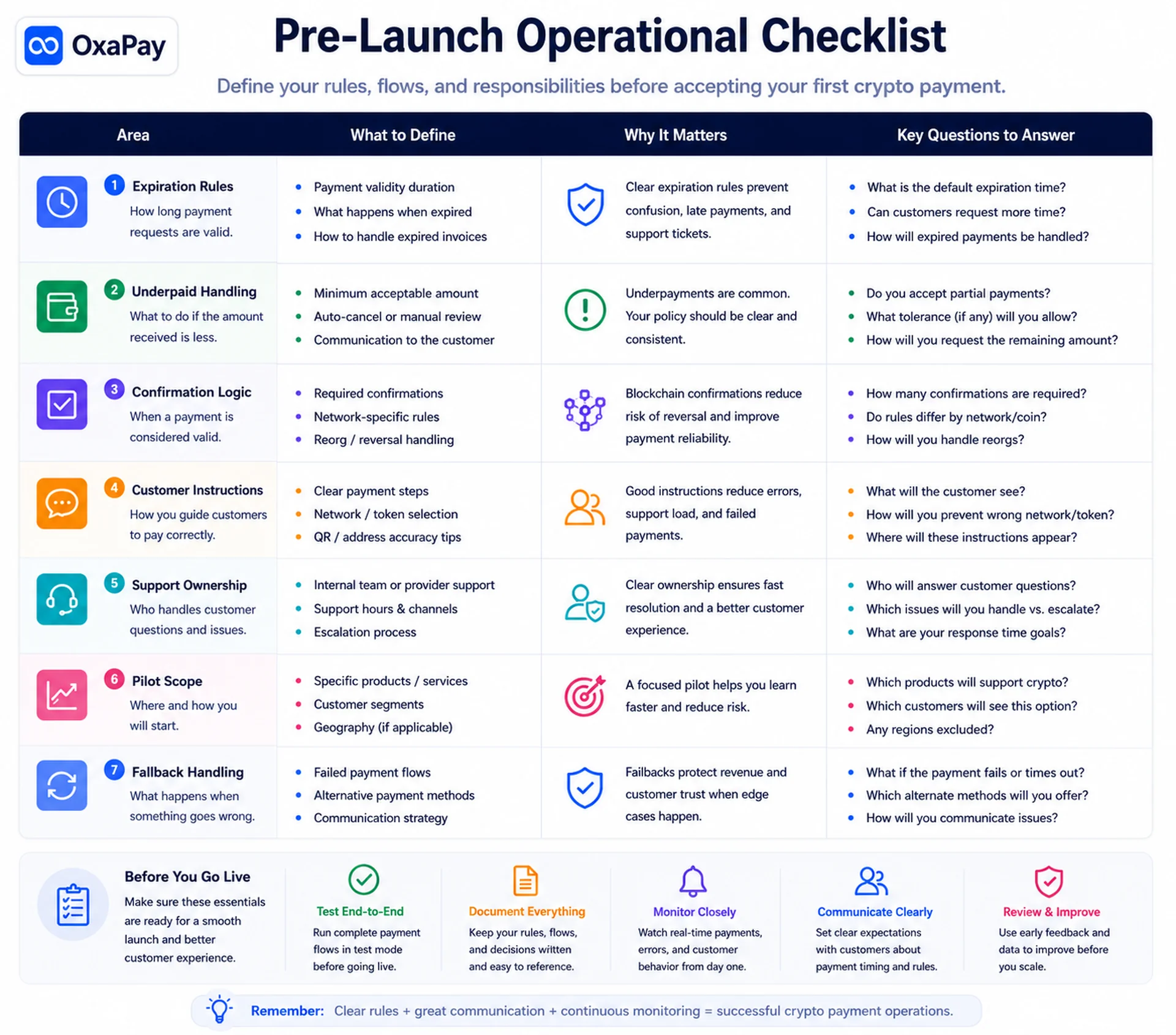
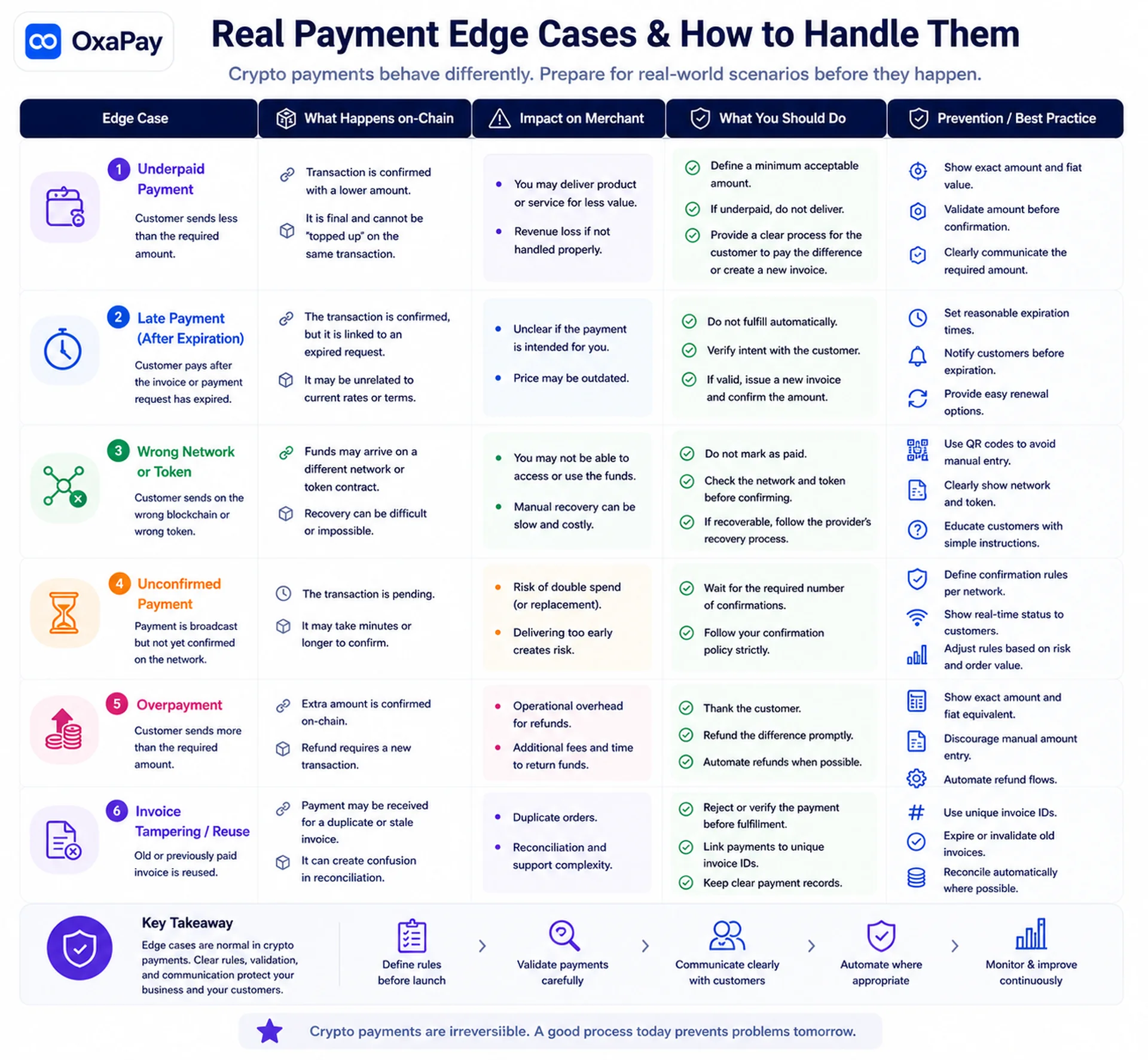
Define completion, expiration, exceptions, refunds and fulfillment before launch
Provider states do not automatically define when orders may ship or accounts may be credited. A transaction marked detected or paying should not trigger irreversible delivery. The merchant must map each payment status to allowed business actions and customer messages.
Write explicit rules for partial or excessive payments, expired invoices, transfers on the wrong chain and refunds. Define whether balances can be topped up, accepted within tolerance, refunded or escalated, and assign a responsible owner for every path. Keep customer-facing messages simple and accurate.
- Underpayment: tolerance, top-up, review or rejection
- Late payment: validate price, stock and the original order
- Overpayment: credit, refund, documentation and approval
- Wrong network: investigate recoverability before making a promise
- Refund: validate destination, amount, fees, approvals and accounting
Merchant takeaway: Every non-ideal state needs an owner, a permitted action and a customer message.
Official references and related resources: OxaPay Payment Status Table
Regulation, sanctions, tax, accounting and recordkeeping belong in the launch decision
Obligations vary with the jurisdiction, asset, business activity, custody and conversion or payout services. Assess consumer, sanctions, AML, tax and financial reporting requirements before taking live funds. FATF offers virtual-asset risk guidance, while the OECD reporting framework provides an international tax-transparency reference.
Accounting rules require separate analysis: cryptocurrency holdings may not be classified as ordinary cash under IFRS. Agree on valuation, timestamps, record retention, control of funds, treasury reconciliation and local professional review before balances accumulate. International guidance does not replace local legal advice.
- Legal scope: assess acceptance, custody, conversion and payout obligations
- Records: preserve order ID, payment ID, TXID, time, value, fees and outcome
- Valuation: specify exchange-rate source and recording time
- Treasury: document who can hold, convert, withdraw and reconcile
Merchant takeaway: Operational discussion only, not legal, tax, financial, security or accounting advice.
Official references and related resources: FATF Virtual Assets · OECD Crypto-Asset Reporting Framework · IFRS Cryptocurrency Holdings
Launch a controlled pilot with narrow scope and deliberate test cases
The initial release should establish whether one payment use case can work safely rather than prove that crypto fits the entire business. Limit the pilot by customer segment, product, geography, asset-network combinations, amount per payment and daily volume.
Test successful payments and the edge cases most likely to generate harm: pending or delayed transactions, partial payments, expiration, duplicates, refunds and unavailable callbacks. Assign owners for payment operations, support, engineering and finance, plus explicit suspension conditions.
- Scope: one use case, limited assets and a transaction ceiling
- Test plan: successful, delayed, underpaid, expired, duplicate and refund cases
- Ownership: named payment, support, finance and escalation contacts
- Stop conditions: security incident, duplicate fulfillment or unresolved ledger gaps
Merchant takeaway: A pilot succeeds when staff can reconstruct every payment from order to final action.
Official references and related resources: Generate Invoice API · Webhooks · Payment Information API
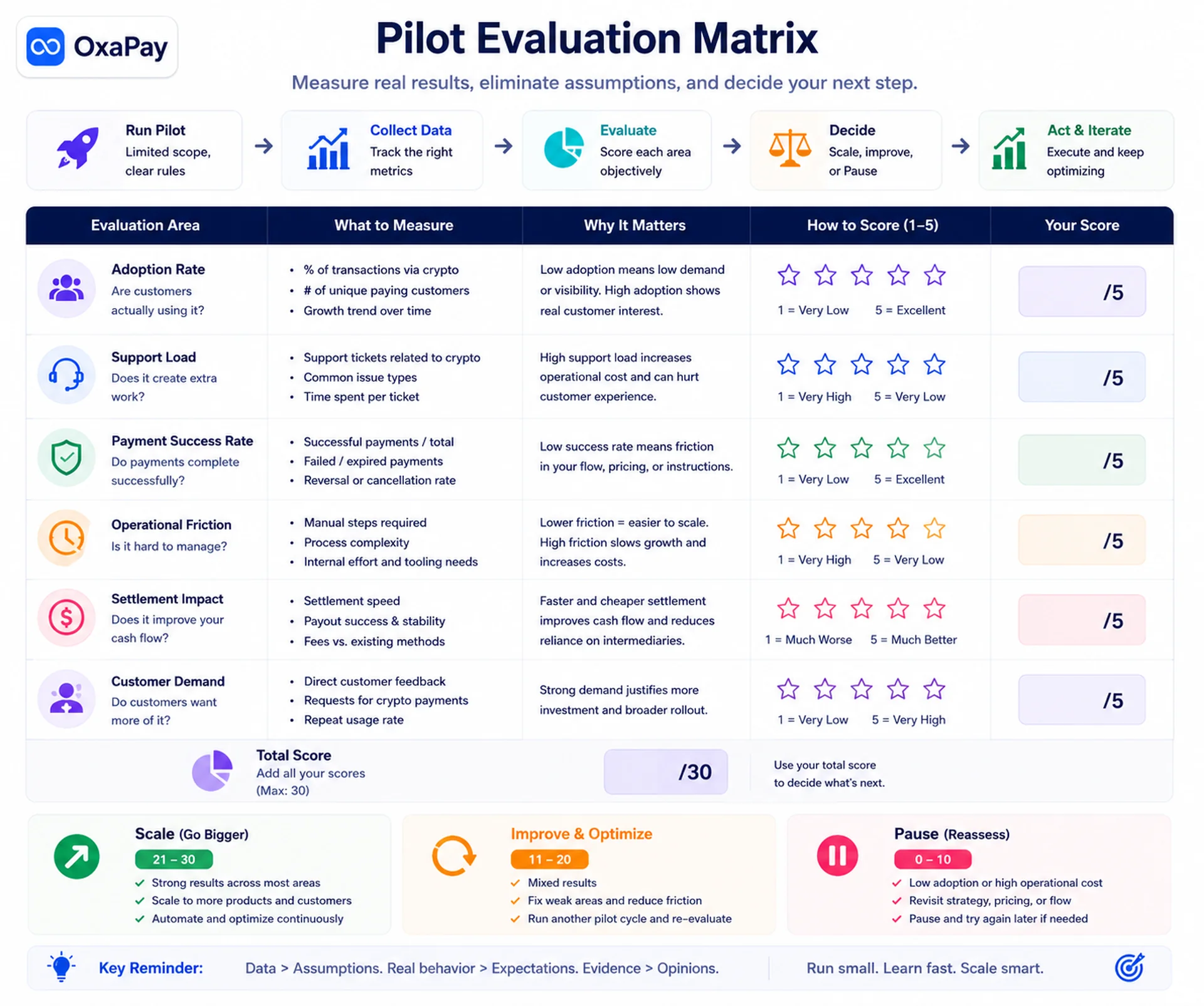
Measure customer value, payment quality and operating cost before scaling
Payment volume is not proof of value. Assess whether eligible customers choose the option, created requests become accepted payments, transactions complete quickly enough and exception handling stays manageable.
Measure the number of customer contacts and staff minutes per successful payment, not only provider fees. Combine fulfillment reliability, settlement variance and reconciliation gaps with recovered revenue or new-market access. Scale only when customer benefits outweigh the total operating burden.
- Adoption: share of eligible customers choosing crypto
- Completion: requests reaching the accepted state
- Time: duration until safe fulfillment or settlement
- Exceptions: delayed, short, expired or unmatched payments
- Support: contacts and minutes per successful payment
- Net value: added access or savings after all costs
Merchant takeaway: Scale, redesign or pause according to results, not the quantity of technical events.
Official references and related resources: Payment History API
Use OxaPay tools according to the merchant problem
OxaPay offers different merchant payment approaches; a no-code collection request, storefront, SaaS flow or recurring balance top-up should not automatically share one integration. Payment Links can validate demand; hosted invoices preserve amount, lifetime and order details; plugins connect supported platforms; APIs support custom payment sessions.
For API integrations, keep the OxaPay tracking identifier beside the merchant order ID. Authenticate and process callbacks safely, and query payment information or history after missed events. OxaPay provides the payment layer; merchants remain responsible for fulfillment, support, compliance and accounting.
- Test demand: Payment Link for simple collections
- Add structure: Hosted Invoice with payment reference and callback
- Connect commerce: plugin for a supported platform
- Build automation: Merchant API and durable state integration
Merchant takeaway: Choose tools for a defined workflow, while retaining merchant-owned operating policies.
Official references and related resources: Payment Link · Invoice · Plugins · Merchant API
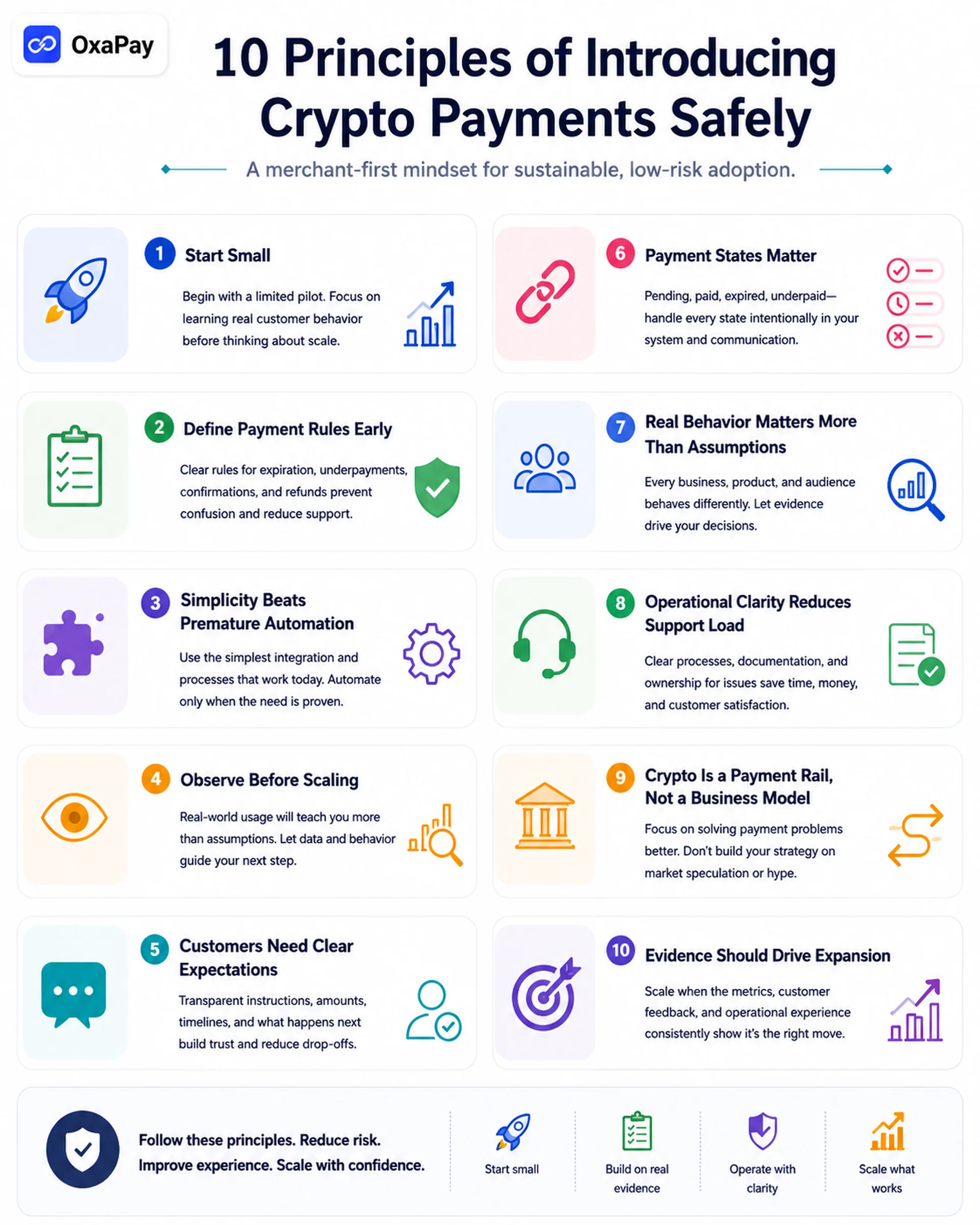
Ten operating principles for introducing crypto payments safely
Safe adoption follows a sequence of deliberate decisions rather than a one-click enablement. Define the business problem, the people accountable and the smallest workable payment route. Then test real failure conditions before extending reach.
The principles below combine the customer experience with network realities, operational safeguards, finance evidence and explicit criteria for stopping or scaling a pilot.
- 01. Begin with a measurable payment problem
- 02. Assign an operating owner before launch
- 03. Choose the simplest suitable payment model
- 04. Enable only supported assets and networks
- 05. Do not equate detection with fulfillment
- 06. Define short, late, extra, failed and refunded payments
- 07. Secure credentials, webhooks and business actions
- 08. Maintain reconstructable finance and support records
- 09. Run a limited pilot with stop conditions
- 10. Expand only when customer value and operational evidence agree
Merchant takeaway: These controls do not remove every risk; they make risk, responsibility and next steps visible.
Ground merchant decisions in payment, security, regulation and accounting evidence
The BIS material describes cross-border payment frictions, while Bitcoin developer documentation explains the network payment process. FATF and OECD provide risk-based virtual-asset and reporting perspectives; the IFRS committee addresses accounting treatment and OWASP documents API security risks.
Use current OxaPay product pages and developer documentation for available tools, assets, prices, API parameters and payment statuses because these details may change. This guide is educational and cannot substitute for advice from qualified professionals in the relevant jurisdiction.
- BIS: commercial payment frictions
- Bitcoin documentation: transaction and confirmation behavior
- FATF and OECD: regulatory and reporting reference points
- IFRS: accounting classification
- OWASP: API security
- OxaPay documentation: live product and integration contract
Merchant takeaway: A good strategy is defined by the quality of reasoning, controls and evidence—not merely the decision to adopt.
Official references and related resources: BIS Cross-Border Payments · Bitcoin Payment Processing · FATF · OECD · IFRS · OWASP