
Every payment system depends on one thing above all else:
Trust.
Traditional payment networks build that trust through centralized control. Banks, payment processors, and financial institutions verify transactions, maintain records, and determine which payments are valid.
Blockchain systems approach the same challenge differently.
Instead of trusting an institution, the network relies on cryptography, distributed validation, and consensus rules to secure transactions.
This is what makes blockchain payment security fundamentally different from traditional payment infrastructure.
In blockchain systems, security is not added afterward as a protective layer. It is built directly into how transactions are created, verified, and recorded.
Blockchain Security Starts Before a Transaction Is Broadcast
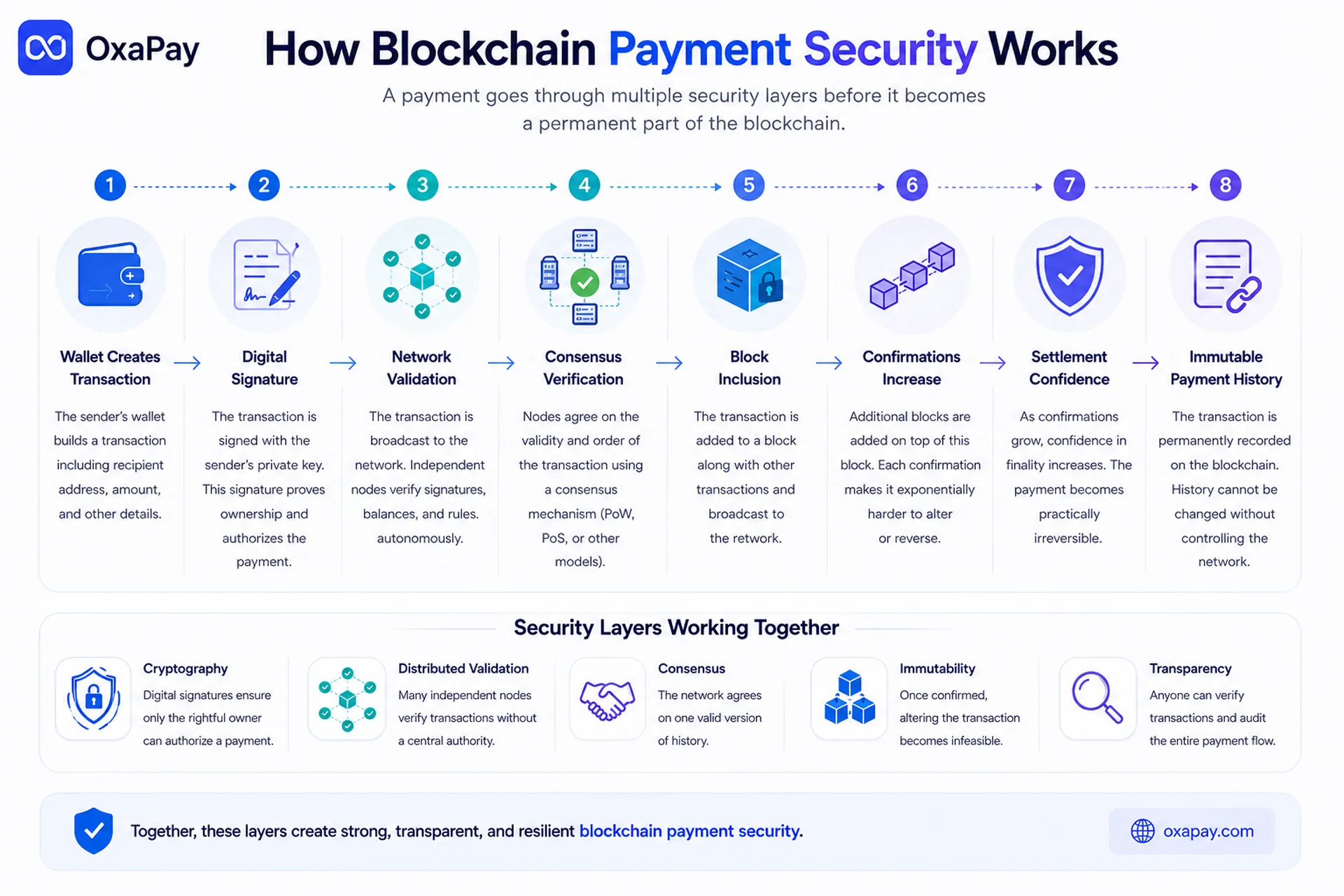
One of the most important differences in blockchain payments is that authorization happens cryptographically.
Before a transaction enters the network:
- the wallet constructs the transaction
- the sender signs it using a private key
- the signature mathematically proves ownership of the funds
The network does not ask:
“Who are you?”
Instead, it asks:
“Can you produce a valid cryptographic signature for these funds?”
This removes the need for centralized identity verification during transaction authorization. The blockchain trusts the mathematics behind the signature rather than the identity of the sender. For readers who want a deeper technical view, the Bitcoin Developer Guide explains how transactions are structured and signed in Bitcoin-based systems.
Read the Bitcoin transaction guide
Transactions Cannot Simply Be Altered After Signing
Once a transaction is signed, its contents become cryptographically tied to that signature.
Even small changes to the amount, recipient address, or transaction structure would immediately invalidate the signature.
This prevents silent manipulation.
A malicious actor cannot intercept a transaction, change its destination, and forward it to the network while keeping the original proof intact. The signature would no longer be valid.
That is why authorization in blockchain payments happens before the network even begins collective validation.
The Network Verifies Transactions Collectively
A valid signature alone is not enough to secure a payment.
The network must also verify that the transaction follows all protocol rules.
Instead of relying on a central authority, blockchain networks distribute this responsibility across many independent nodes.
Each node verifies:
- signatures
- balances
- transaction rules
- protocol compliance
Importantly, these checks happen independently.
There is no single organization deciding whether a payment should be accepted.
This distributed validation model is one of the foundations of blockchain payment security because trust shifts from institutions to collective verification.
For readers who want to understand the full payment flow before diving deeper into security, this guide to how blockchain payments work explains the transaction journey from payment creation to settlement.
Security in Blockchain Is Closely Connected to Consensus
Validation alone is still not enough.
The network must also agree on transaction order and blockchain history.
This is where consensus mechanisms become critical.
Different blockchains use different approaches, including:
- Proof of Work
- Proof of Stake
- delegated validation systems
- other consensus models
Although the mechanisms differ, the objective remains the same:
preventing fraudulent transaction histories from becoming accepted network state.
Consensus is what makes double-spending difficult. Without consensus, multiple versions of transaction history could exist simultaneously, creating uncertainty about which payments are valid.
Together, cryptographic signatures, distributed validation, and consensus create the security foundation that blockchain networks rely on. NIST also describes consensus, cryptographic primitives, and distributed ledgers as core concepts in blockchain architecture.
Read the NIST blockchain technology overview
Why Immutability Matters for Payments
Once transactions are confirmed and additional blocks are built on top of them, altering history becomes increasingly difficult.
This property is commonly called immutability.
Immutability does not mean reversal is mathematically impossible. It means rewriting blockchain history becomes economically and computationally impractical under normal conditions.
For payment systems, this changes how settlement works.
Traditional payments may:
- be reversed
- be charged back
- depend on intermediary decisions after the transaction occurs
Blockchain transactions become progressively harder to alter as confirmation depth increases.
Consider the difference between a card payment and a confirmed blockchain payment.
A merchant may receive a card payment today and still face a chargeback weeks later. A blockchain transaction that has accumulated sufficient confirmations becomes increasingly difficult to reverse because changing it would require altering accepted network history.
This changes the trust model around settlement certainty.
Blockchain Security Is Not the Same as Wallet Security
This distinction is critical.
People often say:
“Blockchain was hacked.”
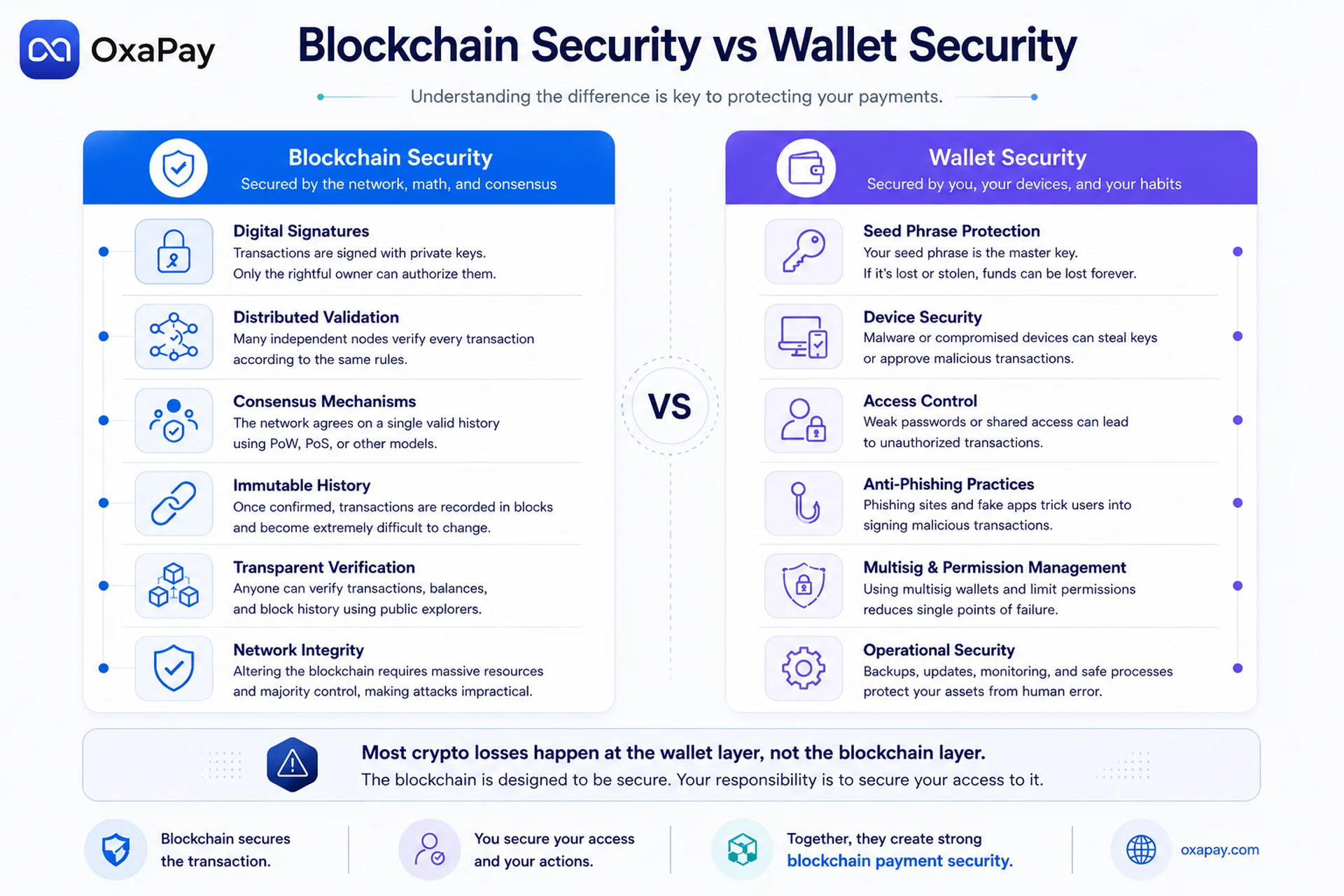
But many real-world losses occur outside the blockchain itself.
The blockchain may remain completely secure while users lose funds because of:
- exposed seed phrases
- phishing attacks
- compromised devices
- malicious smart contract approvals
- poor operational security
The network secures transaction integrity. It does not protect users from unsafe key management.
This is why blockchain security and wallet security are related, but not identical concepts.
For merchants, wallet protection is a separate operational layer. This guide on securing crypto wallets for merchants explains practical safeguards such as access control, backups, and secure wallet management.
Transparency Is Also Part of Security
Blockchain systems expose transaction activity publicly.
Anyone can:
- inspect transactions
- verify balances
- track confirmations
- audit payment flows through blockchain explorers
This transparency changes how verification works.
Instead of trusting reports from an intermediary, participants can independently inspect network state.
For merchants, this visibility reduces ambiguity around:
- payment timing
- confirmation progress
- transaction authenticity
Transparency does not eliminate fraud entirely. However, it significantly reduces hidden manipulation within payment infrastructure.
If you want to understand how users and merchants can inspect payments directly, this guide explains what a blockchain explorer is and how to use one.
Smart Contracts Introduce Additional Security Considerations
On programmable blockchains such as Ethereum, payments may interact with smart contracts instead of simply transferring value between wallets.
This enables capabilities such as automated settlements, token payments, subscription logic, and other programmable payment workflows.
At the same time, security no longer depends solely on blockchain consensus.
Poor contract design, excessive permissions, or software vulnerabilities can create risks even when the underlying blockchain remains secure.
As a result, blockchain payment security on smart contract networks depends both on the security of the blockchain itself and on the quality of the application logic built on top of it.
Ethereum’s developer documentation explains how smart contracts work, and its security guidance covers common design and implementation risks.
Read Ethereum smart contract documentation
Read Ethereum smart contract security guidance
Why Decentralization Changes Attack Surfaces
Centralized systems usually create centralized points of failure.
If a central database, payment processor, or settlement system is compromised, the impact can affect the entire network.
Blockchain systems distribute responsibility across many independent participants.
This changes attack economics significantly.
Manipulating blockchain state typically requires:
- large-scale computational control
- significant validator influence
- majority consensus manipulation
Rather than attacking a single server, an attacker must overcome a distributed system designed to resist coordinated manipulation.
The difficulty of executing such attacks across decentralized infrastructure is one of the reasons blockchain payment security can be highly resilient.
Security Does Not Mean Instant Finality
A transaction appearing on the network does not automatically mean it is fully secure.
Transactions typically move through several stages:
- broadcast
- pending
- included in a block
- confirmed
- final enough to trust
This distinction is especially important for businesses.
For example, imagine an online store receives a $20 payment. The merchant may be comfortable accepting the order after a single confirmation because the financial risk is relatively small.
Now consider a $10,000 payment for expensive equipment. In that situation, the merchant may wait for multiple confirmations before treating the payment as fully settled.
The transaction may be visible almost immediately, but settlement confidence increases as additional blocks are added on top of it.
This is one of the most practical aspects of blockchain payment security. Security is not a binary state that appears instantly. It strengthens progressively as the network gains greater certainty about a transaction’s position in blockchain history.
For a deeper business-focused explanation, this guide to payment confirmation systems explains why confirmation policies are operational decisions, not just blockchain events.
Businesses Still Need Operational Security
Even with strong blockchain infrastructure, merchants still need operational safeguards.
These may include:
- secure wallet management
- multisignature authorization systems
- controlled employee access
- backup and recovery procedures
- transaction monitoring
- network-aware payment policies
Blockchain reduces certain categories of payment risk. It does not eliminate operational responsibility.
For example, a business can receive payments on a highly secure blockchain and still lose funds because of poor access controls or compromised wallet credentials.
This is why payment infrastructure platforms such as OxaPay Merchant Service focus not only on blockchain connectivity, but also on structured payment flows, transaction monitoring, and operational reliability across supported networks.
Developers and payment teams should also protect the API layer around payment systems. This guide on payment API security best practices explains how API keys, access control, and secure configuration affect crypto payment operations.
The blockchain secures the transaction.
The payment system secures the workflow surrounding that transaction.

What Blockchain Security Really Means
One of the biggest misconceptions about blockchain security is assuming that it comes from a single feature.
In reality, security emerges from multiple layers working together.
These layers include:
- cryptographic signatures
- distributed validation
- consensus mechanisms
- immutable transaction history
- transparent verification systems
No individual component creates trust on its own.
The system creates trust collectively.
This layered design is ultimately what gives blockchain payment security its strength.
Conclusion
Blockchain payment security is built on multiple layers working together, including cryptography, distributed validation, consensus, and transparent verification.
Rather than depending on a central authority, blockchain networks create trust through mathematical rules and collective agreement. At the same time, secure wallet management, smart contract design, and operational safeguards remain essential parts of a secure payment environment.
If your business wants to accept cryptocurrency payments through a secure and reliable infrastructure, explore the OxaPay Crypto Payment Gateway to simplify payment processing, monitor transactions, and manage crypto payments across multiple blockchain networks.