Most people first encounter blockchain through payments.
A customer sends Bitcoin. A wallet shows “sent.” A transaction appears on a blockchain explorer within seconds. From the outside, the process can feel surprisingly simple.
But 区块链支付 work differently from traditional payment systems. Instead of a central institution validating transactions, blockchain networks rely on distributed agreement across the network.
Because of this, a blockchain payment is not instantly final the moment it is sent. Before settlement becomes reliable, the transaction must move through stages such as broadcast, validation, block inclusion, and confirmation. For merchants, understanding how blockchain payments work helps explain why delays, confirmation waiting, and settlement uncertainty are normal parts of blockchain transaction processing.
Blockchain Is a System of Agreement
It is easy to think of blockchain as a place where transactions are simply stored.
In reality, storage is only one part of the system. The more important function is agreement.
Instead of relying on a central institution to validate payments, blockchain networks distribute verification across many independent participants. Nodes check whether transactions follow network rules, whether funds can actually be spent, and whether the same funds have already been used elsewhere.
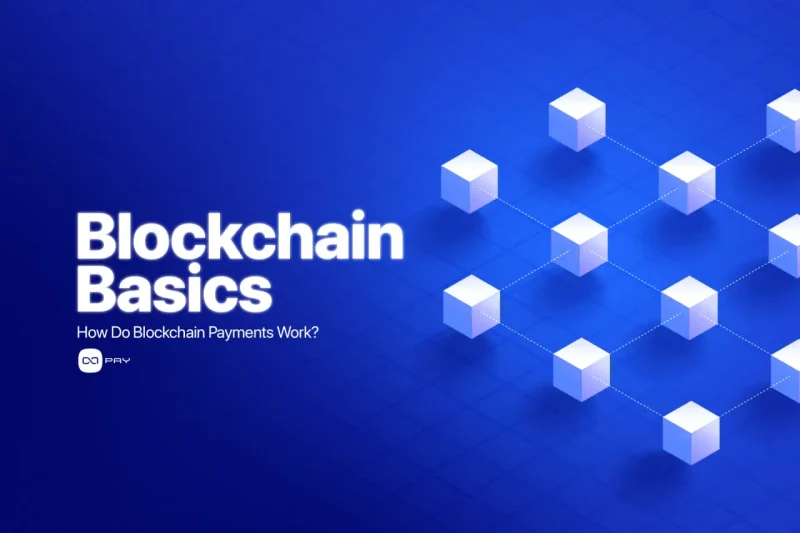
Validated transactions are grouped into blocks, and those blocks are connected chronologically to form the blockchain itself.
This structure allows the network to continuously agree on which transactions belong in the shared history of the system.
That is why blockchain is not simply recording payments. It is continuously determining which payments the network accepts as valid.
Why This Changes Payment Behavior
Traditional payment systems rely on centralized infrastructure to finalize transactions. Blockchain systems work differently because agreement happens across a distributed network instead of inside a single institution.
This is why blockchain payments move through stages rather than becoming instantly final. Before a payment becomes reliable enough to trust, the network must receive the transaction, validate it, include it in a block, and continue building confirmations on top of it.
That process creates concepts like pending transactions, confirmation waiting, fee competition, and settlement timing.
What Actually Happens When a Payment Is Sent
When a customer sends a blockchain payment, the transaction does not immediately become part of the blockchain.
Understanding how blockchain payments work begins with understanding what happens after a transaction is broadcast to the network.
It begins as a signed digital message broadcast to the network. Nodes receive the transaction, verify its structure and validity, and then propagate it further across the system. Within seconds, the transaction may already appear inside wallets or blockchain explorers.
However, visibility does not mean settlement.
At this stage, the transaction is still waiting to be included in a block. Most blockchain networks maintain a pool of pending transactions, commonly called the 内存池, where transactions compete for inclusion based on network conditions and transaction fees.
This is the point where blockchain payments shift from simple transmission to network prioritization.
Why Some Transactions Confirm Faster Than Others
Two transactions sent at nearly the same time can behave very differently depending on fee levels, congestion, and block availability.
One may be included quickly, while another remains pending longer than expected.
From a user perspective, this can feel inconsistent.
From the network’s perspective, it is simply how limited block space is allocated under demand.

Why Blockchain Payments Don’t Settle Instantly
Traditional payment systems often hide settlement complexity behind centralized infrastructure. Blockchain networks expose more of that process directly.
One of the most important parts of understanding how blockchain payments work is recognizing why settlement takes time.
Transactions are processed in blocks, and blocks are created at intervals rather than continuously. Each block has limited capacity, which means the network cannot include every pending transaction immediately during periods of high activity.
As demand increases, transactions begin competing for available block space.
This is why payments may remain pending even after they have already been broadcast successfully. In many cases, the transaction itself is valid, but the network has not prioritized it yet.
Common Reasons Transactions Experience Delays
Several factors can influence this behavior:
- network congestion
- transaction fee competitiveness
- block timing
- sudden spikes in blockchain activity
This does not necessarily indicate failure.
It reflects the reality that blockchain networks operate under resource constraints and decentralized coordination rather than centralized processing guarantees.

What Confirmation Actually Means
Once a transaction is included in a block, it receives its first confirmation.
To understand how blockchain payments work operationally, merchants need to understand what confirmations actually represent.
This is an important step because it means the network has accepted the transaction into its current version of history. But blockchain systems are probabilistic by nature, which means inclusion alone does not immediately guarantee permanence.
As additional blocks are added on top of the original block, the transaction becomes increasingly difficult to reverse or replace. Each new confirmation strengthens confidence that the transaction will remain part of the chain permanently.
Why Confirmations Matter for Merchants
This is why confirmations accumulate over time.
They are not simply progress indicators. They represent growing settlement confidence within the network.
For merchants, this distinction matters operationally. A transaction that has been seen by the network is not necessarily reliable enough to fulfill an order immediately.
Different businesses choose different confirmation thresholds depending on:
- payment size
- operational risk tolerance
- the blockchain being used
Understanding this progression is one of the foundations of interpreting blockchain payments correctly.
Transparency Does Not Automatically Create Clarity
One of blockchain’s strongest characteristics is 透明度.
Transactions can be tracked publicly from the moment they are broadcast. Users can monitor confirmations, wallet activity, block inclusion, and transaction history directly through 区块链浏览器.
But transparency alone does not automatically make the system easy to interpret.
A transaction may appear visible before it is confirmed. It may be confirmed but still lack strong settlement confidence. It may also remain delayed even though nothing is technically wrong.
To users unfamiliar with blockchain behavior, these situations can appear inconsistent or broken.
In reality, they are often normal stages of transaction processing inside decentralized systems.
Most Payment Confusion Comes From Misinterpretation
Most confusion around blockchain payments comes not from hidden behavior, but from misunderstanding visible behavior.
A transaction fee may simply be too low during congestion. A payment may have been sent through the wrong blockchain network. Settlement timing may vary because network demand changed unexpectedly.
These situations are operational behaviors, not necessarily technical malfunctions.
The challenge in blockchain payments is rarely just sending transactions. The real challenge is understanding what the network is actually signaling at each stage of the payment lifecycle.
From Blockchain Activity to Payment Decisions
Blockchain networks provide raw transaction information.
They show whether a transaction exists, whether it has propagated through the network, whether it has entered a block, and how many confirmations it has accumulated.
What blockchain does not do is decide how businesses should act on that information.
That layer belongs to payment infrastructure.
This is one of the most overlooked aspects of how blockchain payments work in real business environments.
A payment system translates blockchain activity into operational decisions, such as:
- when to mark an invoice as paid
- when additional confirmations are needed
- when to wait because settlement confidence is still low
- when a payment may require manual review
Without this interpretation layer, merchants are forced to analyze blockchain states manually for every payment.
As crypto payments scale operationally, understanding this distinction becomes increasingly important.
Businesses that want to understand how payment infrastructure interprets blockchain activity can also read this guide on how crypto payment gateways work.
结论
Blockchain payments behave differently because blockchain itself works differently. Transactions are not finalized instantly by a central institution. They move through a distributed process of validation, block inclusion, and confirmation before reaching reliable settlement confidence.
For merchants, understanding how blockchain payments work changes how crypto payments are interpreted operationally. Once the underlying process becomes clear, payment states, confirmation timing, and network behavior become far easier to monitor, understand, and manage in real business workflows.
As crypto payment operations grow, merchants need more than blockchain visibility alone. OxaPay 加密网关 helps businesses manage confirmations, payment states, and transaction workflows through infrastructure designed for real operational use.