People often talk about cryptocurrencies as if they were one unified system. But in practice, Bitcoin, Ethereum, USDT, Monero, and utility tokens behave very differently from one another. They process transactions differently, create different fee structures, expose users to different risks, and support completely different kinds of digital activity.
That difference becomes much more important once cryptocurrency moves beyond speculation and starts interacting with real operational systems. A business accepting Bitcoin does not experience payments the same way as a business accepting stablecoins on Tron, and a developer building on Ethereum faces different infrastructure constraints than one building on Solana. Even two assets with the same name can behave differently depending on which blockchain network they operate on.
This is why understanding the types of cryptocurrencies is not just about memorizing categories. It is about understanding how blockchain architecture shapes payment behavior, settlement reliability, user experience, and digital economic activity itself.
What Are Cryptocurrencies?
Cryptocurrencies are digital assets that operate on blockchain-based networks. Instead of relying on a central institution to maintain balances and validate transactions, blockchain systems distribute this process across independent network participants who collectively maintain a shared transaction history.
But cryptocurrencies are not simply “digital money.” Each cryptocurrency is connected to a specific network structure, rule set, economic model, technical limitation, and purpose.
Some assets are optimized for decentralization and long-term security. Others prioritize scalability, programmability, privacy, or price stability. That distinction matters because blockchain networks are not interchangeable infrastructure.
The architecture behind an asset directly affects transaction costs, confirmation timing, liquidity behavior, settlement reliability, and operational usability. From the outside, many crypto transactions may look similar. Operationally, they can behave like completely different systems.
Why Different Types of Cryptocurrencies Exist
The crypto industry did not evolve into thousands of assets simply because people wanted alternatives to Bitcoin. Different categories emerged because one blockchain model could not efficiently solve every problem.
Bitcoin introduced decentralized value transfer without centralized ownership. The original Bitcoin white paper presented a peer-to-peer electronic cash system built around cryptographic proof and distributed consensus.
Ethereum expanded blockchain networks into programmable infrastructure. The Ethereum whitepaper introduced a model where blockchain systems could support smart contracts and decentralized applications, not only simple transfers.
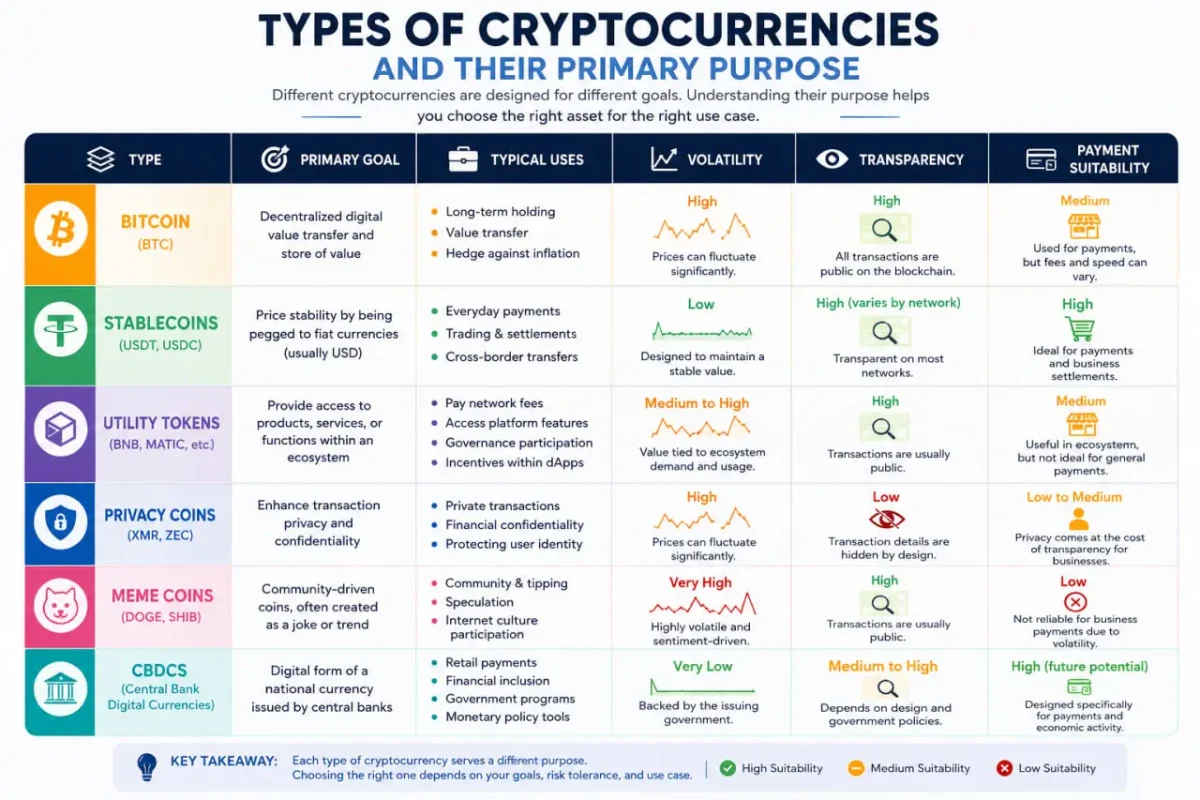
Stablecoins reduced volatility for payments and settlement. Privacy-focused networks emphasized confidentiality. Utility tokens created internal economies for blockchain-based ecosystems.
Each category exists because blockchain systems make different design choices. Some prioritize decentralization and security. Others prioritize speed, cost efficiency, programmability, privacy, or price stability.
Why These Differences Matter for Businesses
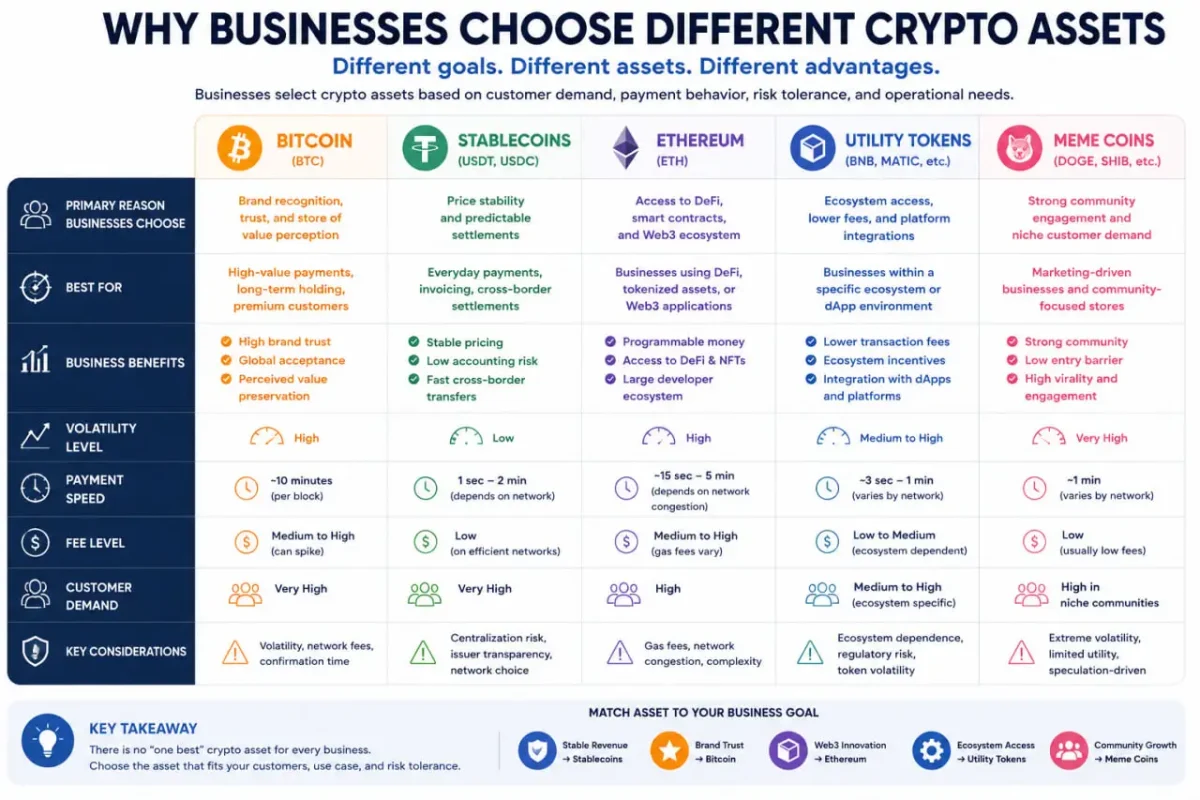
For businesses, cryptocurrencies are not only financial assets. They are payment infrastructure.
A merchant accepting Bitcoin may experience variable fees and longer confirmation expectations during busy network periods. A merchant accepting stablecoins on faster networks may experience lower costs and more predictable settlement behavior.
This is why businesses evaluating crypto payments need to think beyond popularity. The important question is not only which cryptocurrency is famous, but how that asset behaves operationally inside a payment system.
For a deeper business-focused explanation, see OxaPay’s guide on blockchain payments.
Bitcoin: The Original Cryptocurrency
Bitcoin is the first decentralized cryptocurrency and remains the most recognized blockchain asset globally.
Its original purpose was peer-to-peer digital value transfer without relying on banks or centralized intermediaries. Over time, many users also began treating Bitcoin as a long-term store of value or decentralized reserve asset.
This shift matters because the way people use an asset influences how its payment ecosystem develops. When users primarily hold Bitcoin rather than spend it frequently, Bitcoin behaves differently from networks optimized for high-throughput payments.
Why Bitcoin Behaves Differently Operationally
Bitcoin prioritizes decentralization, security, predictability, and long-term network stability. It does not prioritize maximum transaction speed or extremely low fees.
That design choice creates trade-offs. During periods of high network demand, mempool congestion can increase, fees become more competitive, and confirmation timing may become less predictable.
For businesses, this means Bitcoin payments require operational awareness. A payment detected on the network is not necessarily finalized immediately. Confirmation policy, fee conditions, and transaction propagation all matter.
This is one reason structured payment infrastructure becomes important for merchants accepting Bitcoin at scale. OxaPay explains this further in its article on the payment confirmation process.
Altcoins: Cryptocurrencies Beyond Bitcoin
Altcoins refer to cryptocurrencies other than Bitcoin. But operationally, this category represents much more than “alternative coins.”
Most altcoins exist because developers wanted to change the limitations or priorities of earlier blockchain systems. Some focus on scalability, transaction speed, programmability, interoperability, energy efficiency, or developer flexibility.
Ethereum became the most influential example because it transformed blockchain networks from simple transaction systems into programmable infrastructure. Instead of using blockchain only for value transfer, developers could build smart contracts, decentralized applications, token ecosystems, and automated financial systems.
Why Blockchain Architecture Changes Payment Behavior
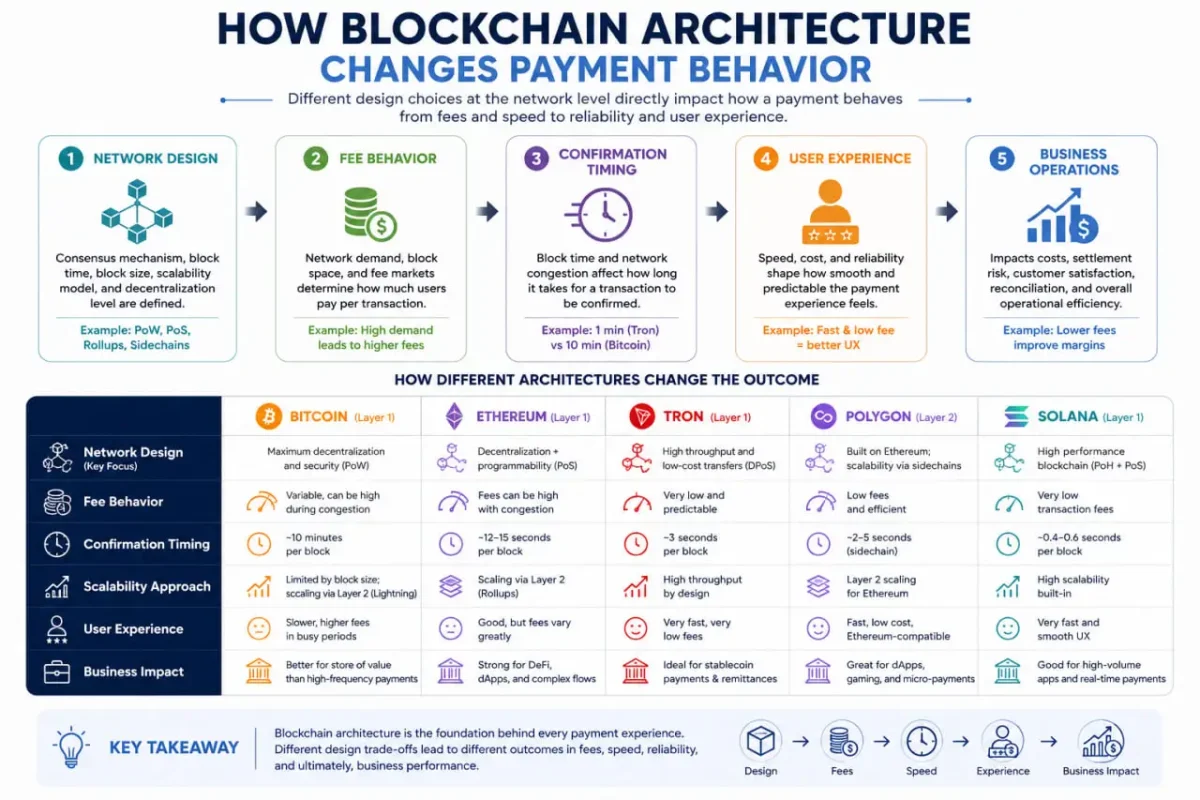
Two crypto payments can appear identical to users while behaving completely differently underneath.
One transaction may settle quickly. Another may require longer confirmation windows. One network may experience volatile fees during congestion. Another may prioritize lower-cost throughput. One ecosystem may have stronger wallet compatibility, while another may depend on more fragmented infrastructure.
This is why merchants evaluating crypto assets should not focus only on market popularity. Payment usability depends heavily on network stability, liquidity, wallet support, infrastructure tooling, and operational predictability.
Stablecoins: Crypto Designed for Commercial Stability
Stablecoins became one of the most important cryptocurrency categories because they addressed one of crypto’s biggest operational problems: volatility.
A business cannot easily price products, manage accounting, or forecast revenue when payment assets fluctuate heavily within short periods. Stablecoins attempt to reduce this problem by maintaining relatively stable value, usually against fiat currencies such as the US dollar.
USDT and USDC are among the most widely used examples. For many businesses, stablecoins function less like speculative crypto assets and more like blockchain-based settlement instruments.
Circle describes USDC as a stablecoin designed around reserve backing and transparency on its official USDC transparency page.
Stablecoins Are Not One Unified System
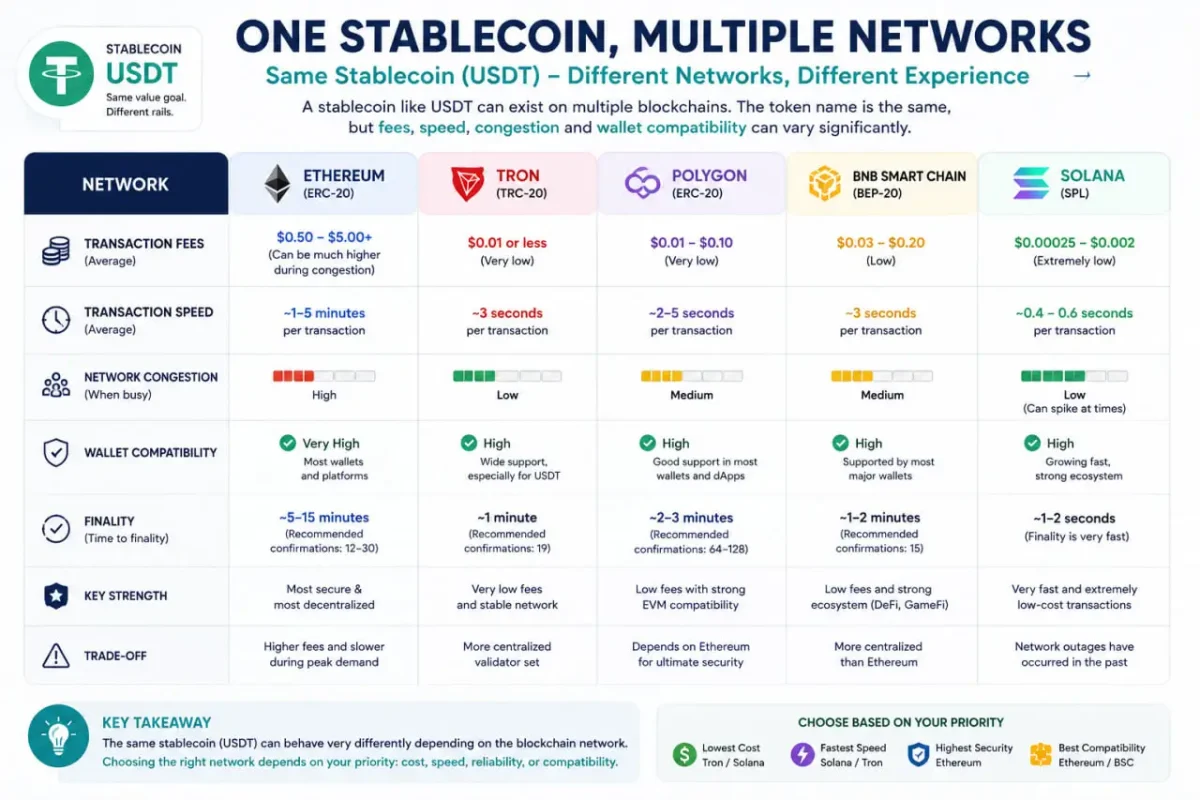
One of the most misunderstood aspects of stablecoins is that the same asset can exist across multiple blockchain networks at the same time.
USDT on Ethereum does not behave operationally the same way as USDT on Tron, Polygon, BNB Smart Chain, or Solana. The token name may remain the same, but the infrastructure underneath changes the payment experience.
For businesses, this means choosing a stablecoin is only part of the decision. The blockchain network supporting that stablecoin often matters just as much as the asset itself.
Utility Tokens: Ecosystem-Based Assets
Utility tokens are designed to provide access to functions inside blockchain ecosystems.
Some are used to pay network fees, access decentralized applications, unlock platform functionality, participate in governance, or support ecosystem incentives.
BNB is one well-known example because it connects closely to activity within Binance-related infrastructure and applications.
Utility tokens are not primarily designed for stable payments. Their value is usually tied to ecosystem growth, user participation, network demand, and expectations around platform adoption.
Why Utility Tokens Became Important
Utility tokens became popular because blockchain ecosystems needed internal economic systems. A decentralized application cannot always rely on traditional payment rails to coordinate incentives, transaction execution, platform access, or governance.
However, many utility token projects also struggled because the token had little real utility, demand depended mainly on speculation, or the ecosystem failed to grow sustainably. In practice, the long-term value of a utility token depends on whether the underlying ecosystem creates real usage.
Privacy Coins: Confidentiality by Design
Most public blockchains prioritize transparency. Transactions can usually be viewed publicly through blockchain explorers, even if wallet owners are not directly identified by name.
Privacy-focused cryptocurrencies take a different approach. Assets such as Monero and Zcash use specialized cryptographic systems to reduce transaction visibility and increase confidentiality.
According to the official Monero documentation on stealth addresses, stealth addresses help create one-time addresses for transactions, making it harder to link payments to a recipient’s public address.
Why Privacy Creates Operational Complexity
Commercial payment systems usually depend on visibility. Businesses often need transparent transaction records for accounting, reconciliation, customer support, auditing, and payment verification.
Privacy-focused assets can complicate these workflows because the system intentionally reduces transaction transparency. This does not make privacy coins inherently problematic. It simply means their design goals differ from transparent payment-oriented systems.
In most commercial payment environments, operational clarity is often more practical than maximum transaction anonymity.
Meme Coins: Community-Driven Assets
Meme coins are heavily influenced by internet culture, online communities, and speculative attention. Dogecoin and Shiba Inu are among the most recognized examples.
At first glance, meme coins may appear disconnected from practical infrastructure utility. But their growth revealed something important about digital economies: community attention itself can become an economic force.
Some meme coins developed active payment communities, exchange liquidity, and merchant interest. At the same time, meme-driven markets often experience stronger volatility, rapid sentiment shifts, and less predictable long-term demand.
For businesses, the practical question is not whether a meme coin is trending temporarily. It is whether supporting it creates meaningful customer demand and operational value.
Security Tokens and CBDCs
Some blockchain-based assets function less like open cryptocurrencies and more like regulated financial infrastructure.
Security tokens may represent ownership rights, debt exposure, revenue participation, or regulated investment instruments. CBDCs, or central bank digital currencies, represent digital versions of national currencies issued directly by central banks.
These systems show that digital asset infrastructure is expanding beyond open crypto markets. But structurally, they differ significantly from decentralized cryptocurrencies such as Bitcoin or Ethereum.
For most merchants, security tokens and CBDCs are currently less relevant as open crypto payment tools and more important as indicators of how digital financial infrastructure may evolve globally.
The Real Differences Between Cryptocurrencies
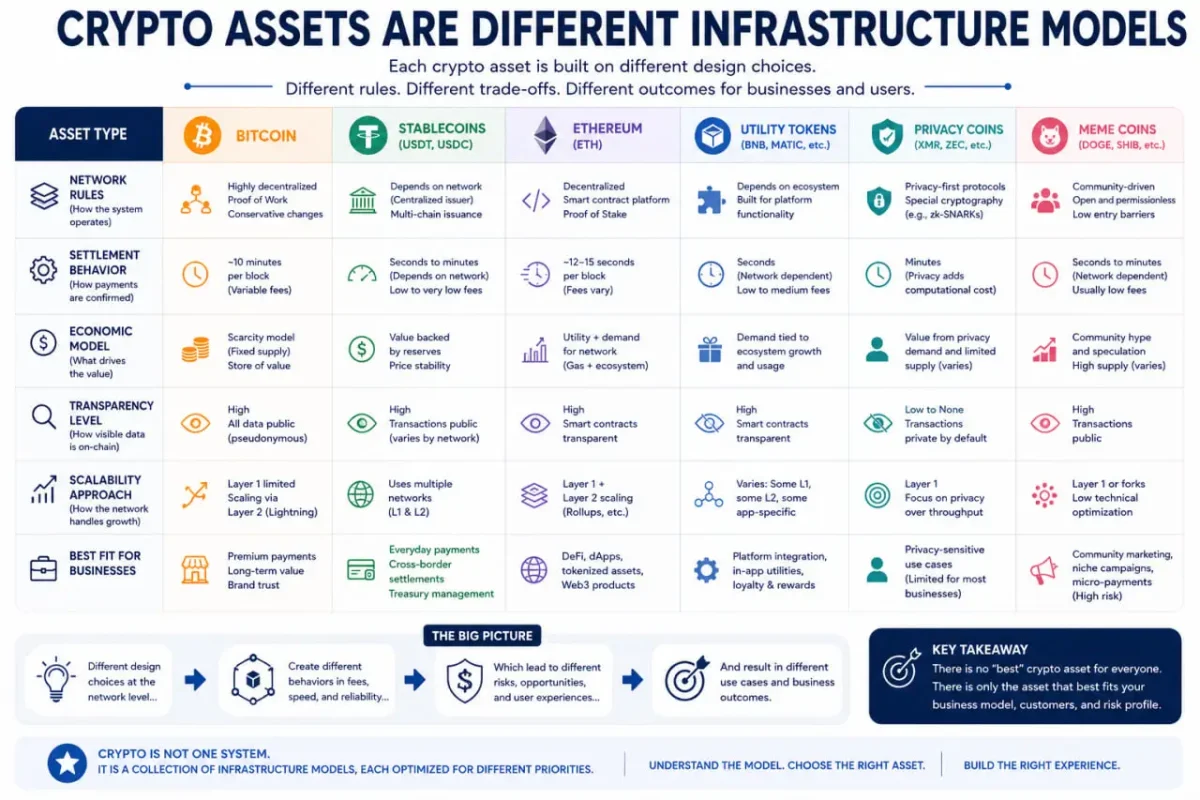
Most cryptocurrency differences ultimately come down to infrastructure design choices.
Different networks optimize for different priorities. That affects how the asset behaves economically and operationally.
Purpose
Some assets focus on decentralized value transfer. Others focus on programmability, ecosystem coordination, privacy, or payment stability.
Economic Behavior
Bitcoin and Ethereum can fluctuate significantly in price. Stablecoins aim for price stability. Utility tokens often depend on ecosystem demand and participation.
Network Infrastructure
Different blockchain systems create different experiences in fee behavior, confirmation timing, transaction throughput, wallet compatibility, and reliability during congestion.
Transparency and Privacy
Some blockchain systems prioritize public visibility. Others prioritize confidentiality. This design choice affects auditing, support workflows, payment traceability, and operational monitoring.
Commercial Practicality
An asset may be technologically impressive while remaining impractical for payments. If users rarely hold it, liquidity is limited, infrastructure support is weak, or transaction behavior is difficult to predict, the asset may struggle commercially despite technical innovation.
Practical Uses of Cryptocurrencies Today
Cryptocurrencies are now used across many digital environments.
Some users treat Bitcoin as a long-term reserve asset. Developers build decentralized applications on programmable blockchains. Communities coordinate through governance tokens. Stablecoins support trading infrastructure, cross-border settlement, and crypto commerce.
But one of the most practical real-world uses remains payments. Not because blockchain replaces every traditional payment system, but because it enables forms of value transfer that operate differently from conventional financial infrastructure.
Why Payment Infrastructure Matters More Than the Asset Alone
A blockchain network can process transactions. But businesses still need systems capable of interpreting those transactions operationally.
That includes understanding payment states such as pending, detected, confirming, completed, expired, underpaid, or failed.
This operational layer is where many businesses underestimate complexity. The challenge is usually not “Can a customer send crypto?” The challenge is “Can the business reliably manage payment behavior across multiple blockchain systems?”
That difference separates simple wallet usage from real payment infrastructure. For businesses that want to manage this process with automation, OxaPay’s webhook documentation explains how payment updates can be sent to merchant systems in real time.
What Businesses Should Consider Before Accepting Cryptocurrencies
Businesses do not need to support every cryptocurrency simply because it exists. The better approach is to evaluate assets based on operational fit.
Important questions include:
- Is customer demand meaningful?
- How volatile is the asset?
- Which blockchain networks support it?
- How predictable are transaction fees?
- Does the ecosystem have reliable infrastructure?
- Can payments be monitored consistently?
- Does the payment flow remain understandable for customers?
The goal is not maximizing the number of supported assets. The goal is building a payment environment that remains reliable for both businesses and users.
For businesses exploring this area, OxaPay’s crypto merchant service provides a practical example of how payment infrastructure can support multiple assets and networks.
How OxaPay Fits Into This Picture
For merchants, the difficult part of crypto payments usually begins after the transaction appears on-chain.
Different assets and blockchain networks create different fee structures, confirmation timing, settlement behavior, and operational edge cases.
OxaPay crypto gateway helps businesses manage these differences by turning blockchain activity into structured payment workflows across multiple cryptocurrencies and networks.
Instead of manually interpreting raw blockchain transactions, merchants can manage payment states more clearly while reducing operational complexity.
This is where the distinction between “accepting crypto” and “operating crypto payments reliably” becomes much more visible.
Businesses that need a simple payment flow can explore crypto payment links, while teams that need deeper automation can use OxaPay’s API documentation.
Conclusion
Cryptocurrencies are not one unified technology category solving one universal problem.
Bitcoin, Ethereum, stablecoins, utility tokens, privacy-focused assets, meme coins, and other blockchain systems all represent different infrastructure models with different economic behaviors and operational trade-offs.
For businesses, the most important question is rarely “Which cryptocurrency is the most popular?” The better question is: “Which cryptocurrency fits the operational reality of the payment system we are building?”
Once these differences become clear, cryptocurrencies stop looking like interchangeable digital coins. They start looking like infrastructure systems designed for different forms of digital economic activity.
Get started with OxaPay Crypto gateway today and prepare your business for the future of global finance.