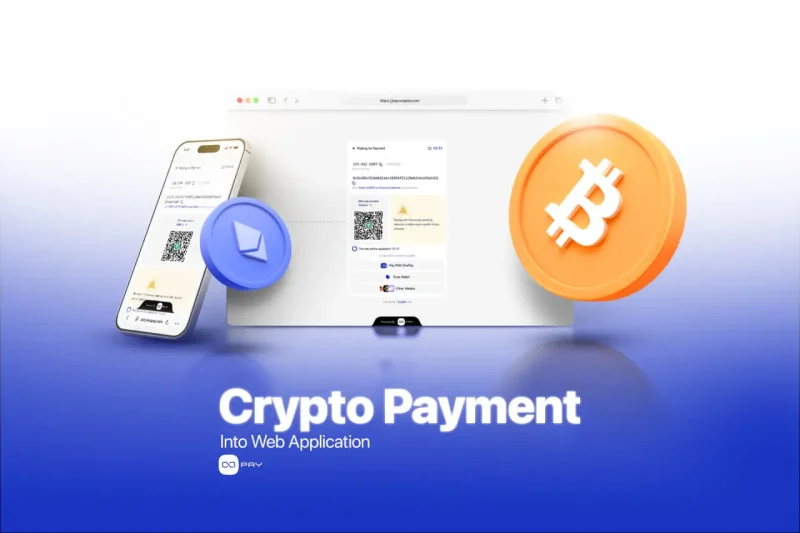
A user completes a crypto payment, but your system does not know what to do next. The transaction exists on-chain, yet your application still shows “pending.” This is where most integrations break. Integrating crypto payments into a web application is not about adding a button. It is about designing a system that can initiate payments, track asynchronous events, and update business state with confidence.
If your integration cannot answer one question consistently, it will fail in production: When is a payment considered complete for the business?
This guide explains what it really takes to implement crypto payments in a web application and how to build a clean, production-grade flow using a gateway approach.
What “Crypto Payments into Web Application” Means
A web application is any product delivered through a browser, typically with a frontend (UI) y una backend (server) that controls business logic. In payment terms, your web app must be able to:
- Create a payment session (amount, currency, order reference).
- Present a payment experience the user can actually complete.
- Receive asynchronous payment updates (webhooks, not polling-only).
- Reconcile and finalize the order or service access based on reliable rules.
Crypto changes the model because blockchain confirmations are asynchronous. Users can pay late, pay less, or pay more, and your system must handle all of it without breaking consistency.

The 7 Decisions You Must Make Before Writing Code
1. What payment model fits your product?
Choose one primary model, then expand later:
- Invoice model: best for checkout flows, SaaS subscriptions, and order tracking.
- Payment link model: best for simple, shareable payments without heavy UI.
- Static address model: best for recurring deposits per user, but harder to reconcile without strict mapping.
If you try to support everything at once, you will ship a confusing system.
2. What does “paid” mean in your business?
Define it in business language, then map it to crypto reality:
- Paid when the transaction is detected?
- Paid when it reaches N confirmations?
- Paid when it is fully settled by gateway rules?
A vague definition leads to refunds, disputes, and duplicated fulfillment.
3. What state machine will your backend use?
You do not need complex architecture, but you do need explicit states:
- created
- pendiente
- paid
- expired
- failed
If you do not model states, your system will drift.
4. How will you handle underpayment and overpayment?
Decide your policy upfront:
- Underpayment: reject, partial credit, or allow completion within tolerance.
- Overpayment: credit balance, refund automatically, or flag for review.
Even a simple rule must be defined early.
5. What is your webhook strategy?
Webhooks are not a feature. They are the backbone of reliable integration.
- Your backend must accept HTTPS POST callbacks
- It must verify authenticity and be idempotent
- It must update your order state consistently
OxaPay’s docs describe using a callback_url to receive payment updates, but the principle applies to any reliable gateway.
6. What will the user experience show during waiting time?
Users abandon crypto checkout when they are unsure. Your UI must answer:
- Did the system receive the transaction?
- Is it still confirming?
- What should the user do if it takes longer?
Clarity reduces abandonment more than speed.
7. What is your monitoring and reconciliation plan?
Assume failures happen:
- delayed confirmations
- temporary webhook outages
- user closes the tab early
- network congestion
You need a reliable way to re-check payment status.
For example, OxaPay provides a endpoint Payment Information that allows querying payment details using track_id, which helps maintain consistency even when events are delayed.
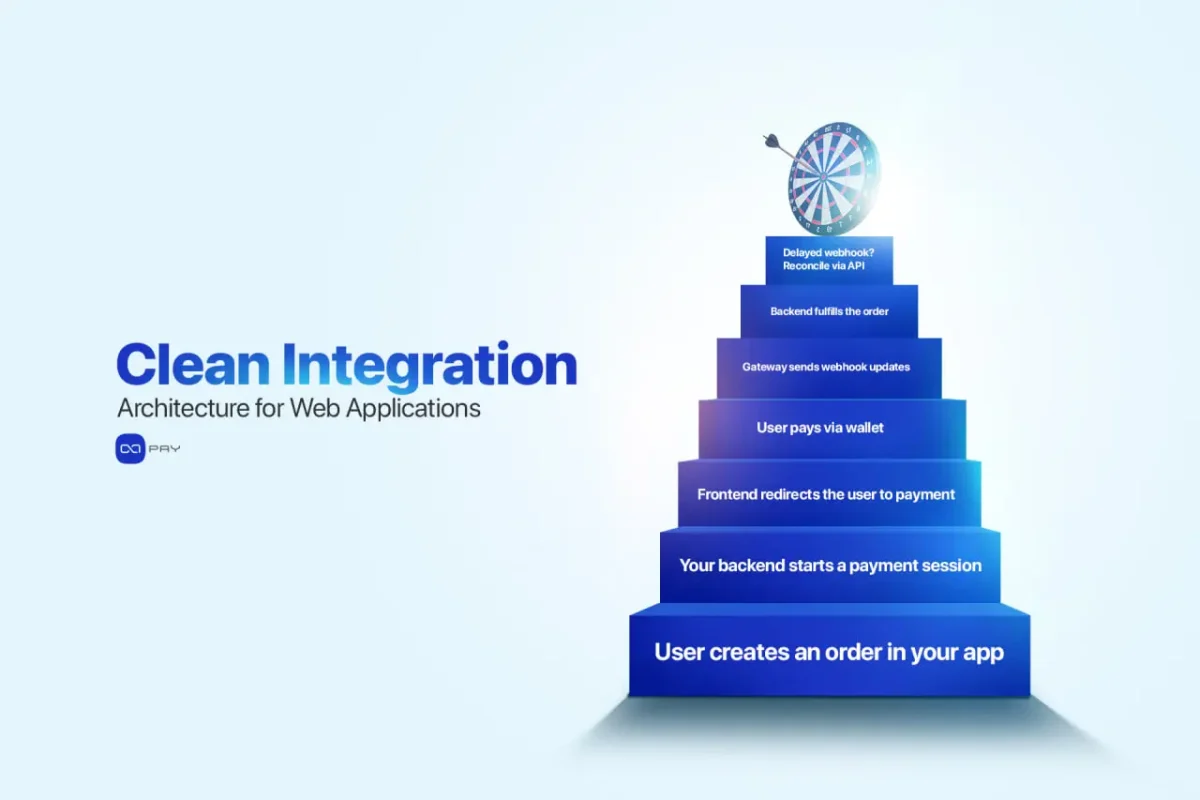
A Clean Integration Architecture for Web Applications
A production-safe flow typically looks like this:
- User creates an order in your app.
- Backend requests a payment session from a gateway.
- Frontend redirects the user to a payment page.
- User pays via wallet.
- Gateway monitors blockchain and sends webhook updates.
- Backend updates order state and triggers fulfillment.
- System reconciles state if webhook delays occur.
This is the simplest architecture that still scales.
Step-by-Step: Integrating Crypto Payments Using OxaPay Invoices
This section focuses on practical implementation. The core components are:
- Merchant API Key
- Invoice creation endpoint
- Webhook callback URL
- track_id for reconciliation
Step 1: Create an invoice from your backend
OxaPay’s invoice endpoint:
POST https://api.oxapay.com/v1/payment/invoice
You send:
- Importe
- divisa
- order reference
- callback_url
Your backend stores track_id and the payment URL.
Step 2: Redirect the user to the payment page
Your frontend should:
- open the payment URL
- show a waiting state
- rely on backend confirmation
Step 3: Implement the webhook endpoint correctly
Webhooks are delivered via HTTPS POST to callback_url.
Your handler must:
- accept JSON
- be idempotent
- update state reliably
Minimal pattern:
event = request.json
track_id = event["track_id"]
status = event["status"]

if already_processed(event["event_id"]):
    return 200

update_payment_state(track_id, status)
mark_processed(event["event_id"])

if status == "paid":
    fulfill_order(track_id)
Step 4: Add reconciliation support
Your backend should support checking payment status using track_id.
GET https://api.oxapay.com/v1/payment/{track_id}
This step ensures your system remains reliable even when webhook delivery is delayed.
Step 5: Test before production
Use a sandbox environment to verify:
- invoice creation
- webhook behavior
- state transitions
- reconciliation logic
Step 6: Go live with monitoring
Track:
- webhook delivery
- payment completion rates
- time-to-paid
- failure patterns
This is where integration quality becomes visible.
Common Mistakes That Break Crypto Payment Integrations
- Treating crypto like instant card payments
- Updating order state from frontend
- Not storing track_id
- Ignoring underpayment/overpayment
- Poor UX during confirmation
Fixing these issues alone improves most integrations significantly.
Why This Integration Model Works in Practice
A web application does not need complexity. It needs clarity.
A gateway-based approach provides:
- structured payment creation
- asynchronous state updates
- reliable reconciliation
la pasarela cripto de OxaPay is one example of a gateway that supports this model through invoice-based flows, webhook callbacks, and trackable payment states. The value is not in features alone, but in how well the system aligns with real-world payment behavior.
Conclusión
Integrating crypto payments into a web application is not about adding crypto. It is about building a reliable payment lifecycle.
When systems define “paid” clearly, rely on backend-driven updates, and support reconciliation, crypto becomes a stable payment method rather than an operational risk.
A structured approach, supported by a pasarela de pagos criptográficos that handles asynchronous payments correctly, allows web applications to scale without losing control over their payment logic.