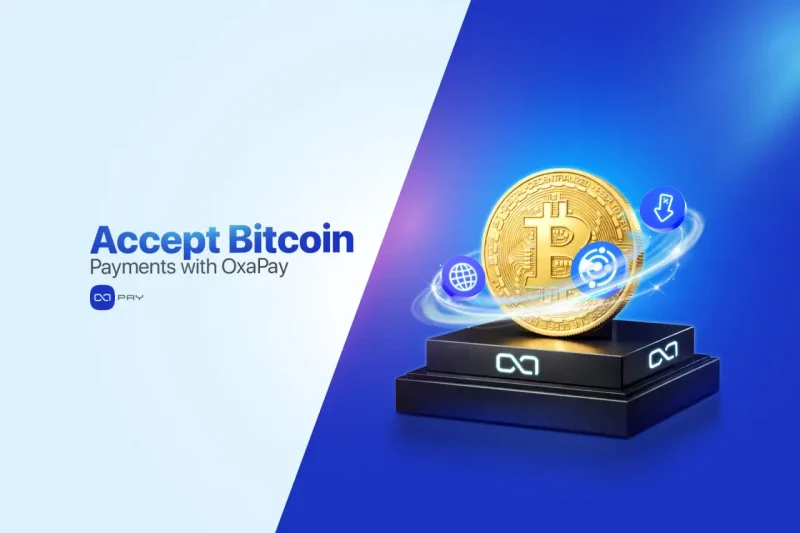
Bitcoin payments for businesses are easy to set up if your goal is only to show a wallet address. Making Bitcoin payments work for a real business is a different problem. You need clean reconciliation, predictable settlement behavior, a consistent customer flow, and risk controls that do not depend on hope or manual checking.
This guide stays on the business layer on purpose. It explains what changes when you adopt Bitcoin payments for businesses as a payment rail, what to watch for, and how OxaPay Bitcoin Gateway fits when you want payments to behave like a serious checkout option rather than an experiment.
Why businesses add Bitcoin in the first place
Bitcoin payments for businesses are not one thing. Different businesses adopt them for different financial reasons, and you should be honest about which one matters to you.
Lower total payment costs, especially cross-border
Card fees and cross-border banking costs are not just the headline percentage. There are also hidden costs: declines, fraud tooling, operational overhead, and settlement delays that push you toward holding larger cash buffers.
Los costes ocultos de los sistemas de pago tradicionales y cómo los resuelve el cripto
Bitcoin can reduce parts of that stack because it is a direct value transfer network. If you sell internationally, that difference becomes more noticeable. OxaPay adds a predictable gateway layer on top with a transparent fee model that starts from 0.4 percent for payments, which is often the difference between “nice idea” and “financially meaningful.”
Faster payment finality visibility
Traditional rails can “approve” a payment and still behave unpredictably later due to disputes, compliance checks, or batch settlement schedules. Bitcoin behaves differently. Once a transaction is confirmed and your confirmation policy is satisfied, the risk profile changes.
Confirmaciones de pago en sistemas tradicionales frente a redes criptográficas
What matters for a business is not only confirmation, it is visibility. OxaPay focuses on real-time payment status updates and clear payment lifecycle tracking, so your operations can move without waiting for someone to manually verify a transaction.
Serving customers who cannot easily pay with cards
In many markets, customers have internet access but limited access to global cards or stable banking rails. Bitcoin is not perfect, but it is globally reachable. For some businesses, that is the entire reason to add it.
Reducing chargeback exposure on high-risk categories
Chargebacks are not a small annoyance. They shape your fraud policy, your cash flow timing, and sometimes your ability to keep a payment account at all. Bitcoin does not have chargebacks in the card-network sense once a payment is confirmed, which changes the economics for digital goods, subscriptions, and cross-border services.
Impugnaciones de pago y devoluciones de cargo: Lo que debe saber
You still need risk controls, but it is a different kind of risk, and it is more operationally manageable.
Bitcoin vs traditional payment methods: the differences that actually matter
Most comparisons stop at “fees and speed.” Businesses should look deeper because the hidden friction is where the money leaks.
1. Settlement behavior and liquidity pressure
A bank wire that settles in days forces you to plan around liquidity gaps. A card payment that settles in batches forces you to manage payout schedules and reserve risk.
Bitcoin, when handled properly, gives you earlier clarity. OxaPay’s dashboard and transaction history are built to reduce the “unknown period” where your business has shipped value but finance cannot confidently reconcile the payment.
2. Dispute mechanics and operational risk
Cards and PayPal can reverse payments long after delivery. Banking rails can freeze or delay transfers due to compliance checks.
Bitcoin cannot be reversed in the same way after confirmation, but it introduces different issues: fee market variability, confirmation delays in peak periods, and volatility exposure. The correct comparison is not “Bitcoin is risk-free,” it is “Bitcoin moves the risk into places you can design around."
3. Customer payment experience
Cards can fail for reasons that look random to a customer: issuer declines, 3DS friction, regional restrictions, mismatched billing data.
Bitcoin payments can be simple for crypto-native customers, but only if the payment flow is designed well. OxaPay focuses on a clean invoice-style payment experience with wallet-friendly flows and status updates that reduce support tickets like “Did you receive my payment?"
The business problems that decide whether Bitcoin “works”
Bitcoin payments for businesses rarely fail because the technology is impossible. They fail because the operating model is unclear.
Pricing and volatility
If you price in BTC, your revenue becomes a moving target. If you price in fiat but accept BTC, you need a conversion policy and a clear definition of when the exchange rate is locked.
OxaPay supports fiat pricing while customers pay in Bitcoin, and it also provides Auto Swap capabilities so you can reduce volatility exposure by converting incoming value into stablecoins such as USDT based on your treasury preference. The important part is not the feature name, it is the ability to run a stable revenue model even when BTC moves.
Operational reconciliation
Finance teams care about matching a payment to an order, not about reading block explorers. If reconciliation is manual, you will eventually leak time, create accounting errors, and grow support load.
OxaPay’s core value for businesses is that it turns a raw on-chain transfer into a trackable payment record with consistent statuses, history, and reporting.
Customer support load
When payment UX is unclear, support becomes your “payment monitoring system.” That is expensive and scales badly.
A good Bitcoin flow reduces ambiguity. Clear instructions, clear status updates, and consistent payment states reduce tickets and reduce human error.
Risk controls and security
Bitcoin removes chargebacks, but it does not remove operational risk. You still need strong account security and controlled access to payment infrastructure.
OxaPay supports controls such as two-factor authentication, IP allowlisting, and secure webhook verification mechanisms so businesses can harden the operational layer around payments. For a growing team, these controls matter as much as fees.
Where OxaPay fits: choosing the right acceptance model
A common mistake is thinking there is only one way to “accept Bitcoin.” There are multiple acceptance models, and the right one depends on how your business sells and how much control you need.
If you want a scalable checkout flow
You need a structured payment experience that can handle real order volume, predictable tracking, and clean reporting. OxaPay’s invoice-based approach is designed for that model, especially when you want Bitcoin to behave like a standard payment method in your checkout.
If you want to start quickly without rebuilding systems
Some businesses need speed more than customization. In those cases, using platform integrations y no-code payment options reduces launch time and still gives you centralized tracking and reporting. The business goal is to ship a working payment path, measure demand, and then decide whether deeper customization is worth it.
If you sell in physical locations
In-person crypto payments often fail because the staff experience is messy. A proper POS-style flow should be simple, consistent, and fast to verify. TPV para comerciantes de OxaPay is built for that business reality, especially for merchants who want a wallet-based flow without adding new hardware complexity.
How to evaluate success after you launch Bitcoin payments
Most businesses launch Bitcoin and then judge it emotionally: “Some people used it” or “Nobody used it.” That is not a decision framework. Here is a better one.
Measure payment mix impact
Track what share of revenue comes via Bitcoin, and whether those customers are incremental or simply switching from cards. If Bitcoin brings new markets or new customer segments, the strategic value is higher than the raw volume suggests.
Measure cost-to-collect
Compare the total cost of collecting payment, not just the gateway fee. Include support load, fraud overhead, settlement delays, and refund handling. Bitcoin often wins when you include the full operational picture.
Measure failure and dispute reduction
If you operate in a category with high chargebacks, the value of Bitcoin is often visible in reduced dispute pressure and fewer revenue clawbacks. That can be more important than headline fees.
Measure treasury stability
If volatility causes accounting stress or profit unpredictability, adopt a conversion policy. This is where Auto Swap style tools matter because they let you choose stability without abandoning crypto acceptance.
Conclusión
Bitcoin payments can be a serious business advantage when you treat them as a payment rail with real operational requirements, not as a wallet address on a page. The businesses that win are the ones that design for reconciliation, clarity, and risk control from day one.
OxaPay is strongest when you want Bitcoin acceptance to be structured, trackable, and scalable, with business-grade visibility and volatility management options that let you run predictable revenue operations.