How Blockchain Consensus Shapes Payment Infrastructure
Understand how decentralized networks establish transaction order, choose a canonical history, reach finality, and turn protocol-level agreement into payment confidence for merchants and infrastructure teams.
Consensus gives a decentralized payment network one accepted history
A payment network needs a consistent answer to two questions: which transactions are valid, and in what order did they become part of the ledger? A centralized processor can answer both from one database. A blockchain must reach the answer across many independent nodes.
Blockchain consensus is the collection of rules and coordination processes that helps those nodes converge on one canonical history. It does not mean every participant agrees at every instant. Temporary disagreement can occur. Consensus defines how the network resolves that disagreement and continues.
This is why consensus matters to payments. A transaction can only support a reliable business decision after the network has accepted its place in the shared history with enough confidence. For the broader transaction-to-business model, first review 区块链支付:从网络交易到业务支付.
Consensus shapes payment behavior, but it is not the whole protocol
Many explanations attribute transaction speed, fees, congestion, smart contract execution, and finality entirely to consensus. That is too broad. These outcomes emerge from several connected protocol layers.
Protocol rules define signatures, balances, scripts, gas limits, account changes, and other conditions that every valid state transition must satisfy.
Fork-choice and finality rules help nodes choose among competing valid blocks and converge on the accepted ledger state.
Miners, validators, leaders, or elected producers construct candidate blocks within protocol limits and apply network-specific prioritization.
UTXO rules, account updates, virtual machines, and smart contracts determine what a valid transaction actually does.
Peer-to-peer propagation, mempool policy, block limits, execution capacity, and fee mechanisms influence inclusion time and congestion behavior.
Consensus still has major influence because it decides how proposed history becomes accepted history. But a network with the same broad consensus family can behave very differently when execution, capacity, block production, or networking rules change.
Readers who need the adjacent layers can explore how crypto transactions move through a network, how mempool competition affects inclusion,以及 how the EVM executes programmable state changes.
Transaction ordering is the bridge between consensus and payment truth
A blockchain does more than store transactions. It places them into a shared sequence. That sequence determines which spend occurred first, which account state existed before a smart contract call, and which conflicting history survives.
Nodes can sometimes receive different valid blocks at nearly the same time. This creates a temporary fork. A fork-choice rule tells nodes which branch to follow. Later blocks, validator votes, or finality checkpoints strengthen the selected branch until the competing history is abandoned or becomes impractical to restore.
Network propagation is not instantaneous. Local mempools and node views can temporarily differ.
The proposed block must satisfy protocol rules, but the producer may still have discretion over valid inclusion and ordering.
Proof of accumulated work, validator attestations, lockout rules, or other protocol evidence guides this choice.
The exact mechanism depends on the network. Confirmation depth and explicit checkpoint finality are not the same model.
Bitcoin documents how proof of work and chain selection make old history progressively harder to replace in its official block-chain guide. Ethereum separates head selection from checkpoint finality through LMD-GHOST and Casper FFG.
Different networks create trust through different coordination models
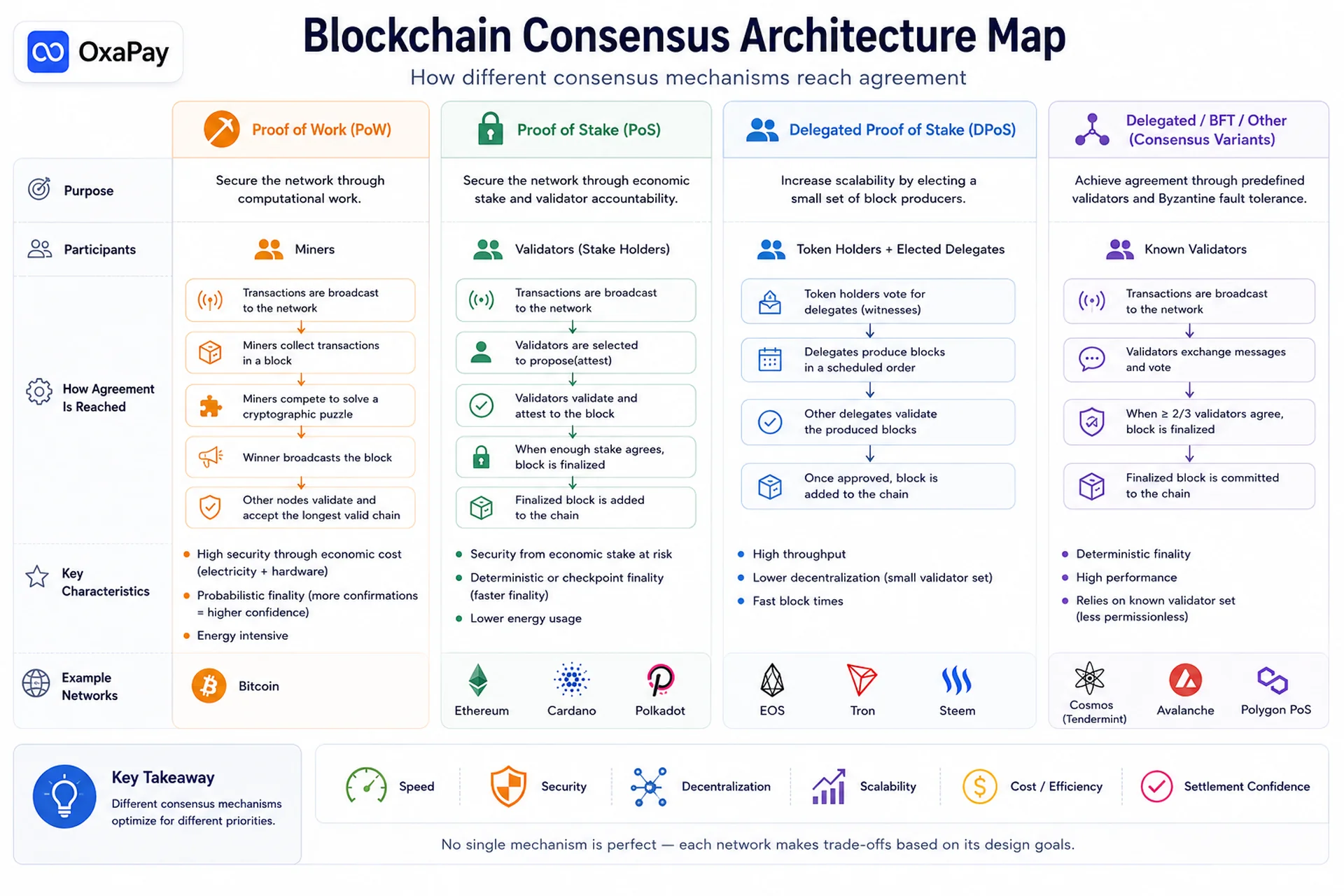
Labels such as Proof of Work, Proof of Stake, or Delegated Proof of Stake are useful starting points. They are not complete operational descriptions. A payment team must also understand fork choice, finality, producer selection, execution, and the network’s observable commitment states.
Miners compete to propose blocks. Nodes follow the valid chain with the most accumulated work. There is no separate checkpoint that instantly changes a transaction from reversible to final. Reversal becomes harder as confirmation depth increases.
Proposers create blocks and validators attest to them. LMD-GHOST guides head selection. Casper FFG finalizes checkpoints when the required stake votes are present, creating explicit economic finality.
Proof of History provides a verifiable ordering clock. Tower BFT applies vote lockouts to consensus. Payment applications still need to distinguish processed, confirmed, and finalized commitment levels.
TRX holders vote for a limited producer set. TRON documents 27 Super Representatives that validate transactions and produce blocks in an elected order. This supports fast coordination with a smaller active producer set.
Solana’s payment documentation explains why processed, confirmed, and finalized are different operational states. TRON’s official consensus documentation describes how token voting selects its Super Representatives.
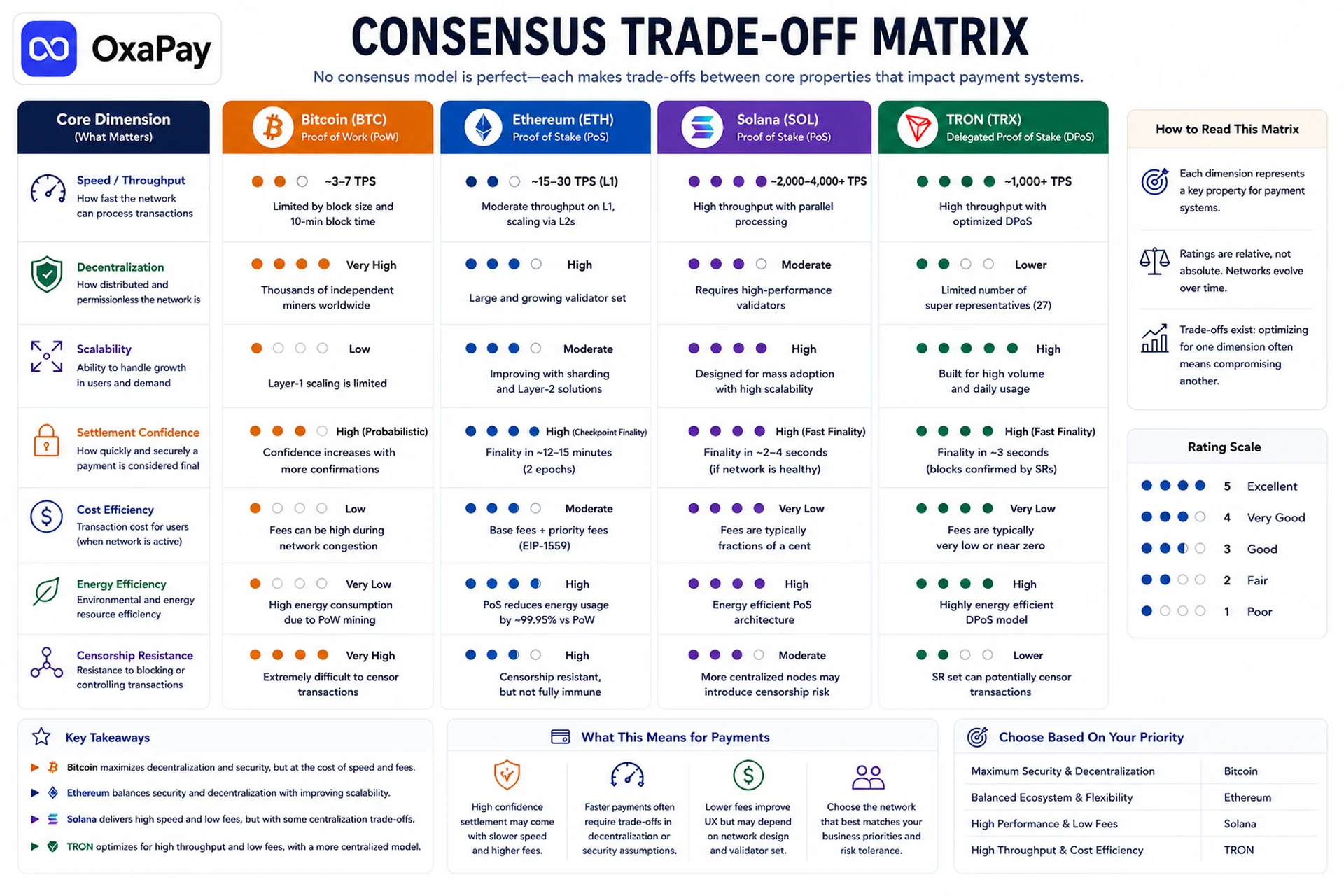
None of these models is automatically “best” for every payment. A low-value digital purchase, a high-value settlement, and a treasury transfer have different tolerance for delay, reversal risk, validator concentration, and operational interruption.
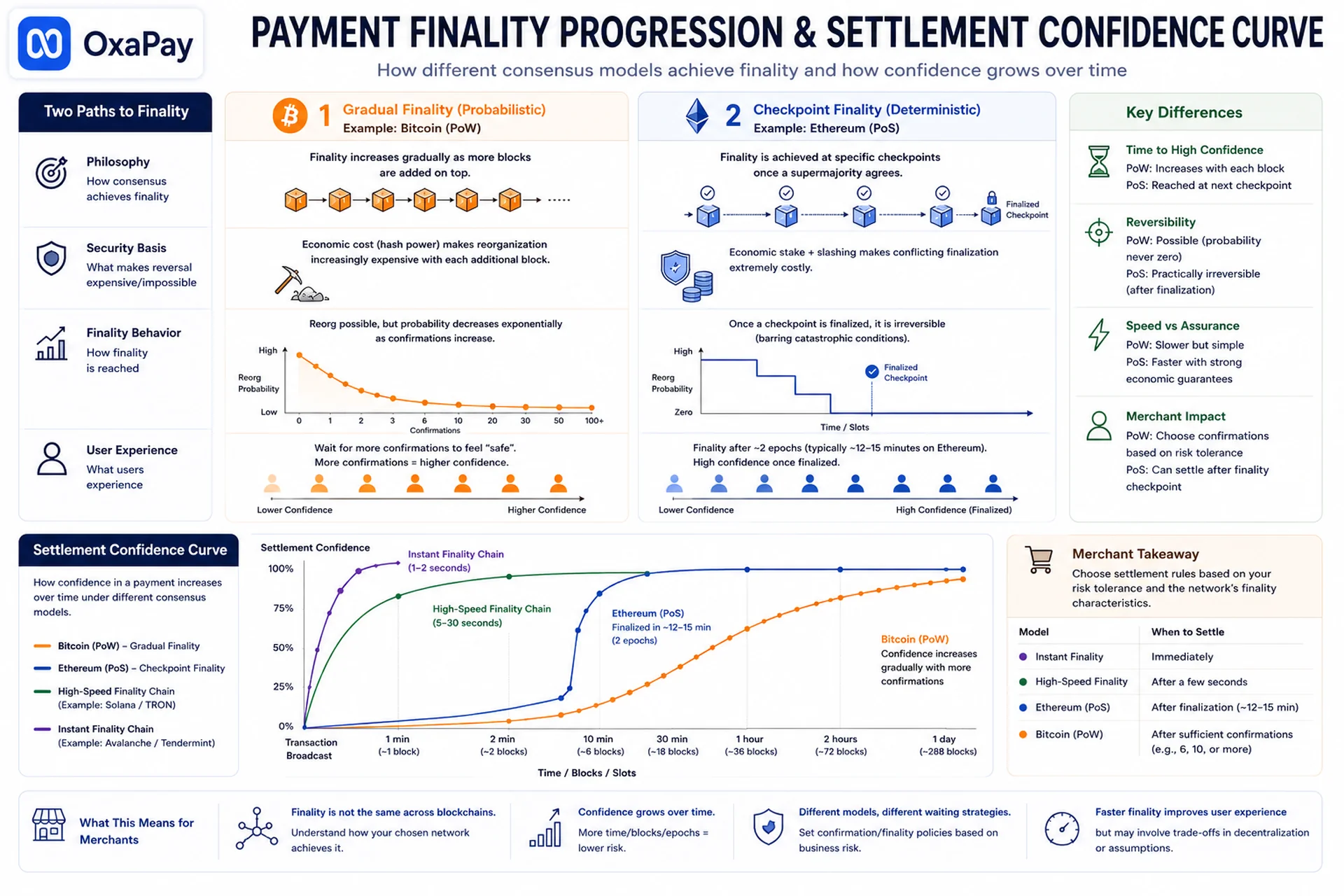
Finality is not one universal point shared by every blockchain
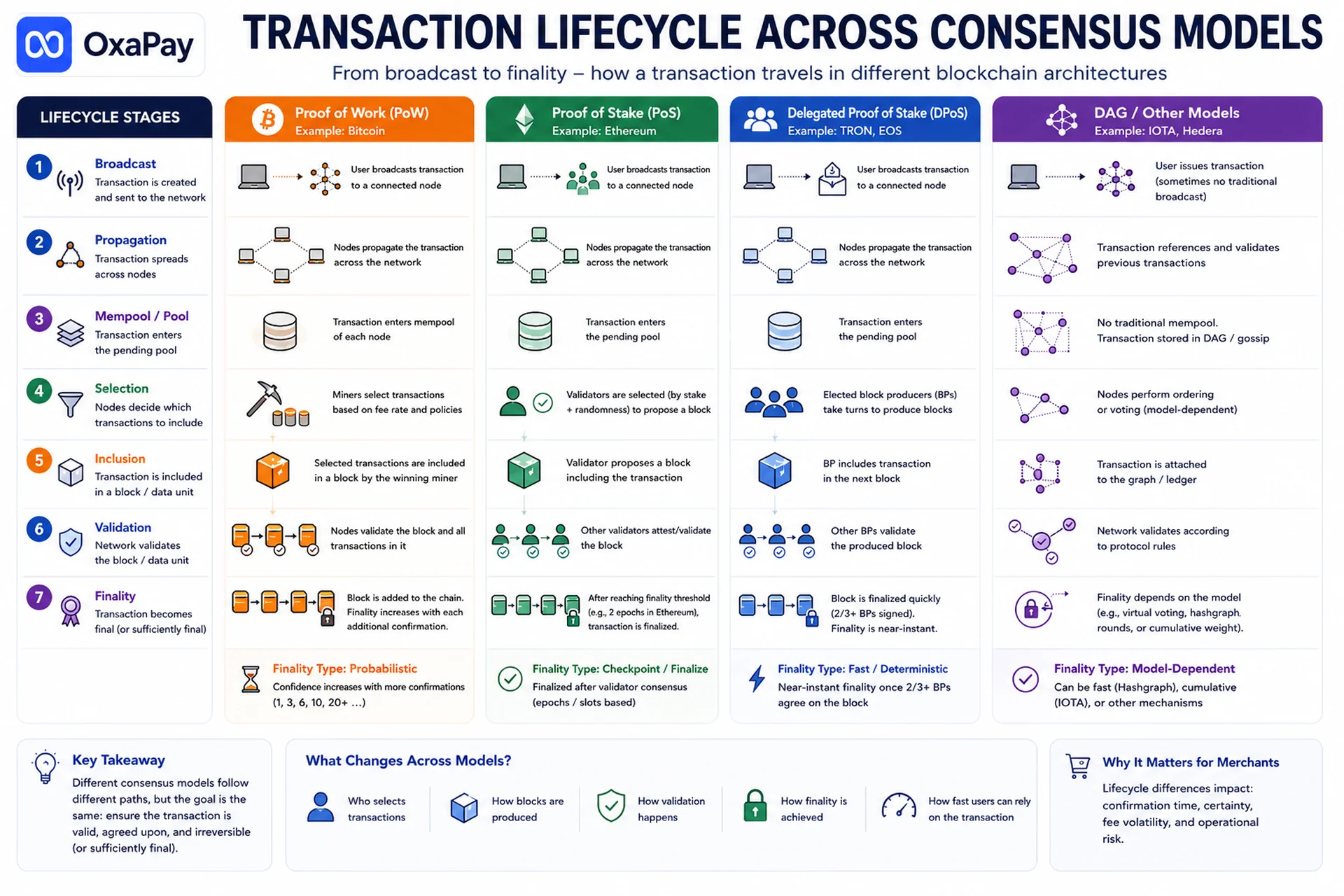
Inclusion means a transaction appears in a block. Finality describes how strongly the network can support the claim that this block will remain in accepted history. The path between those states differs by protocol.
This is the familiar Bitcoin model. No fixed depth removes all possible risk. The business chooses a practical threshold based on value and consequences.
Reverting a finalized Ethereum checkpoint would require severe protocol violation and the destruction of substantial staked value.
Networks such as Solana expose distinct commitment levels. A fast UI response can use a weaker signal than irreversible fulfillment.
The Bitcoin developer guide describes how each additional block increases transaction confidence in 支付处理. Ethereum defines finality as a cryptoeconomic guarantee backed by validator stake. These are different sources of confidence, not different names for the same counter.
Payment infrastructure must translate this network evidence into a merchant rule. That deeper design problem belongs to 支付确认系统.
A network can preserve safety while temporarily losing progress
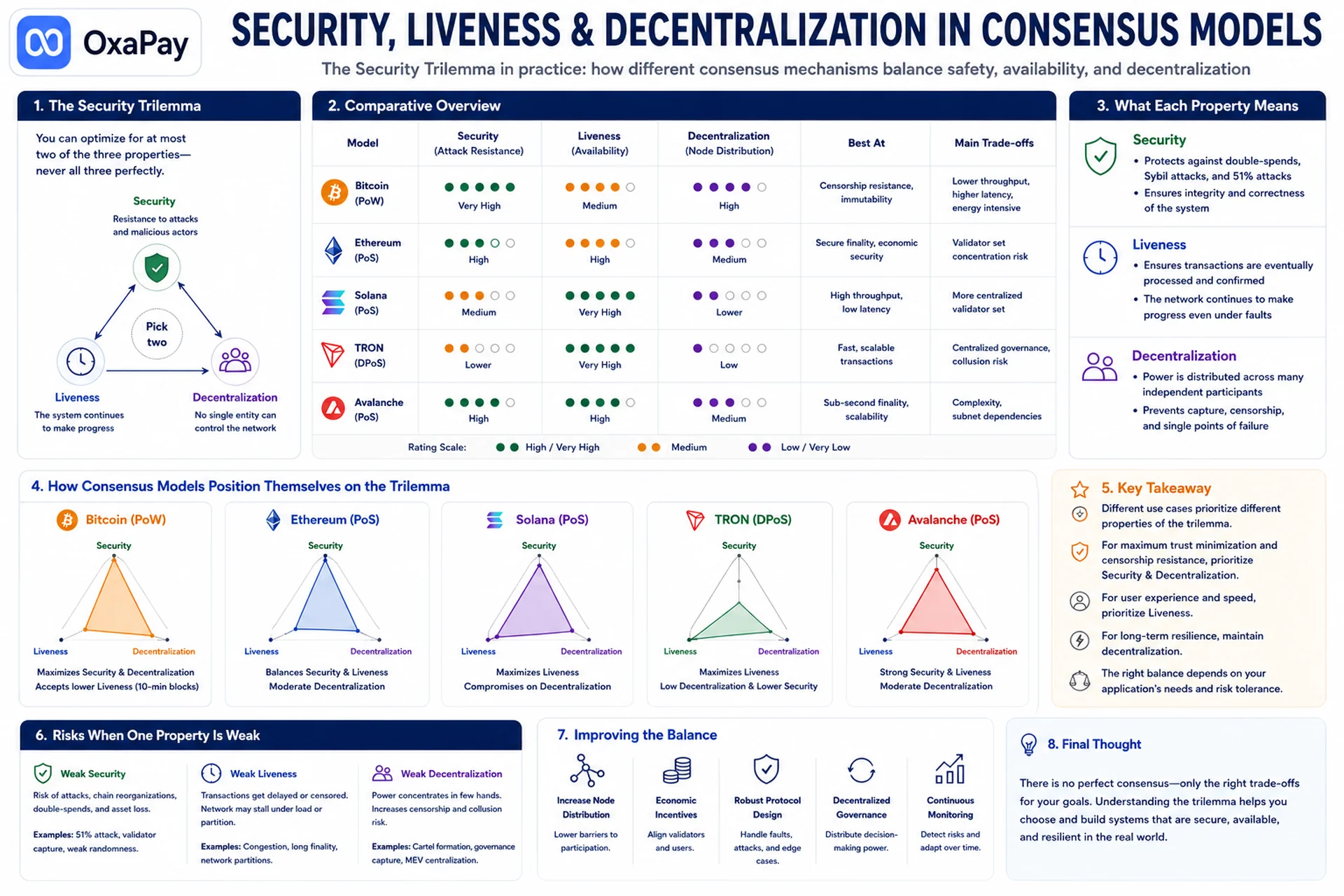
Payment reliability is often reduced to “is the blockchain secure?” A more useful operational view separates safety from liveness.
Safety protects the integrity of accepted state. A serious safety failure could make two incompatible payment histories appear final.
Liveness can degrade during partitions, validator outages, client failures, producer coordination problems, or severe network stress.
After a reorganization, finality delay, or outage, payment records may need replay, revalidation, and reconciliation before business actions resume.
A chain can stop finalizing without accepting conflicting finalized history. From a merchant perspective, that still matters. Orders remain pending, customers wait, and automated fulfillment may need to pause.
Production infrastructure should represent these conditions explicitly. A payment may be detected but delayed by network health. It should not be forced into a simple paid-or-failed model. The observation and recovery layer is explored in 区块链支付系统中的实时监控.
Consensus influences fee behavior, but scarcity and pricing rules complete the picture
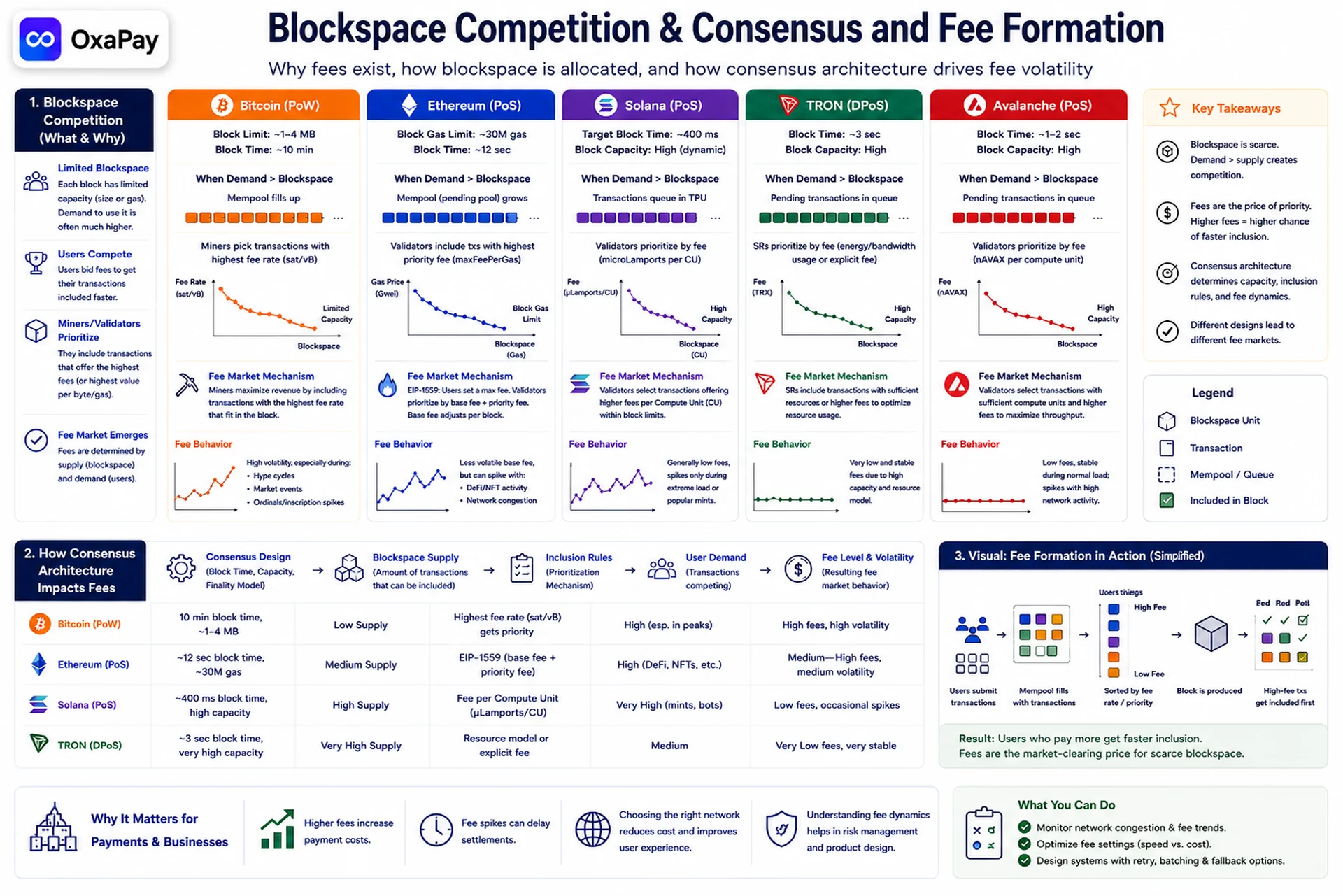
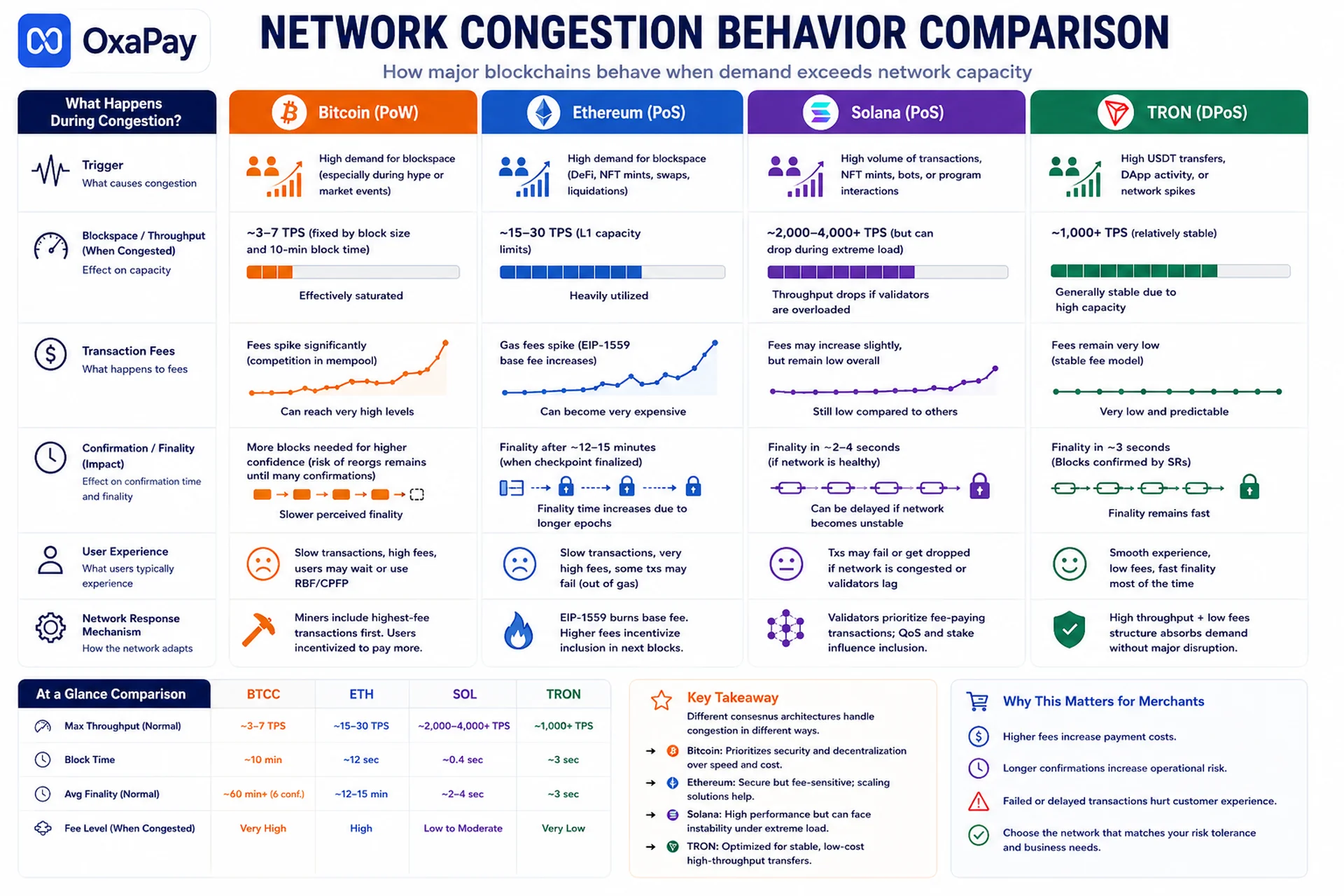
The statement “fees are caused by consensus” is incomplete. Fees emerge from transaction demand, scarce block or execution capacity, protocol pricing, producer incentives, and user competition. Consensus determines how proposed blocks become accepted, while adjacent rules determine the available capacity and the price of inclusion.
In Bitcoin, transactions compete by fee rate for limited blockspace. In Ethereum, gas measures execution demand, while EIP-1559 adjusts a protocol base fee around a target block size and allows priority tips. TRON combines consensus with its Bandwidth and Energy resource model. These systems can all process payments, but they expose different cost and delay patterns.
Payment transfers, swaps, token activity, and smart contract calls may compete for the same bounded network resources.
Limits protect validation and propagation requirements, but they also create scarcity during demand peaks.
Fee rate, priority tips, local markets, resource credits, or other mechanisms influence ordering among otherwise valid transactions.
The customer sees delay or higher cost. The merchant sees longer pending states, changing support load, and more pressure on expiration policy.
Ethereum’s official gas and fee documentation explains how the base fee changes with block usage. For Bitcoin-specific operations, OxaPay’s analyses of transaction fee calculation 和 block time and latency show why fee and timing expectations must remain separate from payment completion rules.
Block producers influence valid transaction inclusion and ordering
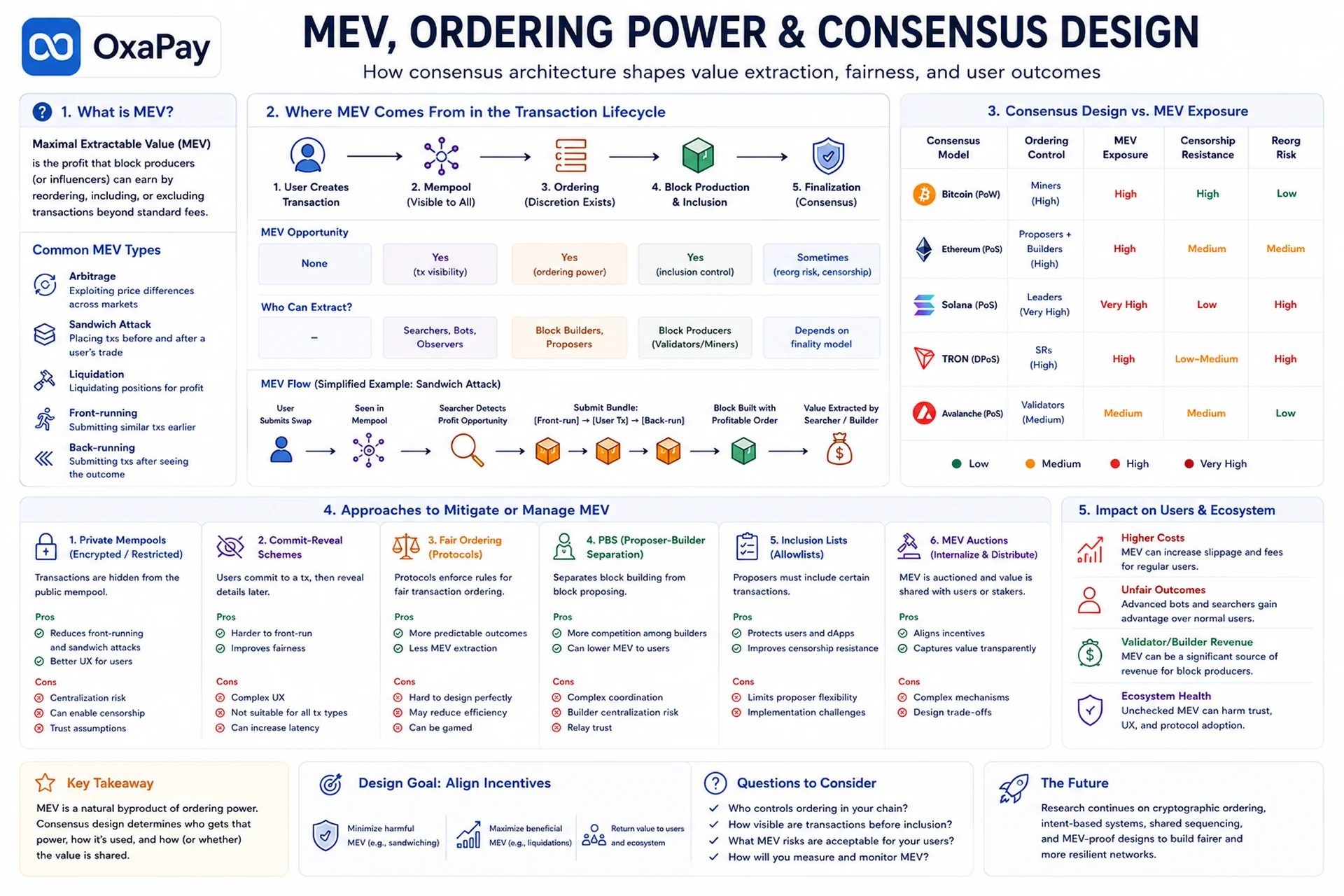
Consensus selects or recognizes the participants that propose blocks. Within protocol constraints, those producers can often choose which valid transactions to include and how to order them. This discretion creates an economic layer around block production.
On programmable networks, transaction order can change the result of swaps, liquidations, arbitrage, and other smart contract interactions. The value that can be extracted by including, excluding, or reordering transactions is known as maximal extractable value, or MEV.
A simple asset transfer is usually less directly exposed than a complex DeFi trade. However, merchants still experience the surrounding effects. Priority competition can influence fees, inclusion timing, failed transactions, and the stability of the shared execution environment.
Ethereum’s official MEV documentation explains how block production creates this ordering opportunity.
Payment infrastructure should be consensus-aware, not consensus-specific everywhere
A multi-chain payment system needs one operational model without pretending every chain is identical. The correct design isolates network-specific logic behind adapters and exposes normalized payment states to the business layer.
Store native confirmation states, finality type, transaction expiry, replacement behavior, fee model, token identity, and known recovery constraints.
Nodes, RPC providers, subscriptions, and indexers should be monitored for lag, disagreement, missing events, and degraded network conditions.
The adapter should preserve important differences instead of reducing every network to one confirmation counter.
Business actions should follow controlled state transitions. A duplicate observation must never create duplicate fulfillment.
Finality delay, provider disagreement, chain halt, or unusual reorgs may require longer waiting, manual review, or a temporary fulfillment pause.
The larger architecture is mapped in OxaPay’s 加密货币支付系统架构. The key design goal is not to hide every network difference. It is to place those differences in the correct layer so merchant systems receive stable, explainable payment states.
OxaPay abstracts network operations while preserving payment state
Merchants usually do not want to maintain a separate consensus adapter, observer, confirmation policy, and payment-state integration for every chain. A payment gateway can absorb much of that operational work and expose a more consistent interface.
OxaPay publishes its available assets and network routes through the supported coins and blockchains page and its supported currencies API documentation. This matters because the same asset symbol can exist on several networks with different fee, finality, and operational behavior.
根据 OxaPay 支付状态表 exposes operational states such as waiting, confirming, paid, underpaid, expired, and refunded. These statuses do more than mirror a block explorer. They translate network evidence into payment states that merchant systems can process.
How to evaluate a blockchain for payment use
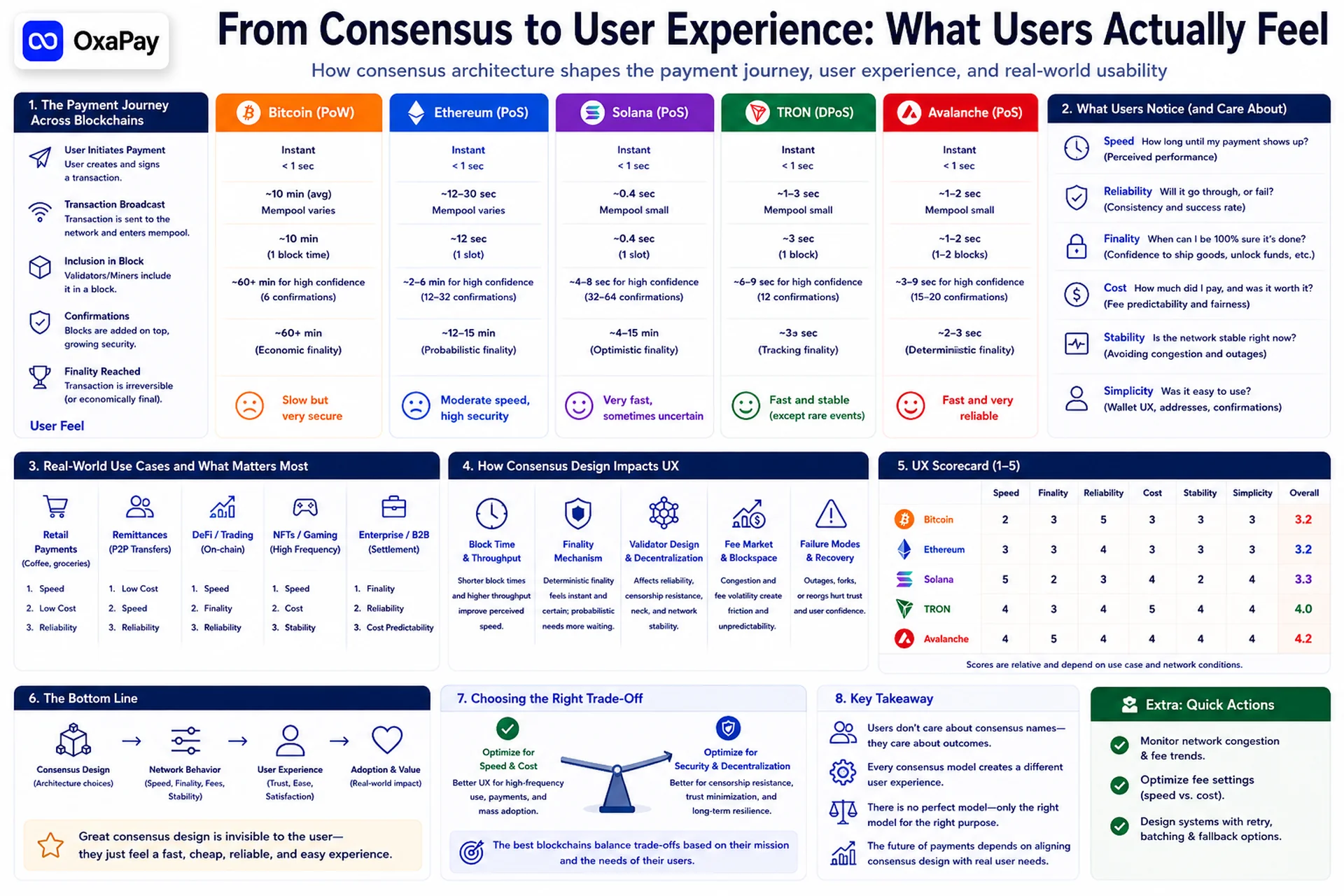
Transaction speed is only one input. A merchant or infrastructure team should evaluate the whole route from customer transaction to accepted business state.
Identify whether confidence is depth-based, checkpoint-based, or exposed through commitment tiers. Do not reuse one threshold across all networks.
Consider block time, mempool behavior, fee sensitivity, recent blockhash requirements, replacement rules, and the customer’s ability to recover.
Understand reorganization risk, finality delay, producer concentration, client diversity, network halts, and available operational signals.
A technically strong network can still be unsuitable when customers lack the asset, fees exceed order value, or treasury conversion is difficult.
Low-value reversible access can use a different policy from high-value goods, irreversible delivery, account withdrawals, or treasury settlement.
The practical merchant path continues in the Merchant Guide to Accepting Crypto Payments. It turns network and infrastructure knowledge into readiness, provider, fulfillment, treasury, and launch decisions.
Official technical sources used in this analysis
The article relies on primary protocol and developer documentation rather than generalized consensus comparisons. These references are useful for deeper verification.
Proof of work, chain selection, block structure, and confirmation depth.
Consensus terminology, Proof of Stake, fork choice, and finality.
Processed, confirmed, and finalized transaction commitment states.
Super Representative election, block production, and network agreement.