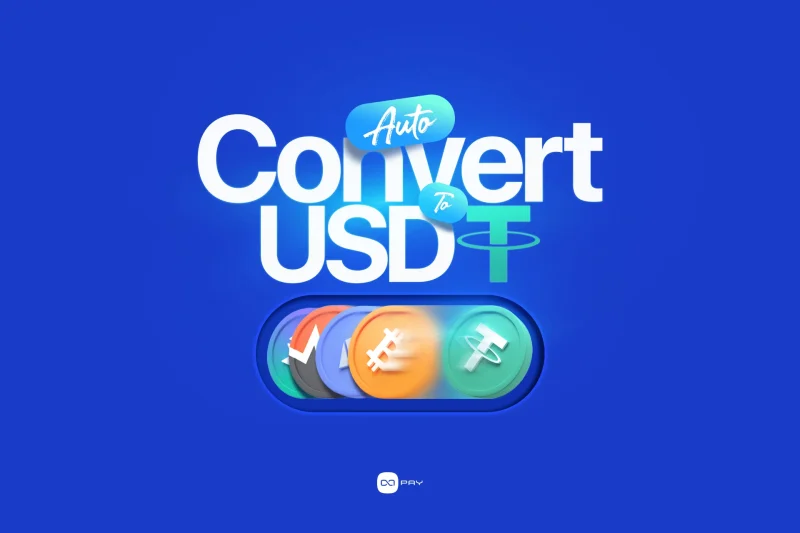
Accepting Bitcoin, Ethereum, and other cryptocurrencies gives customers more ways to pay, but it can also leave merchants holding assets whose value changes after checkout. Auto Convert to USDT addresses this operational problem by automatically converting eligible crypto payments into USDT. For businesses that prefer predictable treasury balances, it can reduce manual conversion work and limit short-term exposure to volatile payment assets without restricting which supported cryptocurrencies customers can use.
What Is Auto Convert to USDT?
Auto Convert to USDT is an OxaPay merchant setting that automatically exchanges received crypto payments into USDT.
The customer still pays using an accepted cryptocurrency. The merchant does not need to monitor the received asset and perform a separate manual conversion after every payment. When Auto Convert is enabled for the relevant Merchant API Key, OxaPay converts incoming eligible payments into USDT as part of the merchant’s payment flow.
This separates two decisions that businesses often confuse:
- Payment acceptance: Which cryptocurrencies can customers use?
- Treasury preference: Which asset does the merchant want to retain after payment?
A merchant may allow customers to pay in BTC, ETH, LTC, or another supported currency while preferring to manage most payment revenue in USDT.
The broader relationship between payment acceptance, conversion, balances, and withdrawal is explained in «Модели расчетов для криптоплатежей».
Why Merchants Convert Crypto Payments to USDT
A product may be priced at $500, but a customer might pay using a volatile cryptocurrency. If the merchant continues holding that asset, the value of the received payment can increase or decrease after the sale.
That may be acceptable for a business that deliberately wants crypto exposure. However, it is less suitable for a merchant that needs predictable funds for payroll, suppliers, advertising, refunds, or operating expenses.
Auto Convert can support four practical objectives.
Reduce Short-Term Price Exposure
Automatic conversion reduces the period during which revenue remains exposed to movements in the received asset.
However, this does not make the entire payment system risk-free. Instead, it changes the merchant’s exposure from the original cryptocurrency to USDT.
USDT is designed to track the US dollar, and Tether states that USD₮ tokens are pegged 1:1 to USD and backed by its reserves. Merchants should still treat USDT as a private stablecoin with issuer, liquidity, operational, regulatory, and redemption considerations rather than as identical to a bank deposit or central-bank money.
Make Treasury Balances More Consistent
Without a conversion policy, a merchant may accumulate small balances across several cryptocurrencies.
As a result, the business has more treasury decisions to make:
- which assets to hold;
- when to convert them;
- which balances are large enough to move;
- how to value each asset;
- how to explain changing portfolio values.
Therefore, converting eligible payments into one preferred asset can make the merchant’s working balance easier to monitor and use.
Reduce Manual Treasury Work
Manual conversion requires someone to review balances, decide when to act, obtain a rate, execute the conversion, and record the result.
For a business receiving payments throughout the day, this can become repetitive operational work. Therefore, Auto Convert applies a consistent rule automatically instead of requiring a separate decision for every incoming payment.
Preserve Customer Choice
Treasury consistency does not require forcing every customer to pay in USDT.
Instead, customers can continue selecting supported payment currencies, while the merchant defines what should happen after the payment is received. OxaPay publishes supported currencies and networks dynamically through its Supported Currencies endpoint.
Review the current supported currencies.
How Auto Convert Works in OxaPay
The business flow is straightforward:
- The merchant creates or receives a crypto payment through an OxaPay merchant service.
- The customer pays using an accepted cryptocurrency.
- OxaPay processes the payment according to the merchant configuration.
- When Auto Convert is enabled, the eligible received asset is converted into USDT.
- The merchant’s resulting balance and payment records reflect the conversion.
Auto Convert is configured through the Merchant API Key settings. OxaPay’s current setup guidance lists Auto Convert to USDT among the advanced Merchant API Key options, alongside features such as Underpaid Coverage, Fee Paid by Payer, Auto Withdrawal, and Mixed Payment.
However, the merchant should verify current interface labels and eligible currencies in the OxaPay dashboard because supported assets, networks, limits, and product settings can change.
Auto Convert Is Not the Same as Manual Swap
Both features convert assets, but they solve different problems.
| Особенность | When conversion happens | Best suited for |
|---|---|---|
| Auto Convert | Automatically after eligible merchant payments | Consistent treasury policy and reduced manual work |
| Manual Swap | When the user chooses to convert an existing balance | Flexible, case-by-case treasury decisions |
| Limit Order | When a defined target condition is reached | Price-controlled conversion timing |
| Автоматический вывод средств | Moves funds to an external wallet | Balance distribution rather than asset conversion |
OxaPay Swap allows users to request conversions between supported pairs, while the Swap Rate and Swap Pairs endpoints provide current rates, available pairs, and minimum amounts.
Auto Convert is appropriate when the merchant has already made a standing decision:
Eligible crypto payments should become USDT without waiting for a separate treasury action.
In contrast, Manual Swap is more appropriate when the business wants to decide individually whether and when to retain or convert each asset.
Auto Withdrawal is also a different control. It determines where funds move after receipt or conversion, not merely which asset the business holds.
When Auto Convert Makes Sense
Auto Convert is particularly useful when a business:
- prices products or services primarily in fiat currency;
- needs predictable working balances;
- accepts several volatile cryptocurrencies;
- does not intend to hold payment assets as an investment;
- wants to reduce manual conversion decisions;
- pays suppliers or contractors in stablecoins;
- requires simpler treasury reporting;
- processes enough payments that manual conversion no longer scales.
For example, consider a hosting provider that prices annual plans in USD but accepts BTC, ETH, LTC, and other cryptocurrencies.
The business earns revenue from hosting, not from predicting crypto prices. Therefore, holding each received asset creates exposure unrelated to its core service. In this case, Auto Convert allows customers to retain payment choice while the merchant applies a more consistent post-payment treasury policy.
When Auto Convert May Not Be the Right Default
Auto Convert should not be enabled simply because cryptocurrency can be volatile.
A business may prefer not to convert automatically when:
- it deliberately wants to retain specific assets;
- it uses received crypto to pay suppliers in the same currency;
- its treasury policy requires manual approvals;
- it prefers another settlement asset;
- conversion costs outweigh the benefit for certain payments;
- it needs to preserve separate asset balances for operational reasons;
- it wants to control conversion timing.
A balanced policy does not need to treat every asset identically.
For example, a merchant may choose to retain USDT and USDC, automatically convert BTC and ETH, and manually review less common assets. However, the available configuration should be confirmed against the current OxaPay dashboard and merchant-service settings.
Ultimately, the decision should follow the business’s liquidity needs, expense currency, risk tolerance, and accounting process.
Auto Convert Reduces One Risk but Creates Another Exposure
Converting a volatile asset to USDT reduces exposure to the original asset’s price movement. However, it does not eliminate all treasury risk.
After conversion, the merchant is exposed to factors associated with USDT, including:
- issuer and reserve arrangements;
- market liquidity;
- access to redemption or off-ramp services;
- legal and regulatory treatment;
- operational availability;
- the network on which USDT is held or transferred.
International guidance on stablecoin arrangements emphasizes the importance of credit risk, liquidity risk, operational resilience, redemption rights, and legal finality.
Therefore, the correct conclusion is not that Auto Convert is either completely safe or unnecessary. Instead, conversion changes the type of risk being managed.
Understand the Cost of Automatic Conversion
Auto Convert should be evaluated using the complete economic result, not only the convenience it provides.
Relevant costs may include:
- the merchant payment-processing fee;
- the conversion rate or spread;
- any applicable swap or service charge;
- later blockchain withdrawal costs;
- accounting and reconciliation work;
- the avoided cost of manual treasury management;
- the reduced or increased exposure caused by conversion timing.
OxaPay provides real-time Swap Rate and Swap Pairs endpoints for supported conversions, while current service and transfer pricing should be checked through the official OxaPay dashboard and страница с ценами.
Therefore, the cheapest approach is not necessarily the one with no conversion. A business that avoids a small conversion cost but spends more time managing balances or absorbs a large market move may have a higher effective cost.
For a wider cost framework, see The Total Cost of Crypto Payment Infrastructure.
Keep the Original Payment and Conversion as Separate Records
Auto Convert can simplify treasury management, but accounting records should not hide what the customer originally paid.
The merchant should retain:
- Order ID;
- OxaPay Track ID;
- original payment asset;
- original crypto amount;
- статус платежа;
- хеш транзакции;
- conversion asset;
- conversion rate;
- USDT amount received;
- payment and conversion timestamps;
- applicable fees.
The original payment record answers:
What did the customer pay?
The conversion record answers:
What did the business do with the received asset?
Combining the two into one simplified number may create problems during reconciliation, refunds, financial review, or historical valuation.
OxaPay’s Payment Information and Payment History endpoints provide payment-level details, while Swap endpoints provide conversion-related data.
The practical accounting workflow is covered in Crypto Accounting for Businesses.
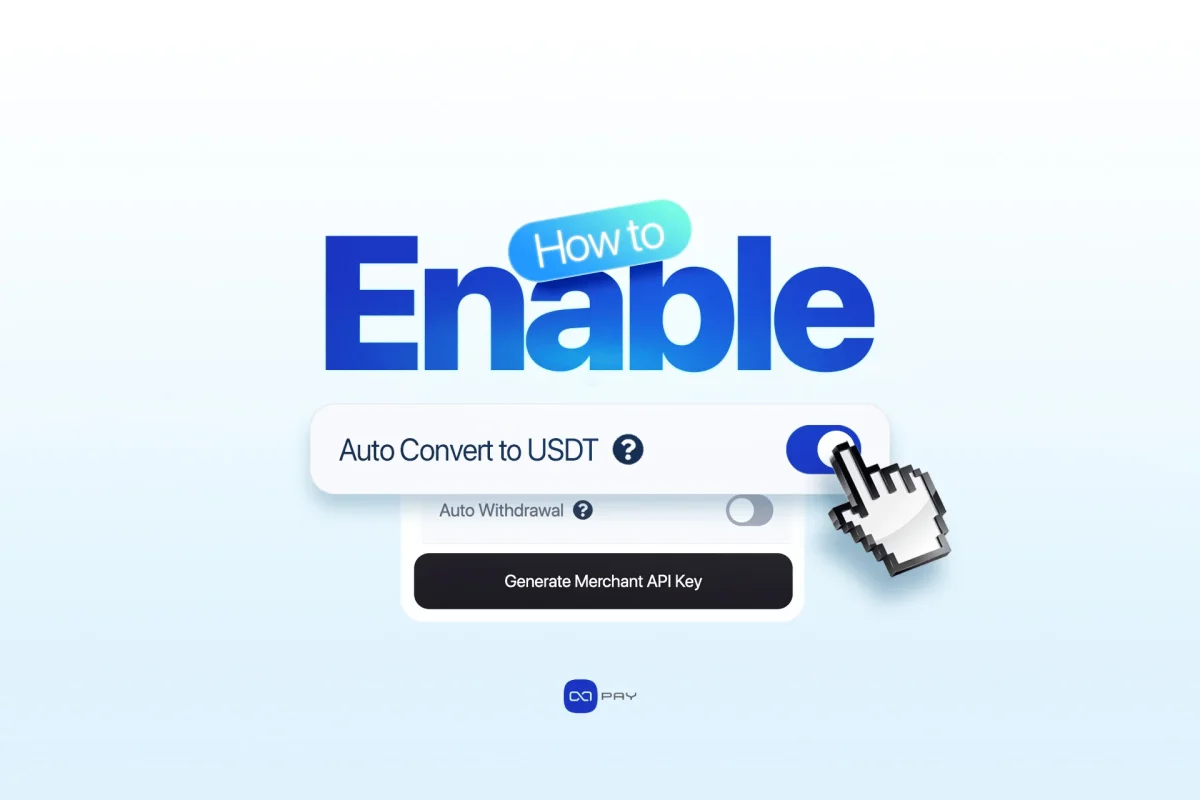
How to Enable Auto Convert to USDT
OxaPay currently documents Auto Convert as an advanced option associated with Merchant API Key configuration.
A practical setup sequence is:
- Sign in to the OxaPay dashboard.
- Open the Merchant Service or Merchant API Key section.
- Create a new Merchant API Key or edit the relevant existing key.
- Давать возможность Автоматическая конвертация в USDT.
- Review the accepted currencies and other advanced settings.
- Save the configuration.
- Run a controlled test payment before relying on the setting in production.
OxaPay states that existing Merchant API Keys can be edited to turn Auto Convert on or off.
For businesses operating multiple websites, products, or treasury policies, separate Merchant API Keys can provide clearer configuration boundaries.
Test More Than a Successful Payment
A test should confirm the complete operational result.
Проверьте:
- the customer can pay using an eligible cryptocurrency;
- the payment reaches the expected status;
- the merchant order is updated correctly;
- the original payment details remain available;
- the resulting USDT balance is correct;
- the conversion can be identified in records;
- Webhooks and internal reports still contain the information needed;
- refunds and reconciliation can trace the original payment.
Do not enable Auto Convert across all production traffic immediately when the business depends on downstream accounting, withdrawal, or reporting processes.
Instead, begin with a limited payment flow, compare the original payment and final balance, and confirm the operational records before expanding usage.
Build a Simple Auto Convert Policy
The setting works best when it follows a written treasury policy.
A basic policy should answer:
- Which payment assets should be converted?
- Is USDT the preferred working asset?
- Who can enable or disable Auto Convert?
- How will conversion costs be reviewed?
- How will original payment and conversion records be retained?
- What happens during a USDT market or operational incident?
- When should funds be withdrawn from OxaPay?
- How often should balances and conversions be reconciled?
As a result, Auto Convert is less likely to become an undocumented dashboard toggle that Finance, Operations, and Engineering interpret differently.
Common Auto Convert Mistakes
Assuming USDT Is the Same as Fiat USD
USDT is a blockchain-based stablecoin designed to track USD. However, it is not the same product as a bank-account dollar balance.
Removing the Original Payment Record
The BTC, ETH, or other asset sent by the customer remains important for support, refunds, accounting, and reconciliation.
Enabling Conversion Without Testing Reporting
The merchant should confirm that Finance can still identify the payment, conversion, fees, and resulting balance.
Confusing Auto Convert with Auto Withdrawal
Conversion changes the asset. In contrast, withdrawal changes where the asset is held.
Converting Every Asset Without a Treasury Reason
The decision should reflect the business’s expenses, liquidity needs, customer flows, and risk policy.
Claiming That Conversion Eliminates Volatility
It reduces exposure to the original asset. However, it replaces that exposure with USDT-related exposure.
Use Auto Convert as a Treasury Rule, Not a Shortcut
Auto Convert to USDT can make crypto revenue easier to manage when a business wants to accept multiple assets without retaining exposure to each one.
A strong implementation should:
- define why the business prefers USDT;
- confirm which payments are eligible;
- preserve the original payment details;
- understand conversion and withdrawal costs;
- test payment, conversion, reporting, and reconciliation;
- document who controls the setting;
- review the policy as volume and treasury needs change.
криптошлюз OxaPay provides the payment infrastructure, conversion tools, and merchant configuration needed to apply this rule automatically.
Ultimately, Auto Convert should be enabled when it fits the merchant’s treasury strategy, not merely because the feature is available. Used with clear records and operating policies, it can reduce manual work, make balances more consistent, and help merchants manage crypto revenue with greater predictability.