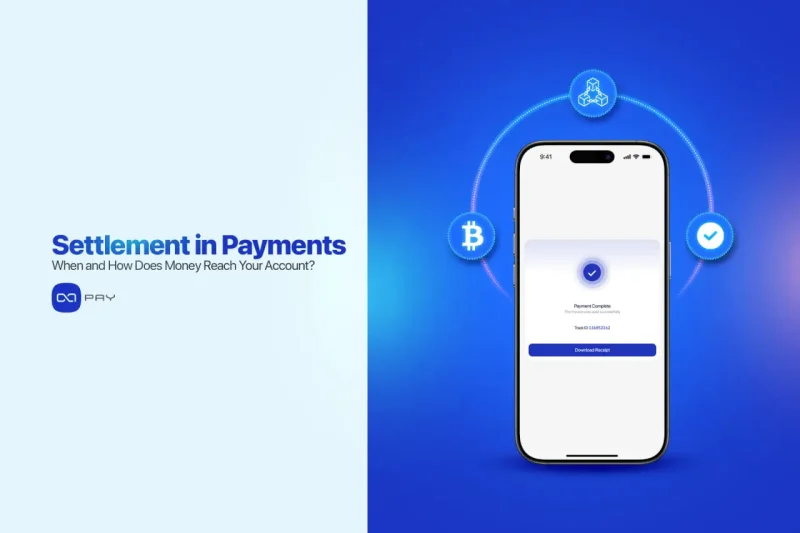
For many merchants, payments seem simple: a customer pays, and the money should instantly appear in the business account. In practice, however, the process is far more complex. Every transaction moves through several stages before a business can actually use the funds, and one of the most critical of these stages is settlement , the point where money is finally transferred from the customer’s account to the merchant’s.
In this article, we’ll explain what settlement means, how it works in traditional and crypto systems, why timing matters, and how gatways like OxaPay crypto gateway help merchants gain control over their cash flow.
What Is payment Settlement?
Payment settlement is the moment of truth in payment processing. It’s the stage where a transaction becomes real, when the money actually moves from the customer’s account into the merchant’s. While authorization only checks if funds or credit are available, settlement completes the process by transferring those funds.
- Authorization vs. Settlement:
- Authorization = Checks the validity of the payment and places a temporary hold on funds.
- Settlement = Moves the reserved funds into the merchant’s account.
Think of authorization as a promise and settlement as the delivery of that promise. Until settlement occurs, merchants don’t truly have access to the money. Once the payment is settled, the funds become usable for business operations. Depending on the system, this can take seconds in crypto or several days in traditional banking, making settlement timing a key factor in cash flow management.
How Settlement Works in Traditional Payment Systems
Card Payments (Visa, Mastercard, Amex)
When a customer pays with a credit or debit card:
- The issuing bank authorizes the transaction.
- The card network routes funds from the issuing bank to the acquiring bank.
- The merchant’s acquiring bank credits the merchant account after processing.
Timing: Settlement often takes 1–3 business days. On weekends or holidays, it can take longer.
Costs: Transaction fees typically range between 2–4%, plus fixed fees.
Risks:
- Chargebacks: Even after settlement, customers can dispute charges, forcing funds to be withdrawn.
- Holds: Banks sometimes delay settlement for “high-risk” merchants or industries.
Payment Service Providers (PSPs) like PayPal or Stripe
Payment Service Providers (PSPs) simplify the process by acting as both the gateway and the acquiring bank. For merchants, this reduces complexity but still comes with challenges:
- Instant vs. Delayed Settlement: Some PSPs offer instant payouts (with extra fees), while standard transfers can take 1–7 days.
- Account Freezes: PSPs may hold funds if they detect “suspicious” activity, often without detailed explanation.
Merchant Experience: PSPs make onboarding easy, but cash flow can be unpredictable.
Cross-Border Settlements in Traditional Systems
If a merchant sells internationally, cross-border settlement becomes even more complex:
- Payments may route through multiple correspondent banks.
- Each intermediary takes fees and introduces delays.
- Settlement can take 5–7 business days or more.
For global merchants, this creates major cash flow challenges.
Settlement in Crypto Payments
In crypto, settlement is managed by the blockchain. Once a transaction is confirmed and recorded on-chain, the funds are already in the merchant’s wallet.
How It Works
- The transaction enters the blockchain’s mempool as unconfirmed.
- Miners (Proof of Work) or validators (Proof of Stake) include it in a block.
- Once confirmed, the transfer is final and irreversible.
Speed and Fees by Network
- Bitcoin: ~10 minutes per block. For higher security, 3–6 confirmations are common, meaning settlement can take 30–60 minutes.
- Ethereum: ~15 seconds per block, but merchants often wait for 12+ confirmations (~3 minutes).
- TRON / Polygon: Near-instant confirmations, often within seconds, with fees close to zero.
Advantages
- Low Fees: Typically <1%, far cheaper than card payments.
- Irreversibility: No chargebacks. Once settled, the merchant owns the funds.
- Cross-Border Simplicity: Funds move directly from wallet to wallet, bypassing banks and intermediaries.
Risks
- Network Congestion: During heavy blockchain activity, settlement may slow down.
- Volatility: If merchants accept crypto directly without converting, settlement value may change due to price swings.
Comparing Traditional vs. Crypto Settlement
| Factor | Traditional Systems | Crypto Payments |
| Settlement Time | 1–3 days (domestic), 5–7 days (cross-border) | Seconds to ~1 hour, depending on blockchain |
| Fees | 2–4% + fixed fees | <1% (network + gateway) |
| Risk of Reversal | High (chargebacks, disputes) | None (irreversible once confirmed) |
| Cross-Border | Slow, multiple intermediaries | Direct, borderless |
| Liquidity | Delayed access | Almost instant access |
👉 The difference is clear: crypto payments settle faster, cheaper, and with fewer risks of reversal.
Why Payment Settlement Timing Matters for Merchants
Settlement isn’t just technical, it’s financial strategy.
Cash Flow Management
Merchants rely on steady cash flow to pay suppliers, employees, and operational costs. If funds are delayed for days, businesses may need to borrow money or dip into reserves.
Transparency with Customers
Understanding settlement timing helps merchants set realistic delivery and refund policies. Customers trust businesses that communicate clearly about how and when payments are finalized.
Example:
- A small online store selling electronics receives $10,000 in weekend sales.
- With card payments, funds may not arrive until Wednesday or Thursday.
- With crypto, funds could be in the merchant’s wallet within an hour, ready for reinvestment.
👉 Settlement speed can be the difference between stagnation and growth.
Optimizing Payment Settlement with OxaPay
OxaPay crypto gateway gives merchants control and flexibility in how settlement works:
- Auto Withdraw: Instantly move settled funds to a wallet of your choice.
- Auto Convert to USDT: Eliminate volatility by automatically converting payments into stablecoins.
- Instant Settlement: Supported blockchains like TRON and Polygon provide near-instant confirmation.
- Global Reach: Accept payments from anywhere, without waiting for cross-border banking delays.
For merchants, this means settlement isn’t just faster, it’s predictable, secure, and built for business scalability.
✅ Quick Checklist for Merchants
- Understand the difference between authorization and settlement.
- Track how long settlements take in your payment systems.
- Factor settlement timing into your cash flow planning.
- Choose tools (like Auto Withdraw) that reduce settlement delays.
- For large payments, set clear confirmation thresholds.
- Use stablecoins to reduce volatility risk.
Conclusion: Why Fast Settlement Matters for Businesses
Settlement is more than a technical term, it’s the moment when merchants truly gain access to their money. In traditional systems, it can take days, cost significant fees, and carry the risk of chargebacks. In crypto, it’s faster, cheaper, and irreversible.
For merchants, understanding settlement means smarter cash flow, reduced risk, and better long-term planning. And with tools like OxaPay, settlement becomes not only quicker but also easier to manage, helping businesses stay liquid, secure, and ready to grow.
👉 Start optimizing your cash flow today with OxaPay and experience settlement the way it should be: fast, reliable, and global.