A Practical Merchant Guide to Crypto Payments
This guide helps merchants decide whether accepting crypto payments makes sense, how to start without unnecessary complexity, and how to evaluate real payment behavior before scaling.
About This Guide
Before anything else, this merchant guide to crypto payments focuses on answering one core question:
Does accepting crypto payments make sense for your business?
This is not a sales page. It does not assume crypto payments are right for every business, and it does not push a single integration method before the business case is clear.
Instead, the guide helps merchants approach crypto payments with a clear operational mindset. It explains how crypto payments behave, how to choose an appropriate integration method, how to evaluate providers, and how to define rules before going live.
What This Guide Is
A Decision Guide
It helps you decide whether crypto payments are relevant to your customer base, geography, and payment friction.
An Operating Framework
It explains what must be defined before real money starts moving, including expiration, completion, underpayment, and support rules.
A Controlled Launch Model
It shows how to test crypto payments with limited scope before expanding into more complex workflows.
A Reality Check
It treats crypto as a payment rail, not as a universal solution or business model by itself.
What This Guide Is Not
- not a promotional page
- not speculative content about crypto markets
- not a promise that crypto payments fit every business
- not a “set and forget” implementation shortcut
Crypto payments introduce different behaviors and responsibilities. This guide assumes you want to understand them before moving forward.
Quick Decision Framework
Strong Fit
- international or cross-border customers
- digital products, SaaS, or remote services
- real payment friction with cards or banks
- need for more flexible settlement options
Situational Fit
- mixed local and international customers
- testing alternative payment methods
- crypto as a secondary checkout option
- limited use cases before full rollout
Low Priority
- mostly local customers
- current payment system works reliably
- no real settlement or decline issues
- no internal capacity to manage payment rules
First Decision
If crypto payments do not solve a clear business problem, they can wait. If they do, start small and measure real behavior.
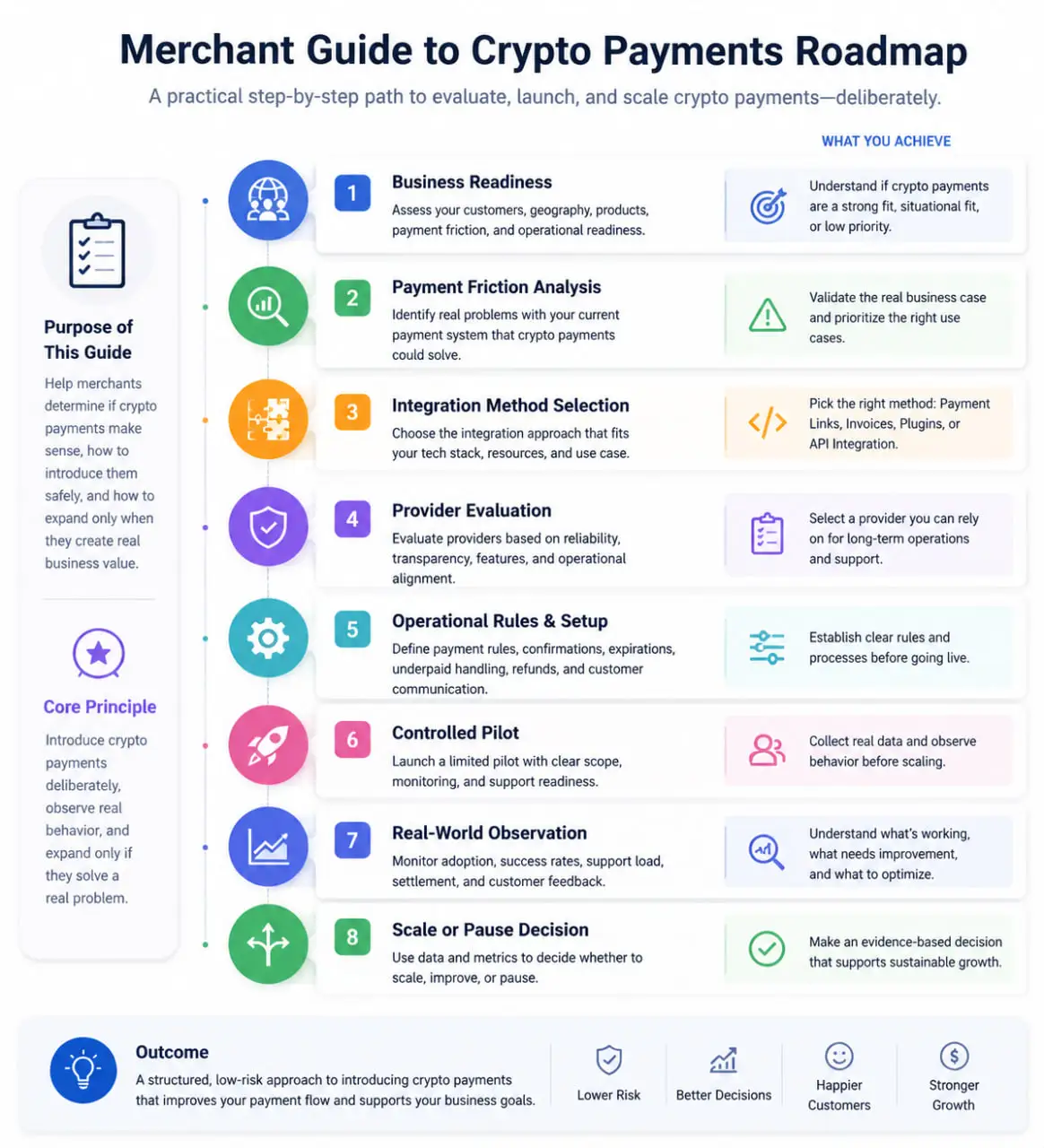
A roadmap view of how merchants should move from early qualification to controlled crypto payment rollout and evidence-based scaling.
Who This Guide Is For
- merchants with international or cross-border customers
- businesses offering digital products, SaaS, subscriptions, or remote services
- founders and operators facing payment friction with cards or banks
- teams that want clarity before committing engineering or operational resources
It is especially useful for merchants who want to avoid early mistakes such as assuming instant settlement, underestimating operational edge cases, or launching without clearly defined payment rules.
Who This Guide Is Not For
- businesses whose customers are entirely local and already pay reliably
- teams looking for promotional or speculative crypto content
- operators who want a payment method without any operational responsibility
Stopping after qualification, or pausing after a pilot, can be the right decision. The goal is not forced adoption. The goal is a clear and informed payment strategy.
Stage 1: Crypto Payment Readiness
This stage helps you decide whether accepting crypto payments makes sense for your business right now.
The question is not whether crypto payments are modern or popular. The question is whether they solve a real payment problem for your customers, your operations, or your settlement process.
Your Customers and Geography
Crypto payments create the most value when your customers are not concentrated in one easy-to-serve local market.
- mostly international customers: strong signal
- mixed local and international customers: situational signal
- mostly local customers with reliable payment access: weak signal
If customers can already pay easily with local cards or bank transfers, crypto may not add immediate value.
What You Sell and How You Get Paid
Crypto payments usually fit best when products or services are digital, borderless, remote, or difficult to serve through traditional rails.
Strong Fit
- SaaS subscriptions
- digital services
- remote consulting
- global freelance work
Needs More Review
- physical goods with shipping complexity
- high-refund business models
- products needing strong dispute workflows
- local-only retail transactions
If your model depends heavily on recurring billing, refunds, or disputes, crypto may still work, but the operational design needs more care.
Your Current Payment Friction
Crypto rarely replaces a payment system that already works well. It becomes valuable when existing rails create measurable friction.
- high decline rates for international customers
- slow cross-border settlement
- high payment processing costs for certain markets
- chargeback exposure in specific product categories
- customers asking for alternative payment options
If none of these are real problems today, crypto is optional, not urgent.
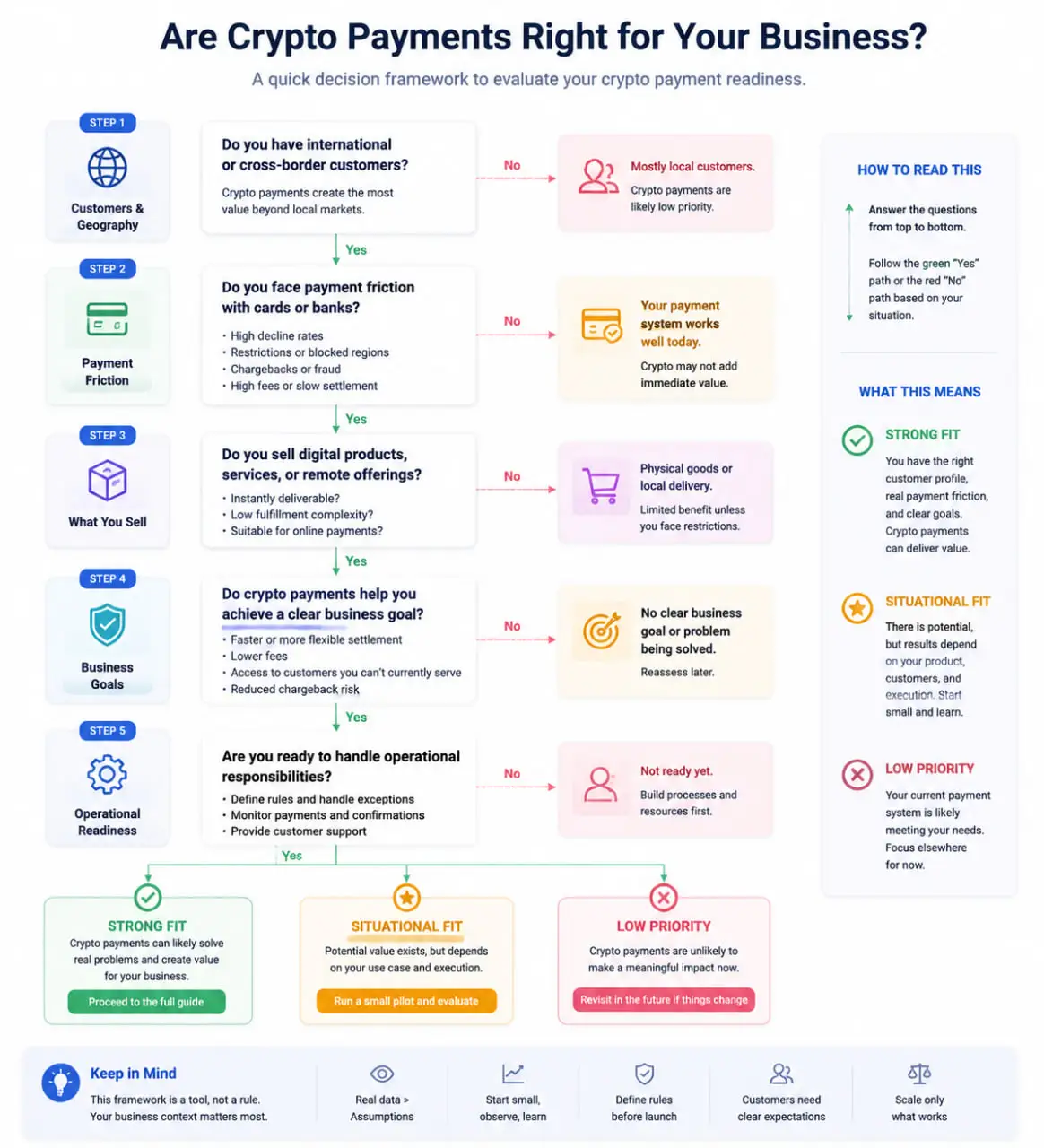
A merchant-focused decision framework that helps businesses evaluate whether crypto payments are a strong fit, a situational fit, or a low-priority payment option.
Operational Readiness
You do not need a large technical team, but you do need clear rules.
- a clear payment flow for customers
- rules for underpaid, late, or expired payments
- basic understanding of confirmations and settlement timing
- simple tracking for accounting and support
- someone responsible for reviewing payment exceptions
Stage 1 Decision
At the end of this stage, you should decide whether crypto payments are worth testing before choosing any tool or provider.
Stage 2: What Merchants Need to Know Before Moving Forward
This stage is not about becoming a crypto expert. Its purpose is to prevent false assumptions before you go any further.
Crypto payments do not behave like card or bank payments. Understanding a few core realities early will help you avoid confusion, support issues, and incorrect expectations later.
Crypto Payments Are Network-Based, Not Institution-Based
Crypto transactions are processed by blockchain networks, not banks or card companies.
- no central authority reverses a payment like a card chargeback
- network conditions affect timing
- settlement depends on confirmations and payment-state interpretation
If your business relies heavily on reversibility or instant cancellation, crypto payments need careful operational boundaries.
Timing Is Probabilistic, Not Guaranteed
Crypto payments are not instant by default.
- a payment may appear quickly but still be unconfirmed
- confirmation times can vary by network
- network congestion can introduce delays
Amounts Can Be Incorrect or Incomplete
Unlike card payments, many crypto payments are user-initiated. That means payment behavior can be less predictable.
- customers may send less than required
- customers may send more than required
- payments may arrive after expiration
- users may choose the wrong network if the flow is unclear
These situations are normal payment behaviors. They should be planned for before launch.
Crypto Payments Are Transparent by Default
Blockchain transactions are publicly visible on the networks where they occur.
Operational Benefit
Payments can be independently verified, audited, and traced through transaction records.
Operational Responsibility
Payment instructions, addresses, networks, and status messaging must be clear enough to avoid confusion.
Transparency helps verification, but it does not replace payment-state management.
Crypto Is a Payment Rail, Not a Business Model
Accepting crypto does not automatically increase sales, reduce all fees, or eliminate payment problems.
It is another way for value to move. Whether it adds value depends on customer demand, payment friction, settlement needs, and the operational quality of the payment flow.
Stage 2 Takeaway
If you understand that crypto payments can be irreversible, delayed, user-driven, and operationally different from traditional payments, you are ready to choose an integration approach.
This understanding is not optional. It is the foundation for every decision that follows.
Stage 3: Choosing the Approach That Fits Your Business Model
This stage is about how crypto payments should enter your business, not which provider you should use first.
Before comparing platforms, plugins, or APIs, define which payment approach fits how your customers actually buy from you.
Start With Your Sales Flow, Not the Technology
- Is the payment one-time or recurring?
- Is delivery instant or manual?
- Does the customer need an account?
- Is pricing fixed or flexible?
- Do you need automated fulfillment or manual review?
Choosing a method that does not match your sales flow usually creates more work, not less.
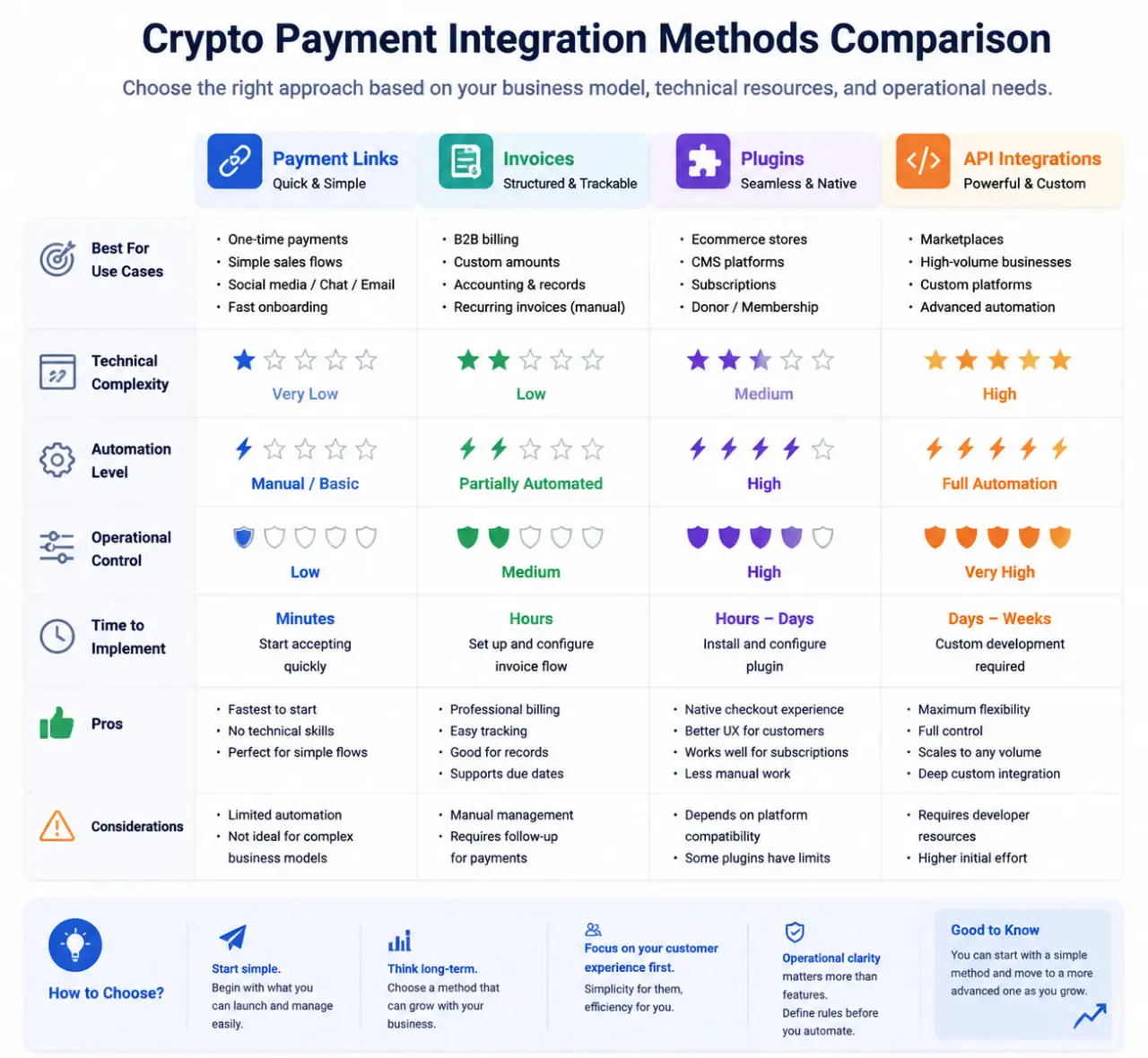
A comparison infographic explaining different crypto payment integration methods, including complexity, automation level, operational control, and ideal business use cases.
Common Integration Approaches
| روش | بهترین برای | پیچیدگی | When to Use |
|---|---|---|---|
| لینکهای پرداخت | Simple payments, services, manual sales | کم | Starting point, testing demand, one-time requests |
| فاکتورها | Structured payments with amount and timing | Low to medium | When tracking, expiration, and payment context matter |
| Checkout or Store Plugins | E-commerce stores | متوسط | Automated checkout flows with order tracking |
| Custom API Integrations | Custom systems, SaaS, marketplaces | بالا | Only when simpler methods do not fit operational needs |
Each method solves a different problem. None is universally better.
Merchant Scenarios
Freelancer or Agency
Start with payment links or invoices. Manual review is acceptable because payment volume is usually lower and each payment has context.
SaaS Business
Use invoices or API integration when account activation, subscription access, and internal state changes need automation.
E-commerce Store
Use a plugin or checkout integration when orders, carts, stock, and fulfillment need a connected flow.
High-Value B2B Invoice
Use structured invoices with clear confirmation, reconciliation, and manual review rules before fulfillment or service delivery.
Favor Simplicity at the Start
A common mistake is choosing the most advanced method first.
- complex integrations increase setup time
- they increase support burden
- they can hide real customer behavior behind automation
- they make early diagnosis harder when something goes wrong
Stage 3 Decision
At the end of this stage, you should clearly answer:
Which integration method fits my business with the least risk?
Choosing the method first prevents forcing your business into a tool that does not fit.
Stage 4: Finding the Right Provider for Your Chosen Method
At this stage, you already know how you want to accept crypto payments. Now the question becomes which پردازنده پرداخت کریپتو should support that approach.
This step is about evaluating providers realistically, not choosing the most popular name.
Match the Provider to the Integration Method
Before comparing feature lists, confirm that the provider supports the way your business actually needs to collect and process payments.
- supports your selected integration method
- handles your payment flow without awkward workarounds
- fits your delivery and operational model
- gives enough status visibility for support and accounting
A provider that forces you to redesign your flow is rarely a good fit.
Focus on Reliability Over Features
Early on, reliability matters more than advanced functionality.
- clear payment status handling
- predictable expiration behavior
- transparent transaction tracking
- consistent webhook or callback logic
- underpaid, late, and expired payment handling
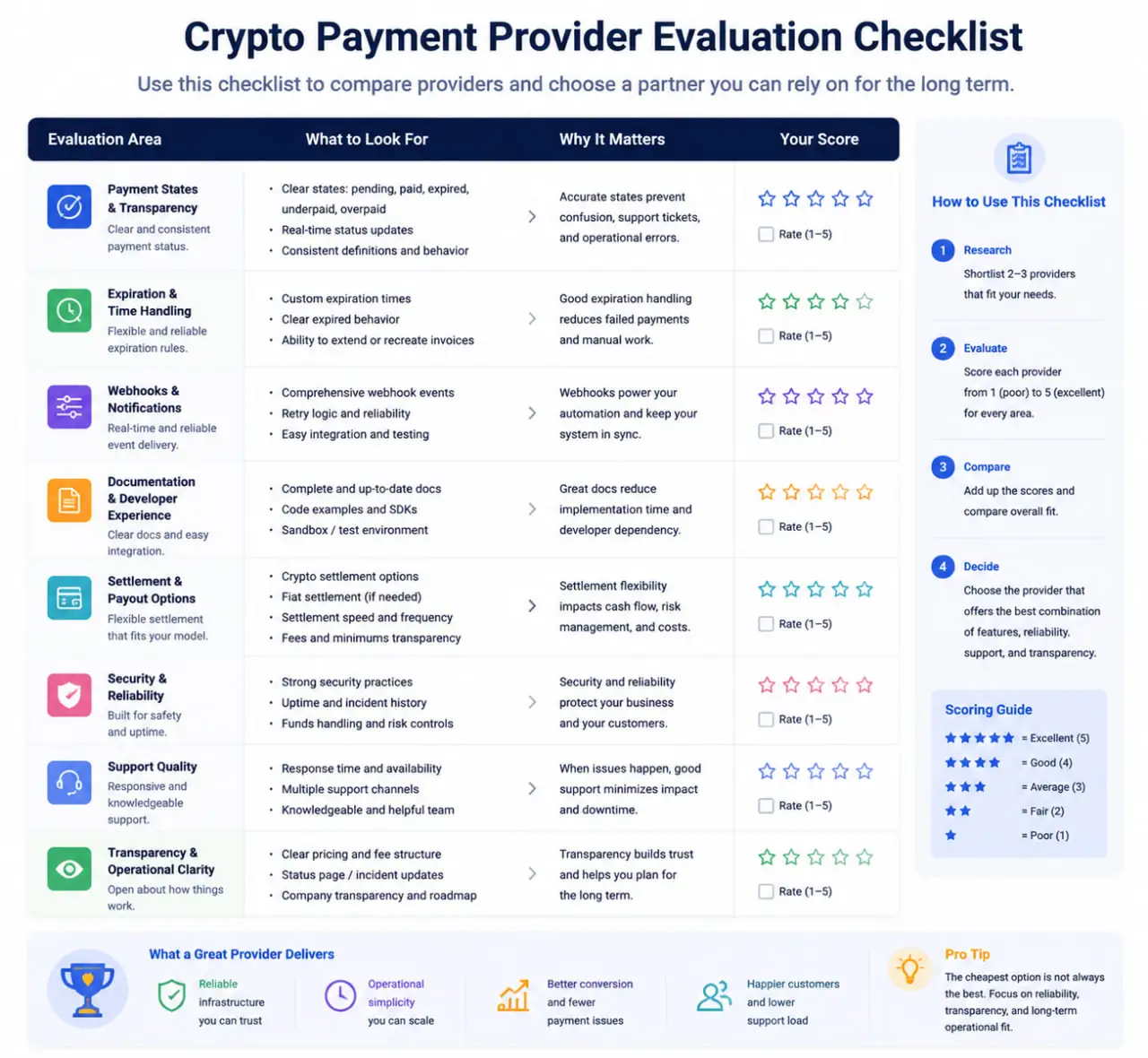
A structured checklist for comparing crypto payment providers based on operational transparency, payment handling, support quality, documentation, settlement flexibility, and reliability.
Understand Operational Responsibilities
Some providers handle more operational logic for you. Others expect you to manage more of it yourself.
- who handles underpaid or late payments?
- how is expiration enforced?
- what happens when a payment arrives after expiration?
- how are callbacks, webhooks, or notifications delivered?
- how much manual intervention is expected?
Hidden operational work becomes support overhead later.
Evaluate Support and Documentation Quality
When something goes wrong, clarity matters more than speed alone.
- payment states should be explained clearly
- documentation should match real behavior
- edge cases should be covered, not hidden
- support should understand operational payment issues
Good documentation often reflects a mature payment system.
Stage 4 Decision
By the end of this stage, you should be able to say:
If that statement is not true, keep looking before going live.
Stage 5: Preparing for Real-World Payments Before Going Live
This stage happens before you accept your first real crypto payment. The goal is not implementation alone. The goal is to avoid confusion once money starts moving.
At this point, you already know that crypto payments may fit your business, how you want to integrate them, and which provider you plan to use. Now you need to define how payments will behave in practice.
Define the Scope of Crypto Payments
Do not introduce crypto payments everywhere at once.
- which product or service will accept crypto?
- which customers can use it?
- which channel does it apply to?
- which currency or network options will be available?
Starting with a limited scope reduces risk and makes behavior easier to observe.
Set Correct Expectations for Customers
Customers often assume crypto works like cards. Your payment flow should prevent that assumption from creating confusion.
- explain confirmation time clearly
- show what payment status means
- communicate what happens during delays
- make expiration windows visible
- explain when fulfillment begins
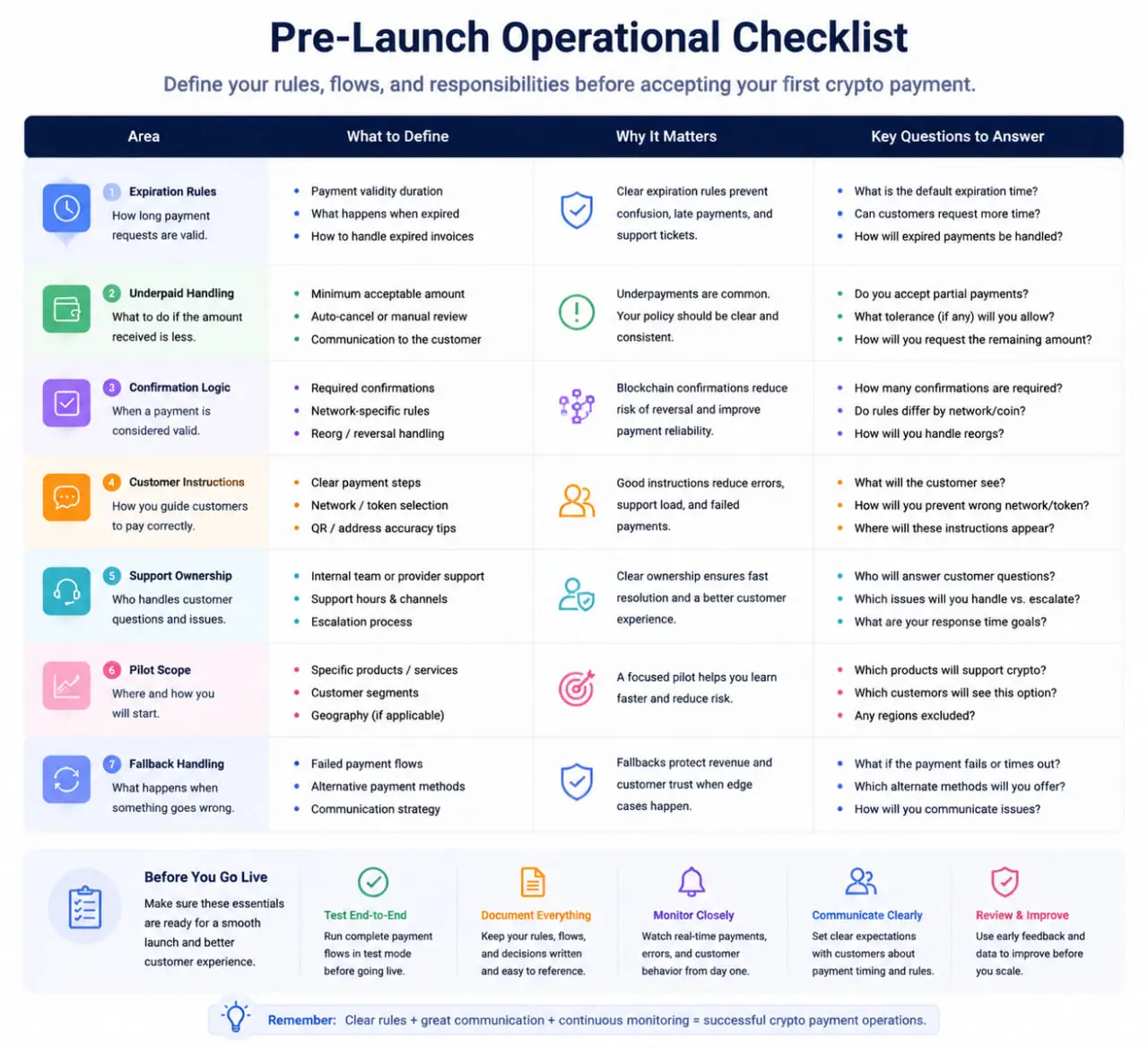
An operational checklist designed to help merchants define payment rules, support processes, confirmation handling, and customer communication before launching crypto payments.
Define Simple Payment Rules
These rules are not purely technical. They are business decisions.
| Situation | Rule to Define | چرا مهم است؟ |
|---|---|---|
| Underpaid payment | Accept within tolerance, request top-up, or reject | Prevents manual case-by-case decisions |
| Late payment | Accept conditionally or treat as expired | Protects customer experience and order logic |
| Unconfirmed payment | Wait, show pending status, or require confirmation depth | Prevents premature fulfillment |
| اضافه پرداخت | Credit, refund, or manually review | Supports accounting consistency |
Undefined rules turn normal payment behavior into operational problems.
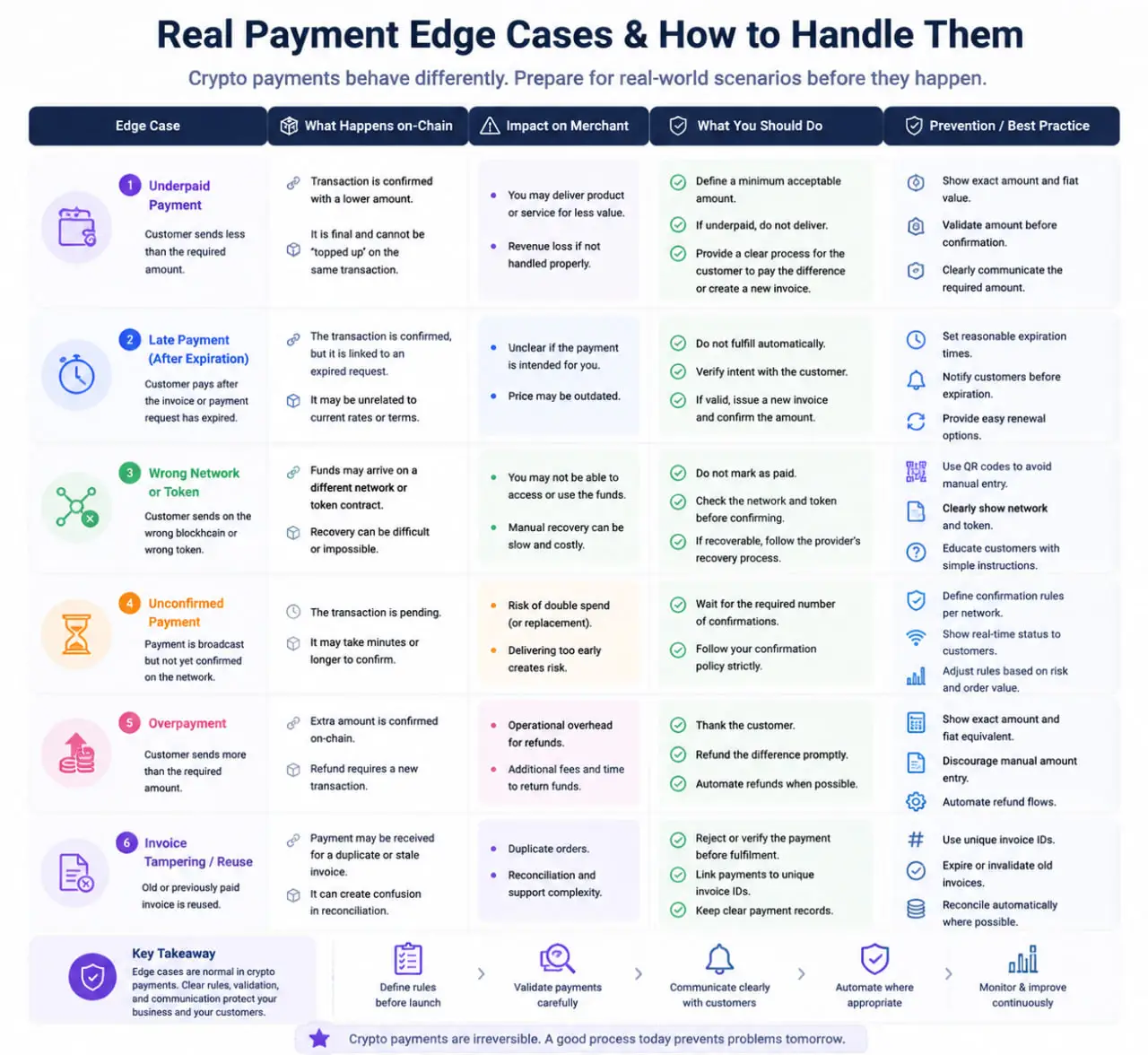
A practical infographic explaining common crypto payment edge cases and how merchants should respond operationally to reduce confusion, payment errors, and support issues.
Plan a Controlled Pilot
Do not treat the first launch as a growth phase. Treat it as a learning system.
- limited transaction volume
- low payment amounts
- a specific product or service
- clear observation goals
- assigned support responsibility
Stage 5 Takeaway
By the end of this stage, you should have a clearly defined payment scope, simple customer instructions, operational rules, and a controlled pilot plan.
With this in place, real payment behavior becomes easier to observe and safer to evaluate.
Stage 6: Running Your Pilot and Evaluating Real Results
This stage is where crypto payments move from theory to real usage.
The goal is not immediate growth. The goal is understanding how crypto behaves in your actual business environment.
Launch in a Controlled Environment
- use a limited product or service
- keep transaction volume low
- avoid complex flows or unnecessary automation
- monitor every exception manually at first
Early simplicity makes behavior easier to observe and reduces operational risk.
Observe Real Payment Behavior
Focus on what actually happens during payments, not what you expected to happen.
- do customers complete payments without confusion?
- are there timing or confirmation issues?
- do underpaid, overpaid, or late payments occur?
- how often do customers need support?
- does crypto reduce friction for a specific customer segment?
A customer sending a payment after expiration or sending slightly less than required is not a rare failure. It is real payment behavior.
Compare Against Existing Payment Methods
Crypto payments should be evaluated relative to the payment system you already use.
- does crypto reduce friction for certain customers?
- does it improve acceptance where existing payment methods struggle?
- does it reduce or increase operational work?
- does it create customer confusion?
- does it justify broader rollout?
The goal is not to replace existing methods by default. The goal is to identify where crypto adds practical value.
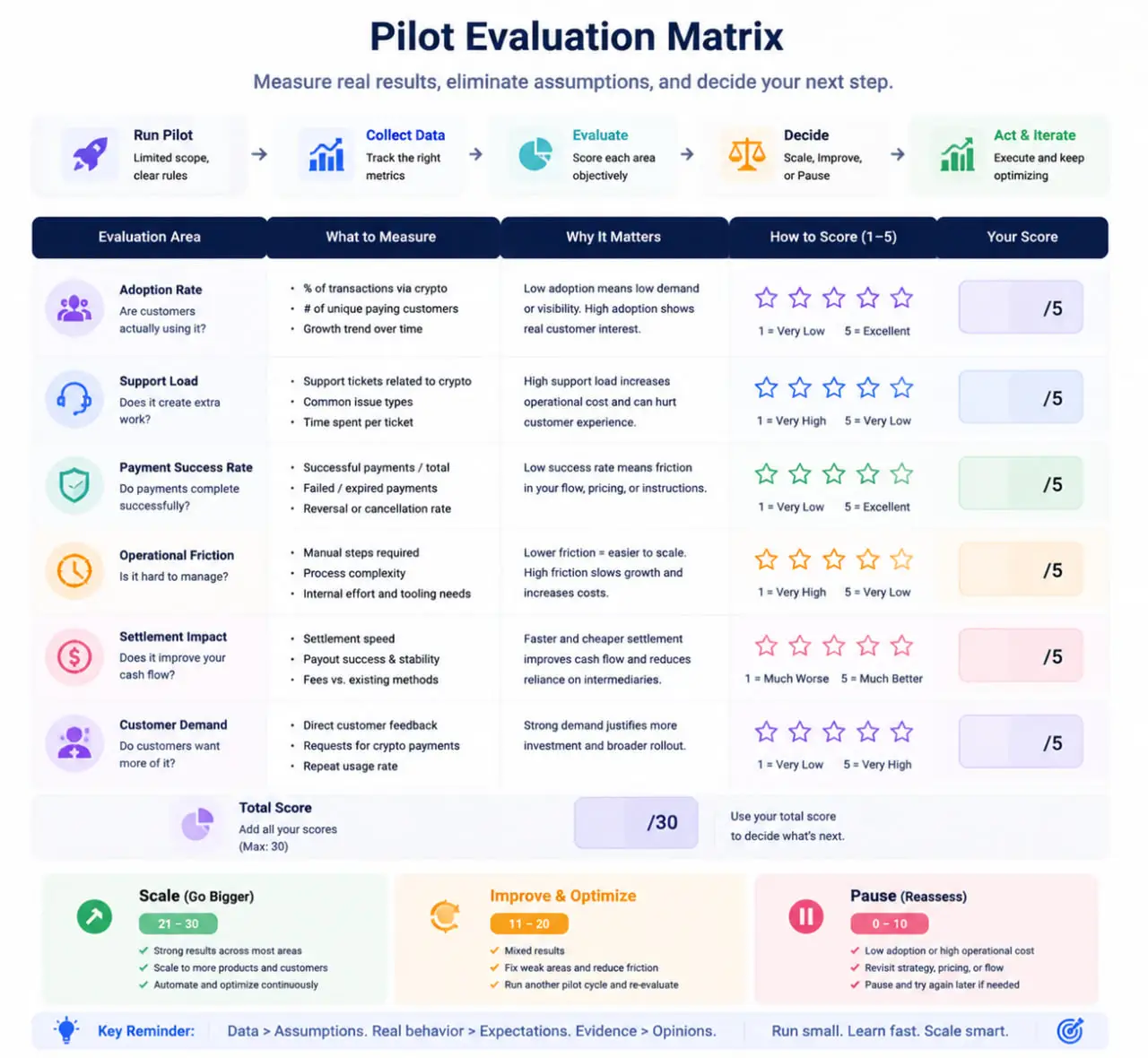
A decision matrix for evaluating crypto payment pilots using operational metrics such as adoption, payment success, customer demand, support load, and settlement impact.
Final Decision: Scale or Pause
A pilot should not drift endlessly. At the end, make a clear decision based on what you observed.
| Signal | Scale if… | Pause if… |
|---|---|---|
| Adoption rate | Enough relevant customers choose crypto to justify keeping it active | Usage remains very low without a clear reason |
| Support load | Questions are low or manageable | Support volume rises faster than payment volume |
| Payment success rate | Most payments complete successfully | Underpaid, expired, or confused payments appear repeatedly |
| Business impact | Crypto reduces friction or opens useful demand | No noticeable improvement appears |
Where OxaPay Fits
Once a merchant decides that crypto payments are worth testing, the next challenge is not only accepting a transaction. It is turning payment activity into a manageable business process.
اکساپی helps merchants structure that process with payment links, invoices, plugins, APIs, status tracking, and automation options that support controlled crypto payment adoption.
Start Simple
Use payment links or invoices to test demand without building a complex integration too early.
Move Toward Structure
Use invoices, plugins, or API workflows when payment context, order tracking, and automation become important.
Monitor Payment Behavior
Track payment states, timing, and transaction behavior instead of treating every payment as a simple paid/unpaid event.
Scale When Evidence Supports It
Expand crypto payments only when the pilot shows real customer demand and manageable operational impact.
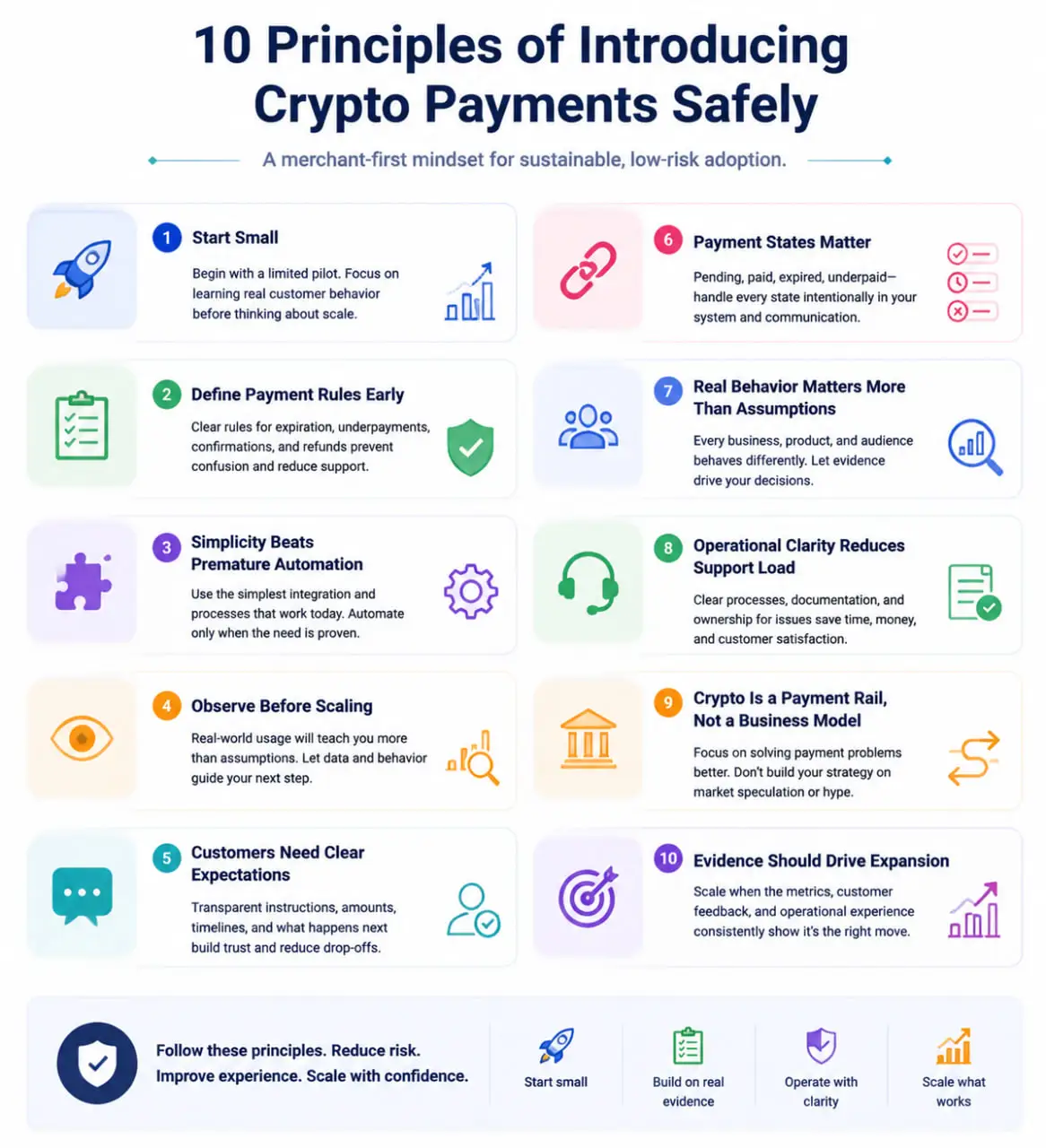
A summary infographic presenting ten key principles for introducing crypto payments safely, including operational clarity, payment-state management, controlled scaling, and evidence-based decision-making.
Final Takeaway
Crypto payments become useful when they are introduced as a controlled payment option, not as an uncontrolled experiment.
The right path is simple: qualify the need, understand the behavior, choose the simplest suitable method, define operational rules, run a limited pilot, and scale only when real evidence supports expansion.
For some merchants, that path leads to wider adoption. For others, it leads to a justified pause. Both outcomes are valuable because both are based on business reality instead of assumptions.