Is Your Business Ready for Crypto Payments?
A practical framework for testing customer demand, operating capability, treasury readiness, compliance, security, support, and launch risk before accepting crypto payments.
Readiness Is More Than Customer Interest
A customer asking to pay in crypto is a useful signal. It is not, by itself, proof that the business is ready to support crypto payments.
Readiness means the payment method solves a real problem and the business can operate it safely. The team must understand who will use it, how payment states affect fulfillment, who handles exceptions, where funds settle, and how records enter accounting.
This distinction matters most in international commerce. The Financial Stability Board identifies cost, speed, access, and transparency as recurring cross-border payment challenges . Crypto may improve selected corridors or customer experiences, but only when the operational design fits the business.
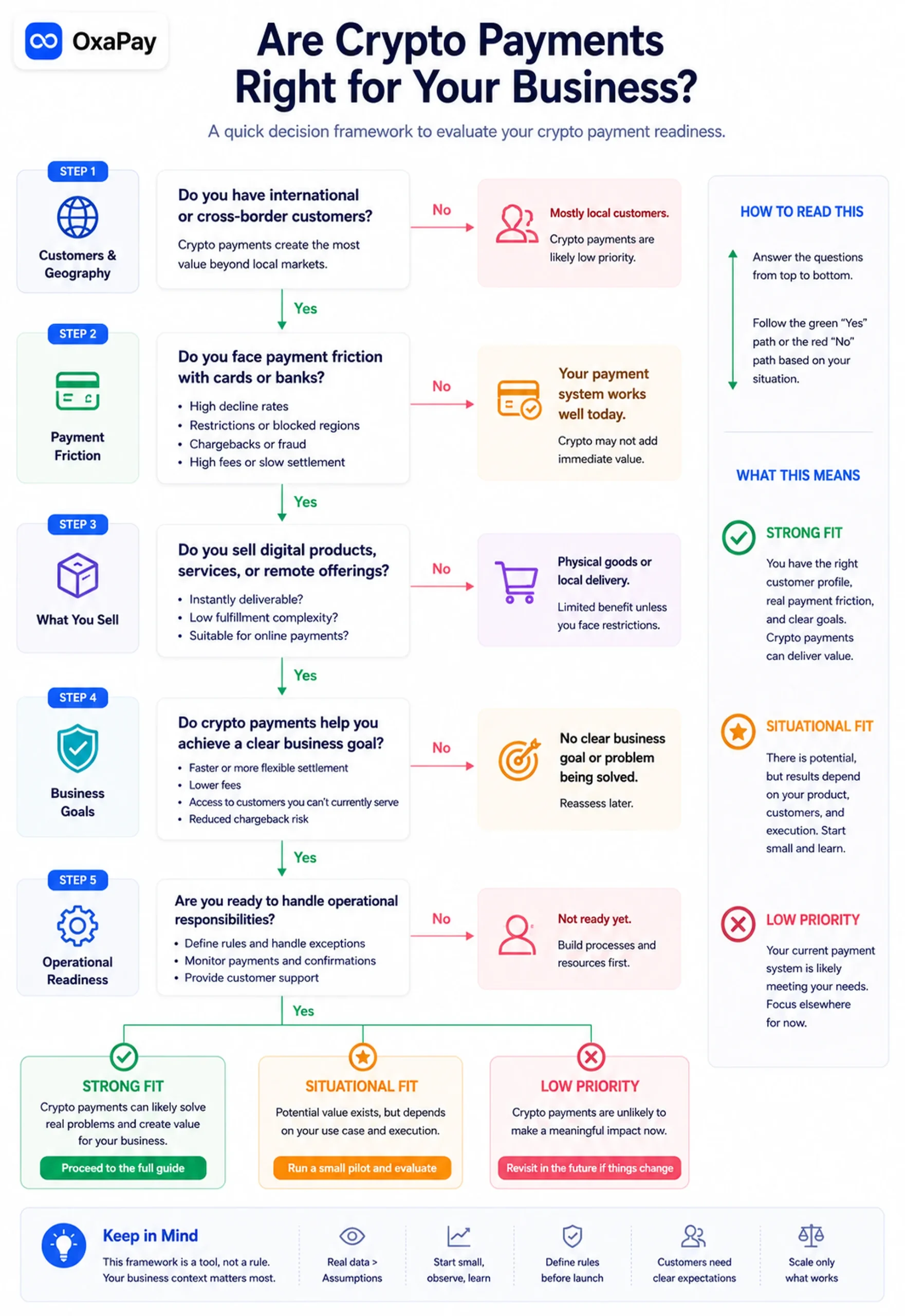
The Three Parts of Crypto Payment Readiness
Commercial Fit
The payment method addresses customer demand, geographic limits, failed payments, settlement delays, or another measurable business problem.
Operating Capability
The business can define ownership, payment rules, support responses, reconciliation, and fulfillment decisions.
Risk Control
The team can manage treasury exposure, security, access, records, legal review, and payment exceptions.
Controlled Evidence
A limited pilot can test demand and operational impact before the business commits to wider adoption.
What Does Not Prove Readiness
A Competitor Accepts Crypto
Competitor activity does not prove that your customers have the same need or that your operating model can support it.
A Wallet Address Exists
Receiving funds does not create invoice matching, payment states, support rules, access controls, or accounting records.
One Customer Requested It
A single request can justify discovery, but not a broad rollout without repeatable demand or a valuable account relationship.
The Integration Looks Easy
Technical setup may be simple while refunds, settlement, exceptions, reporting, and customer communication remain unresolved.
How to Use This Readiness Assessment
Score each readiness dimension from zero to two. Use evidence from your current payment operation rather than optimistic plans.
| Score | Meaning | Evidence Standard |
|---|---|---|
| 0 | Not defined | No owner, policy, data, or practical answer exists. |
| 1 | Partially ready | The issue is understood, but the process is manual, incomplete, or untested. |
| 2 | Ready for a pilot | An owner, rule, workflow, and testable operating approach are in place. |
The score is a diagnostic tool, not a compliance certification or guarantee of business success.
Document the Current Payment Operation First
A readiness assessment needs a baseline. Record how customers pay today, where payments fail, when funds become available, and how exceptions enter support and accounting.
Without a baseline, the pilot can show activity but cannot show whether crypto improved the payment operation.
1. Customer and Market Readiness
Start with the customers who would actually use crypto. General interest in digital assets is less useful than evidence from specific customer groups, countries, or payment situations.
Questions to answer
- Which customers have requested crypto as a payment option?
- Are those customers unable or unwilling to use current methods?
- Does demand come from a repeatable segment or isolated requests?
- Which countries, products, order values, and channels are involved?
- Do customers already understand wallets, assets, and networks?
Strong Evidence
Repeated requests, failed international checkouts, limited card coverage, or measurable demand from a defined customer segment.
Weak Evidence
Internal enthusiasm, competitor activity, or broad assumptions that crypto users will appear after launch.
2. Payment Problem and Business-Case Readiness
Crypto should solve a defined payment problem. Common examples include inaccessible local payment methods, cross-border acceptance limits, slow settlement, high friction for remote services, or demand for stablecoin settlement.
Do not reduce the business case to a headline processing fee. Compare the full operating effect, including integration, support, conversion, refunds, reconciliation, accounting, and off-ramp costs. Use the provider’s actual pricing structure rather than assuming every crypto transaction has the same cost.
| Business Signal | What to Measure | Readiness Test |
|---|---|---|
| Payment access | Declines, unavailable methods, abandoned checkouts | Crypto can serve a measurable gap. |
| la fricción transfronteriza | Processing time, fees, settlement delay, FX layers | The target corridor has a clear problem. |
| Customer demand | Requests, conversion intent, repeat buyers | Demand is tied to a defined segment. |
| Operational impact | Support time, reconciliation effort, exception volume | Expected benefit exceeds added work. |
3. Product, Delivery, and Refund Readiness
The product determines how much payment uncertainty the business can tolerate. Digital goods can be delivered instantly but may be difficult to recover. Physical goods allow a review period before shipment. B2B services may support manual approval, while automated SaaS access needs reliable payment-state rules.
Lower Operational Complexity
- manual B2B invoices
- consulting and agency work
- low-volume remote services
- orders reviewed before fulfillment
Higher Operational Complexity
- instant digital delivery
- automated account activation
- high-refund products
- recurring or usage-based billing
Define whether the business can delay fulfillment, how refunds will be priced and sent, and who absorbs network or conversion costs. These policies belong to the merchant even when a gateway handles transaction processing.
4. Customer Experience and Support Readiness
A technically correct payment flow can still fail commercially when customers do not understand the amount, asset, network, expiration window, or confirmation status.
Your customer-facing flow should answer
- Which asset and network must the customer use?
- How long is the quoted amount valid?
- What does pending or confirming mean?
- When will the order be fulfilled?
- What should the customer do after an incorrect payment?
The available options should match real support capacity. Before presenting many choices, review the provider’s supported currencies y supported networks . Then expose only the combinations that the business is prepared to explain and reconcile.
5. Operational Ownership and Exception Readiness
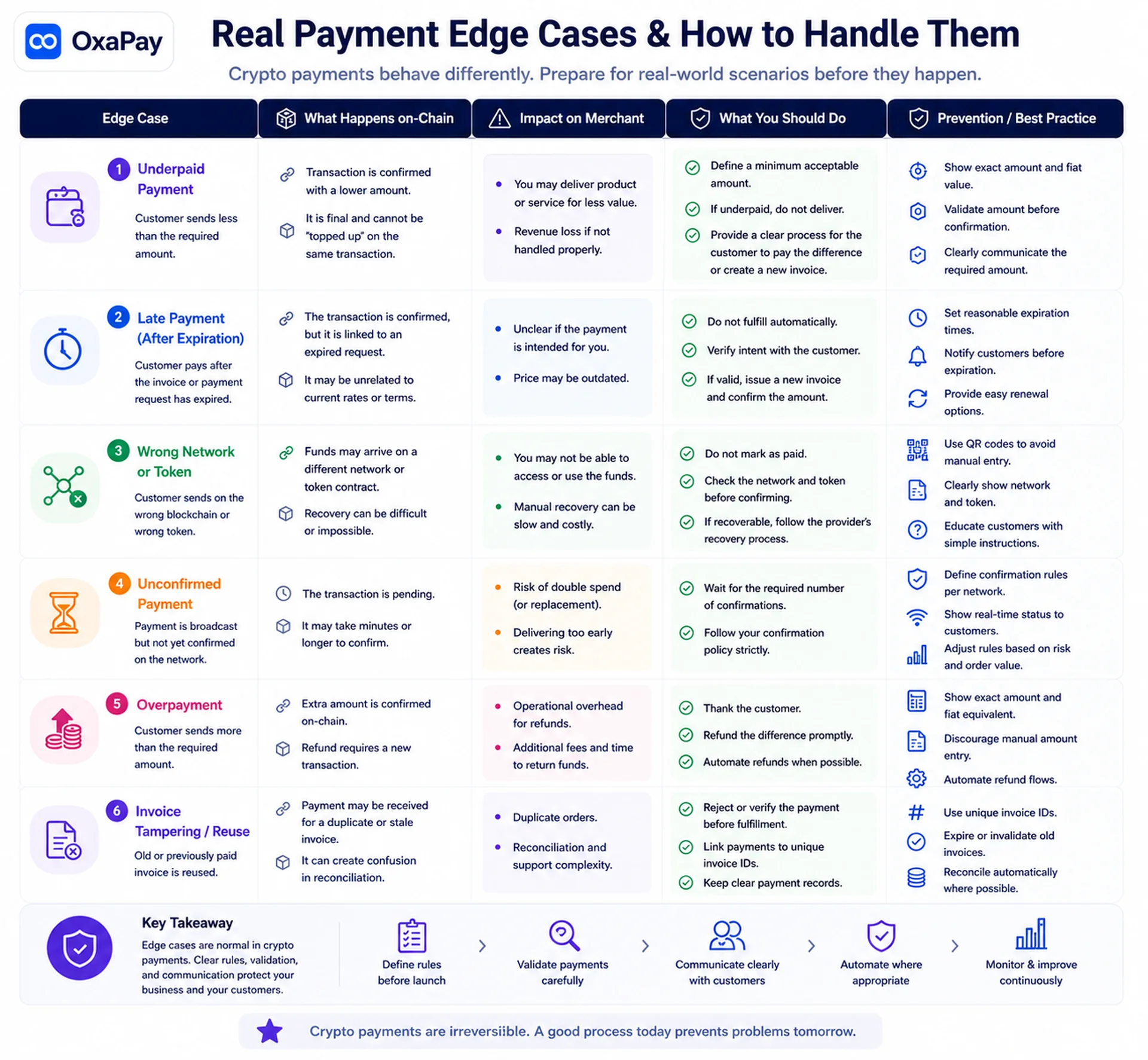
Crypto payments produce normal exceptions that cannot be treated as rare surprises. Customers may underpay, overpay, pay after expiration, use the wrong network, send a duplicate payment, or contact support while the transaction is still confirming.
Readiness does not require automating every case. It requires deciding who owns each case, what evidence they use, and what outcome they are allowed to approve.
| Exception | Owner Must Decide | Minimum Evidence |
|---|---|---|
| Pago insuficiente | Top-up, tolerance, rejection, or manual approval | Expected amount, received amount, asset, network |
| Late payment | Honor the quote, reprice, refund, or review | Invoice expiry, transaction time, current value |
| Red equivocada | Recovery is possible, impossible, or chargeable | Destination, network, custody model, access |
| Pago duplicado | Refund, credit, or apply to another order | Order references and transaction history |
For API-based flows, the team should understand the provider’s estados de pago and know how to retrieve Payment Information de OxaPay during investigation.
6. Settlement and Treasury Readiness
Accepting crypto and keeping crypto are different decisions. A merchant may receive the original asset, convert it, or settle in a stablecoin. Funds may also remain inside a payment account or move to an external wallet.
Define these decisions before launch
- Which asset should the business ultimately hold?
- Who can approve conversion or withdrawal?
- How often should funds move to external wallets?
- How much balance can remain with a provider?
- How will network fees and liquidity affect withdrawals?
- How will exchange-rate differences be recorded?
Same-Asset Exposure
The business retains the asset received and accepts its price, liquidity, and accounting effects.
Conversion Exposure
The business reduces one risk but introduces conversion timing, spread, provider, and off-ramp dependencies.
7. Legal, Compliance, Accounting, and Tax Readiness
Crypto payment obligations vary by jurisdiction, business model, asset, customer type, and the role each service provider performs. A business should not assume that using a gateway transfers every regulatory or reporting responsibility away from the merchant.
FATF’s risk-based guidance for virtual assets shows why responsibilities depend on activities and risk. The accounting treatment also requires professional review. The IFRS Interpretations Committee has published an agenda decision on cryptocurrency holdings , while applicable local standards may differ.
Minimum readiness questions
- Is accepting crypto permitted for this business and customer market?
- What transaction and customer records must be retained?
- How are revenue, fees, refunds, gains, and losses recorded?
- Which exchange-rate source and timestamp will accounting use?
- Do tax-reporting or information-exchange rules affect the operation?
- Who approves policy changes when regulations evolve?
The OECD’s international tax-transparency materials now include the Crypto-Asset Reporting Framework . Its practical relevance depends on jurisdiction and business activity, so local advice remains necessary.
8. Technical and Security Readiness
Technical readiness depends on the integration method. A manual payment link needs fewer internal systems than a checkout plugin or API. However, every method still needs access control, account protection, reliable status visibility, and a recovery process.
No-Code or Low-Code
Confirm account security, staff permissions, payment review, customer communication, and exportable records.
Integración de plugins
Test compatibility, updates, order-state mapping, staging, rollback, and administrator access.
Integración API
Protect credentials, validate inputs, restrict access, log actions, and separate payment events from fulfillment decisions.
Webhook Automation
Authenticate events, handle retries, prevent duplicate actions, log failures, and support status reconciliation.
NIST’s Cybersecurity Framework provides a useful model for governing, identifying, protecting, detecting, responding to, and recovering from cyber risk. Teams building custom integrations should also review the OWASP API Security Top 10 .
When payment updates drive automated actions, review the provider’s webhook behavior before production. The merchant endpoint should be safe when an event is delayed, repeated, or temporarily unavailable.
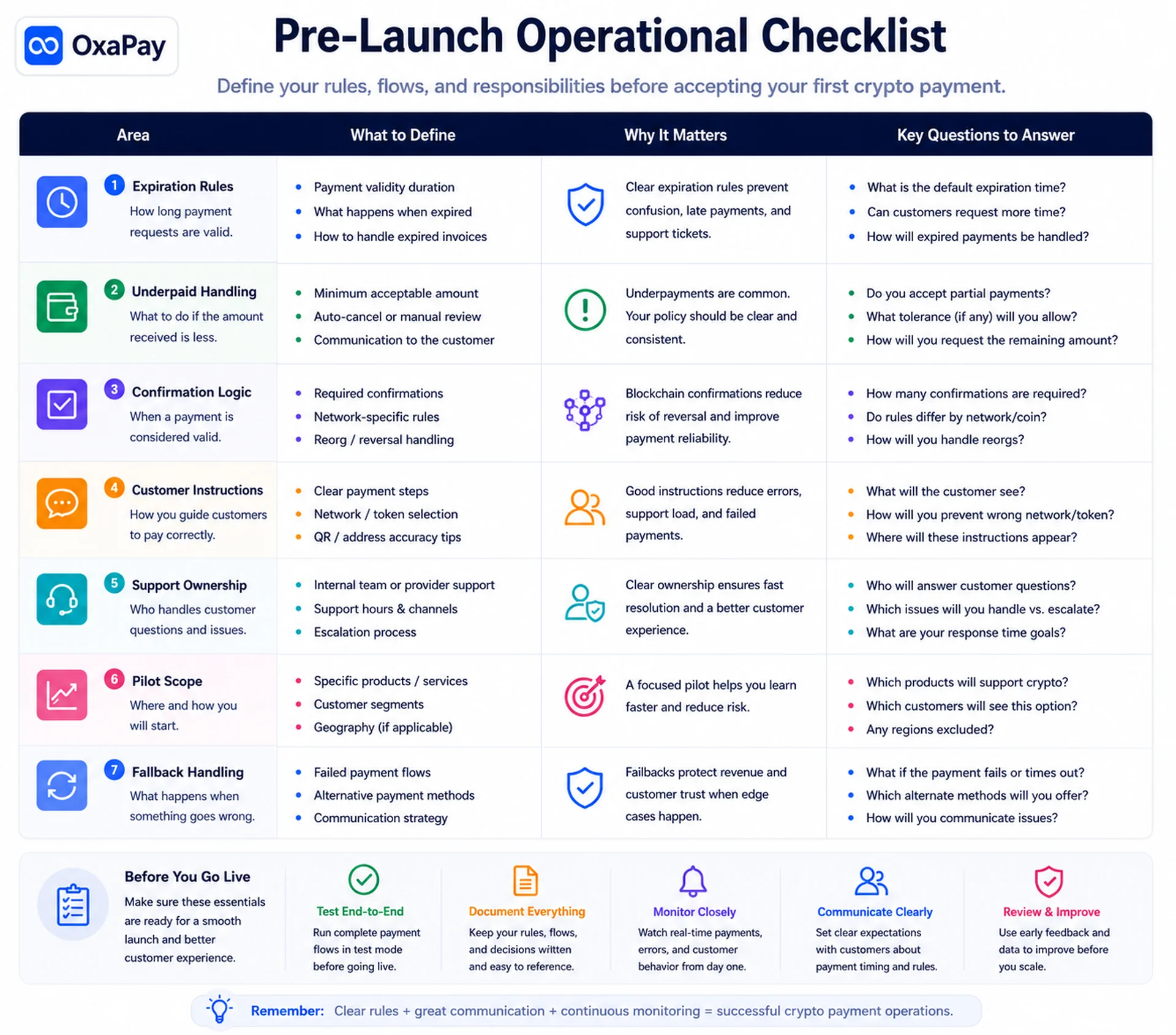
Your Crypto Payment Readiness Score
| Dimensión | Score 0–2 | Evidence to Record |
|---|---|---|
| Customer and market readiness | ___ | Target segment, requests, payment barriers |
| Payment problem and business case | ___ | Baseline cost, decline, settlement, or access metrics |
| Product, delivery, and refunds | ___ | Fulfillment and refund policies |
| Customer experience and support | ___ | Instructions, statuses, escalation process |
| Operations and exceptions | ___ | Owners and decision rules |
| Settlement and treasury | ___ | Asset, conversion, balance, withdrawal rules |
| Legal, accounting, and tax | ___ | Reviewers, records, jurisdictional assessment |
| Technical and security | ___ | Integration owner, controls, testing, recovery |
| Total | ___ / 16 | Use the outcome bands below. |
What Your Score Means
13–16: Ready for a Controlled Pilot
The core use case, owners, rules, and controls exist. Launch with limited scope and measurable success criteria.
8–12: Conditionally Ready
The business case may be valid, but several dependencies remain partial. Close the highest-risk gaps before real customer payments.
0–7: Not Ready Yet
Demand, ownership, or controls are too unclear. Continue discovery rather than adding a payment method that operations cannot support.
Critical-Gap Override
A total score cannot compensate for a zero in legal ownership, security, settlement control, or exception handling.
How Readiness Changes by Business Model
| Business Model | Main Readiness Strength | Main Readiness Risk |
|---|---|---|
| Freelancer or agency | Low volume and strong payment context support manual review. | Weak bookkeeping or inconsistent refund rules. |
| SaaS | International demand and digital delivery may create clear value. | Automated access, renewals, and recurring billing need careful design. |
| Comercio electrónico | Crypto can become an additional checkout method. | Inventory, fulfillment, returns, and order-state synchronization add complexity. |
| Digital products | Borderless delivery and low distribution cost may fit crypto users. | Premature delivery may be difficult to reverse. |
| B2B services | Structured invoices and manual approval can reduce launch complexity. | High values require stronger confirmation, treasury, and audit controls. |
Choose the Smallest Test That Produces Useful Evidence
A readiness assessment should lead to a proportionate test. The first implementation does not need to represent the final architecture.
Una enlace de pago can test demand with minimal setup. A structured factura comercial adds payment context and expiration. Stores may use an available e-commerce plugin , while businesses with custom automation can evaluate the API de comerciante only when operational requirements justify it.
Final Decision: Ready, Conditionally Ready, or Not Yet
A business is ready for crypto payments when demand, operational capability, and risk control meet in one testable use case. Readiness does not require perfect automation. It requires clear ownership and deliberate limits.
A conditionally ready business should close its critical gaps before accepting real payments. A business that is not ready should continue discovery without treating delay as failure. Avoiding a poorly designed launch is a valid commercial decision.
Informational content only. Legal, tax, accounting, security, and compliance requirements depend on jurisdiction and business activity.