Crypto payment failures can cost more than one abandoned order. A customer may have chosen a product, opened an invoice, and even transferred funds without receiving a completed purchase. Much of the work of attracting and persuading that customer is already done. The merchant risks losing a near-conversion sale, while the customer wonders whether the money arrived and whether it is safe to try again.
This is a revenue and customer-experience problem, not simply a technical status. Merchants must distinguish between an abandoned attempt, a transaction still progressing, and funds received without the expected business outcome. Each requires a different response, and some situations can be recovered without asking the customer to start from the beginning.
A Failed Checkout Does Not Always Mean a Failed Blockchain Transaction
Imagine a customer paying $120 for a digital service in USDT. The transfer appears on-chain, but the order remains unpaid because the amount is short, confirmation is pending, or the merchant’s application has not updated the order.
These are different conditions: an amount discrepancy, a transaction still progressing, or a possible integration failure after payment acceptance. Calling all three a “failed payment” hides the cause.
Businesses must separate payment outcome (what happened to the funds) from purchase outcome (whether the customer received the expected product, access, or credit).
| What happened | What the merchant should determine | Business risk |
|---|---|---|
| Customer opened checkout but sent no funds | Was this ordinary abandonment or a preventable checkout obstacle? | Lost purchase opportunity |
| Customer sent less than requested | Can the difference be completed or accepted under policy? | Recoverable order, support effort |
| Funds arrived after an invoice expired | Can the payment be matched and handled at valid terms? | Unresolved funds, delayed order |
| Transfer is detected but still confirming | Has the required acceptance state actually been reached? | Premature fulfillment or confusing feedback |
| Payment is accepted but the order remains pending | Did the order update or downstream workflow fail? | Paid customer without delivery |
Not every expired invoice represents lost revenue. A customer who never sent funds and one whose payment was interrupted should be classified separately.
The Most Expensive Failure Happens After Purchase Intent Is Clear
By the time a customer selects crypto and initiates payment, the business has already invested in attracting and converting them. An interruption here can waste that effort near the point of revenue. Improving product pages will not solve cases in which customers have already sent funds but their orders remain unresolved.
Unlike a visitor who leaves while comparing products, a customer who generates an invoice or initiates a transfer has shown stronger purchase intent. That distinction can help merchants prioritize work: a recoverable payment exception is not the same problem as attracting more visitors or persuading them to buy.
Our guide to reducing cart abandonment covers the broader checkout journey. Payment recovery addresses a later stage, when an actual attempt needs resolution.
Where the Revenue Loss Accumulates
The immediate loss is an incomplete order, but additional costs appear across teams:
Lost recovery opportunities. A customer who slightly underpays may still complete the purchase if given a clear next step. If the system only reports “failed,” the customer may abandon instead of sending the remaining amount. Recovery friction turns a solvable exception into a lost order.
Support and investigation time. “I paid, but my order is pending” can require Support, Operations, and Engineering to reconcile the payment reference, network, expected amount, and order record. When the cause is unclear, a guide to investigating a missing crypto payment helps teams trace the transaction before asking the customer to retry. Repeated exceptions raise operating costs even if the payment amounts do not change.
Delayed activation or fulfillment. A paid SaaS account may remain inactive, an ecommerce order may miss dispatch, or a funded platform balance may be unavailable. The business may have received funds, but the customer has not received the promised outcome. This gap should be monitored separately from blockchain transaction success.
Customer hesitation next time. A buyer who had to prove that funds left their wallet may delay another purchase, choose another payment method, or move to a competitor. The effect is harder to observe than an abandoned invoice because it appears in future behavior.
Do not add all these costs as independent losses. Sales, support labor, refunds, and repeat-purchase effects need separate measures to avoid double counting. See the total cost of crypto payment infrastructure for the broader cost model.
What Recoverable Payment Loss Looks Like in Numbers
Consider a hypothetical online business with 1,000 initiated crypto payment attempts during a month. Of those, 850 orders complete without an exception, 100 customers leave without sending funds, and 50 attempts involve a payment exception such as an underpayment, late arrival, or unresolved order state. The business ultimately resolves 30 of those 50 exceptions and completes the associated orders.
The results are 880 completed purchases, 20 unresolved exception cases, and 100 attempts with no transferred funds. The exception recovery rate is 30 ÷ 50, or 60%. The payment-attempt completion rate is 880 ÷ 1,000, or 88%, assuming each attempt is counted consistently and tied to one order.
Now suppose better instructions, faster investigation, and clearer recovery paths help the business resolve 40 exceptions instead of 30. That creates 10 additional completed orders in this illustration. At an average order value of $120, the resulting $1,200 is additional gross sales, not $1,200 of profit. If the contribution margin were 40%, those orders would generate approximately $480 of contribution before the incremental cost of recovery.
This is a scenario, not an OxaPay performance claim or a forecast. Its value is methodological: measure whether recoverable attempts become completed orders, rather than assuming every technical exception equals a permanent lost sale. Also avoid calling the full face value of unresolved, partially funded payments “lost revenue” without checking subsequent completion, refunds, and the merchant’s revenue-recognition policy.

Why Some Payment Failures Damage Retention More Than Others
Retention risk depends on the customer’s experience, not merely the merchant’s recorded payment status.
An expired invoice with no funds sent may be an inconvenience. A customer who transferred crypto but received no order confirmation faces a larger trust problem: the money appears to have left their wallet, but no product or credit has arrived. The uncertainty is worse without a visible status, reference number, or resolution timeline.
For SaaS, an unresolved payment can cast doubt on whether the next renewal will activate access. For a platform, an inaccessible funded balance may discourage another deposit. An agency client may need reassurance before making a future payment. These different retention risks may look identical in a transaction-status report.
Businesses should measure rather than assume that payment errors cause churn. Compare repeat purchases or renewals across normally completed payments, promptly resolved exceptions, and prolonged cases. Account for differences in customer history, order value, country, asset, and purchase frequency. Use the same follow-up window for each cohort. Such comparisons reveal associations, not proof that the payment problem caused later behavior.
Repeat-purchase rate after a payment exception, compared with an appropriate customer cohort, connects payment quality to behavior after the initial order. This can reveal whether a quick, clear resolution helps preserve confidence even when the original attempt did not go smoothly.
Measure the Customer Journey, Not Just the “Failed” Status
A dashboard showing only Paid, Failed, and Expired counts cannot tell the full commercial story. Merchants need an order-level view that follows the same customer intent through invoice creation, on-chain activity, resolution, and fulfillment.
| Métrica | Recommended definition | What it reveals |
|---|---|---|
| Payment-attempt completion rate | Completed purchases ÷ initiated payment attempts | How often payment intent becomes an order |
| Payment-exception rate | Attempts requiring review or recovery ÷ initiated payment attempts | How much friction the payment process creates |
| Exception recovery rate | Exception cases ultimately completed ÷ eligible exception cases | Whether recovery actually saves orders |
| Median exception resolution time | Median time from exception detection to final resolution | How long customers remain uncertain |
| Paid-but-unfulfilled rate | Accepted payments without the required order action ÷ accepted payments | Integration and fulfillment gaps |
| Repeat-purchase rate after exception | Customers who purchase again within a fixed window ÷ eligible customers in that exception cohort | Whether difficult payment experiences correlate with weaker retention |
Use consistent denominators. One customer may open several invoices for the same order or retry after an expiration; counting each invoice as a different customer or lost sale exaggerates failures. Link attempts to stable order and customer references, distinguish attempts from unique orders, keep observation windows consistent, and report still-pending attempts separately rather than forcing them into “failed.”
De OxaPay Payment History guide explains the transaction records that merchants can connect to order and customer data for reconciliation and measurement.
Recovery Is a Business Policy Before It Is a Feature
For underpayments, a merchant may request the remaining amount, accept an approved shortfall, or refund the funds. The right choice depends on margins, product type, payment terms, and risk. A low-margin physical product may permit less flexibility than a digital service. Late payments may require a separate decision after quoted exchange-rate terms expire.
A recovery policy should specify tolerances, deadlines, customer instructions, Support ownership, and refund conditions. OxaPay’s article on underpaid and expired invoices details available merchant actions.
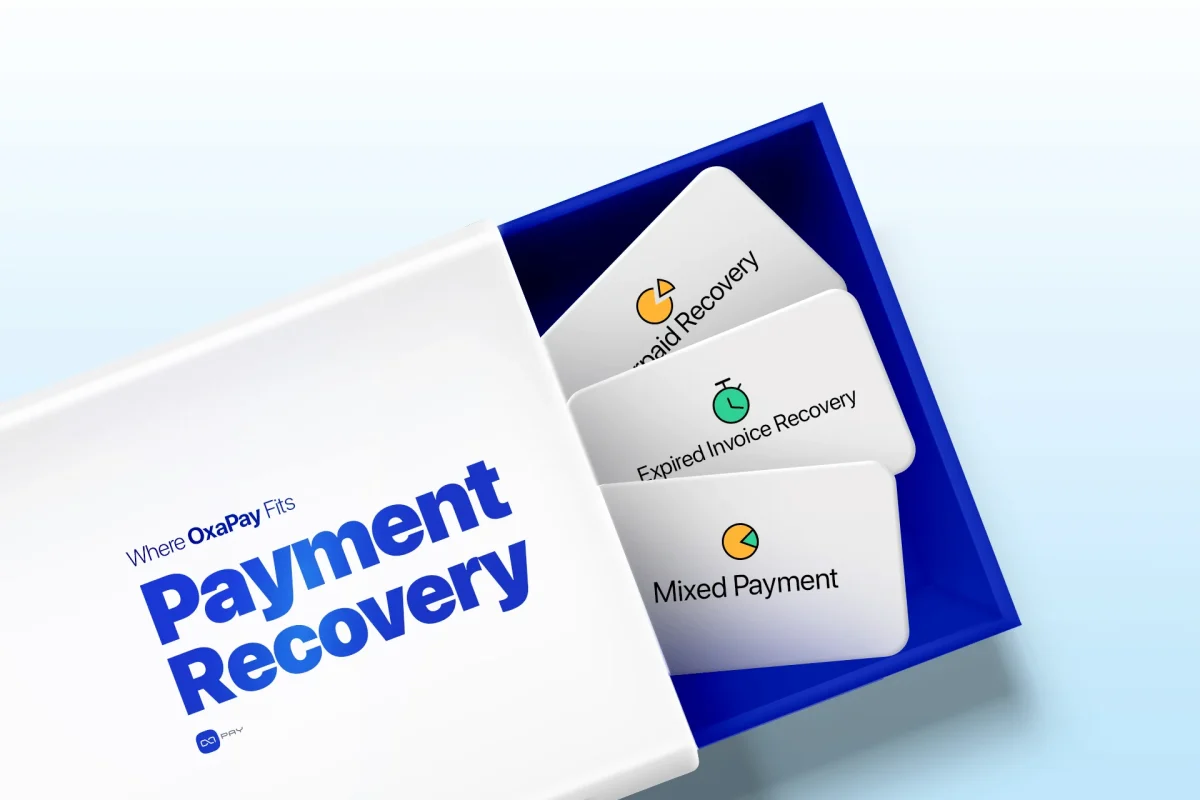
If paying the balance in the original asset is inconvenient, OxaPay’s Mixed Payment feature can let eligible customers finish with another accepted cryptocurrency instead of restarting the purchase.
That does not mean every detected payment should be accepted or every order released. Payment visibility and permission to fulfill are different. A transfer seen on-chain may still be confirming, and a shortfall may exceed the merchant’s approved tolerance. Clear status communication should reduce confusion without weakening the business’s confirmation, security, or refund rules.
The Payment Can Recover While the Customer Experience Still Fails
Payment recovery is incomplete if the merchant’s application still shows the order as pending. The intended business action must also occur.
For example, a software customer may pay successfully but remain locked out because a callback was missed or the application failed to process it. The money is accounted for, but the purchase experience has failed.
Merchants should connect their order ID to the provider’s payment reference, verify significant status changes, and make fulfillment actions safe to repeat without double activation or duplicate credit. A missed or repeated webhook must not leave the order permanently unresolved. Teams need a way to recheck the authoritative payment record rather than relying only on one notification. See payment reliability in ecommerce operations for the broader integration controls.
Track accepted payments still awaiting fulfillment, correction requests, and time from acceptance to delivery.
Where OxaPay Fits into Payment Recovery
OxaPay supports recovery through payment statuses, transaction records, and tools for eligible underpaid or expired invoices. Mixed Payment and Payment History can help customers complete a shortfall and help teams investigate what happened.
The merchant still defines fulfillment rules, acceptable shortfalls, customer communication, and refund decisions. OxaPay supplies payment information and available actions; it cannot decide which outcome makes commercial sense for each business.
The goal is controlled recovery where appropriate, not a promise that every failed payment can be saved.
A Practical Way to Reduce Revenue Leakage
Begin by reviewing a representative period of payment attempts, including completed orders, invoices that never received funds, underpaid cases, late arrivals, and paid-but-pending orders. Match each case to the customer and order when possible. A payment report without that connection cannot reliably tell whether a transaction was recovered, refunded, retried, or genuinely lost.
Next, identify where the avoidable loss occurs. Is the customer confused by the network or amount before sending funds? Are minor shortfalls producing unnecessary restarts? Are late payments going unresolved? Or does the payment complete while the order update fails? These problems need different fixes: clearer instructions, recovery rules, faster exception handling, or more reliable order synchronization.
Finally, assess the outcome with a consistent baseline. Look at completion rate, eligible-exception recovery rate, time to resolution, paid-but-unfulfilled cases, and subsequent purchasing behavior. Segment by payment method, network, new versus returning customer, and order value where sample sizes allow. An improvement in one headline percentage is less meaningful if unresolved payments or support cases merely move into another category.
For every unresolved case, record the original order, expected and received amounts, transaction reference, current status, assigned owner, and next action. This makes it possible to distinguish a genuinely lost purchase from a payment that is still confirming, a refund in progress, or an order awaiting an application update. Review whether each intervention produces a completed purchase, not just a different status label.
A payment system should also avoid prompting the customer to send a second transaction when the first one may still be in progress. Clear progress states are essential. The distinction between detection and confirmation, and its effect on customer confidence, is explored in how payment confirmation affects conversion.
The Business Outcome Is the Metric That Matters
A crypto payment failure is not always money that never moved. It may be an incomplete amount, a payment arriving outside the intended window, a transfer awaiting the required confirmation, or a successful payment disconnected from the order it was meant to fulfill. Lumping these situations together obscures both the risk and the opportunity.
For merchants, the better question is not simply how many invoices were marked failed. It is how many customers tried to pay, how many reached a completed purchase, how many exceptions were recoverable, and what happened to those customers afterward.
Better payment recovery can protect more than immediate sales. It can reduce unnecessary support work, restore confidence when something goes wrong, and prevent a technically valid transfer from turning into a poor customer experience. Businesses using OxaPay Crypto Invoice can build that approach around clear payment records, defined recovery policies, and fulfillment actions tied to the correct payment state.