A crypto payment solution gives a business the infrastructure to accept cryptocurrency without manually checking wallets, transaction hashes, exchange rates, and blockchain confirmations for every order. The right system connects checkout, payment detection, order status, settlement, reporting, and customer support into one manageable workflow.
This guide explains how these solutions work, which models are available, what operational problems they must solve, and how to choose the right setup for your business.
What Is a Crypto Payment Solution?
A crypto payment solution is a combination of software, blockchain connectivity, and operational tools that enables a business to request, detect, confirm, record, and manage cryptocurrency payments.
A wallet alone can receive funds, but it does not automatically know which customer paid, which order the transfer belongs to, whether the amount is correct, or when the business should release a product. A business-ready cryptocurrency payment solution adds that missing payment context.
In practice, a complete solution should be able to:
- Create a payment request for a specific order or customer
- Calculate the required crypto amount from the order value
- Provide the correct asset, network, address, and payment window
- Detect the transaction and monitor its confirmation status
- Update the merchant’s website or application
- Settle or convert funds according to business preferences
- Preserve records for reconciliation, refunds, and support
This makes “crypto payment solution” a broader term than crypto wallet, payment link, or 加密支付网关. Those may be parts of the solution, but the real business system is the full workflow around the payment.
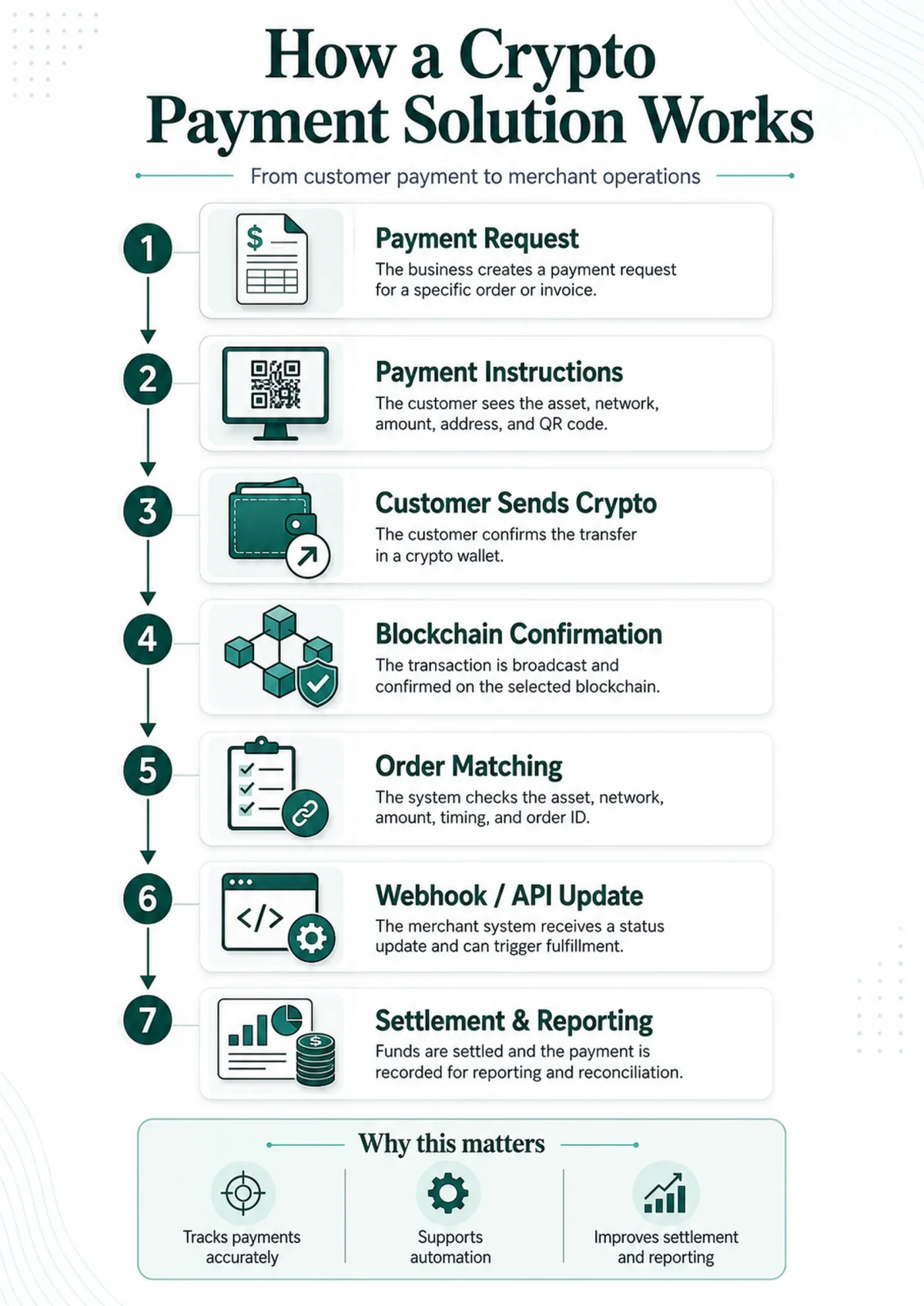
How Does a Crypto Payment Solution Work?
Most business payments follow the same operational lifecycle, even when providers and blockchain networks differ.

1. The Business Creates a Payment Request
The merchant’s checkout, invoice system, application, or dashboard creates a payment request. It normally includes the order amount, pricing currency, accepted cryptocurrencies, callback information, and expiration time.
For example, a $100 software subscription might be presented as a time-limited amount in USDT, Bitcoin, or another supported asset.
2. The Customer Receives Payment Instructions
The solution displays:
- The cryptocurrency
- The blockchain network
- The exact payment amount
- The receiving address
- A QR code or wallet-compatible action
- The remaining payment time
The network matters as much as the asset. Sending USDT over the wrong blockchain can lead to a failed or difficult-to-recover payment, so the checkout must make the network explicit.
3. The Customer Sends the Transaction
The customer confirms the transfer in a crypto wallet, which broadcasts the transaction to the selected blockchain.
At this stage, the payment may be visible but not yet sufficiently confirmed. A serious payment system distinguishes between detected, confirming, and paid rather than treating every broadcast transaction as final.
4. The Blockchain Confirms the Payment
Validators or miners include the transaction in the blockchain. The confirmation policy should reflect the network, transaction value, and merchant risk tolerance.
Bitcoin’s developer documentation notes that unconfirmed and high-value payments may require additional double-spend risk analysis. Proof-of-stake networks use different confirmation and finality models.
5. The Solution Matches the Payment to the Order
The system checks:
- Was the correct asset used?
- Was it sent through the correct network?
- Was the complete amount received?
- Did the payment arrive before expiration?
- Has the transaction already been assigned to another order?
This attribution layer is one of the main differences between a business payment solution and a simple wallet transfer.
6. The Merchant System Receives an Update
When the payment reaches the required state, the provider sends an API response or webhook event. The order can then move from pending to paid, account access can be activated, or fulfillment can begin.
The integration should be idempotent. Repeated delivery of the same webhook must not activate the same subscription or fulfill the same order twice.
7. Funds Are Settled and Recorded
Depending on the provider and configuration, the merchant may:
- Keep the original cryptocurrency
- Convert it to a stablecoin
- Convert it to fiat where supported
- Withdraw it to an external wallet
The payment record should retain the order ID, requested and received amounts, asset, network, exchange rate, transaction hash, timestamps, fees, and final status.
Without these fields, finance and support teams eventually face reconciliation problems.
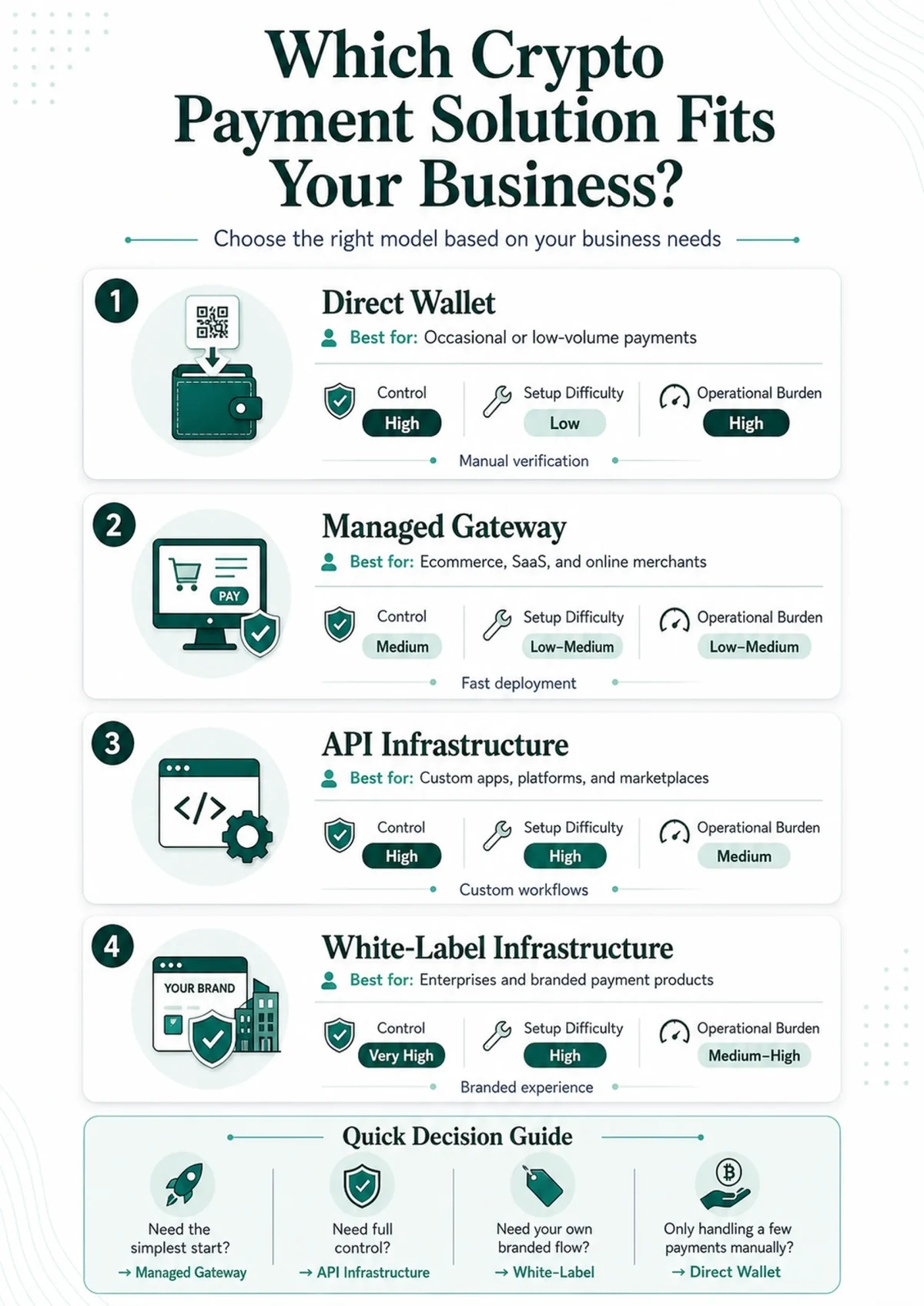
Main Types of Crypto Payment Solutions
The most useful way to compare crypto payment solutions is by how much infrastructure and operational responsibility the business wants to manage.
| Model | Setup | Merchant Control | Operational Burden | Best Fit |
|---|---|---|---|---|
| Direct wallet acceptance | Simple | 高的 | 高的 | Occasional or low-volume payments |
| Managed crypto payment gateway | 快速地 | 中型 | Low to medium | Ecommerce, SaaS, services, online merchants |
| API-based payment infrastructure | Technical integration | 高的 | 中型 | Custom apps, platforms, marketplaces |
| White-label infrastructure | Advanced integration | 非常高 | Medium to high | Enterprises and branded financial products |
Direct Wallet Acceptance
The merchant shares a wallet address and receives payments directly.
This is simple, but the business remains responsible for:
- Address management
- Transaction monitoring
- Exchange-rate calculations
- Confirmation decisions
- Customer and order identification
- Wallet security
- Reconciliation
- Refunds
Direct wallet acceptance can work for occasional peer-to-peer transactions. It becomes difficult when several customers pay similar amounts, invoices expire, reporting is required, or fulfillment must be automated.
Managed Crypto Payment Gateway
A 加密支付网关 connects the customer’s wallet to the merchant’s checkout and business workflow.
It can generate payment requests, display instructions, monitor transactions, manage payment states, and notify the merchant when payment conditions are met.
This is usually the most practical model for businesses that want to accept crypto without building and maintaining blockchain infrastructure internally.
API-Based Crypto Payment Infrastructure
一个 API-based solution gives the business more control over payment creation, checkout behavior, status handling, settlement logic, and internal automation.
The provider manages much of the blockchain connectivity, while the merchant integrates payment events into its own application.
This model fits:
- SaaS products
- Marketplaces
- Gaming platforms
- Digital services
- Account-based applications
- Custom ecommerce systems
An API is an integration method rather than a completely separate payment category. The important distinction is how much of the customer experience and operational logic the merchant controls.
White-Label Payment Infrastructure
A 白标解决方案 allows a company to provide a branded crypto payment experience while relying on a third party’s underlying infrastructure.
It can suit platforms, payment businesses, and enterprises that require greater control over branding and customer flow but do not want to build network monitoring, payment detection, and settlement systems from the ground up.
Payment Links, Invoices, Plugins, POS, and Static Addresses
These are collection or integration methods, not entirely separate payment systems.
- Payment link: A hosted payment request shared through email, messaging, or social media
- Crypto invoice: A defined amount and status connected to a particular payment
- Plugin: A ready integration for a supported ecommerce or billing platform
- POS flow: A payment request designed for in-person collection
- Static address: A reusable address assigned to a particular customer or account
- API: A method for embedding payment creation and status handling into a custom system
Several of these methods can use the same gateway, blockchain monitoring, and settlement infrastructure. The right method depends on how the business sells, identifies customers, and fulfills orders.

Which Solution Fits Your Business?
| Business Model | Practical Starting Point | Why |
|---|---|---|
| Freelancer or social seller | 付款链接 or hosted invoice | No website or development required |
| Ecommerce store | 插件 or hosted checkout | Connects payment status to store orders |
| SaaS or digital service | API and webhooks | Automates account access, credits, or subscriptions |
| Platform with repeat deposits | 静态地址 and API | Attributes incoming funds to user accounts |
| Marketplace or high-volume platform | API, reporting, and payouts | Supports automation across payment operations |
| Enterprise or branded payment product | White-label or custom infrastructure | Provides greater workflow and brand control |
The simplest method that can reliably support the business workflow is normally the best starting point. Complexity should be added only when payment volume, customer experience, or internal automation requires it.
What a Business-Ready Crypto Payment Solution Must Handle
A basic checkout can display an address. A production crypto payment processor must manage what happens before, during, and after the transfer.
Pricing and Expiration
The system should define how long a crypto quote remains valid and what happens if the customer pays after it expires.
This is especially important for volatile assets because the crypto amount required for the same fiat-priced order can change over time.
Assets and Networks
Supporting a token is not enough. The solution must identify the correct blockchain and help prevent network-selection mistakes.
Businesses should choose networks based on:
- Customer demand
- 交易费用
- Confirmation behavior
- Wallet compatibility
- 流动性
- Operational risk
Payment States
A binary paid-or-unpaid model is too simple.
Real payment workflows may include:
- Waiting
- Detected
- Confirming
- Paid
- Underpaid
- Overpaid
- Expired
- 失败的
- Refunded
The merchant must decide which state triggers fulfillment and which requires manual review.
Payment Exceptions
Customers may send slightly less because of wallet or network fee handling, send more than required, pay after expiration, or submit the same transaction information twice.
The system needs explicit handling rules rather than leaving staff to resolve every exception manually.
Confirmation and Fulfillment Policy
A low-value digital purchase may tolerate a different confirmation threshold from a high-value physical order.
The provider should expose enough status information for the merchant to apply a risk-based fulfillment policy.
Settlement and Volatility Management
The merchant should decide whether to:
- Hold the original asset
- Convert it to a 稳定币
- Convert it to fiat where available
- Withdraw it to another wallet
Stablecoin conversion can reduce exposure to market volatility, but it does not eliminate issuer, network, custody, or regulatory risk.
Reconciliation and Reporting
Finance teams need more than a transaction hash.
They need searchable and exportable records that connect blockchain activity with:
- Orders
- Customers
- 费用
- Exchange rates
- Conversions
- Settlements
- Refunds
Refund Operations
Blockchain payments are generally not reversed through a card-style chargeback process, but businesses still need a refund policy.
The policy should determine:
- Which asset will be returned
- Which exchange rate will apply
- Who will pay the network fee
- How the destination address will be verified
- Which team can authorize the refund
Security and Access Control
A payment system should protect API keys, webhook endpoints, administrative access, and withdrawal settings.
HTTPS, webhook-signature verification, least-privilege permissions, two-factor authentication, secure secret storage, and duplicate-event protection should be part of the implementation. These controls should follow established web service security practices.
Compliance and Recordkeeping
Requirements vary by jurisdiction and by whether a business only accepts payment or also provides custody, exchange, transfer, or other virtual-asset services.
Businesses should evaluate local tax, accounting, consumer-protection, sanctions, AML, and licensing obligations rather than assuming that one global rule applies. FATF guidance also distinguishes between ordinary use of virtual assets and activities performed by virtual asset service providers.

Benefits of Using a Crypto Payment Solution
Access to Crypto-Holding Customers
Crypto payments give customers another way to pay, especially in cross-border commerce and crypto-active markets.
Continuous Availability
Blockchain networks operate continuously, although confirmation speed still depends on the network and merchant policy.
Potentially Lower Costs
Crypto payments may reduce some card and cross-border fees. Total cost still includes processing, network, conversion, withdrawal, development, and support expenses.
Lower Chargeback Exposure
Confirmed blockchain transactions are not usually reversed through card-network chargebacks, but refunds, disputes, fraud, and operational errors still require management.
Stablecoin Settlement
Stablecoins can help merchants reduce exposure to the price volatility of assets such as Bitcoin and Ether.
Business Automation
A managed solution can connect payments to fulfillment, account crediting, subscriptions, reporting, notifications, and treasury workflows.
Challenges and Risks
Volatility and Network Conditions
Asset prices, network fees, and confirmation times can change quickly. Rate-expiration rules, suitable network selection, and automatic conversion can reduce these risks.
Irreversible User Errors
Wrong assets, networks, or addresses may be difficult to recover. Clear payment instructions are therefore essential.
Operational Exceptions
Underpayments, expired invoices, duplicate payments, webhook failures, and refunds need defined handling procedures.
Compliance and Tax Complexity
Crypto payment, accounting, and tax requirements vary by jurisdiction. Businesses should retain complete transaction records and seek qualified advice where necessary.
Provider and Custody Risk
Merchants should understand who controls funds, how withdrawals are secured, how disruptions are handled, and whether transaction data can be exported.
How to Choose the Right Crypto Payment Solution
Do not begin with the number of supported coins. Begin with the payment workflow your business needs.
1. Define the Use Case and Acceptance Model
Identify whether you need ecommerce checkout, invoices, subscriptions, account deposits, marketplace payments, payouts, or a branded payment flow.
Then choose between direct wallet acceptance, a managed gateway, API integration, or white-label infrastructure based on your required control and technical capabilities.
2. Evaluate Assets, Networks, and Settlement
Confirm that the provider supports the assets and networks your customers use. The checkout should clearly display the selected network to reduce payment errors.
Also review whether funds can be held, converted, or withdrawn automatically, along with settlement timing, minimums, fees, and custody conditions.
3. Choose the Right Integration
Select the method that fits your existing systems:
- 付款链接 for manual sales
- Hosted invoices for simple checkout
- 插件 for supported platforms
- 蜜蜂 for custom applications
- 静态地址 for repeated deposits
- 白标 for branded payment flows
4. Review Payment and Exception Handling
Check how the solution manages confirmations, expired invoices, late payments, refunds, network disruptions, duplicate callbacks, and underpayments or overpayments.
A provider should support the full payment lifecycle, not only successful transactions.
5. Compare Total Cost and Reporting
Include processing fees, network fees, conversion spreads, withdrawal costs, development, and operational support. The advertised rate is only one part of the total cost, so review the provider’s service-specific pricing.
Reporting should also connect transactions with orders, customers, fees, conversions, and settlements.
6. Check Security and Business Fit
Review API authentication, webhook verification, withdrawal protection, account permissions, audit history, supported regions, onboarding requirements, and service restrictions before committing development resources.
How to Implement a Crypto Payment Solution
1. Map the Payment Workflow
Define how orders are created, when a payment is considered complete, and what triggers fulfillment or refunds.
2. Select Assets, Networks, and Settlement
Choose the cryptocurrencies and networks your customers use, then decide whether funds will be held, converted, or withdrawn.
3. Choose the Integration Method
Use a payment link or hosted invoice for simple payments, a plugin for supported platforms, an API for automated workflows, or a static address for repeated deposits.
4. Define and Secure Payment Handling
Set rules for waiting, confirming, paid, underpaid, expired, failed, and refunded payments. Protect credentials, verify webhooks, use HTTPS, and prevent duplicate fulfillment.
5. Test and Monitor
Test successful and failed payment scenarios before launch. After going live, monitor payment success, confirmation times, exceptions, support requests, and settlement costs.

Where OxaPay Fits as a Crypto Payment Solution
OxaPay provides a managed 加密支付网关 and merchant infrastructure for businesses that want to accept and manage cryptocurrency payments without building blockchain-monitoring infrastructure internally.
Businesses can start with a no-code 付款链接, use 插件 for supported ecommerce and billing platforms, generate Merchant Invoices, or integrate custom applications through Merchant APIs, webhook, and official SDKs. OxaPay also provides 白标 和 静态地址 services for businesses that need branded payment flows or reusable user-level deposit addresses.
Operational features include:
- Payment-status tracking
- Underpaid-payment handling
- 混合支付
- Automatic conversion to USDT
- Automatic withdrawal
- Transaction reporting
- Payout services
OxaPay webhooks can send payment-status updates to merchant systems, allowing fulfillment and internal workflows to react to payment events.
OxaPay publishes different prices for different services and states that eligible rates may be reduced to 0.4%. Merchants should therefore check current service-specific pricing instead of treating 0.4% as a universal fee.
This range supports several adoption paths:
- Freelancers and social sellers can begin with Payment Links
- Online stores can use supported plugins or invoice flows
- SaaS and digital platforms can use APIs and webhooks
- Account-based platforms can use Static Addresses
- Businesses requiring a branded flow can evaluate White Label
The practical value is not simply receiving cryptocurrency. It is connecting blockchain payments to order status, automation, settlement preferences, and usable business records.
Final Decision
Choosing the right crypto payment solution is ultimately about finding the best fit between your payment workflow, technical resources, settlement preferences, and growth plans. A solution should not only help you accept cryptocurrency, but also make payments easier to track, manage, and reconcile as your business grows.
For most businesses, the best approach is to begin with the simplest reliable setup and move toward deeper automation only when transaction volume and operational complexity make it necessary.