Crypto mass payouts let a business distribute funds to many recipients through a coordinated process. The challenge is ensuring that each approved recipient receives the right asset, on the right network, and in the right amount. The business must also prove which obligations it has settled.
Consider a marketplace preparing payments for 120 sellers. Some recipients have changed their wallet details, while other transfers still await confirmation. A dashboard may show that the payout run started without proving that all 120 sellers received their funds.
A reliable mass payout process connects approvals, execution, exception handling, and reconciliation. It tracks every recipient separately, even when the business manages hundreds or thousands of transfers in one payout run.
What Is a Mass Payout in Crypto?
A mass payout is a business workflow that brings multiple outgoing payments together for preparation, authorization, execution, and reporting. Businesses use it for marketplace earnings, affiliate commissions, contractor fees, supplier payments, customer withdrawals, and rewards.
Провайдер batch refers to the administrative group of payments. A payout refers to an individual transfer to one recipient. Approving a batch does not finalize every transfer, and submitting a batch does not prove that every recipient received their funds.
Each payout record should ultimately capture the beneficiary, underlying obligation, amount, asset, destination, network, provider reference, and final status. An external payout may also generate a blockchain transaction hash. A provider can complete an internal transfer inside its own system without creating a separate on-chain transaction for the recipient.
Businesses therefore need separate batch-level and recipient-level statuses. One successful submission can still produce a partly completed payout run.
Where Mass Payouts Solve a Real Business Problem
Mass payouts work best for businesses that make frequent outbound payments and know exactly what they owe each recipient.
Marketplaces and creator platforms distribute seller earnings after deducting fees, refunds, or reserves. They must match each payout to an earnings balance and prevent duplicate payments.
Affiliate networks and digital businesses pay recurring commissions. They need clear payment thresholds, valid wallet details, and efficient ways to handle payout exceptions.
Agencies and international businesses may pay contractors or suppliers in stablecoins. They must verify asset and network compatibility, account for fees, and maintain accurate financial records.
Employee payroll involves additional wage, tax, and reporting requirements. For more details, see our guide to crypto payroll systems. This article focuses on managing multi-recipient payouts reliably.
Build the Payout Batch Before Sending Money
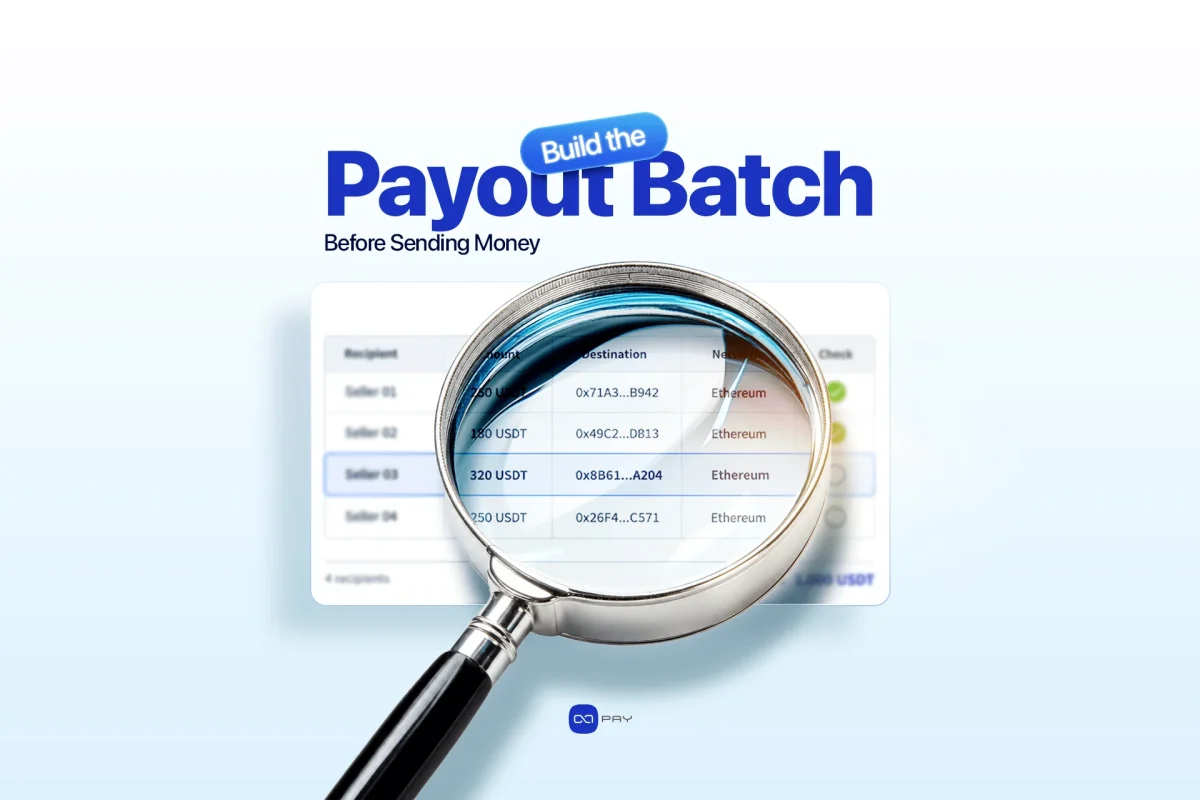
The most effective control is to create an auditable batch before sending funds. Finance must identify each payment obligation, Operations must confirm recipient eligibility, and the technical system must track whether it has already executed each instruction.
Start with an approved payment list. Each record should include a payout ID, beneficiary ID, payment obligation, amount, asset, destination, network, and scheduled payout period. Keep obligation IDs separate from wallet addresses, since recipients may change addresses or use one address for multiple payments.
Next, verify that the asset and network match the destination and include any required memo or tag. Never assume an address from an earlier payout remains valid. Recheck significant changes to recipient details before releasing funds.
Finally, review the batch totals, recipient count, and unusual payouts. A second authorized person should approve high-risk changes to reduce errors and unauthorized transfers.
Save the exact batch version that the approver reviewed. If someone changes an amount, asset, or destination afterward, the business should require a new approval for that payout. This gives the team a clear record of what it authorized and what it actually sent.
| Control point | Question to answer | Evidence to retain |
|---|---|---|
| Obligation | Why does this recipient need a payout? | Invoice, balance, commission, or withdrawal reference |
| Destination | Do the asset and network match the destination? | Verified address, required memo or tag, change history |
| Approval | Did the right person authorize this payout? | Approver, timestamp, batch version, and totals |
| Execution | Did the system already submit this payout? | Internal payout ID, provider track ID, request outcome |
| Completion | Did the payout reach its required final state? | Status, applicable transaction details, reconciliation result |
These records help a business answer a recipient who says, “I haven’t been paid,” without relying on a batch-level success message.
Choose the Transfer Route by Recipient
Crypto payouts may stay within a provider’s system or move to an external blockchain wallet. Each route has different recipient requirements, costs, and evidence of delivery.
С OxaPay’s Payout Service, internal transfers to OxaPay addresses are fee-free. External transfers incur network fees and applicable minimums. Internal payouts can suit frequent small payments when recipients use OxaPay. External payouts allow recipients to receive funds in their own supported wallets, although network choice affects cost and timing.
Neither route works for everyone. Requiring recipients to use a specific account may create friction, while supporting many external networks can increase destination errors. Choose routes around actual recipient needs.
Ask recipients which asset and network they can receive before the payout date. A low network fee offers little benefit if the recipient supplies an incompatible destination or must spend additional time recovering access to the funds.
Stablecoins such as USDT or USDC can simplify payout denominations but still carry issuer, network, and depegging risks. Our guide to stablecoins in business operations covers the broader treasury considerations.
Funding, Exchange Rates and Cutoff Times
Even an approved batch can fail if available balances cannot cover the transfers and applicable network fees. Check funding for each asset before execution.
Define whether recipients receive fixed crypto units or fiat-equivalent amounts. For example, if a contractor is owed $300, the business needs a rule for when it converts that value into crypto and who bears rate changes. If the contract instead specifies 300 USDT, accounting records still need the appropriate value in the business’s reporting currency.
Set a cutoff for recipient changes and approvals. Freeze the approved batch version, confirm balances, and estimate network fees. Hold a payout for renewed approval if someone changes its destination after the cutoff.
The funding check should also distinguish the total owed from the balance available to send. Any amount reserved for network costs, pending transfers, or other commitments can affect whether the business can complete the full run.
Finally, choose a payout frequency that balances recipient waiting time against transaction costs and operational reviews. More frequent runs can improve access to funds, but may increase external transfers and support work.

Submission Is Not Settlement
After authorization, track the outcome of each payout. Submission, processing, queueing, blockchain confirmation, and final payment are different stages. OxaPay documents the states processing, pending, подтверждается, Подтверждена, canceledи rejected.
Under OxaPay’s documented model, pending means the payout is in the payment queue, while подтверждается means a blockchain transaction awaits confirmation. Подтверждена indicates successful payment. An accepted API response alone does not prove completion. See the official Payout Status Table.
The published Generate Payout API reference accepts one recipient address per request. A business can coordinate many individual payout instructions, but it should not assume that this endpoint accepts an array of recipients. Check the account’s supported workflow before designing a bulk import.
Give each instruction a stable internal payout ID and store the returned OxaPay track_id. If a request times out, investigate the original transfer before retrying. An uncertain response can hide a successful payout, and a second request might send funds twice. Use Информация о выплатах for a known track ID and Payout History to investigate other records. If you cannot determine the outcome safely, hold the payout for review.
Keep provider statuses and internal accounting records in sync. Notifications may help teams respond, but they should not replace the underlying payout records.
If an integration uses payout status callbacks, treat them as prompts to update the recipient record. The business should still reconcile important outcomes against the provider’s payout information or history, particularly after delivery failures or uncertain responses.
What a Partially Completed Payout Run Looks Like
Imagine a marketplace owes 120 sellers 250 USDT each, for a total of 30,000 USDT. The figures below are illustrative, not OxaPay transaction data.
Before sending, the platform finds two unverified wallet changes and one unsupported destination network. It holds those three payouts, totaling 750 USDT, and submits the other 117, totaling 29,250 USDT. Later, 116 payouts reach Подтверждена, while one remains подтверждается on the blockchain.
The accurate report is 120 scheduled, three held, 117 submitted, 116 confirmed, and one confirming. The platform can account for every portion of the 30,000 USDT without treating submission as final delivery.
In amount terms, 29,000 USDT has reached the confirmed state, while 1,000 USDT remains unresolved: 750 USDT in held instructions and 250 USDT awaiting blockchain confirmation. This is more useful to Finance than a single batch status.
The three held recipients need corrected details or reapproval. The recipient awaiting blockchain confirmation needs a status update, not a duplicate transfer. Finance keeps outstanding obligations open until the relevant payouts reach their required completed state.
Measure the Full Cost of a Mass Payout Run
Network fees are only one part of payout costs. A business also spends time on approvals, support, reconciliation, treasury work, and exceptions. Compare routes using the cost of a завершено payout.
Cost per completed payout = (direct transfer costs + allocated operating costs + exception-resolution costs) / number of completed payouts.
For example, a run with 400 completed transfers incurs $90 in hypothetical network fees and $150 in attributable staff time. Its cost is ($90 + $150) / 400, or $0.60 per completed payout. Real network fees vary by asset, chain, and conditions.
Internal transfers may remove transfer fees without removing operating costs. Our article on комиссии за криптовалютные транзакции explains the fee mechanics in more detail.
Security Controls That Matter Most at Scale
A payout system that sends funds to hundreds of addresses creates significant risk if someone compromises a credential or changes a recipient destination. Controls must cover who approves payouts, which destinations may receive them, and how the business prevents duplicate instructions.
OxaPay requires two-factor authentication to create or edit a Payout API key. It also provides IP restrictions for payout requests. The guide to allowed IPs for payout security explains that control. Businesses should also secure their own API secrets, separate batch preparation from approval, and investigate unexpected wallet changes.
Never retry a payout simply because the original response did not arrive. Check its history and status first; if the result remains uncertain, escalate the case rather than authorizing another transfer. Assign an owner to each exception and preserve the evidence. These practices also support broader работы с криптоплатежами.
Transfer technology does not remove contractual, tax, wage, reporting, or legal restrictions. Check the relevant obligations and recipient eligibility before releasing funds.
How OxaPay Fits into a Mass Payout Workflow
OxaPay provides payout execution and status information. The business remains responsible for deciding who should receive funds and why, using its own orders, commission records, invoices, or approved withdrawal ledger.
A practical flow is to prepare and validate recipient records, approve the batch, confirm funding, submit the individual transfers through a Payout API key or supported account workflow, and monitor each returned track ID. Send rejected or unresolved payouts to an exception queue instead of treating the batch as fully paid.
OxaPay’s payout history and status information support reconciliation, but the business should retain its own obligation IDs, approvals, and exception records. Those details connect a completed transfer to the commercial reason behind it.
How to Tell Whether the Process Is Improving
Measure more than submission volume. Four useful indicators are the on-time confirmed payout rate, manual-review rate, duplicate or wrong-destination incident rateи cost per completed payout. Track completion times for internal and external transfers separately.
Start with a small pilot using trusted recipients and supported networks. Test incorrect addresses, insufficient funds, destination changes, delayed status updates, and uncertain API responses. These cases reveal weaknesses that a smooth, all-successful test might miss.
Record the time and effort needed to resolve each exception. That baseline helps the team decide which checks to automate and whether the process becomes less expensive as the number of recipients grows.
As payout volume increases, automate routine cases while keeping exceptions visible and assigning someone to resolve them.
Что дальше?
A reliable mass payout process starts with clear obligations, approved destinations, traceable transfers, and recipient-level reconciliation. Before scaling, test a small batch and make sure your team can explain every incomplete or rejected payout. When you are ready to connect the execution layer, use the OxaPay Payout API guide for integration details.