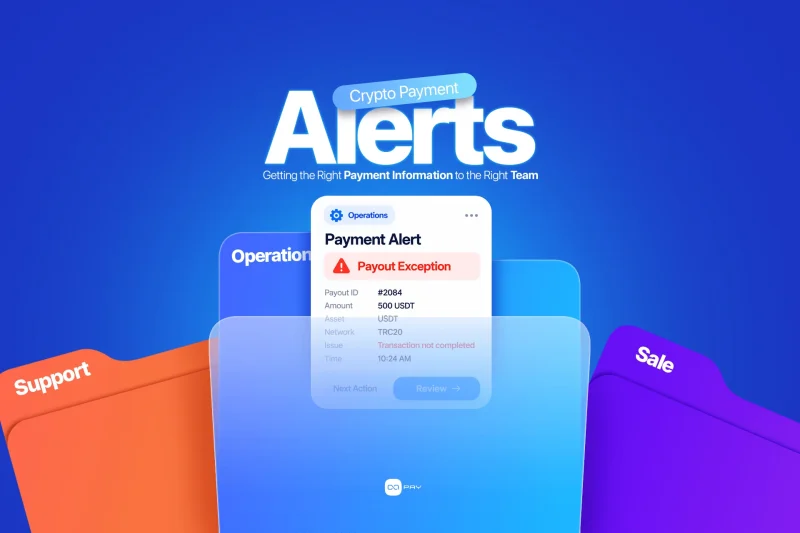
A customer pays a криптоинвойс, but the account manager does not know onboarding can begin. Another customer contacts Support because their transfer was detected but the order still shows unpaid. Meanwhile, an underpaid invoice sits unnoticed until someone checks the dashboard. Effective crypto payment alerts close the gap between those events and the teams that can act.
None of these situations necessarily means the payment infrastructure failed. They expose a different weakness: the business received payment information without getting it to the person who could act on it. Crypto payment alerts solve that problem when they connect a meaningful payment event to a clear owner and a specific next step. Sending more notifications, on its own, solves very little.
A Payment Event Is Not the Same as an Alert
A payment system reports facts: a transaction has been detected, its confirmation state changed, or a payout reached another stage. A business alert makes a judgment about those facts. It asks whether someone needs to do something now, and whether receiving a message will change the outcome.
Consider a small online store that automatically fulfills hundreds of ordinary paid orders. Announcing each successful payment in a team chat adds activity, not value. Now consider a large B2B invoice tied to a scheduled client launch. Its completion may release a sales handoff that cannot happen automatically. That payment is worth bringing to the account manager’s attention.
The difference is not the cryptocurrency or the payment status. It is the decision waiting on the event. This is also why alerts should complement, rather than duplicate, the broader controls described in работы с криптоплатежами.
A useful operating model is:
Payment event → Business context → Alert rule → Responsible owner → Action
If the workflow cannot name an owner or an action, the event may belong in a report or a dashboard rather than an immediate alert.
Design the Response Before Choosing the Channel
Teams often begin by asking whether crypto payment notifications should go to email, Slack, or Telegram. The more important question comes first: What becomes possible—or what might go wrong—if this payment information is noticed too late?
Sales may need to proceed with a high-value customer. Support may need to explain an incomplete payment while the customer is still at checkout. Operations may need to investigate a discrepancy between a payment record and an order. Finance may need visibility into an unusual outgoing transfer, while Engineering needs to know that a callback integration has stopped processing updates.
These are different jobs. One shared channel cannot make them equally actionable. Define the business decision, the person or team accountable for it, and an acceptable response window before selecting the delivery channel. The answer may be an immediate message, an item in a monitored queue, or a scheduled summary.
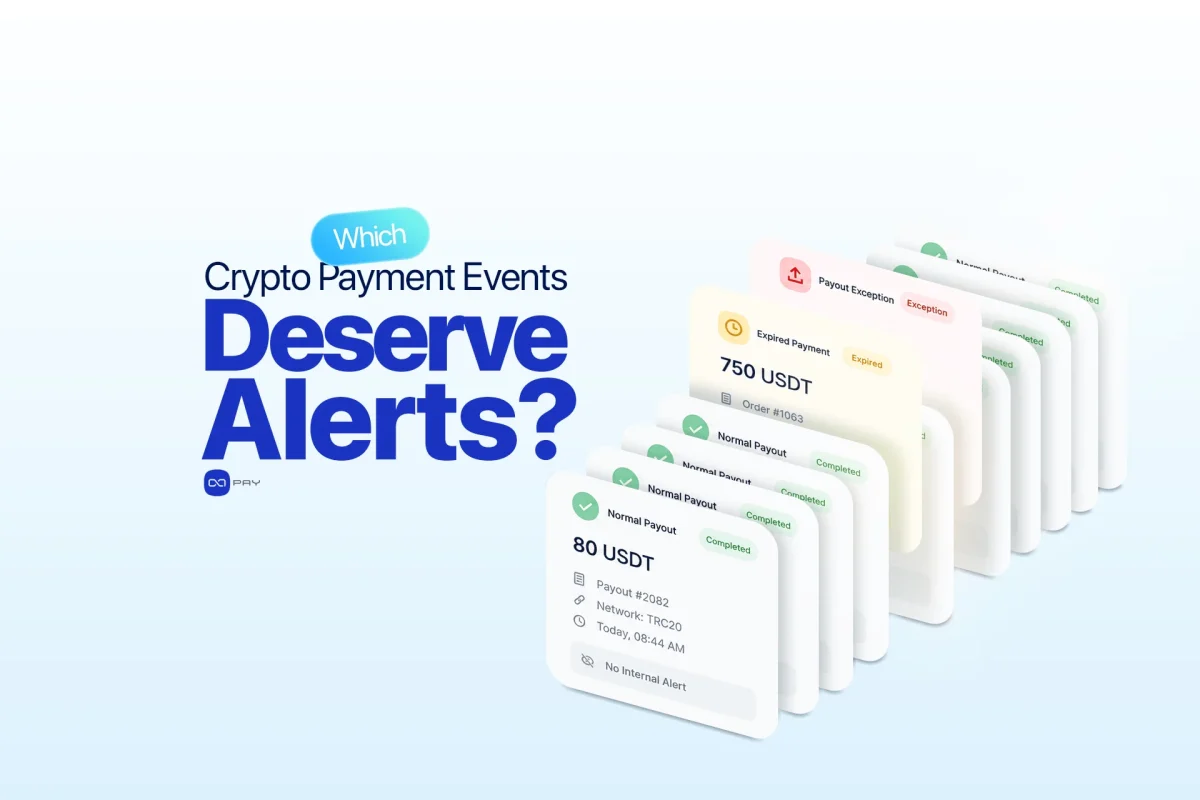
Which Crypto Payment Events Actually Deserve an Alert?
Successful payments that unlock human work
A completed payment does not always justify notifying an employee. If the business already activates the service, updates the order, and sends the customer confirmation automatically, no one has to interrupt their work to observe that success.
An alert becomes valuable when confirmation unlocks a manual step: approving a custom deployment, scheduling onboarding, releasing a high-value order, or following up on a negotiated invoice. A threshold can help, but value alone is not enough. A $10,000 routine subscription renewal may need less attention than a $900 payment awaiting a time-sensitive account handoff.
A sensible rule therefore combines accepted payment state + business context + named next action, not merely “amount above X.”
Underpayments and other recoverable exceptions
A customer may send slightly less than the requested crypto amount. The blockchain transfer can be valid even though the invoice has not met the merchant’s acceptance conditions. Without a timely signal, the first person to notice may be the customer, asking why the purchase is still pending.
For Support, the right alert is not simply “payment received.” It should show the expected amount, amount received, payment reference, current state, and the merchant’s next permitted step. Depending on the applicable payment rules, that step may be to explain the remaining amount, review whether the shortfall falls within an allowed tolerance, or escalate the case. It must not imply that every underpayment can automatically be approved. For the payment mechanics, see OxaPay’s guide to underpayments and transaction fees.
Importantly, an underpayment alert can be a merchant-defined rule derived from payment information; it should not be assumed to be a separate webhook event supported by every integration.
Expired invoices that still have a live customer behind them
An expired invoice is often just an abandoned checkout. Alerting Support for every expiry will bury genuinely useful cases. But expiration has a different meaning if there is an open support conversation, an active high-value quotation, or a customer attempting to complete the transfer.
A selective rule might send a support alert only when invoice expired + customer interaction still active. An unattended low-value invoice can instead appear in aggregate reporting. If the payment provider does not emit a dedicated expiry callback for that integration, the merchant can assess expiry using its stored invoice deadline and a status lookup. A notification should never claim that money arrived simply because an invoice’s timer ended.
Outgoing payouts that require review
Outbound payments carry a different kind of risk. A failed or unexpected payout can affect supplier relationships, refunds, and treasury balances. The owner may be Finance or Operations rather than Sales or Support.
An ordinary payout that completes as expected may only need to be recorded. A failed payout, an unusually large amount, or a destination that does not match an approved business instruction may merit immediate review. The alert rule should distinguish provider-reported payout states from risk checks created by the merchant’s own approval process.
A missing business update after a valid payment
Sometimes the blockchain-facing payment record and the business-facing order disagree. A payment may have reached the merchant’s accepted state while an ecommerce plugin, CRM, or account system still marks the order unpaid. This is a particularly useful exception to detect because an apparently successful payment can still produce a customer-facing failure.
A webhook alone cannot reliably announce that a separate order update never happened. Detecting that condition requires comparing the accepted payment record with the downstream order or fulfillment state after a defined interval. That comparison turns a silent integration problem into a meaningful alert for the technical owner or Operations team.
Make the Alert Explicit About Ownership
The same payment status may matter to different teams for different reasons. A clear routing policy avoids sending a general notification and hoping somebody handles it.
| Situation | Основной владелец | Expected response | Delivery priority |
|---|---|---|---|
| Accepted payment awaiting an account-manager handoff | Sales | Continue onboarding or the agreed customer action | Immediate when time-sensitive |
| Underpayment on an active customer order | Support | Check the shortfall and explain the approved next step | Prompt, while customer is active |
| Expired invoice with no active order or conversation | No individual owner | Include in a periodic checkout report | Summary only |
| Accepted payment but order still unpaid after the allowed delay | Operations / Engineering | Investigate synchronization or fulfillment | High until resolved |
| Failed or unexpected payout | Finance / Operations | Verify the payout record and decide on recovery | High when business-critical |
The priority labels are examples, not settings supplied by OxaPay. Each business should adapt them to its own order values, staffing hours, service commitments, and risk profile. The useful distinction is between information someone may want to see and a case somebody is responsible for resolving.
Give the Recipient Enough Information to Act
“Crypto payment received” is rarely a complete business alert. It forces the recipient to open several systems just to identify the customer and order. A stronger notification explains the event, identifies the record, states why it matters, and suggests the next permitted action.
For example, a support alert could read:
Payment requires review — Order ORD-2048. Expected: 100 USDT. Recorded amount: 98.5 USDT. State: pending merchant review. Track ID: [payment reference]. Next action: Check the invoice’s underpayment policy and contact the customer before requesting another transfer.
The numbers are illustrative, and the wording must reflect the real system state. A Sales version of the same payment would emphasize the account, order value, and handoff instead of technical transaction fields. Finance may need the asset, network, amount, destination, and transaction reference. Different recipients can receive different views of one underlying event without creating different versions of the truth.
Keep the alert concise, but preserve an order or customer reference, the provider’s payment identifier where available, the relevant status, and a link to the authoritative record. OxaPay’s payment history tools illustrate why retrievable payment records matter when a team needs to investigate an alert later.
Real-Time Alerts Must Respect Payment State
A blockchain transaction being detected is not always the same as a payment being accepted for fulfillment. In OxaPay’s documented merchant webhook flow, an initial Paying update means payment activity has been observed while confirmation is pending; Paid indicates the payment has reached the provider’s confirmed merchant state. A merchant should not instruct staff to release goods merely because an earlier update arrived.
This separation matters for wording as well as automation. “Payment detected—monitoring” can be useful for customer reassurance. “Order is ready for fulfillment” should require the acceptance state and any additional business checks that the merchant’s policy demands. Payout status names and their operational meanings should be handled separately from incoming payment states.
For implementation detail, the OxaPay webhook setup guide explains how payment updates enter a merchant system. The notification layer should preserve the meaning of the underlying state, never turn every update into an unconditional “paid” message.
Prevent Alert Fatigue Without Hiding Important Cases
An alert system can fail even when every message is technically correct. When people receive too many routine notifications, they start ignoring the channel. The solution is not to suppress everything; it is to reduce messages that do not produce a useful action.
First, use different treatments for normal payments and exceptions. Routine success can update systems quietly. An unresolved high-value order can create an owned case. Low-priority events can be grouped in a daily summary. Where a case remains open, later updates should refresh that case rather than creating another identical notification.
Second, use deduplication. Payment callbacks can be retried, and a payment can progress through multiple status changes. A merchant-side alert engine needs a stable reference—such as payment ID, relevant state or rule, and case identity—so repeat delivery does not create repeat tasks. This is particularly important where notifications trigger customer-facing messages or fulfillment actions.
Third, define escalation by business consequence, not arbitrary urgency. An underpayment awaiting a customer response might remain with Support. An accepted payment that still cannot be fulfilled after the agreed window might escalate to Operations or Engineering. A high-severity alert also needs an acknowledgment and a resolution state; a delivered chat message is not proof the issue was handled.
Finally, alerts need a fallback for missed updates. A scheduled check against payment and order records can find exceptions that a callback failure, downstream outage, or routing mistake did not surface. This complements the daily crypto payment operations workflow rather than replacing it.

Build the Alert Layer Around OxaPay Payment Data
Торговые услуги OxaPay provide payment information and status updates that businesses can use to build their own alert workflows. For an API integration, an internal Order ID can associate a payment with a business transaction, while OxaPay’s Track ID supports tracing that payment through the provider’s records. A configured webhook sends status updates to the merchant’s callback endpoint.
From there, the merchant’s own workflow should validate the callback, match it to the order, interpret its status, and apply the business rule. A useful architecture is:
OxaPay payment update → Verified merchant endpoint → Order context and policy check → One owned alert or no alert
The distinction matters: OxaPay reports payment data; the merchant defines what warrants interrupting Sales, Support, Finance, or Operations. Thresholds, employee assignment, escalation periods, and messaging channels belong to that business layer unless the business has separately implemented them.
Webhook security and reliability are part of the design. OxaPay documents HMAC-SHA512 signatures for callback validation and retry attempts for unsuccessful deliveries. The receiving system should verify authenticity, keep processing idempotent, and return the success response specified in the official webhook documentation. A notification should not be sent from an unverified callback.
For teams that prefer a visual automation layer, Make can route selected, trusted payment information into communication or internal tools. For example, a confirmed payment tied to a premium onboarding task could create a Sales notification; an exception identified by the merchant’s rules could open a Support case. OxaPay’s article on automating crypto payment workflows with Make covers that wider integration model. Make is the workflow tool here—not the authority that decides whether a blockchain payment is final.
An Alert Is Not the Payment Record
An email thread or Telegram message may be where someone first learns about a payment, but neither should be the final source of truth. Notifications can be deleted, forwarded without context, or left unread. Business decisions need to remain traceable to the original payment and order records.
The alert should point to a durable case or transaction view showing what was detected, which rule fired, who was assigned, and how the case ended. Keeping that evidence connected is easier when payment fields are consistently organized, as explained in crypto payment data management for business.
This also improves the customer experience. When a customer asks, “I already paid—why is my order pending?”, Support should be able to retrieve the payment and its current business state immediately, rather than searching old notifications and reconstructing the timeline.
Measure Decisions Improved, Not Messages Sent
Notification volume is an activity metric. It does not reveal whether the alert system is useful. More informative measures include how long it takes an owner to acknowledge a genuine exception, how long cases remain unresolved, how many alerts lead to an action, and how often a customer reports a payment problem before the business detects it.
A useful review might show that most completed-payment alerts require no human response, while a small number of underpayment cases account for most urgent support work. The correct response is not necessarily more monitoring. It may be to replace routine-success alerts with a summary and give active payment exceptions a clearer owner and response path.
The most important outcome is a shorter gap between a payment needing human attention и someone taking the appropriate action. As order volume grows, well-designed crypto payment alerts should become more selective, not louder.
The objective is straightforward: let normal payments continue without interruption, surface exceptions before they become customer complaints, and ensure that every important alert reaches a person who can do something useful with it.