A customer sends a crypto payment.
The wallet shows the transaction as sent almost immediately. A transaction hash appears, and from the customer’s perspective, the process often feels complete.
But from a system perspective, the transaction is only beginning its journey.
This is where many misunderstandings around crypto payments start.
A crypto transaction is not a single event. It moves through several stages before a business can confidently treat the payment as reliable. Understanding those stages is what helps merchants interpret payment activity correctly, avoid operational mistakes, and make better fulfillment decisions.
To understand how crypto transactions work, you have to look beyond the wallet interface and follow what happens inside the network after the transaction is created.
A Transaction Begins as Proof, Not Movement
When someone sends crypto, the first thing created is not movement, but authorization.
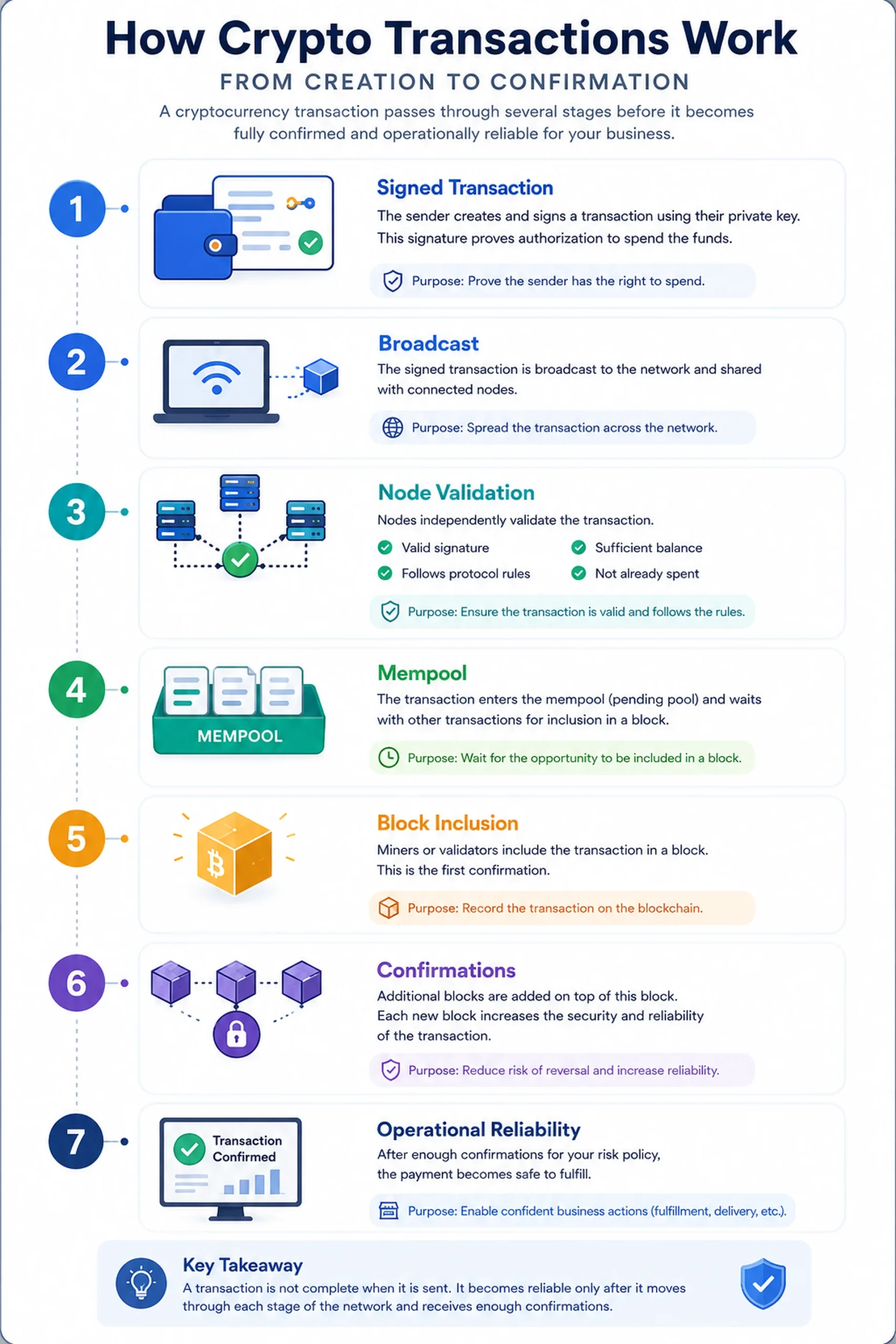
The wallet builds a structured transaction message containing the sender, recipient, amount, and a cryptographic signature. That signature proves the sender has the right to spend the funds. Without it, the network rejects the transaction completely. The Bitcoin Developer Guide explains this transaction structure in more technical detail for readers who want to understand the underlying model.
Only after the transaction is signed does the network begin processing it.
This distinction matters because blockchain payments are fundamentally verification systems. Before value can move, the network has to verify that the transaction is legitimate.
The Network Sees It Before It Accepts It
Once signed, the transaction is broadcast across the network.
Nodes share it with each other, and within seconds the transaction may appear in wallets, blockchain explorers, or merchant dashboards. For users, this visibility often creates the impression that the payment has already completed.
But visibility is not confirmation.
At this stage, the transaction is only known by the network. It has not yet been included in a block or secured through confirmations. From an operational perspective, the payment is still in an uncertain state. A blockchain explorer can help users inspect transaction activity, but merchants still need confirmation logic before acting on a payment.
The Mempool Is Where Competition Begins
After being broadcast, the transaction enters a pending state.
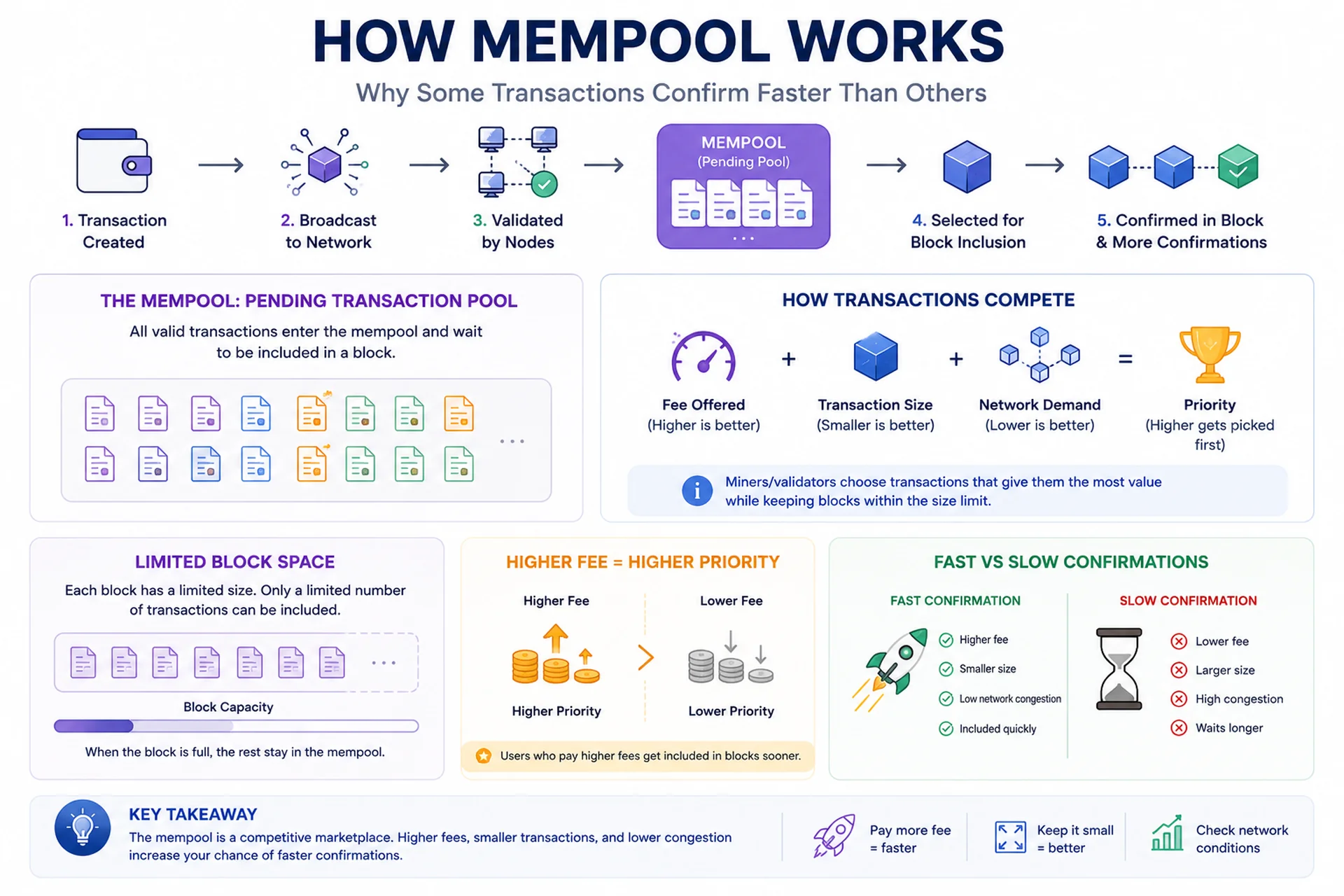
It waits alongside many other transactions competing for limited block space. This environment is commonly called the mempool. In practice, it behaves less like a simple queue and more like a fee-driven marketplace.
Validators and miners usually prioritize transactions offering more attractive fees, especially during periods of heavy network activity. This is why two similar transactions can confirm at very different speeds.
One may confirm almost immediately while another remains pending far longer than expected.
The difference is often not the transaction itself, but the network conditions surrounding it at that moment.
Validation Happens Across the Network
Before a transaction can be included in a block, nodes independently verify it.
They check whether the signature is valid, whether the sender has enough balance, and whether the transaction follows protocol rules.
There is no central authority approving the payment.
Instead, the network collectively enforces the rules through distributed validation. This is one of the defining differences between blockchain payment processing and traditional payment systems.
Inclusion Is the First Real Commitment
A transaction becomes significantly more meaningful once it is included in a block.
At that point, it is no longer waiting inside the mempool. It becomes part of the blockchain’s recorded history.
This is what we call the first confirmation.
Many users interpret this moment as final completion, but operationally it is better understood as the beginning of reliability rather than the end of uncertainty.
Confirmation Is About Reducing Risk
Once a transaction is included in a block, additional blocks continue building on top of it. Every new confirmation makes the transaction harder to reverse or replace.
This is why confirmations matter.
A business selling a low-cost digital product may accept the risk of acting after one confirmation. A higher-value order usually requires a more conservative approach.
The number of confirmations a merchant waits for is ultimately a business decision tied to operational risk, customer experience, and transaction value. For a deeper operational view, OxaPay’s guide to the payment confirmation process explains how confirmation logic affects real payment handling.
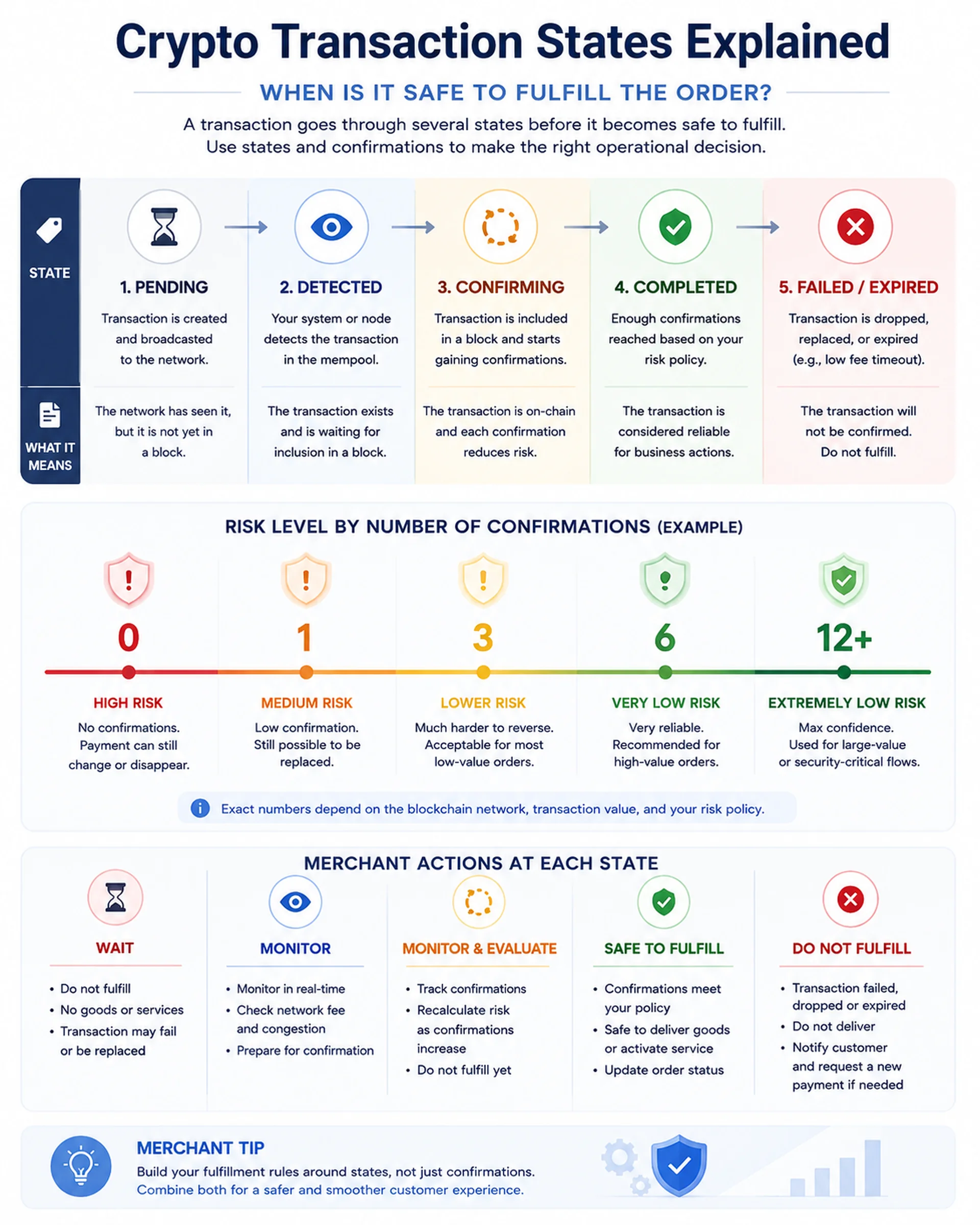
When Is It Safe to Fulfill the Order?
This is one of the most important practical questions merchants face when accepting crypto payments.
A transaction appearing in a wallet or blockchain explorer does not automatically mean the payment is safe to fulfill. It may still be pending, waiting for confirmation, or competing for block space during network congestion.
The acceptable level of risk depends on factors such as:
- order value
- blockchain network
- product type
- merchant risk tolerance
For example, a small digital purchase may only require minimal confirmation depth. A large physical shipment usually requires stronger confirmation confidence before fulfillment.
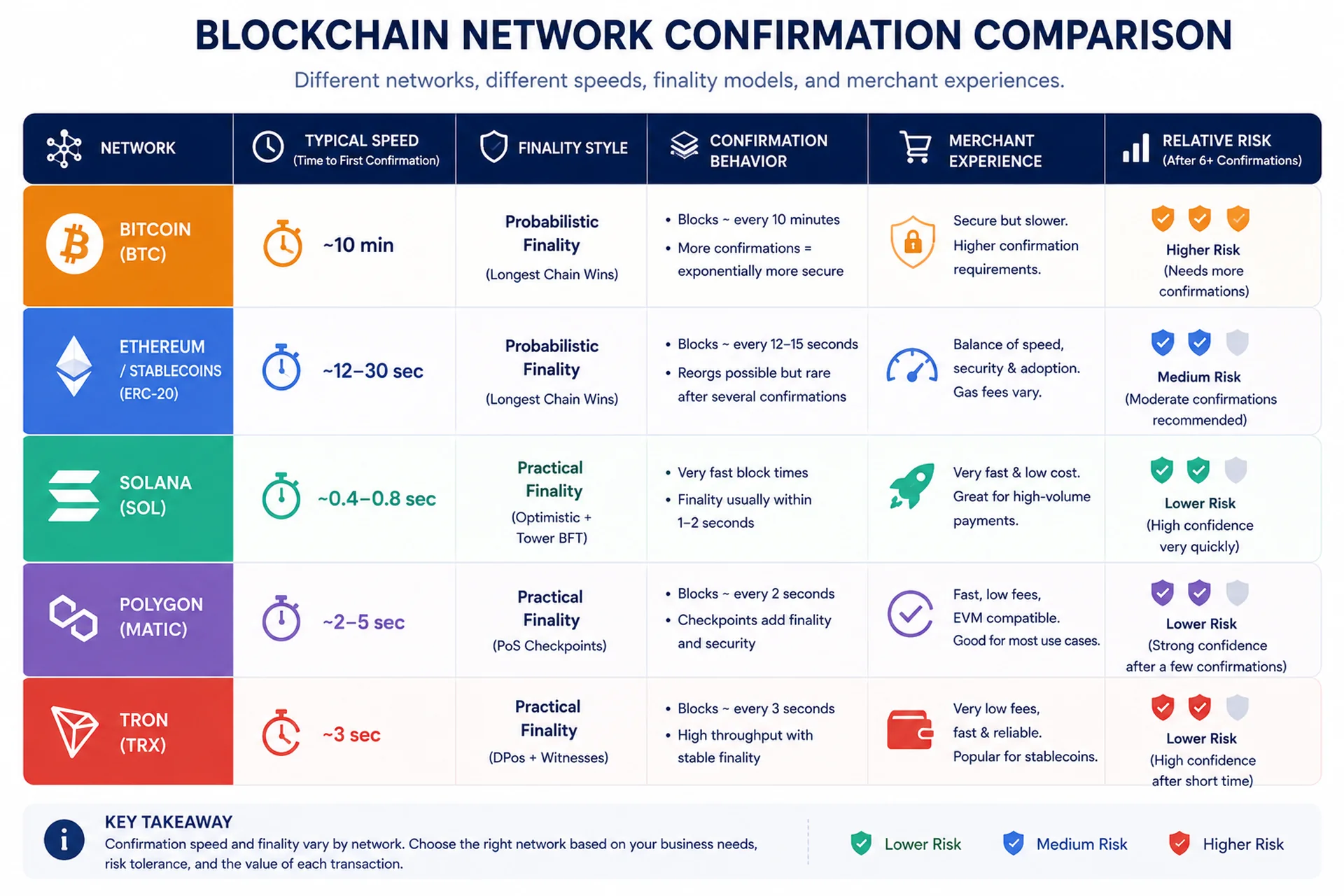
Bitcoin transactions often require more confirmations because of their probabilistic finality model. Networks such as Solana, Tron, and Polygon usually reach practical finality much faster, which changes how merchants approach payment flow and order handling.
The important point is simple:
A transaction being visible is not the same thing as a transaction being operationally safe.
Why Transactions Sometimes Feel Inconsistent
From a customer perspective, crypto payments can seem unpredictable.
Some transactions confirm quickly while others take much longer. In most cases, this is not randomness or failure. It is simply the result of changing network conditions.
At any given moment:
- more transactions may be competing for inclusion
- fee levels may increase
- block space may become limited
- congestion may temporarily rise
As demand changes, confirmation timing changes with it.
This is why delays during busy network periods are common, especially when transactions use lower fees. Real-time tools such as mempool.space can help users observe Bitcoin network congestion and fee pressure as it changes.
Not All Networks Behave the Same Way
Different blockchain networks process confirmations differently, and these differences directly affect merchant operations.
Bitcoin generally confirms more slowly and relies on probabilistic finality, which is why businesses often wait for multiple confirmations before treating payments as highly reliable.
Ethereum and stablecoin payments usually confirm faster, although congestion and gas fee conditions can still influence timing and cost. Ethereum.org provides a useful overview of Ethereum transactions and a separate technical explanation of Ethereum gas fees.
Networks such as Solana, Tron, and Polygon are optimized for faster confirmation cycles and lower fees, making them more suitable for smaller purchases and faster checkout experiences. Solana’s official documentation also explains transaction confirmation and expiration for developers who need more detail.
For merchants, these differences influence fulfillment timing, customer expectations, operational risk, and payment flow design. This is why choosing the best blockchain for accepting USDT payments depends on cost, speed, and reliability together, not speed alone.
Common Pitfalls Merchants Face
Most payment problems do not come from blockchain networks failing.
They usually come from misunderstanding transaction state or network behavior.
One common mistake is treating a detected transaction as completed too early. A payment may appear inside a wallet or explorer while still waiting for confirmations.
Another issue involves unsupported networks. A customer may send USDT on ERC20 while the merchant only supports TRC20. From the customer’s perspective, the payment was sent successfully, even though the merchant infrastructure may not process it correctly.
Underpayments and overpayments create additional operational complexity, especially during volatile market conditions or exchange-rate fluctuations.
Many merchants also underestimate how differently blockchain networks behave. Confirmation timing, congestion behavior, and fee competition vary significantly between chains.
The blockchain itself is usually functioning correctly.
The challenge is interpreting blockchain activity correctly inside a business workflow.
From Network Activity to Business Decisions
Blockchain networks only show what happened technically.
They can show that:
- a transaction exists
- the network has seen it
- it has entered a block
- confirmations are increasing
But the blockchain does not decide what the business should do next.
It does not determine when an order should be fulfilled, how delayed payments should be handled, or how mismatches should be resolved.
That operational layer exists outside the blockchain itself.
For merchants, a crypto transaction is not only network activity. It is part of a broader payment workflow involving automation, fulfillment logic, customer experience, and operational risk management.
Seeing Transactions as a Lifecycle
A crypto transaction is easier to understand when viewed as a lifecycle rather than a single event.
The transaction begins as a signed message, becomes visible across the network, competes for inclusion, gains confirmations over time, and eventually reaches a state where the business considers it reliable enough for action.
This is why mature payment systems separate states such as:
- pending
- detected
- confirming
- completed
- failed or expired
These distinctions help merchants avoid acting too early while still maintaining smooth customer experiences. OxaPay’s explanation of crypto transaction status goes deeper into how these states help users and businesses understand payment progress.
Once transactions are viewed through this operational lens, blockchain payments stop feeling mysterious. They become systems that can be monitored, interpreted, and managed more confidently.
Best Practices for Merchants
Businesses accepting crypto payments usually reduce operational problems by following a few practical rules:
- define confirmation policies based on order value
- automate payment monitoring through webhooks or callbacks
- verify both address and network before fulfillment
- separate detected payments from completed payments
- monitor underpayments, overpayments, and delayed confirmations
- compare blockchain activity with internal order records when resolving mismatches
Most modern payment systems do not rely on manually checking blockchain explorers. They automate transaction monitoring and update payment states in real time through callback and webhook systems. OxaPay’s webhook documentation explains how payment status updates can be delivered automatically to a merchant system.
These practices do not remove blockchain complexity entirely, but they make payment operations safer and more predictable.
Conclusion
Crypto transactions are often described as simple transfers.
In reality, they are structured messages moving through systems designed to validate, prioritize, confirm, and stabilize payments over time.
From the moment a transaction is created to the point where it becomes operationally reliable, multiple factors influence the outcome. Network conditions, confirmation depth, fee competition, and payment interpretation all affect how crypto payments behave in practice.
Understanding how crypto transactions work means understanding that process, not just the wallet interface.
Because once you understand where a transaction is within its lifecycle, you stop guessing.
You start making clearer operational decisions.
“Ready to streamline your crypto payments? Explore how OxaPay crypto gateway can simplify transaction monitoring, confirmations, and operational workflow for your business.”