Accepting cryptocurrency payments is no longer a challenge for businesses. Today, dozens of crypto Merchant Services Providers offer tools for payment acceptance, settlement, automation, and integration.
The challenge is no longer finding a provider, but choosing the right one.
A provider that works well for a small online store may not meet the needs of a SaaS platform, gaming business, or company processing large transaction volumes. Factors such as supported cryptocurrencies, integration options, settlement flexibility, automation capabilities, and long-term scalability can all influence the success of your payment operations.
This guide explains how to evaluate Merchant Services Providers and identify the solution that best fits your business requirements.
What Is a Crypto Merchant Services Provider?
A crypto merchant services provider enables businesses to accept cryptocurrency payments without building their own payment infrastructure.
Instead of manually managing wallet addresses and tracking blockchain transactions, businesses can use tools such as payment processing, invoices, payment links, checkout integrations, APIs, reporting, and payout automation to streamline payment operations.
These services simplify crypto payment acceptance and help businesses integrate digital assets into their existing workflows.
Why Choosing the Right Provider Matters
Crypto payments directly affect revenue collection, customer experience, operational efficiency, and financial reporting.
A poor provider may create problems such as:
- Complicated checkout experiences
- Slow payment confirmations
- Limited cryptocurrency support
- High processing costs
- Difficult integrations
- Weak reporting capabilities
- Poor technical support
In contrast, a well-designed provider can simplify payment operations and help businesses serve customers across multiple countries and payment preferences.
Key Factors to Evaluate Before Choosing a Provider
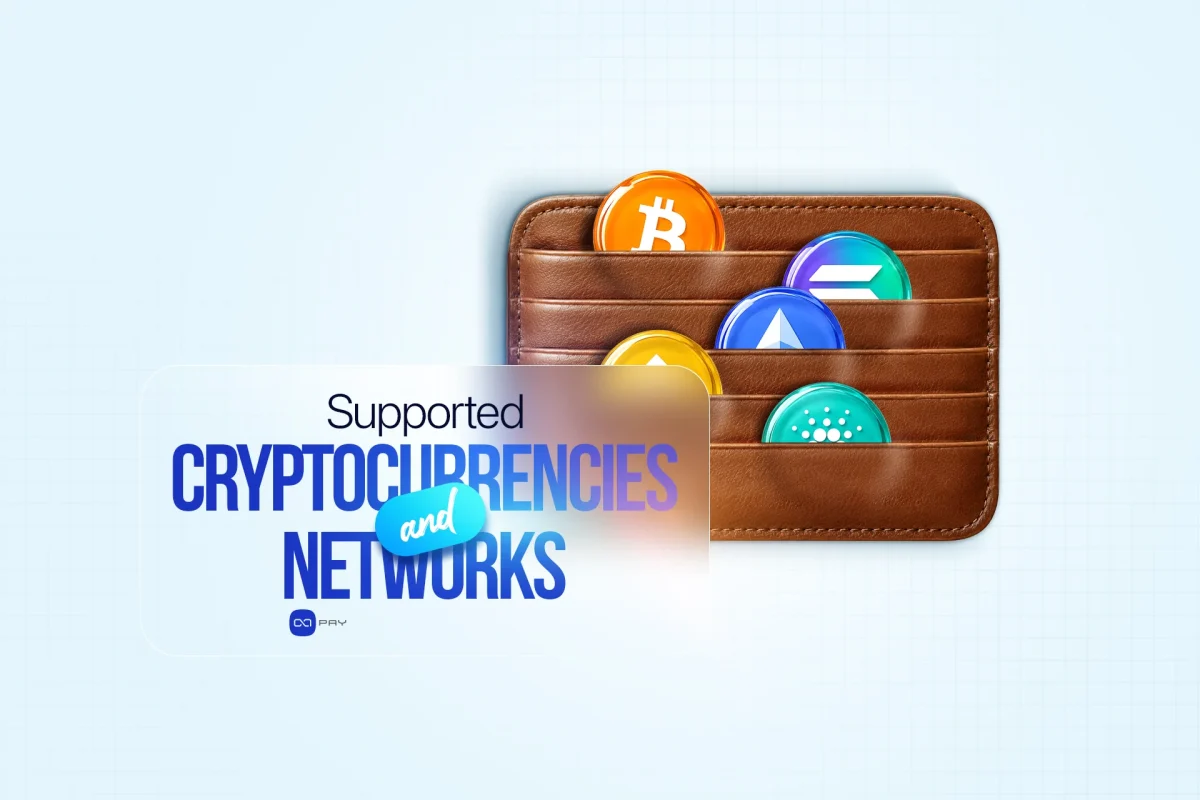
Supported Cryptocurrencies and Networks
Customer preferences vary significantly.
Some customers prefer Bitcoin, while others use stablecoins such as USDT or USDC. Certain markets may rely heavily on networks like Tron, Ethereum, Polygon, Solana, or TON.
A provider should support the cryptocurrencies and blockchain networks most relevant to your customer base.
The broader the support, the more payment flexibility you can offer.
Opciones de integración
Every business has different technical requirements.
A provider should offer integration methods that match your existing systems.
Common options include:
- Merchant APIs
- Hosted checkout pages
- Enlaces de pago
- Static wallet addresses
- E-commerce plugins
- White-label solutions
For developers, API quality and documentation are often among the most important decision factors.
Payment Experience
The payment process should be simple for customers.
A complicated checkout experience can increase abandonment rates and reduce conversion performance.
Look for providers that offer:
- Instrucciones de pago claras
- QR code support
- Mobile-friendly payment pages
- Integrated wallet payments
- Real-time payment status updates
Reducing friction during payment often has a direct impact on conversion rates.
Settlement and Fund Management
Receiving payments is only one part of the process.
Businesses should also evaluate how funds are managed after payment is completed.
Important questions include:
- Can funds be automatically withdrawn?
- Are automatic conversion options available?
- Can payouts be automated?
- How easily can finance teams reconcile transactions?
Settlement flexibility becomes increasingly important as transaction volume grows.
Seguridad y confiabilidad
Payment infrastructure must remain available and secure.
When evaluating providers, consider:
- Platform stability
- Security architecture
- API reliability
- monitorización de transacciones
- Access controls
- Account protection features
Reliable payment infrastructure reduces operational risk and helps maintain customer trust.
Reporting and Operational Visibility
As payment volume increases, businesses need visibility into transaction activity.
Useful reporting features include:
- Payment History
- Transaction filtering
- Status tracking
- Export capabilities
- Merchant analytics
- Real-time monitoring
Good reporting tools reduce administrative workload and improve financial management.
Atención al cliente
Payment issues often require immediate attention.
Before selecting a provider, evaluate:
- Support availability
- Response speed
- Technical expertise
- Communication channels
Fast support can become critical when payment processing directly affects revenue.
Pricing Models and Total Cost of Ownership
When evaluating crypto payment providers, transaction fees are only one part of the total cost. A complete assessment should focus on the overall cost of ownership, which includes all direct and indirect costs associated with payment processing and settlement.
Understanding the Full Cost Structure
The real cost of using a crypto payment provider typically includes more than just a transaction fee. Businesses should evaluate:
- Transaction processing fees per payment
- Withdrawal and payout costs
- Currency conversion or stablecoin conversion fees
- Network-related costs depending on blockchain usage
- Costs associated with premium features such as automation or advanced reporting
These components together determine the actual financial impact of a provider, especially at higher transaction volumes.
Network and Settlement Considerations
Different providers handle blockchain network fees and settlement flows differently. In some cases, fees are passed directly to the end user, while in others they are absorbed or redistributed through configurable pricing models.
For businesses requiring fund settlement beyond crypto assets, additional factors become important, including conversion spreads, withdrawal conditions, and settlement timing. These variables can significantly affect cash flow efficiency and operational predictability.
Volume-Based Pricing and Feature Access
Many providers use tiered pricing models where transaction fees decrease as volume increases. However, pricing tiers are often tied to feature access as well.
Advanced capabilities such as:
- Payment automation tools
- White-label infrastructure
- Advanced analytics and reporting
- Dedicated operational support
are frequently included only in higher-tier plans.
This creates a combined pricing structure where cost is not only determined by transaction volume, but also by the operational capabilities required by the business.
Decision Perspective
Instead of comparing providers based on a single fee metric, businesses should evaluate:
- Total operational cost at expected scale
- Impact of settlement and conversion policies on cash flow
- Feature requirements for automation and reporting
- Long-term scalability of pricing tiers
The most cost-efficient provider is not the one with the lowest fee, but the one that minimizes total operational friction while supporting business growth.

Choosing the Right Provider for Different Business Types
Different business models evaluate crypto payment providers based on different priorities. Instead of comparing feature lists, businesses should focus on which operational requirements matter most for their specific use case.
Empresas de comercio electrónico
For online stores, the priority is reducing checkout friction while maintaining broad payment acceptance.
Key requirements include:
- Fast and simple checkout experience
- Multi-cryptocurrency and stablecoin support
- Reliable payment confirmation tracking
- Easy integration with shopping platforms and plugins
The main goal is to maximize conversion rate while minimizing payment abandonment.
SaaS and Subscription Businesses
SaaS companies prioritize automation and predictable revenue operations over simple payment acceptance.
Key requirements include:
- API-first integration and webhook reliability
- Automated billing and invoice handling
- Strong reporting and reconciliation tools
- Recurring payment workflow support
For these businesses, payment infrastructure must integrate directly into internal systems and scale with user growth.
Gaming and Digital Products
Gaming platforms and digital product businesses typically operate with high transaction volume and fast user flow.
Key requirements include:
- High-speed payment confirmation
- Stablecoin support for pricing consistency
- Scalable infrastructure for peak traffic
- Automated delivery and verification workflows
The focus is operational speed and throughput rather than complex financial tooling.
Developer-Driven Platforms
For developer-focused products, payment infrastructure becomes part of the product itself rather than a supporting tool.
Key requirements include:
- Flexible APIs and SDKs
- Webhooks and event-driven architecture
- Sandbox environment for testing
- White-label or fully customizable payment flows
The priority is integration depth and system control.
Decision Summary
Each business type requires a different balance of:
- Integration flexibility
- Automation depth
- Payment speed and reliability
- Operational visibility
The right provider is the one that best aligns with these operational priorities, not the one offering the most features overall.
Common Mistakes to Avoid When Choosing a Provider
Selecting a crypto merchant services provider is a long-term operational decision. Many businesses focus on a single factor and overlook areas that become important as they scale.
Some of the most common mistakes include:
Choosing Based Only on the Lowest Fee
The cheapest provider is not always the most cost-effective.
Automation capabilities, support quality, reporting tools, and settlement options can have a larger impact on operational efficiency than small differences in transaction fees.
Ignoring Scalability
A provider that works for a small business today may struggle to support future growth.
Businesses should evaluate whether the platform can accommodate increasing transaction volumes and more complex operational requirements.
Not Testing Integration and Support
Documentation quality and support responsiveness can vary significantly between providers.
Testing the integration process and contacting support before committing to a platform can reveal potential issues early.
Overlooking Stablecoin Support
Many businesses prefer stablecoins for operational reasons, including reduced volatility and simpler accounting.
Limited support for major stablecoins such as USDT and USDC can restrict payment flexibility and reduce customer adoption.
Focusing Only on Payment Acceptance
Accepting payments is only one part of the payment lifecycle.
Settlement, reporting, reconciliation, automation, and fund management are equally important considerations when selecting a provider.
Provider Evaluation Checklist
Before selecting a crypto merchant services provider, ask yourself a few key questions:
- Does it support the cryptocurrencies and networks your customers use?
- Does it offer the integration options your business requires?
- Are pricing, settlement, and withdrawal policies transparent?
- Can it scale as your transaction volume grows?
- Does it provide the reporting, automation, and operational tools you need?
- Is customer support responsive and reliable?
The best provider is rarely the one with the lowest fee. It is the one that aligns with your business requirements, operational workflows, and long-term growth plans.
How OxaPay Supports Modern Businesses
Modern businesses don’t just need a crypto payment provider that “accepts payments.”
They operate across multiple workflows — checkout, settlement, reporting, and payouts — which require coordination rather than simple payment acceptance.
OxaPay is a full-stack crypto payment infrastructure designed to unify these workflows into a single system, covering payment collection, settlement, conversion, reporting, and payout automation.
Flexible Payment Infrastructure (Not One-Size-Fits-All)
Every business integrates payments differently. Some need a simple payment link, while others require full API-level control.
OxaPay supports multiple integration layers:
- Servicios comerciales for full automation and custom flows
- Enlaces de pago for fast, no-code payment acceptance
- Facturas for structured transaction-based payments
- Direcciones estáticas for recurring or persistent payments
- E-commerce plugins for platforms like WooCommerce, WHMCS, and others
- White-label solutions for branded payment experiences
This multi-layered structure allows businesses to start simple and progressively move toward full automation without changing providers.
Built-in Automation for Scalable Operations
As transaction volume increases, manual processing becomes a bottleneck. OxaPay removes this limitation through built-in automation tools.
Key operational automation features include:
- Auto Convert: instantly convert incoming payments into USDT to reduce volatility exposure
- Retiro automático: automatically transfer funds to external wallets or destinations
- API de pago: programmatic fund distribution for vendors, users, or internal systems
These tools reduce operational overhead and turn crypto payments into a managed financial workflow rather than a manual accounting task.
End-to-End Payment Lifecycle Management
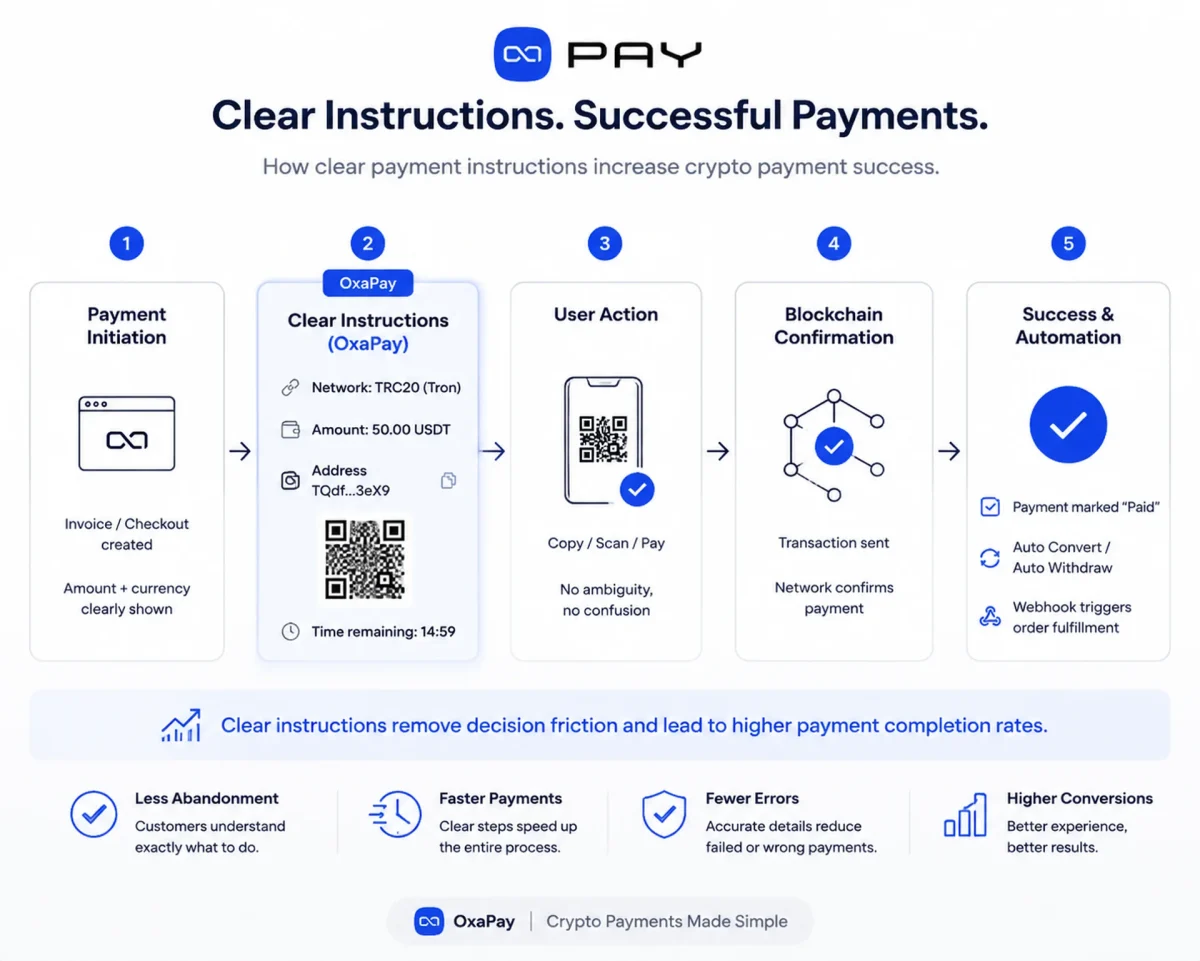
Unlike providers that only focus on payment acceptance, OxaPay manages the full lifecycle of a transaction:
- Payment initiation and invoice generation
- Real-time status tracking (
pending → confirming → paid) - Blockchain confirmation monitoring
- Settlement and fund allocation
- Reporting and transaction reconciliation
This unified model reduces fragmentation between payment processing and financial operations, making it easier for finance and operations teams to maintain consistency and control.
Developer-First Infrastructure for Integration Flexibility
FFor technical teams, payment infrastructure must behave like a system component, not a third-party tool.
OxaPay provides:
- REST APIs with structured invoice and payout endpoints
- Webhooks for real-time event handling
- SDKs for faster and simplified integration
- Sandbox environment for testing and integration validation
- Multi-network and multi-asset support (BTC, ETH, TRX, USDT, etc.)
This allows businesses to embed crypto payments directly into existing systems such as SaaS platforms, gaming economies, or marketplaces without workflow disruption.
Global-Ready Payment Model
OxaPay is designed for businesses operating across multiple regions and customer profiles.
It supports:
- Multiple cryptocurrencies and stablecoins for payment flexibility
- Multi-network transactions (Tron, Ethereum, BSC, Polygon, Solana, etc.)
- Fast settlement options for operational efficiency
- Scalable architecture for high-volume transaction environments
This ensures that businesses are not constrained by regional payment limitations or single-network dependencies.
Operational Outcome
Instead of managing separate tools for payments, conversion, reporting, and payouts, businesses operate within a single system that:
- Reduces manual reconciliation
- Improves settlement speed and predictability
- Minimizes operational overhead
- Scales with transaction volume without structural changes
Reflexiones finales
The best crypto merchant services provider is not necessarily the one with the lowest fees or the largest feature list.
The right choice depends on how well the provider aligns with your business model, customer preferences, operational requirements, and long-term growth plans.
Before making a decision, evaluate the entire payment lifecycle, from checkout and confirmation to settlement, reporting, automation, and support.
Businesses that approach provider selection strategically are more likely to build payment systems that remain efficient, scalable, and reliable as transaction volume increases.