Payment disputes are an inevitable part of online commerce, where even smooth transactions can turn into unexpected challenges. A customer pays, receives the order, and days later the payment is reverse, or another buyer claims they never made the purchase. These payment disputes often stem from delivery issues, misunderstandings, or unauthorized charges, creating financial and reputational risks for merchants.
How each case unfolds depends on the payment system. Traditional banking relies on intermediaries and chargebacks, while crypto payments operate on transparent, irreversible transactions. This guide compares both approaches and explains how بوابة التشفير OxaPay helps businesses manage disputes efficiently in the crypto environment.
What Is a Payment Dispute?
A payment dispute occurs when a customer disagrees with a completed transaction or questions whether it was carried out correctly. It doesn’t always mean fraud or bad intent—sometimes it’s the result of simple confusion or unmet expectations.
Disputes often happen for several reasons:
- The customer never received the product or service.
- The item was damaged or not as described.
- The wrong amount was charged.
- The payment appeared unauthorized, such as with a stolen card or compromised wallet.
- The customer misunderstood the terms, price, or refund policy.
In essence, a dispute is a customer’s way of raising a red flag, asking the merchant or payment provider to review what went wrong. Depending on the system used, this can trigger very different processes. In traditional banking or card networks, disputes often escalate into formal investigations handled by intermediaries like banks or card issuers. In crypto payments, however, no third party can reverse the transaction—so the resolution depends on direct communication between the buyer and the merchant.
Handling disputes quickly and transparently helps maintain trust, protect revenue, and prevent small misunderstandings from turning into chargebacks or negative reviews.
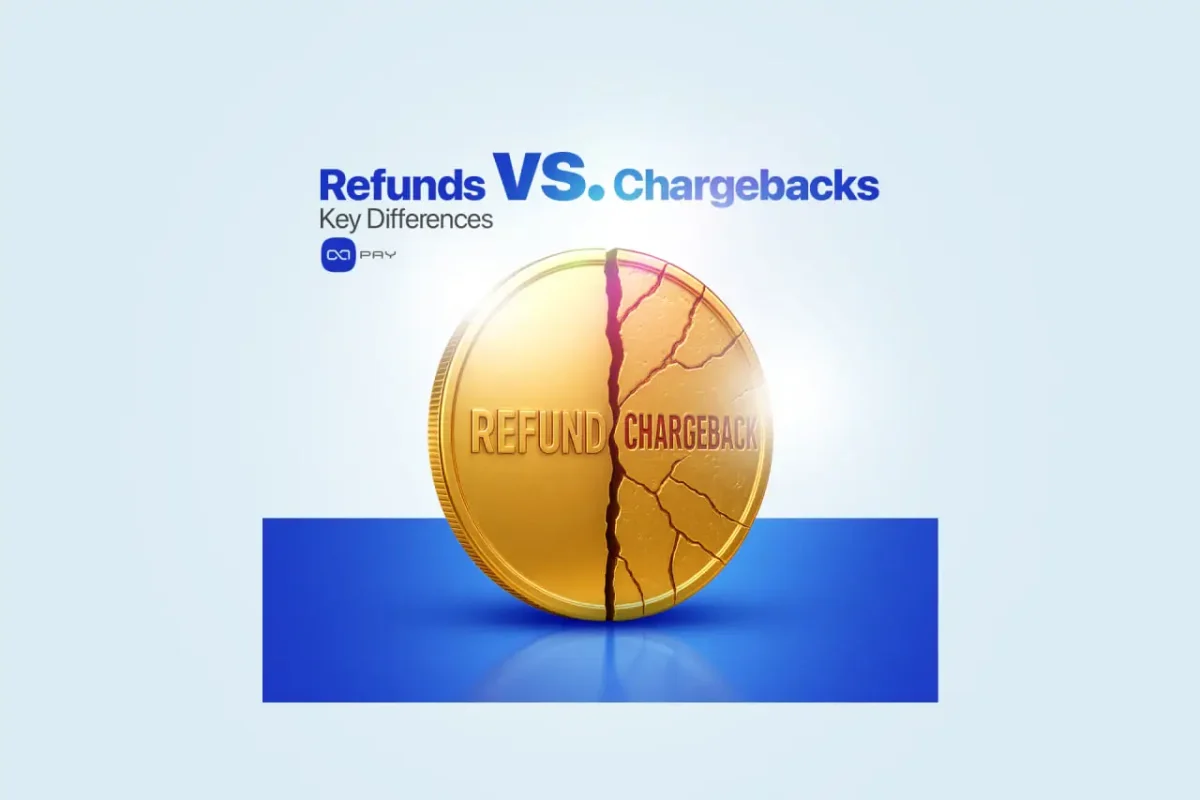
Refunds vs. Chargebacks: Key Differences
Although both refunds and chargebacks return funds to the buyer, they operate under very different principles. The key difference lies in who initiates the process, who controls it, and how it affects the business. Understanding these distinctions helps merchants manage risk and maintain customer trust.
Refund
- Initiated voluntarily by the merchant. The business decides when and how to return the funds, retaining full control over the reason and timing.
- Resolves dissatisfaction or returns. Common for canceled orders, damaged products, or unmet expectations.
- Defined by merchant policy. Clear refund terms reduce confusion and show transparency to customers.
- Prevents escalation. A timely refund can resolve issues before they grow into formal disputes or chargebacks.
Chargeback
- Initiated by the customer through their bank or card provider. The buyer bypasses the merchant, triggering an external investigation.
- Funds forcibly withdrawn. The disputed amount is removed from the merchant’s account while the case is reviewed.
- Designed for consumer protection. Intended to safeguard against fraud or non-delivery but often creates administrative and financial strain.
- Prone to misuse. “Friendly fraud” occurs when customers dispute legitimate purchases, leading to lost revenue and potential account penalties.
- Affects merchant reputation. High chargeback ratios raise processing fees and can even risk suspension from payment networks.
In essence, refunds are proactive actions controlled by merchants to maintain goodwill, while chargebacks are reactive enforcement tools managed by banks. Businesses that resolve issues early through clear policies and direct communication minimize disputes and protect their long-term credibility.
How Chargebacks Work in Traditional Payment Systems
Chargebacks in traditional systems such as Visa, MasterCard, أو PayPal were designed to protect customers from fraud or merchant mistakes. However, the same process that safeguards buyers can create uncertainty and financial strain for businesses.
Here’s how a chargeback typically works:
- The customer files a dispute. A buyer contacts their bank to report an issue such as a wrong amount, missing product, or unauthorized charge.
- Funds are temporarily withdrawn. The bank immediately removes the transaction amount from the merchant’s balance to secure the customer’s claim.
- The merchant submits evidence. The business must provide supporting documents—delivery confirmations, order receipts, or communication logs—to prove the payment was valid.
- The bank reviews and decides. Based on the evidence, the bank either restores the funds to the merchant or finalizes the reversal in favor of the customer.
Pros:
- Strong customer protection. Gives buyers confidence when purchasing online.
- Quick access for consumers. The process is handled directly through banks without requiring merchant contact.
Cons:
- Costly for merchants. Each chargeback involves administrative fees and potential penalties, often higher than the original transaction cost.
- Risk of friendly fraud. Some customers exploit the system to reverse legitimate purchases, causing real losses.
- Reputation impact. Excessive chargebacks can flag a business as high-risk, leading to higher processing fees or account restrictions.
Chargebacks provide consumer assurance but often shift all the financial and operational burden to merchants. This imbalance explains why many businesses look for alternative payment solutions, such as the بوابة التشفير OxaPay, where transactions are transparent, irreversible, and disputes are handled through platform-level resolution rather than bank intervention.
How Refunds Work in Traditional Systems
Refunds are merchant-led and managed directly within the business’s payment platform. Merchants using Stripe, PayPal, or card gateways can return funds proactively:
- Through their dashboard or API, allowing quick action without waiting for bank approval.
- According to their return or cancellation policy, ensuring clear rules for both sides.
- With less risk of penalties or account issues compared to chargebacks.
Refunds maintain merchant control and often resolve issues before they escalate into disputes. Still, delays and intermediary fees may occur, especially in cross-border or multi-currency transactions, sometimes leading to customer frustration despite good intent.
Crypto Payments: A Different Model, But the Same Need
Cryptocurrency payments follow a completely different structure:
- Final and irreversible once confirmed on the blockchain, no central authority can undo them.
- Decentralized by design, removing banks and intermediaries from the process.
- Fast and cost-efficient for international transfers, with minimal processing time.
This model eliminates chargeback abuse but also removes the built-in safety net of traditional systems. For that reason, refund or dispute resolution must rely on transparent business policies and trusted platform tools that manage such cases securely and on record.
How OxaPay Handles Disputes and Refunds
أوكسا باي, a crypto payment gateway, provides built-in tools to minimize disputes and handle them efficiently when they occur.
Underpaid Invoices: Smart Detection & Flexible Completion
When a customer underpays an invoice:
- OxaPay instantly detects the shortfall and displays the exact remaining amount.
- The merchant can choose to:
- Accept the partial payment.
- Let the customer complete the payment with the same coin (التغطية بأقل من قيمتها).
- Allow the remainder to be paid with a different cryptocurrency (الدفع المختلط, if enabled).
- Request a refund if necessary.
- This automated flexibility helps recover sales that would otherwise fail due to payment errors.
Manual Refunds via Support
OxaPay does not allow merchants to issue refunds directly from the dashboard. For cases such as incorrect delivery or customer dissatisfaction:
- The merchant contacts OxaPay Support.
- Transaction details, refund amount, and destination address are provided.
- OxaPay verifies the information and processes the refund securely.
This ensures full transparency and prevents accidental or unauthorized reversals.
Support-Assisted Resolution
For complex cases, OxaPay’s support team mediates between merchants and customers to ensure a fair and timely resolution. There is no need for banks or third-party networks to get involved, keeping the process faster, safer, and fully crypto-native.
Best Practices to Prevent Disputes (All Systems)
Regardless of whether payments are made through traditional networks or crypto gateways, clear processes and communication remain the strongest defense against payment disputes.
- Provide accurate and detailed product or service descriptions to avoid misunderstandings.
- Share payment terms and refund policies clearly before checkout to set proper expectations.
- Confirm all order details and customer information before fulfillment to prevent errors.
- Use unique transaction identifiers and metadata (such as Order ID) to track payments easily.
- Maintain full records and logs for every transaction to support dispute resolution if needed.
- Respond quickly and professionally to customer inquiries or complaints to build trust.
For crypto payments, implementing webhooks to monitor invoice status (paid, underpaid, expired) allows automated and proactive handling—helping merchants address potential issues before they turn into disputes.
Comparison: Traditional vs. Crypto Dispute Management
| Feature | Traditional Payment Systems | Crypto (via OxaPay) |
| Chargebacks | Yes (via bank or card provider) | No |
| Refund Initiation | Merchant or forced through chargeback | Merchant via OxaPay Support |
| Speed of Refund | Several days to weeks | Usually within 24 hours |
| Abuse Risk | High (friendly fraud possible) | Very low |
| Reversal Authority | Bank or card network | Merchant + platform support |
| Customer Communication | Indirect, through banks | Direct, transparent, and faster |
OxaPay’s model gives businesses full visibility and control over payment disputes. While banks handle disputes reactively through reversals, crypto systems, especially those managed through OxaPay, enable preventive, traceable, and transparent communication between merchants and customers, reducing misunderstandings and strengthening long-term trust.
Conclusion: Know Your Tools, Protect Your Business
Payment disputes are unavoidable, but the way they’re handled determines how much trust a business earns. Traditional chargebacks protect consumers but burden merchants, while crypto payments offer control and transparency through irreversible transactions. With OxaPay’s tools for invoice tracking, underpayment handling, and secure refunds, businesses can manage disputes easily and prevent most issues before they escalate.
Start simplifying dispute management today with the بوابة التشفير OxaPay, secure, transparent, and built for modern businesses.